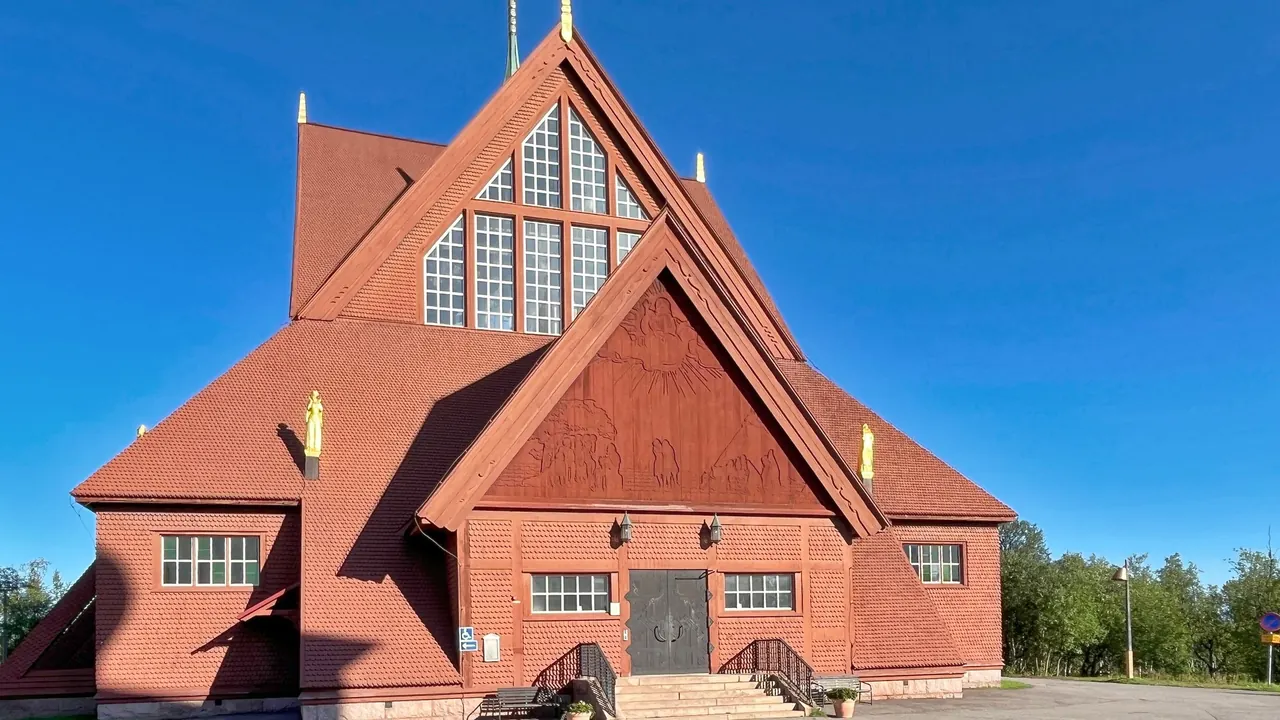
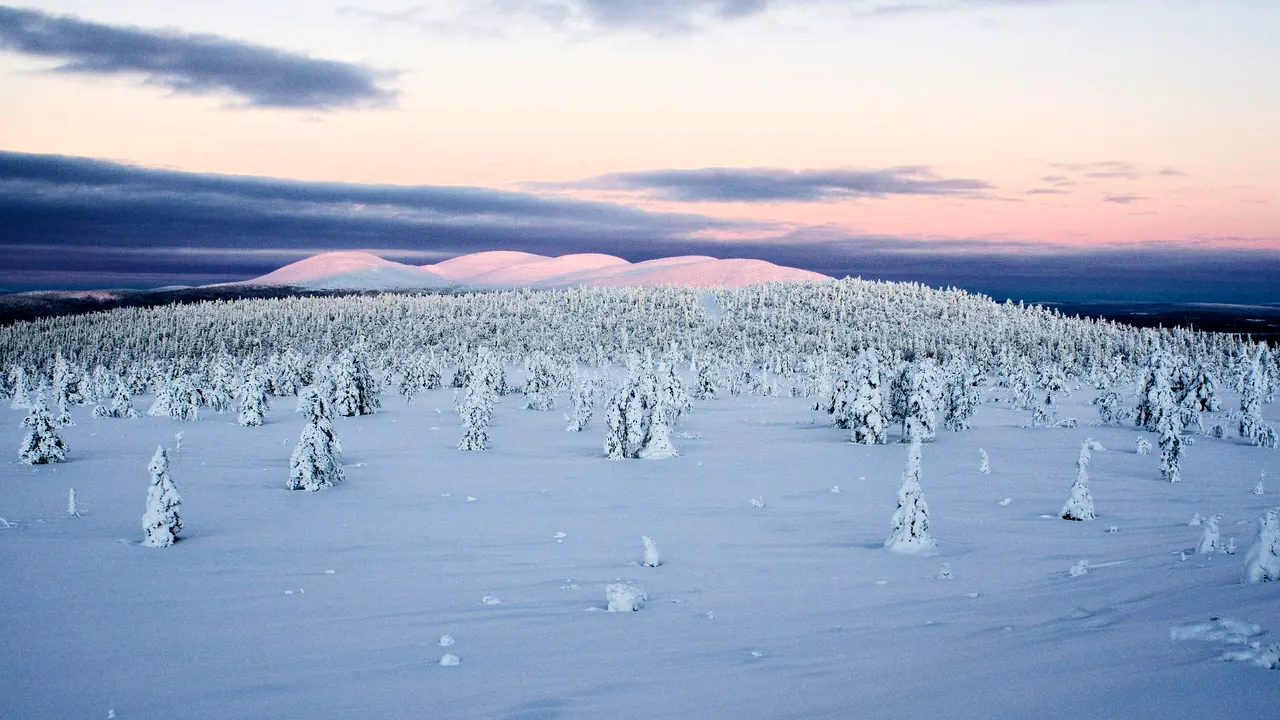
Photos: Kiruna by Steinkatz, CC BY 4.0, cropped; Lapland by Petr Vodička, CC BY-SA 4.0, cropped.
Kiruna or Lapland?
Our verdict in twelve categories, each scored against the same fixed benchmark cities, and the climate month by month, so you can choose for your trip.
Choose Kiruna for
- prices
Kiruna suits travellers who want one compact Arctic base with a strong sense of place. You get a working iron-ore town with the mine itself to go down into, the ice hotel at Jukkasjärvi down the road, and a railway that runs into the mountains at Abisko, all under a very reliable aurora sky. It is a little less punishing on the budget, and it works best for adults and older children who mainly want the landscape.
Choose Lapland for
- families
- wellness
- nightlife
Lapland is the better choice for a fuller winter vacation spread across resorts. Families come for Santa Claus Village and Ranua's animals, couples come for a cabin with its own sauna by a frozen lake, and skiers come for Levi, where evenings can get lively. It costs more, especially at Christmas, but it gives far more back to children and to anyone who wants to slow down.
Scoreboard
Twelve categories on one fixed scale from 0 to 100. The shaded stretch is the gap between the two.
Your match
Pick a travel style or drag the sliders, and both match scores follow your weighting.
Wins on prices with your weighting.
Wins on families and wellness with your weighting.
What matters to you?
Category by category
What the scores mean for a trip.
Beaches & swimming
Neither is a place for a beach, and the difference is small. Swimming in both means a few weeks of cold lake or river water in July. In Kiruna that is the Torne river and the lakes around town.
Lapland has a little more choice: sandy banks along the Ounasjoki and Kemijoki, lake shores around Inari and some sand on the Bothnian Bay near Kemi. In both, most visitors' only swim is an ice-hole dip between sauna rounds.
Food & drink
Lapland eats better, mostly because it has more places that cook with care. The kitchens in Rovaniemi, Levi and Saariselkä work with reindeer, lake fish and cloudberries, and around Inari you also get Sámi dried and smoked meats. Small pleasures add to it, such as salmon flamed by an open fire and squeaky cheese with coffee.
Kiruna uses much the same northern produce, but its best cooking happens out of town, at the lodges and at Jukkasjärvi. In the town itself, meals soon come down to hotel dining rooms, pizzerias and fika.
Culture & sights
There is not much between them, but the kind of culture differs. Kiruna's history is still standing and still working: you can go deep into the iron-ore mine, and the wooden church is built in the shape of a Sami goahti.
Lapland tells its story in museums, because most of its towns were burned in 1944. The best of them are the Arktikum in Rovaniemi and Siida in Inari, and Aalto's rebuilt Rovaniemi adds some architecture. Kiruna has the more memorable single sight, while Lapland gives a deeper picture of Sámi life.
Nightlife
Lapland has an actual night out, which Kiruna mostly does not. In Levi the après-ski bars and a few clubs stay loud late from late winter through Easter, and Rovaniemi's pubs fill with students. In Kiruna you will find a few pubs and hotel bars, and on winter nights most visitors are outside watching the sky instead.
Nature & outdoors
Both give you the full Arctic winter, from husky teams to aurora nights, so the real difference is the shape of the land. Kiruna has proper mountains within reach. The railway west brings you to the Abisko canyon and the first miles of the Kungsleden, and Kebnekaise, Sweden's highest peak, can be climbed from a trailhead not far out of town. It suits walkers who want steep ground and a summit to aim for.
Lapland is broader and softer. Its rolling fells rise over forest, bog and lake across several national parks, instead of being gathered around one town. In winter that means long days of cross-country skiing from one resort to the next, and in early September the ruska turns the fells red and gold. Only Kilpisjärvi, in the far north-west, comes close to the drama of Kiruna's mountains.
Day trips
Both are thin on places to visit, because the outings here head into the wilderness rather than to other towns. From Kiruna the obvious trip is Jukkasjärvi, about 17km away, for the ice hotel, the old wooden church and the Sami homestead. Gällivare by train is a distant second.
Lapland's options depend on where you stay. From Rovaniemi you can reach the coast for an icebreaker trip out of Kemi and the walk across the border from Tornio to Haparanda. From Saariselkä, Inari is a short drive.
Good for families
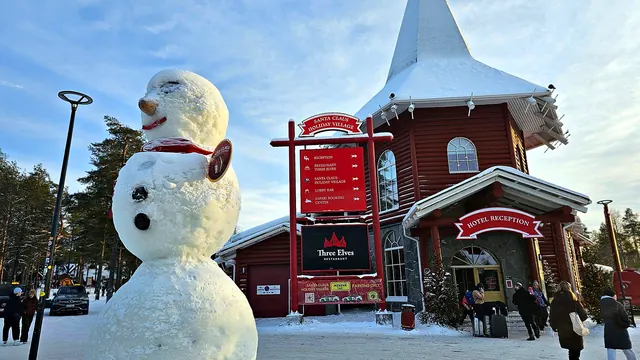
Lapland is far better for children, and above all for small ones at Christmas. Santa Claus Village, the cave theme park and Ranua's bears give a few full days, and the resorts have gentle slopes, ski schools and family cabins.
Kiruna can thrill older children with husky driving, a night in an ice room and late aurora watches. However, everything is a guided adult excursion, and nothing there is built with toddlers in mind.
Getting around
They are equally easy, or equally hard, in different ways. Kiruna is one small town on icy pavements. Buses reach Jukkasjärvi, and the Malmbanan railway takes you to Abisko and the mountains without a car.
In Lapland each resort is a short transfer from its own airport, and the overnight train from Helsinki makes a classic arrival. Moving between areas, though, means long winter drives in the dark, so most visitors pick one base and stay there.
Shopping & style
Neither is a place to shop, and the thing worth buying is the same in both: Sámi duodji in antler, leather and woven bands. In Kiruna you find it in a few craft shops and at the homesteads around Jukkasjärvi. Lapland adds puukko knives, woollens and a lot of Santa Claus Village souvenirs, with the best craft found around Inari.
Affordability
Neither is cheap, but Kiruna usually leaves you with a slightly smaller bill. Rooms there are dear in the aurora season, but most of the money goes on guided outings, because almost everything worth doing is a paid excursion. Limit yourself to a few and stay in a self-catering flat, and the rest of the trip costs about what it would anywhere in Sweden.
In Lapland the stay itself is often the biggest expense, above all at Christmas and New Year and in the glass-roofed aurora cabins. Safaris and Nordic prices for meals and drink come on top. You can get round this by looking after yourself: rent a cabin with its own kitchen and sauna, and spend your days on the free ski trails. Away from December, both late winter and summer are noticeably cheaper.
Live music & performing arts
Live performance is scarce in both, and neither is worth planning a trip around for it. Lapland has a little more that is regular: the Lapland Chamber Orchestra's season in Rovaniemi and a Sámi music festival in Inari. Kiruna has occasional concerts in the church and joik at its winter festival.
Wellness & relaxation
Lapland is much the stronger place to unwind, because the sauna is built into almost every stay. Most cabins have their own, lakeside smoke saunas carry the tradition at its deepest, and the spa hotels in Saariselkä and Levi cover bad-weather days.
In Kiruna, relaxing is something you go out to find: a wood-fired sauna at a wilderness lodge, an ice-hole plunge or a hot tub under the sky. The days in between are mostly spent out in the hard cold.
When should you go?
Pick your month. The climate figures are measured averages, not a forecast.
Kiruna in July
Lapland in July
Daytime high, °C
Rainfall in the month, mm
Where the figures come from
Kiruna has no rain gauge within 25 km of the centre, so its rainfall comes from a gridded climate dataset read at the destination rather than from a gauge further away.
Lapland has no rain gauge within 25 km of the centre, so its rainfall comes from a gridded climate dataset read at the destination rather than from a gauge further away.
Temperature and rainfall are climate normals, averaged over the years shown. Kiruna: 2005-2020 (rainfall 1991-2020) normals, Kiruna Airport (3.8 km from centre). Lapland: 2008-2020 (rainfall 1991-2020) normals, Rovaniemi Rautatieasema / Kuusela (0.6 km from centre).
Winter is equally hard in both, with January highs around -8°C. Kiruna stays below freezing from November right through March. In Lapland, where its figures are measured, the deep cold runs from December to February, with November and March hovering around zero. These are months for snow, sledding and the aurora, not for lingering in the streets. March is Kiruna's driest month, and spring comes a few degrees sooner on the Finnish side.
Summer is short in both and warmer in Lapland, where July reaches about 21°C against 17°C in Kiruna, so a July lake swim is more realistic there. July is also the wettest month in both, and wetter in Kiruna at around 95mm. By September both have cooled to cool hiking weather with less rain than high summer, though Lapland stays the damper of the two through the autumn and into November.
Which traveller are you?
On a family trip with young children, Lapland is the one to book. A day can follow a small child's pace, with one outing in the morning, sledging outside the cabin and an early night. In Kiruna nearly every day depends on a guided excursion and late aurora watches.
For a relaxing and wellness trip, Lapland lets you stay put. The evening ritual of heat, an ice-hole dip and a slow cool-down in the snow happens at your own door, night after night. In Kiruna the sauna is a trip out, between demanding days in the cold.
On a tight budget, Kiruna is the slightly kinder choice, though neither is cheap. A summer stay works well: take the train to Abisko for free walks on its trails, cook your own meals, and pick one or two paid excursions instead of a full programme.
Before you go
| Measure | Kiruna | Lapland |
|---|---|---|
| Official language | Swedish | Finnish, Swedish |
| Currency | Swedish Krona (SEK) | Euro (EUR) |
| Sockets | CF230 V, 50 Hz | CF230 V, 50 Hz |
| Driving side | Right | Right |
| Time zone | UTC+1, UTC+2 in summer | UTC+2, UTC+3 in summer |
| Emergency number | 112 | 112 |
| Elevation | 550 m | - |
| Main airport | Kiruna Airport (KRN)3 km from centre4 non-stop destinations | Rovaniemi Airport (RVN)44 non-stop destinations |
| Public holidays this year | 16 days | 15 days |
By the numbers
| Measure | Kiruna | Lapland |
|---|---|---|
| Population | 17,284 | 176,215 |
| People per km² | 1,516 | - |
| Museums within 10 km | 1 | - |
| UNESCO World Heritage sites within 50 km | 0 | - |
Where else could you go?
Every comparison below shares a destination with this one, so you can follow Kiruna or Lapland somewhere new.
- Tromsovs Kiruna
- Lofotenvs Kiruna
- Rovaniemivs Kiruna
- Tromsovs Lapland
- Lofotenvs Lapland
- Stockholmvs Kiruna