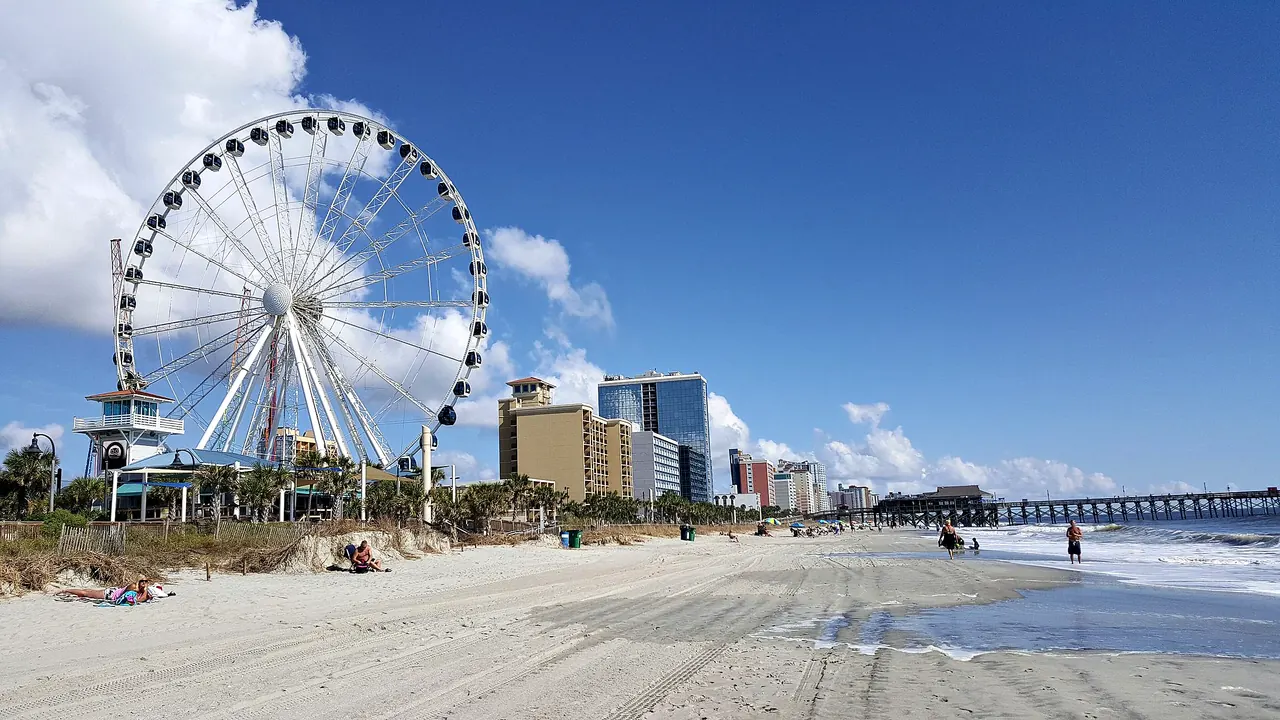
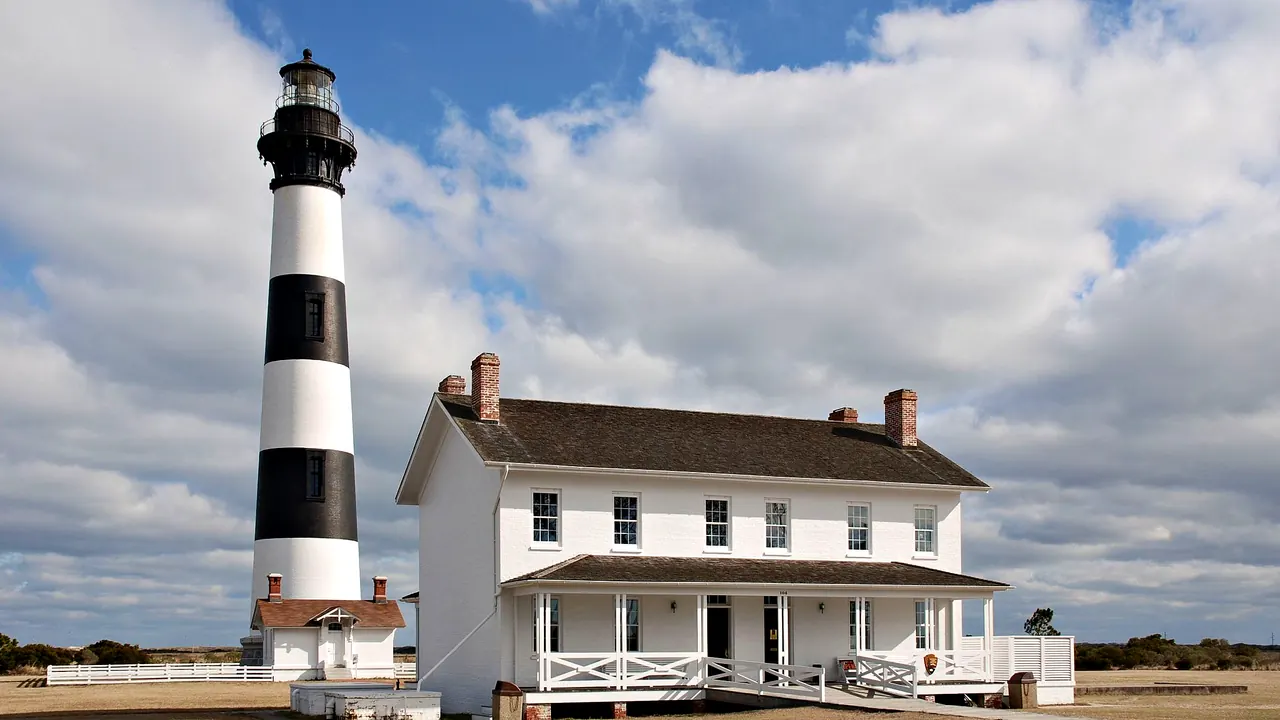
Photos: Myrtle Beach by The ed17, CC BY-SA 4.0, cropped; Outer Banks by Jarek Tuszyński, CC BY-SA 3.0, cropped.
Myrtle Beach or Outer Banks?
Our verdict in twelve categories, each scored against the same fixed benchmark cities, and the climate month by month, so you can choose for your trip.
Choose Myrtle Beach for
- nightlife
- prices
- families
Myrtle Beach suits a family that wants the beach plus a full programme around it: gentle surf for small children, then an aquarium, water parks, an amusement park, mini-golf and big variety shows for the evenings. It is also the cheaper and livelier choice. There are resort bars and dance clubs along the oceanfront, outlet malls, and plenty of hotel rooms and condos to choose from outside July. In return you get a car-bound strip that is loud in summer and has little history of its own.
Choose Outer Banks for
- culture and sights
- getting around
- nature and the outdoors
The Outer Banks are better for travellers who want a slower, wilder coast. You rent a house for the week and spend it on the empty national seashore beaches of Hatteras Island, among the wild horses at Corolla, and on the sounds, which have some of the best flat-water kiteboarding anywhere. The Wright Brothers memorial, the Lost Colony site and the lighthouses also give you more to see than the Grand Strand does. Expect to pay more in summer, to drive long distances on a single road, and to spend your evenings on the porch rather than in a club.
Scoreboard
Twelve categories on one fixed scale from 0 to 100. The shaded stretch is the gap between the two.
Your match
Pick a travel style or drag the sliders, and both match scores follow your weighting.
Wins on nightlife and prices with your weighting.
Wins on culture and sights and getting around with your weighting.
What matters to you?
Category by category
What the scores mean for a trip.
Beaches & swimming
Both coasts are long stretches of Atlantic sand, and neither has clear water or sheltered coves, so the difference lies in the surf and the setting. Myrtle Beach has the warmer, gentler sea, shallow with small waves. In the centre the Grand Strand is lined with towers and piers, and the dune-backed stretches at Surfside and Garden City are calmer.
The Outer Banks are rougher and emptier. Waves and rip currents mean swimmers should stay near the lifeguards at Nags Head or Kill Devil Hills. Further south, the national seashore around Rodanthe, Buxton and Ocracoke has long stretches of undeveloped sand, and toddlers can paddle on the calm sound side instead.
Food & drink
Seafood rules on both coasts, and neither is worth a trip for the food alone. Myrtle Beach leans on buffets and chains along the strip, and the better meals are on the Murrells Inlet waterfront or in the lightly battered Calabash style of fried fish. On the Outer Banks it is steamed shrimp and soft-shell crab, or fish bought at the Wanchese and Hatteras docks and cooked in your rental house.
Culture & sights
The Outer Banks have more to see. The Wright Brothers memorial on the dunes at Kill Devil Hills, the Lost Colony site at Fort Raleigh and the spiral-striped Cape Hatteras lighthouse are real landmarks of American history, though they lie far apart.
Myrtle Beach is a twentieth-century resort with little past on show. Brookgreen Gardens, with sculpture among live oaks and the story of the people enslaved there, deserves a long visit, and Atalaya next door is worth an hour. After that, a single day has covered it.
Nightlife
Myrtle Beach is the place to go out, at least in summer. There are rooftop decks and beach bars around the boardwalk and dance clubs in the entertainment complexes, and the shag is still danced along Main Street in North Myrtle Beach. It is loud rather than polished.
On the Outer Banks, a night out means a sunset drink on a sound-side deck or a brewery taproom in Nags Head. Most evenings end on the porch of the rental house.
Nature & outdoors
Both sit on flat coast of dunes, marsh and maritime forest, but the Outer Banks have more of it, and it is wilder. Jockey's Ridge, the mustangs north of Corolla, the birds and nesting turtles of Pea Island, and the shallow sounds for kiteboarding give an active trip real range.
Myrtle Beach has good birdwatching at Huntington Beach State Park, kayaking in the cypress swamps of the Waccamaw River, and dolphin cruises from the inlets. Golfers also get dozens of courses along the Grand Strand.
Day trips
Myrtle Beach has the stronger day out in Charleston, about two hours south. Closer to hand are Georgetown's old rice port and the quiet beach village of Pawleys Island, and Wilmington and Southport are within reach to the north.
From the Outer Banks, the highlight is the ferry from Hatteras to Ocracoke, an island village of sandy lanes and a small harbour that feels far more remote than anywhere north of it. Colonial Edenton lies inland on Albemarle Sound, and Norfolk and Virginia Beach are up the coast in Virginia, on Hampton Roads, under two hours north when traffic is light. These are pleasant outings, but none matches Charleston, and you need a car from either base.
Good for families
Myrtle Beach is built for children. It has small waves, resort pools with lazy rivers, a large aquarium, water parks, an amusement park with a wooden roller coaster, and an observation wheel on the boardwalk. The catch is summer traffic and the rowdy spring break weeks.
The Outer Banks offer a gentler, more old-fashioned family week of crab-catching, dune climbing at Jockey's Ridge, lighthouse climbs and wild-horse tours. The ocean needs watching because of rip currents, and with no theme park you soon run out of things to do on a wet day.
Getting around
You need a car for both, but the Outer Banks are easier once you arrive. The towns from Kitty Hawk to Nags Head sit close together, with multi-use paths for cycling. Even so, Corolla to Hatteras village takes a couple of hours, and on changeover Saturdays the bridges back up.
Myrtle Beach spreads along multi-lane highways with few pavements or crossings, and summer traffic on Kings Highway is slow. Walking only really works on the beach and around the boardwalk.
Shopping & style
Myrtle Beach has more shopping. There are two big outlet centres, waterfront complexes, the Market Common on the old air force base, and enormous beachwear stores along the highway. The Outer Banks have less, but it has more local character: the galleries of Duck, Manteo and Ocracoke sell pottery, decoys and coastal paintings.
Affordability
Myrtle Beach is the cheaper coast. It has a huge number of motels, hotels and condos, many with kitchens, and rooms can be very cheap outside the summer peak. July and long weekends are the exception.
The Outer Banks are expensive in summer, because oceanfront houses are in demand and many are let only by the week. A big group sharing a house and cooking fish from the docks narrows the gap, and the beaches, the national seashore and the Ocracoke ferry cost nothing.
Live music & performing arts
Neither coast is for serious theatre or music, and what they offer is different in kind. Myrtle Beach has a bigger programme of polished variety: country and gospel revues, dinner shows with knights or pirates, and touring acts at the main entertainment complex. The Outer Banks have one real tradition, The Lost Colony, an outdoor drama staged on Roanoke Island since 1937 on the spot where the settlers lived.
Wellness & relaxation
Neither coast has a bathing tradition, so how restful your stay is depends on where you base yourself and when you go. Myrtle Beach has more spas in its resorts and golf hotels, but the summer strip is loud, and calm is found down at Pawleys Island. The Outer Banks offer the slow pace of a week on the porch listening to the surf, best of all in the villages of Hatteras Island and Ocracoke in spring or autumn.
When should you go?
Pick your month. The climate figures are measured averages, not a forecast.
Myrtle Beach in July
Outer Banks in July
Daytime high, °C
Rainfall in the month, mm
Where the figures come from
Myrtle Beach has no rain gauge within 25 km of the centre, so its rainfall comes from a gridded climate dataset read at the destination rather than from a gauge further away.
Outer Banks has no rain gauge within 25 km of the centre, so its rainfall comes from a gridded climate dataset read at the destination rather than from a gauge further away.
Outer Banks's sunshine is measured 77 km from the centre, at Cape Hatteras.
Temperature and rainfall are climate normals, averaged over the years shown. Myrtle Beach: 1971-2000 (rainfall 1991-2020) normals, Myrtle Beach Air Force Base (5.5 km from centre). Outer Banks: 2009-2025 (sunshine 1981-2010, rainfall 1991-2020) normals, Manteo / Sunny Side (7.7 km from centre).
Myrtle Beach is a little warmer all year. Its sea is pleasant for swimming from late May into October and peaks around 28°C in July and August. In those months daytime highs of about 31°C with humid air make midday sightseeing hard work. The Outer Banks lag behind. Their sea reaches about 26°C at its warmest and is comfortable only from June to September, and in spring the water stays cold even on warm days.
Summer is also the wettest season on both coasts. Myrtle Beach gets the most rain in August, about 187mm, and the Outer Banks get theirs from July into September. Around the central Outer Banks towns, June is the sunniest month, with about 300 hours. Winters are cool rather than harsh on both coasts, a little colder on the Outer Banks, and better for walks and birdwatching than for the beach. May, late September and October are the most comfortable months in either place for being outdoors.
Which traveller are you?
On a family trip with young children, Myrtle Beach is the easier choice. The surf is small and the beach slopes gently, and away from the sand there are an aquarium, water parks, an amusement park and endless themed mini-golf, so rainy days are covered.
For an outdoors trip, the Outer Banks win. The sounds behind Hatteras Island are world-class flat water for kiteboarding and windsurfing, and Jockey's Ridge offers hang-gliding. Pea Island brings huge flocks of migrating birds, and wild mustangs roam the beaches north of Corolla.
On a trip with a tight budget, Myrtle Beach goes further. Its huge supply of motels and condos with kitchens keeps rooms cheap outside July. Outer Banks rentals are expensive in summer and are often let only by the full week.
Before you go
| Measure | Myrtle Beach | Outer Banks |
|---|---|---|
| Currency | US Dollar (USD) | US Dollar (USD) |
| Sockets | AB120 V, 60 Hz | AB120 V, 60 Hz |
| Driving side | Right | Right |
| Time zone | UTC-5, UTC-4 in summer | UTC-5, UTC-4 in summer |
| Emergency number | 911 | 911 |
| Elevation | 8 m | - |
| Main airport | Myrtle Beach International Airport (MYR)5 km from centre58 non-stop destinations | Norfolk International Airport (ORF)44 non-stop destinations |
| Public holidays this year | 12 days | 14 days |
By the numbers
| Measure | Myrtle Beach | Outer Banks |
|---|---|---|
| Population | 35,682 | - |
| People per km² | 591 | - |
| Museums within 10 km | 2 | - |
| UNESCO World Heritage sites within 50 km | 0 | - |
| Swim season, months above 21 °C | 6 months | 4 months |
Where else could you go?
Every comparison below shares a destination with this one, so you can follow Myrtle Beach or Outer Banks somewhere new.
- Virginia Beachvs Outer Banks
- Wilmingtonvs Myrtle Beach
- Charlestonvs Myrtle Beach
- Hilton Headvs Myrtle Beach
- Savannahvs Myrtle Beach
- Shenandoahvs Outer Banks