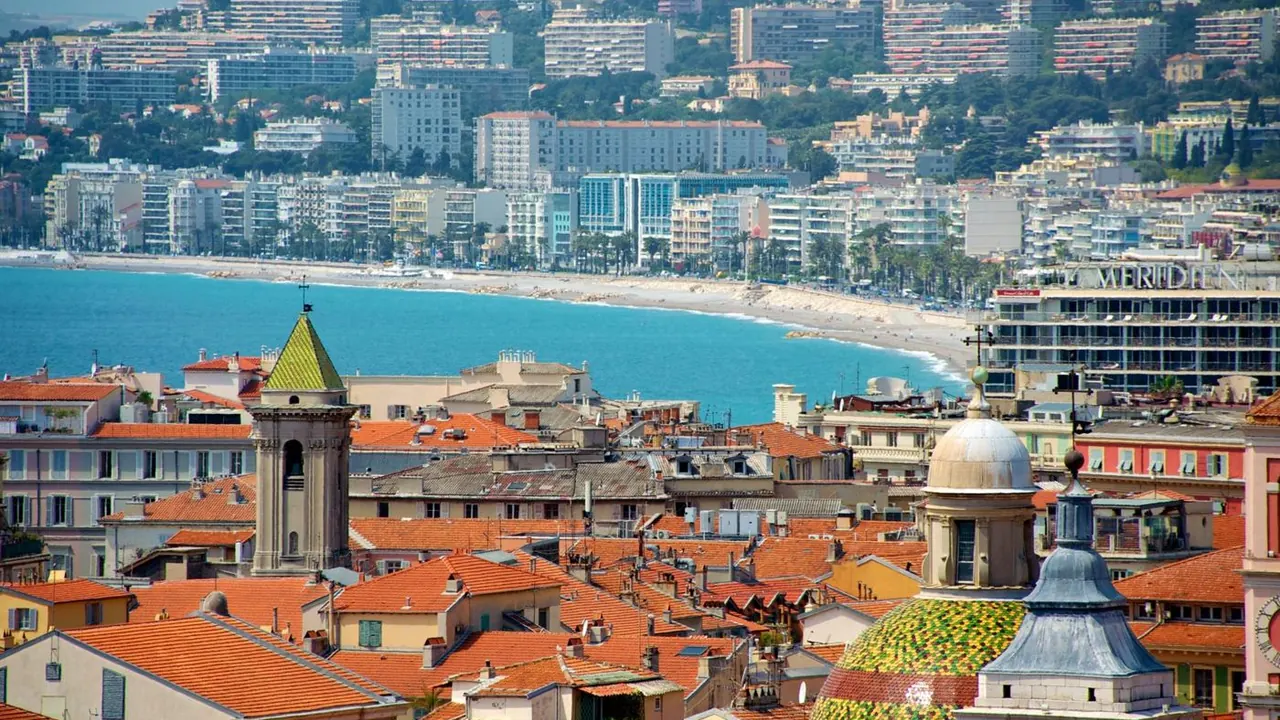
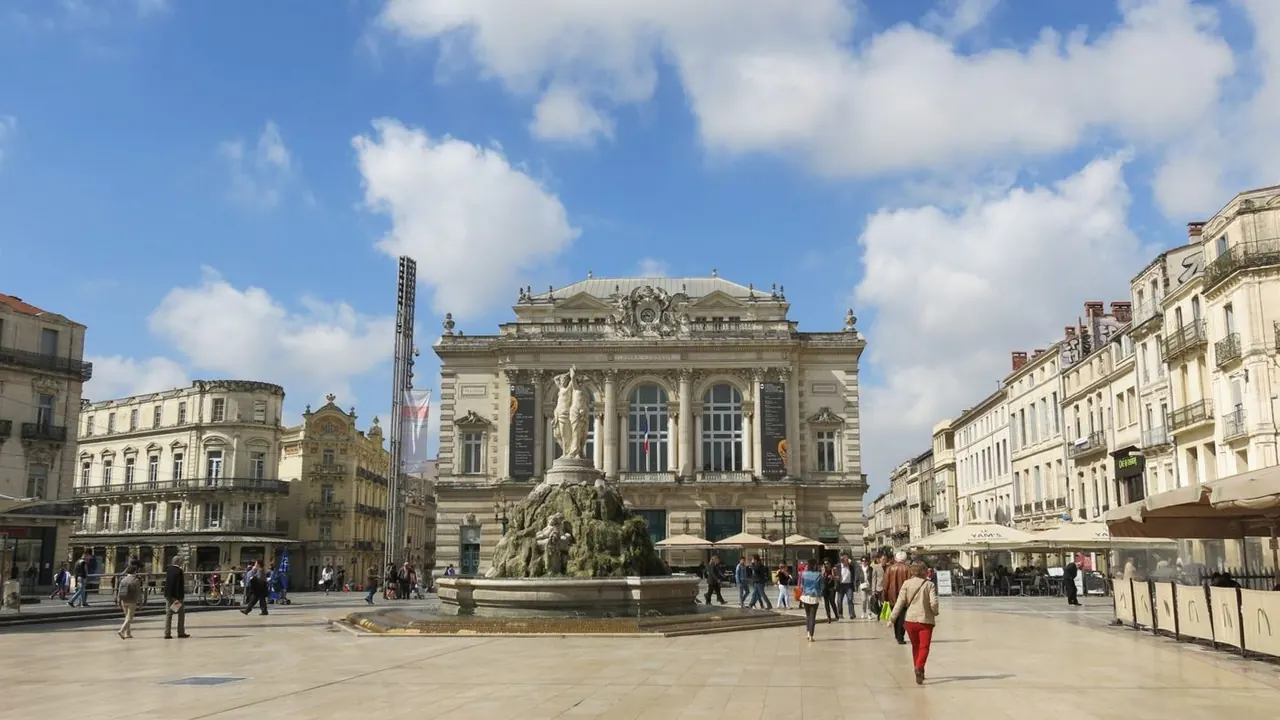
Photos: Nice by Daniel Stockman, CC BY-SA 2.0, cropped; Montpellier by Peter, CC BY 2.0, cropped.
Nice or Montpellier?
Our verdict in twelve categories, each scored against the same fixed benchmark cities, and the climate month by month, so you can choose for your trip.
Choose Nice for
- beaches
- nature and the outdoors
- shopping
Pick Nice when the sea and the scenery matter most. Clear blue water runs right along the edge of the city, the Alps rise behind it, and a string of Riviera towns, from Monaco to Antibes, can be reached by train without a car. You pay more for all this, especially in summer, and the nights are quieter. For a more scenic and polished Mediterranean trip it is the better choice.
Choose Montpellier for
- live music and the arts
- prices
- nightlife
Montpellier is the choice for travellers who want a lively, younger city that costs less. The student crowd keeps the old-town terraces full on weeknights, the opera houses and the summer dance festival give it a real stage, and the shallow sandy beaches suit children. It also makes a good base for Roman Provence, with Nîmes, the Pont du Gard and Arles all close.
Scoreboard
Twelve categories on one fixed scale from 0 to 100. The shaded stretch is the gap between the two.
Your match
Pick a travel style or drag the sliders, and both match scores follow your weighting.
Too close to call, 2 points apart
Wins on beaches and nature and the outdoors with your weighting.
Wins on live music and the arts and prices with your weighting.
What matters to you?
Category by category
What the scores mean for a trip.
Beaches & swimming
Nice has the better swimming, and the sea is right there. Its 7km of pebble shore lies below the promenade, and the water is clear, blue and warmer for longer. The pebbles are the main drawback, which is why people hire loungers or wear water shoes. The sandy bays at Villefranche and Beaulieu are a short ride east.
Montpellier offers the opposite kind of coast. It is a trip of about 11km to Palavas or Carnon, and there you find long, flat, fine sand that slopes very gently into shallow water. The dunes at l'Espiguette are the wildest stretch. It is good for a few beach days, but there are no coves and none of the Riviera's clear water.
Food & drink
The two cities eat equally well, but in different ways. Montpellier's table is the Languedoc: vineyards on the city's edge, oysters and mussels from the Thau lagoon, and the tielle of Sète. The market halls of Castellane and Laissac are where to see and eat it, and student demand keeps casual meals cheap.
Nice has a cuisine all of its own, closer to Italy, with socca hot from wood ovens, pissaladière, stuffed vegetables and the much-argued salade niçoise, and the Cours Saleya market as its showcase. The thing to avoid is the set menus on the promenade terraces. Montpellier's equivalent risk is mostly a limited range at the top end.
Culture & sights
Each city needs two or three days, and they offer different things. Montpellier's strength is its medieval Écusson, a car-free maze of stone mansions with hidden courtyards. It also has the formal Peyrou terrace with its aqueduct, the oldest botanical garden in France, and the Musée Fabre, which is strong on European painting from the Flemish masters onwards. Bofill's Antigone adds a bold piece of twentieth-century planning.
Nice has the edge in modern art. The Matisse and Chagall museums in Cimiez and the Nouveau Réaliste collection at MAMAC make it a city of twentieth-century masters. Its streets tell a double story, with the Italianate lanes of Vieux Nice on one side and the Belle Époque villas and Russian cathedral of the old winter resort on the other.
Nightlife
Montpellier has the livelier nights. One of France's largest student populations fills the bars around Place Jean-Jaurès and the squares of the Écusson even midweek, and later the crowd takes taxis out to clubs towards Lattes. The mood is loud and casual, and it quietens outside term time.
In Nice, an evening out usually means dinner and drinks in the lanes of Vieux Nice, with a few more grown-up bars at the port. Clubs are thin on the ground, the glossy Riviera nights happen in Monaco and Cannes, and outside summer the city winds down early.
Nature & outdoors
Lagoons and limestone hills frame Montpellier, and the landscape is gentler and flatter. Flamingos feed in the étangs behind the coast, the Camargue is about an hour away, and to the north the garrigue climbs to Pic Saint-Loup, with canoeing in the Hérault gorges beyond. Its windy shore is better than Nice's for kitesurfing and windsurfing.
Nice offers more, because the Alps come right down to the sea. Cliff paths circle Cap Ferrat, the corniches are classic cycling roads, and the Mercantour, with its ibex and high lakes, is about two hours inland. In winter you can ski in the morning and be back by the sea the same day, and diving and sailing are easy to arrange.
Day trips
Both are excellent bases, and the difference is the kind of outing. From Montpellier the trips are into history: Roman Nîmes about half an hour away by train, the Pont du Gard, Arles and Avignon at about an hour, and the walls of Carcassonne. Closer in are Sète and Aigues-Mortes, though the smaller villages are much easier with a car.
Nice's trips are a chain of coastal towns along one railway: Villefranche, Monaco, Menton, Antibes and Cannes. Inland there are perched villages such as Èze and Saint-Paul-de-Vence, and Italian towns lie just over the border. Nearly everything is under an hour away, and none of it needs a car.
Good for families
Montpellier is slightly easier with children, mainly because of its beaches. The sand slopes very gently into calm, shallow water, and the city adds a zoo in a large wooded park plus an aquarium and planetarium side by side at Odysseum.
Nice's pebbles are hard on small feet, and it has no big zoo or theme park. Its compensations are the playgrounds and water jets of the Promenade du Paillon, Parc Phoenix, and the long flat promenade for scooters and pushchairs. In both cities, July and August are best split between beach mornings and indoor afternoons.
Getting around
Getting around is about equally easy in both. Each has a compact centre and a tram, but they work differently. Montpellier's centre sits on a low hill with uneven paving, and the tram reaches Antigone and Odysseum. The beach needs a tram and then a bus, and you will want a car for the gorges and the Camargue.
Nice is flatter, and the tram runs straight from the airport to the centre and the port. It also has the coastal railway, which reaches most day-trip towns. A car only becomes useful for the mountains inland.
Shopping & style
Nice is the better place to shop. Avenue Jean Médecin is the main high street, the luxury fashion houses are around rue Paradis, and Vieux Nice sells olive oil, soaps and Provençal fabrics. The Monday flea market on the Cours Saleya adds antiques.
Montpellier has nothing like the luxury streets. Its Écusson lanes hold small boutiques and bookshops, and the Polygone mall sits beside the Comédie. The best things to take home are Languedoc wines, olive oil and honey from the market halls.
Affordability
Montpellier is clearly the cheaper stay. Central hotels are moderately priced for most of the year, the student population keeps simple food and drinks cheap, and the lunch menus and market halls help further. Costs build up mainly at sit-down dinners and in summer rooms on the coast.
Nice is expensive by southern European standards, especially from June to September, when sea-view rooms, beach loungers and promenade terraces cost a lot. Its saving graces are cheap trams and coastal trains, inexpensive museums and socca from the old town. Spring and late autumn are much kinder to a budget.
Live music & performing arts
Opera, dance and concerts run much deeper in Montpellier. Two opera houses, the old Comédie and the modern Berlioz in the Corum, share a season with the national orchestra. Contemporary dance is the specialism, led by the Montpellier Danse festival and a national choreographic centre, and in summer the Radio France festival puts on many free concerts.
Nice's calendar is built around a few big moments: the Nice Jazz Festival in July and the Carnival's parades and flower battles in February. The red-and-gold Opéra de Nice keeps a regional season going in between. Outside those, there is enough for an evening or two, but not much more.
Wellness & relaxation
Neither city has a bathing tradition, and spas in both mostly mean hotel treatment rooms. Montpellier has the closer thermal water, at Balaruc-les-Bains on the Thau lagoon about half an hour away, but its student-filled centre is more lively than restful.
Nice relaxes through its seafront routine: an early swim, a long lunch, an evening walk along the bay. There are thalassotherapy centres along the coast. Out of season it is the calmer of the two.
When should you go?
Pick your month. The climate figures are measured averages, not a forecast.
Nice in July
Montpellier in July
Daytime high, °C
Rainfall in the month, mm
Temperature and rainfall are climate normals, averaged over the years shown. Nice: 1991-2020 normals, Nice (8 km from centre). Montpellier: 1991-2020 normals, Montpellier (7.8 km from centre).
The two share a Mediterranean pattern, but Montpellier has the more extreme summer. July reaches about 30°C in Montpellier, against 28°C in Nice, and the stone streets of the Écusson hold the heat, so midday walking is hard in both. The sea is where they differ most. Nice's water is warm enough to swim from June to September and reaches 25°C in August. Off Montpellier's coast it only gets comfortable in July and August, peaking around 22°C. Both get plenty of sunshine through the summer.
Autumn brings the rain. In Montpellier it arrives in September and October, while Nice's wettest stretch comes later and is heavier, with October and November the worst and about 138mm falling in November. Winters are mild in both places, a little milder in Nice. For walking and sightseeing, May and early June are the best months in either city. Late September is the best time for a mix of sea and streets, though Montpellier turns wet sooner.
Which traveller are you?
On a trip with a tight budget, Montpellier makes the money go further. Days go on the old town and a cheap train to Nîmes or Sète, and evenings on terraces among students. You avoid paying Riviera rates for a bed near the sea.
For a beach and sun trip, Nice lets the sea set the pace of the day. You can swim before breakfast, walk into the old town for lunch and be back in the water by late afternoon, with no bus ride to reach the coast.
For an outdoors trip, Nice gives the most variety in one stay. A headland walk one day, a hard ride in the hills the next, then a day in the high mountains, and most evenings still end with a swim in the bay.
Before you go
| Measure | Nice | Montpellier |
|---|---|---|
| Official language | French | French |
| Currency | Euro (EUR) | Euro (EUR) |
| Sockets | CE230 V, 50 Hz | CE230 V, 50 Hz |
| Driving side | Right | Right |
| Time zone | UTC+1, UTC+2 in summer | UTC+1, UTC+2 in summer |
| Emergency number | 112 | 112 |
| Elevation | 0 m | 7 m |
| Main airport | Nice-Côte d'Azur Airport (NCE)6 km from centre130 non-stop destinations | Montpellier-Méditerranée Airport (MPL)8 km from centre41 non-stop destinations |
| Public holidays this year | 11 days | 11 days |
By the numbers
| Measure | Nice | Montpellier |
|---|---|---|
| City population | 357,737 | 310,240 |
| People per km² | 4,975 | 5,452 |
| Museums within 10 km | 17 | 14 |
| UNESCO World Heritage sites within 50 km | 2 | 2 |
| Swim season, months above 21 °C | 4 months | 2 months |
Where else could you go?
Every comparison below shares a destination with this one, so you can follow Nice or Montpellier somewhere new.