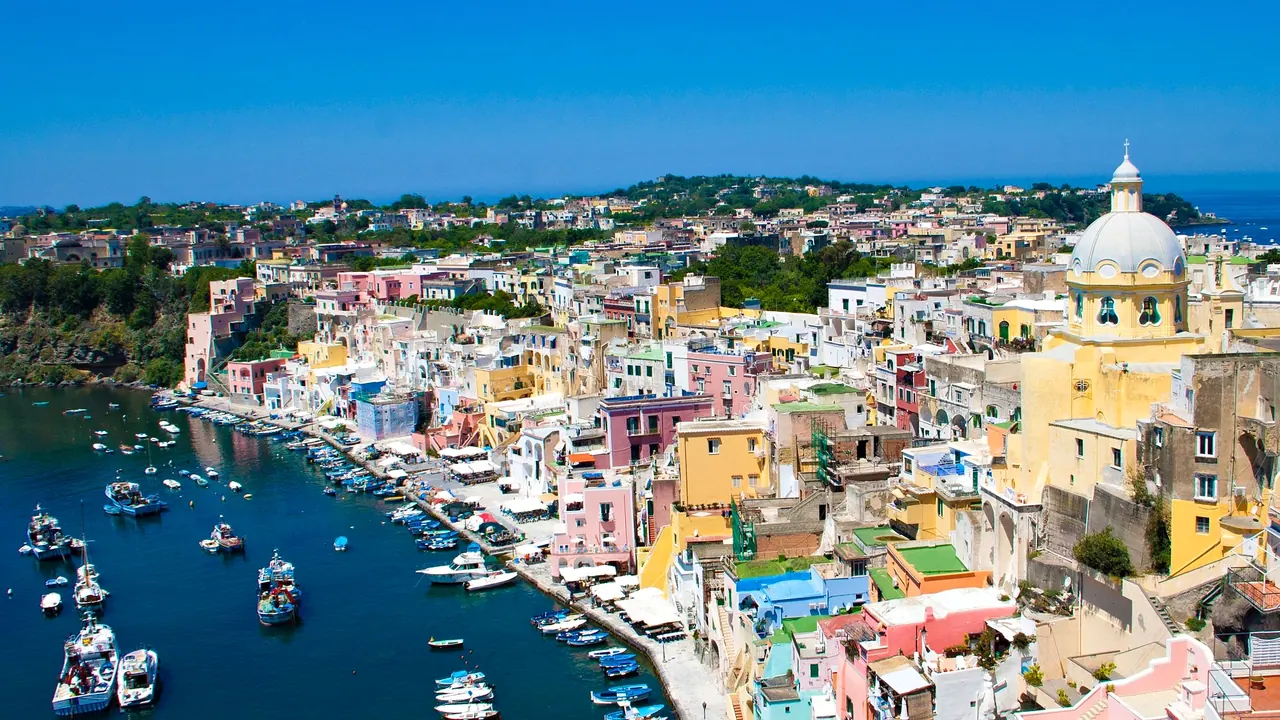
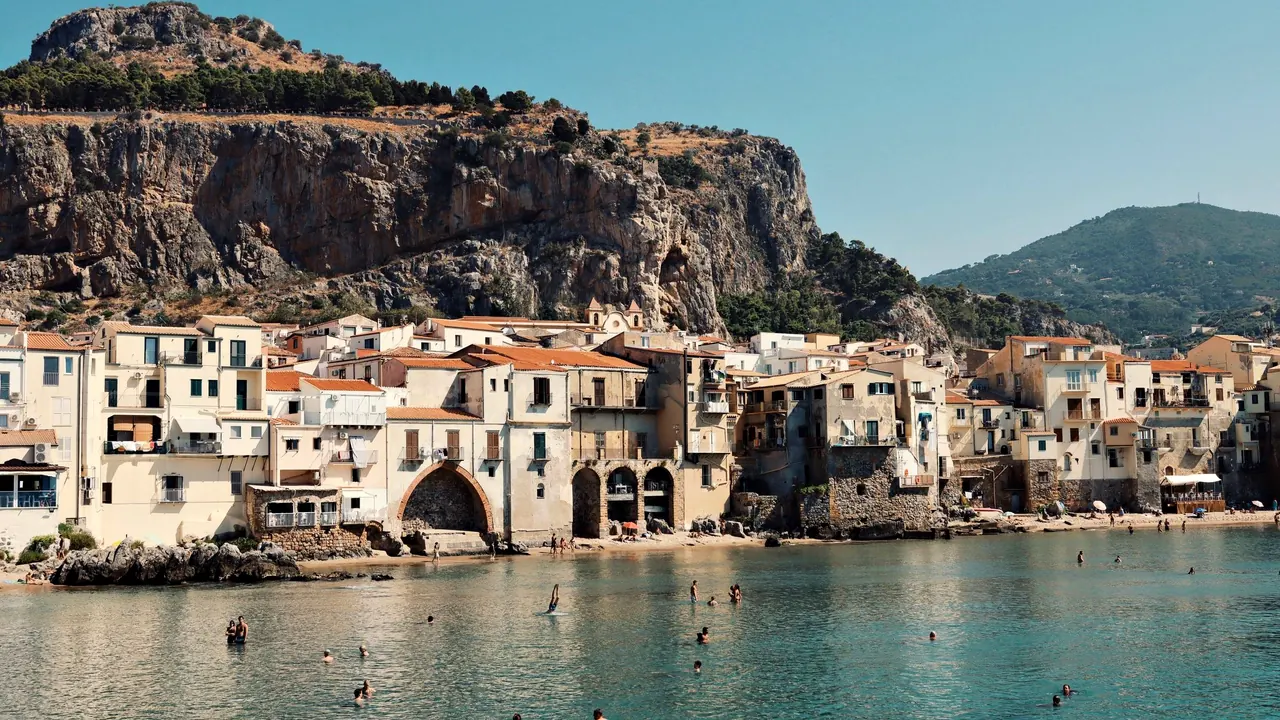
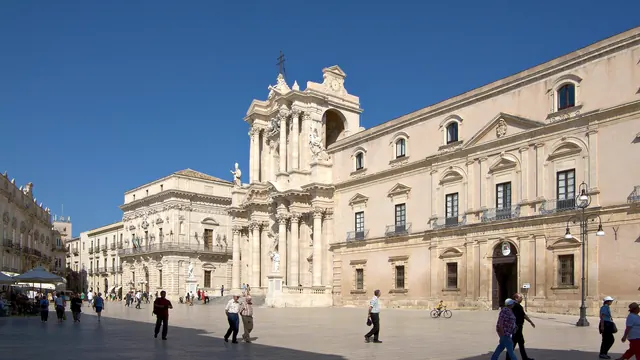
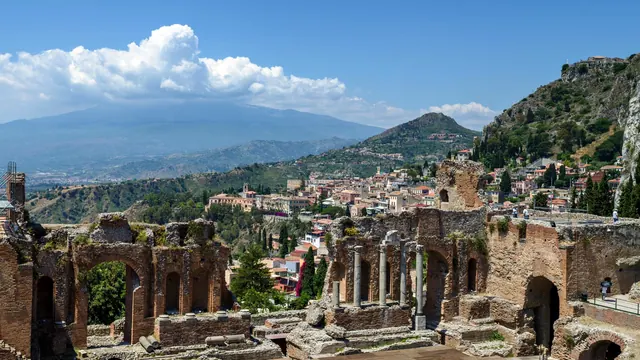
Photos: Procida by DIANA.GRYGAROVA, CC BY-SA 4.0, cropped; Sicily by Efrem Efre, Pexels License.
Procida or Sicily?
Our verdict in twelve categories, each scored against the same fixed benchmark cities, and the climate month by month, so you can choose for your trip.
Choose Procida for
- getting around
- wellness
Procida is the better choice for a slow, single-base island stay where you never need a car. You get a handful of small volcanic coves, harbour dinners at Corricella and an unhurried pace, and Ischia, Naples and the Phlegraean Fields are all a short boat ride away when you want more. What you give up is range: the island itself runs out of sights, food and evenings within a few days.
Choose Sicily for
- culture and sights
- live music and the arts
- nature and the outdoors
Sicily suits a longer, more ambitious trip, ideally a week or more with a hire car and two or three bases. Greek temples, Arab-Norman Palermo, the baroque south east, Etna and the Aeolian volcanoes, and some of Italy's most distinctive food are all within reach, along with a wider choice of beaches. The cost is effort: long drives, slow roads and planning between towns that a small island spares you.
Scoreboard
Twelve categories on one fixed scale from 0 to 100. The shaded stretch is the gap between the two.
Your match
Pick a travel style or drag the sliders, and both match scores follow your weighting.
Wins on getting around and wellness with your weighting.
Wins on culture and sights and live music and the arts with your weighting.
What matters to you?
Category by category
What the scores mean for a trip.
Beaches & swimming
Procida's beaches are small coves of dark volcanic sand. Chiaiolella and Ciraccio suit families, Chiaia lies at the bottom of the steps below Terra Murata, and Pozzo Vecchio is small and sheltered. They are clear and warm, all a short ride apart, but none is large and they fill early in August.
Sicily offers a much wider choice of coastline: the white crescent of San Vito Lo Capo, the marl cliffs of the Scala dei Turchi, the reserve beaches of Vendicari, and the turquoise pools of Favignana. Its own black volcanic beaches are on the Aeolian Islands. The catch is that the best beaches are spread far apart, so it pays to pick one coast and stay there.
Food & drink
Procida's cooking is fish and lemons: the morning's catch at the harbours of Corricella and Marina Grande, the island's lemon salad with mint and chilli, and the lemon-cream lingua pastry. It is good and honest, but after a few dinners the menus start to repeat, and many places close outside the season.
Sicily is one of Italy's great food destinations, with Greek, Arab and Spanish layers in its cooking. You can eat standing at the stalls of Palermo's Ballarò and Capo markets, try granita and brioche for breakfast, and follow regional specialities from Trapani's fish couscous to Modica chocolate and Bronte pistachios. Etna's wineries add tastings.
Culture & sights
Procida's heritage fits into a day or two of slow walking: the walled village of Terra Murata with its abbey and the former prison of Palazzo d'Avalos, and the pastel houses stacked around Corricella. It is charming, but it is a single village's worth of history.
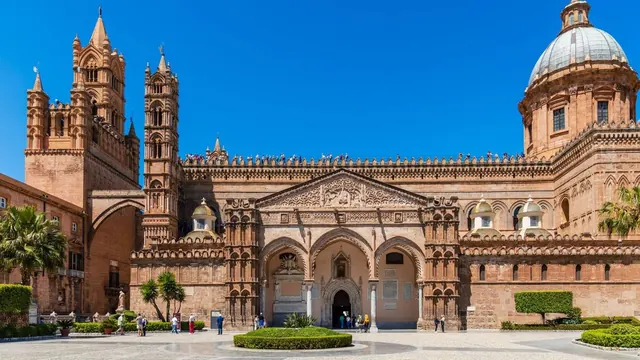
Sicily has heritage from many civilisations at a scale few places match. It has Doric temples at Agrigento and Segesta, the Greek theatres of Syracuse and Taormina, the Roman mosaics of Piazza Armerina, Palermo's gold Arab-Norman interiors and the honey-coloured baroque of Noto and Ragusa Ibla. Seeing the best of it takes about a week and several bases.
Nightlife
On Procida, a night out means dinner, a harbour stroll and a drink at the waterfront bars of Marina Grande or Chiaiolella, which stay lively until about midnight in high summer. For anything more you have to take the ferry and then worry about getting back.
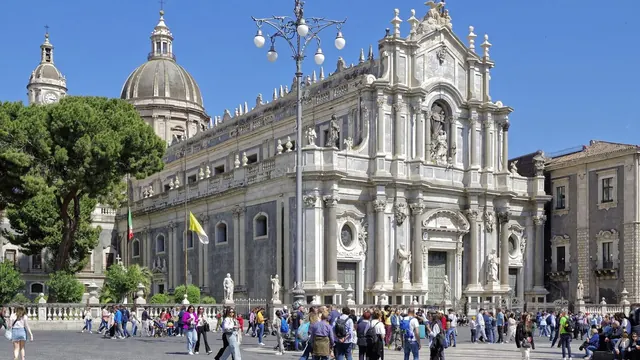
Sicily has real city nightlife. Students and locals fill the piazzas of Catania's historic centre late into the night, people drink in the street around Palermo's Vucciria, and in summer there are beach bars and open-air clubs at Mondello and below Taormina. It is still seasonal and quiet in the small towns.
Nature & outdoors
Procida is a low island of drowned craters and walled lemon gardens. Its walks lead to viewpoints such as the lookout over Corricella and the headlands above Pozzo Vecchio. Add snorkelling, a boat trip round the coast and the occasional guided opening of the Vivara reserve, and a few days cover it.
Sicily's landscapes are on a different scale. You can walk on the lava of Etna, climb Stromboli in the evening to watch it erupt, follow the Zingaro cliff path and explore the beech woods of the Madonie and Nebrodi. The Egadi and Aeolian Islands offer serious diving and sailing.
Day trips
Both make excellent bases for outings, but the trips differ in kind. From Procida every outing starts at the port. Ischia, the neighbouring island, is a quarter of an hour away for its castle at Ischia Ponte. On the mainland, Pozzuoli has its Roman amphitheatre, with the sunken villas of Baia and Greek Cuma beyond, and Naples is under an hour by hydrofoil, with Herculaneum past it. The last ferry back decides when each day ends.
In Sicily the outings stay on the island and mostly need a car. From Syracuse you can tour the baroque towns of Modica and Scicli, from Catania the Etna wine villages, and from Palermo Cefalù and hilltop Erice. Ferries to Favignana or Lipari make longer days out.
Good for families
Sicily works better for most families. Children are welcome everywhere until late, shallow sandy bays such as San Vito Lo Capo and Mondello are easy for small ones, and older children get Etna's lava fields, island boat trips and Palermo's puppet theatre. The drawbacks are long drives, steep hill towns and fierce summer heat.
Procida is calm and compact, and the gentle beaches at Chiaiolella and Ciraccio are within easy reach. But there is nothing beyond sea and ice cream to keep children busy. The pavement-less lanes and the steps at Corricella and Chiaia make a pushchair hard work.
Getting around
Procida is far simpler. The island is only a few kilometres across, small buses and three-wheeled taxis link the port to every corner, and you need no car at all. The only real nuisance is walking the narrow, walled lanes with traffic and no pavements.
Sicily largely means a hire car, with slow, winding inland roads and chaotic driving and parking in Palermo and Catania. Trains are sparse, intercity buses only cover the main towns, and rough seas can cancel island crossings. Without a car you can manage two bases but will miss much of the island.
Shopping & style
Procida's shopping is a stretch of Via Roma near the ferry, with painted ceramics, limoncello, linen and beachwear, and serious shoppers head to Naples. Sicily has much more to take home: majolica from Caltagirone, Trapani coral, Palermo's puppet makers and food such as Modica chocolate and Marsala wine. For fashion there are Via Libertà in Palermo, Via Etnea in Catania and the boutiques of Taormina.
Affordability
Sicily goes further on a modest budget. Street food and pastry cost little, simple trattorias are reasonable, and B&Bs and agriturismi in the cities and inland stay fairly priced even in summer. The expensive places are Taormina, the Aeolians and the big resorts in high season, and a summer car hire adds to the bill.
Procida is cheaper than its better-known gulf neighbours, and you save by needing no car. But rooms are few and mostly small guesthouses, so they cost more in July and August, and the harbour trattorias charge island prices. Late spring and September are the better bet.
Live music & performing arts
Procida has no theatre or regular music, and its one great spectacle is the Good Friday procession of the Misteri, when tableaux of biblical scenes are carried down from Terra Murata. Opera in Naples is close, but the ferry home makes it awkward.
Sicily has a real stage culture. There is a full opera season at Palermo's Teatro Massimo, Bellini's theatre in Catania, Greek tragedy in the ancient theatre of Syracuse and summer concerts at Taormina with Etna behind the stage. The marionette knights of the opera dei pupi are a uniquely Sicilian evening.
Wellness & relaxation
Both are restful for their pace rather than their spas, but the rest comes in different forms. On Procida it means quiet lanes, long harbour lunches and evening light on Corricella, and Ischia's hot springs and thermal gardens are a short hop away for a day of soaking.
In Sicily, unwinding usually means a stone farmhouse or agriturismo among olive groves, or a slow island like Salina. Its thermal spots are scattered and rustic: the springs at Sciacca, the volcanic mud on Vulcano and the crater lake on Pantelleria.
When should you go?
Pick your month. The climate figures are measured averages, not a forecast.
Procida in July
Sicily in July
Daytime high, °C
Rainfall in the month, mm
Where the figures come from
Procida's temperatures are measured 32 km from the centre, at Grazzanise.
Sicily's sunshine is measured 67 km from the centre, at Ustica.
Temperature and rainfall are climate normals, averaged over the years shown. Procida: 1991-2020 (rainfall 1971-2000) normals, Grazzanise (32.2 km from centre). Sicily: 1991-2020 normals, Palermo / Punta Raisi (24.1 km from centre).
Both have the same swimming season, roughly June to October, and the sea peaks in August at about 26°C off Procida and a degree warmer around Sicily. July and August are hot on both. Procida's highs reach about 31°C, which makes its steps and walled lanes tiring at midday, and in Sicily the interior becomes too hot for walking. Sicily's figures run slightly milder in winter and sunnier through spring, so a March or April visit there is brighter.
The big difference is autumn. Procida turns wet quickly after September, and October and November are its wettest months at over 150mm. Sicily stays drier for longer, with its rainiest weather arriving in December, and its July is almost completely dry. For warm sea without the peak heat, aim for June or September on Procida. In Sicily the window stretches from late May to early October, with spring and autumn best for walking.
Which traveller are you?
On a culture and arts trip, Sicily wins by a long way. The temples of Agrigento and Segesta, the mosaics of Palermo and Monreale, and the baroque towns of the south east fill a week, and Teatro Massimo and the Greek theatres add opera and drama.
For an outdoors trip, choose Sicily. You can walk Etna's lava fields, climb Stromboli at dusk, follow the Zingaro cliff path and dive around the Egadi and Aeolian Islands. Procida offers viewpoints, snorkelling and a guided visit to Vivara, and little more.
On a relaxing and wellness trip, Procida has the edge in practice. It is small and needs no car, and the days are long lunches above the harbour and quiet coves. Ischia's thermal pools are a quarter of an hour away, so a day of soaking takes no planning.
Before you go
| Measure | Procida | Sicily |
|---|---|---|
| Official language | Italian | Italian |
| Currency | Euro (EUR) | Euro (EUR) |
| Sockets | CFL230 V, 50 Hz | CFL230 V, 50 Hz |
| Driving side | Right | Right |
| Time zone | UTC+1, UTC+2 in summer | UTC+1, UTC+2 in summer |
| Emergency number | 112 | 112 |
| Main airport | Naples International Airport (NAP)131 non-stop destinations | Falcone–Borsellino Airport (PMO)106 non-stop destinations |
| Public holidays this year | 13 days | 13 days |
By the numbers
| Measure | Procida | Sicily |
|---|---|---|
| Population | 10,092 | 4,983,478 |
| People per km² | 2,347 | - |
| Swim season, months above 21 °C | 5 months | 5 months |
Where else could you go?
Every comparison below shares a destination with this one, so you can follow Procida or Sicily somewhere new.
- Ischiavs Procida
- Caprivs Procida
- Amalfi Coastvs Procida
- Aeolian Islandsvs Sicily
- Aeolian Islandsvs Procida
- Pugliavs Procida