Italy
Taormina
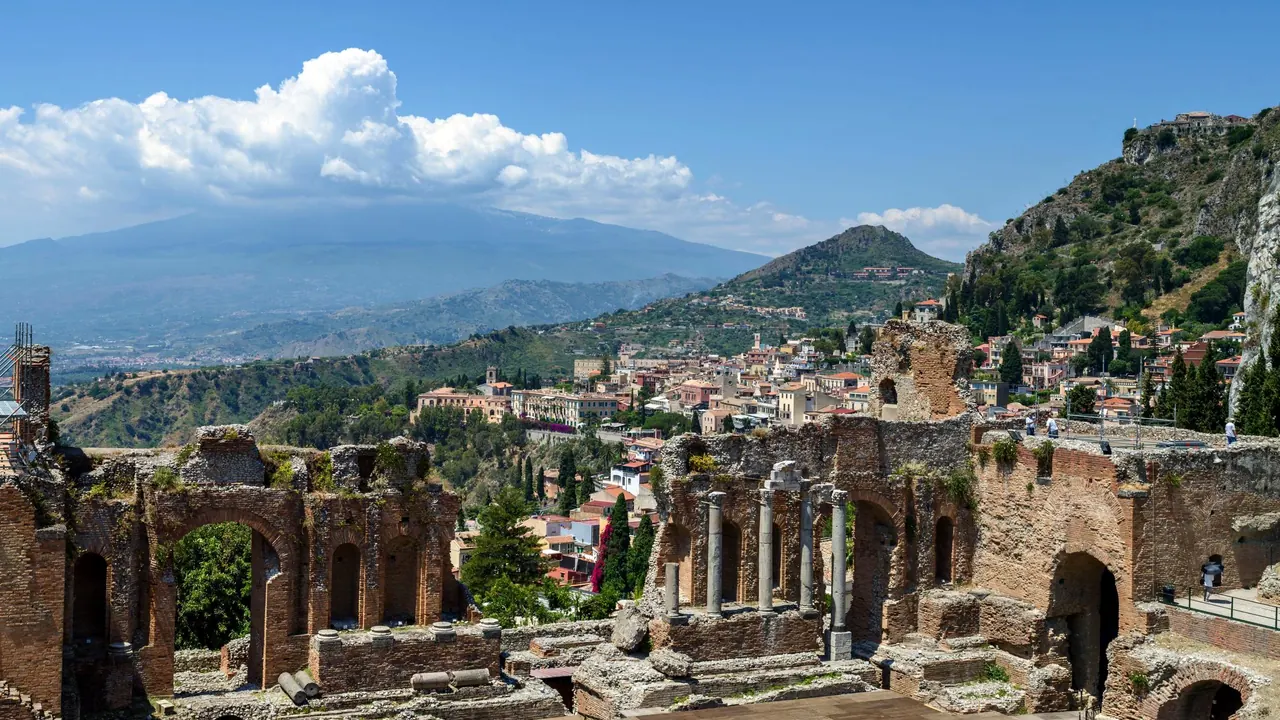
The ancient theatre with the town and Etna beyond
- Nature & outdoors80
- Day trips78
- Beaches72
Photo: Reinhard Bruckner, Pexels License
Match
50
Every category weighted equally
- Beach & sun53
- Culture & arts48
- Food & nightlife46
- Family trip54
- Outdoors59
- Relax & unwind54
- Shopping & style47
- On a budget48
Taormina in twelve categories
Our verdict on each, scored 0 to 100 against the same fixed benchmark cities, so a score means the same thing on every page.
Beaches & swimming. Scores 72 out of 100.
Food & drink. Scores 57 out of 100.
Culture & sights. Scores 45 out of 100.
Nightlife. Scores 28 out of 100.
Nature & outdoors. Scores 80 out of 100.
Day trips. Scores 78 out of 100.
Good for families. Scores 42 out of 100.
Getting around. Scores 55 out of 100.
Shopping & style. Scores 40 out of 100.
Affordability. Scores 30 out of 100.
Live music & performing arts. Scores 33 out of 100.
Wellness & relaxation. Scores 45 out of 100.
Taormina category by category
Beaches & swimming
72The town sits on a terrace above the sea, and a cable car and steep footpaths drop to the bays below. Mazzarò and the cove facing Isola Bella have clear, glassy water, good for snorkelling, but the beaches are narrow pebble strips that fill with rented loungers in high summer. Giardini Naxos to the south and Letojanni to the north have longer stretches of sand and shingle and are a short bus ride away.
The Ionian Sea reaches about 26°C in August and is comfortably swimmable from June to October. A summer stay here usually means mornings on the coast and evenings back up in town. The beaches are lovely in setting but small, so the best spots go early.
Food & drink
57Sicily gives the town a cuisine with real character: pasta alla Norma, swordfish and raw red prawns, arancini, caponata, and cannoli and cassata from the pastry shops. Breakfast is almond or pistachio granita with a warm brioche, which is a local ritual in itself. The volcanic slopes of Etna produce some of Italy's most interesting wines, mainly Nerello Mascalese reds and Carricante whites, and they are on almost every list.
There is a serious upper tier of refined Sicilian cooking, often with sea views. Lower down, many places along Corso Umberto serve tourist menus at resort prices, and the best everyday eating is in the side streets and down in Giardini Naxos. This is a small town, so the choice does not go very deep.
Culture & sights
45The Greek theatre is the reason to come. It was built in the Hellenistic period and largely rebuilt by the Romans, and its broken stage frames Etna and the coastline in one of the most famous views in the Mediterranean. Around it, the old town runs along Corso Umberto between two medieval gates, with the fortress-like Duomo, the Gothic Palazzo Corvaja, Badia Vecchia and Palazzo Duca di Santo Stefano, all built with a mix of Arab, Norman and Catalan influences.
The Villa Comunale gardens and the Isola Bella villa complete a compact list. A curious visitor sees most of it in a day of slow walking. There are no major museums, so deeper sightseeing means heading out of town.
Nightlife
28Evenings mean a long aperitivo in Piazza IX Aprile, a slow passeggiata along the Corso, then wine bars and piano bars with terraces over the sea. In summer a few lounge bars and beach clubs near Mazzarò and Giardini Naxos stay open late. Things are livelier in August, but the crowd is mostly couples and older visitors, and there is no real club scene. Out of season the town goes quiet soon after dinner.
Nature & outdoors
80Mount Etna dominates the view from almost everywhere in town, and it is the main outdoor draw. Within about an hour you can walk over old lava flows and the Silvestri craters, take the cable car and off-road vehicles towards the summit areas with a guide, ski on its slopes in winter or tour the vineyards and chestnut woods on its flanks. The Alcantara gorges, carved through basalt columns, are closer still.
Nearer to town, footpaths climb to Castelmola and Monte Tauro for wide views of the coast. The marine reserve around Isola Bella is good for snorkelling, kayaking and diving among rocky grottoes. The Peloritani hills inland offer quieter walking. Spring and autumn are best, since summer heat makes hiking hard.
Day trips
78The east coast of Sicily is rich in places to visit. Catania is about an hour away, a baroque city of black lava stone with a famous fish market. Syracuse is about two hours south, where the island of Ortigia and the Greek theatre and quarries of Neapolis make one of the best days out in Sicily. With an early start, the honey-coloured baroque towns of the Val di Noto, Noto above all, are also possible.
Closer to town, Castelmola sits on the crag above, and Savoca and Forza d'Agrò are hill villages known from film. Acireale has a baroque centre on the coast. On Etna's northern slopes, wine villages such as Linguaglossa and Randazzo make a slow day of cellar visits. Messina and its strait are about an hour north.
Good for families
42Children are warmly welcomed, the pedestrian centre is safe, and granita, gelato and the cable car down to the sea go down well. Snorkelling at Isola Bella and a trip up Etna to see lava fields and craters suit school-age children best. Little is designed for children, though. The town is built on a steep slope with many steps, the nearest beaches are pebbly and crowded in August, and many hotels are aimed at couples. Families with small children often do better staying down in Giardini Naxos, which has sandier beaches and flatter streets.
Getting around
55The historic centre is small and largely pedestrian, and everything in it is within a short walk along Corso Umberto. The town clings to a slope, though, so stairways and steep lanes are part of every outing. A cable car connects the town to the beaches at Mazzarò, and local buses run to Castelmola and Giardini Naxos.
The railway station sits down by the sea, and the coastal line and regional coaches reach Catania, its airport, Messina and Syracuse. Etna and the inland villages are realistically reached by tour or hired car. Driving in town is difficult, and parking means the multi-storey garages on the edge of the centre.
Shopping & style
40Shopping happens along a single street. Corso Umberto is lined with jewellers, coral and cameo dealers, linen and lace shops, resort-wear boutiques and stores selling Sicilian ceramics, including the painted moor's-head vases and Caltagirone majolica. Look for almond and pistachio sweets, Etna wines and Bronte pistachio cream to take home. It is pleasant for browsing, but much of the stock is aimed at visitors. There are no department stores or larger fashion districts, and for those Catania is the place to go.
Affordability
30This is the most expensive place to stay in eastern Sicily, and it costs far more than the island around it. Grand hotels with sea views set the tone, mid-range rooms in the centre are scarce in summer, and restaurants and bars on the main street charge resort prices. Local buses, bakery snacks and granita are still cheap. Staying down in Giardini Naxos or Letojanni and coming up for the evening costs noticeably less, and so does visiting in spring or autumn.
Live music & performing arts
33On summer nights the Greek theatre is used as it was built to be used, for concerts, opera and ballet, and for international pop and rock acts, with Etna behind the stage. The long-running film festival and the Taormina Arte season have brought performers here for decades. Outside the summer months there is little more than occasional chamber concerts and piano bars, and serious opera and theatre mean going to Catania's Teatro Massimo Bellini.
Wellness & relaxation
45There is no public bathing culture here, so wellness means hotel spas. The large hotels have good ones, often with pools on terraces above the sea and treatments using local volcanic mud, citrus and almond. The real restorative pleasure is the pace: long lunches, the shade of the Villa Comunale gardens and evenings watching Etna change colour. That calm depends on the season. In May, June and late September the town is gentle, but in August cruise and day-trip crowds pack the Corso.
When should you go?
Pick a month to see what it is like. The climate figures are measured averages, not a forecast.
Taormina in July
Daytime high, °C
Rainfall in the month, mm
The whole year
Shaded against this city’s own year: the deepest cell is its best month for that figure and the palest its weakest.
Where the figures come from
Taormina's temperatures are measured 45 km from the centre, at Messina.
Taormina has no rain gauge within 25 km of the centre, so its rainfall comes from a gridded climate dataset read at the city rather than from a gauge further away.
Temperature and rainfall are climate normals, averaged over the years shown. Taormina: 1991-2020 normals, Messina (45.1 km from centre).
Before you go
| Measure | Taormina |
|---|---|
| Official language | Italian |
| Currency | Euro (EUR) |
| Sockets | CFL230 V, 50 Hz |
| Driving side | Right |
| Time zone | UTC+1, UTC+2 in summer |
| Emergency number | 112 |
| Elevation | 204 m |
| Main airport | Catania-Fontanarossa Airport (CTA)47 km from centre96 non-stop destinations |
| Public holidays this year | 13 days |
By the numbers
| Measure | Taormina |
|---|---|
| City population | 10,471 |
| People per km² | 799 |
| Museums within 10 km | 5 |
| UNESCO World Heritage sites within 50 km | 2 |
| Swim season, months above 21 °C | 5 months |
Compare Taormina with
Every comparison with a written verdict behind it.
- Amalfi
- Bari
- Bergamo
- Bologna
- Catania
- Como
- Cortina d'Ampezzo
- Florence
- Genoa
- La Spezia
- Lecce
- Lucca
- Matera
- Milan
- Naples
- Padua
- Palermo
- Pisa
- Portofino
- Positano
- Rome
- Salerno
- Siena
- Sorrento
- Syracuse, Sicily
- Trieste
- Tunis
- Turin
- Valletta
- Venice
- Verona