Italy
Catania
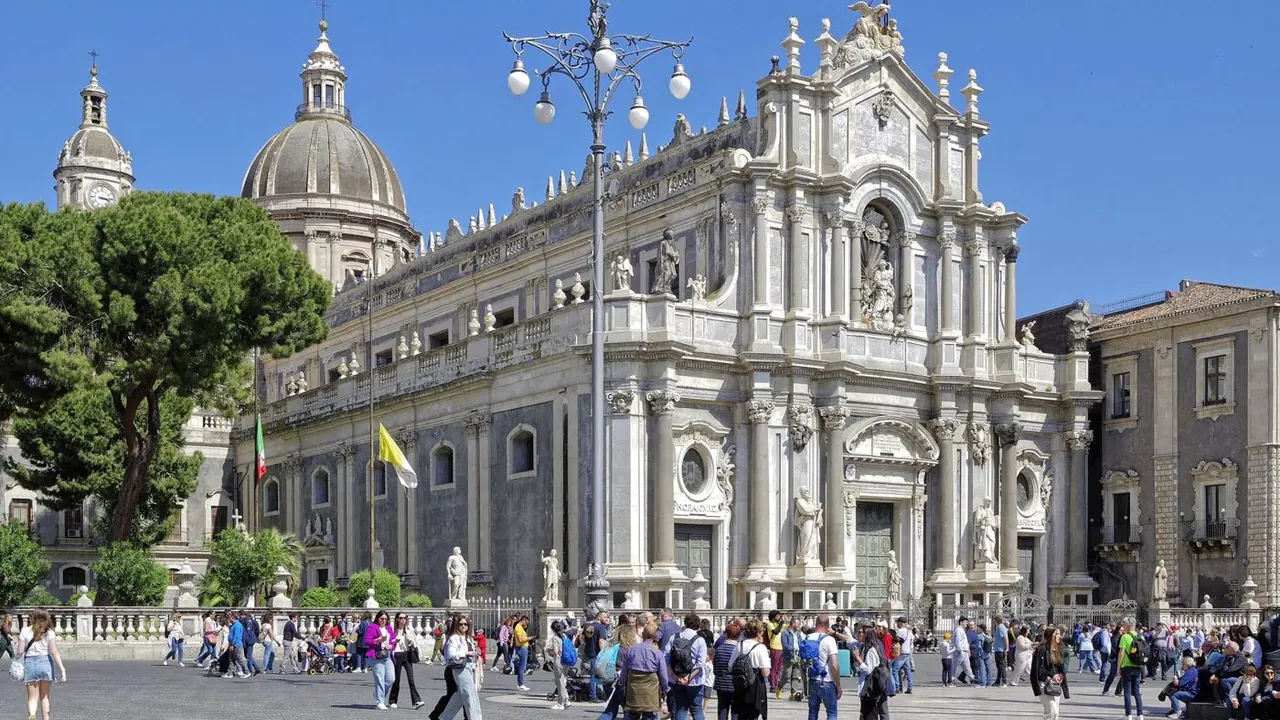
The Cathedral of Sant'Agata
- Day trips84
- Nature & outdoors83
- Food & drink77
Photo: Berthold Werner, CC BY-SA 4.0, cropped
Match
60
Every category weighted equally
- Beach & sun62
- Culture & arts60
- Food & nightlife60
- Family trip62
- Outdoors67
- Relax & unwind60
- Shopping & style57
- On a budget60
Catania in twelve categories
Our verdict on each, scored 0 to 100 against the same fixed benchmark cities, so a score means the same thing on every page.
Beaches & swimming. Scores 72 out of 100.
Food & drink. Scores 77 out of 100.
Culture & sights. Scores 62 out of 100.
Nightlife. Scores 60 out of 100.
Nature & outdoors. Scores 83 out of 100.
Day trips. Scores 84 out of 100.
Good for families. Scores 50 out of 100.
Getting around. Scores 48 out of 100.
Shopping & style. Scores 42 out of 100.
Affordability. Scores 60 out of 100.
Live music & performing arts. Scores 55 out of 100.
Wellness & relaxation. Scores 30 out of 100.
Catania category by category
Beaches & swimming
72Catania has two coastlines, and they feel quite different. South of the centre, La Playa is a long stretch of sand lined with beach clubs, where the city spends its summer weekends. North of the centre, the Riviera dei Ciclopi is black lava rock. Around Aci Castello and Aci Trezza you swim off platforms and ladders into very clear water, with the basalt sea stacks just offshore.
The Ionian Sea reaches about 26°C in August, and swimming is comfortable from June into October. La Playa is broad and easy, but it is busy and nothing special. For prettier coves, Taormina's Isola Bella is about an hour north.
Food & drink
77Catania is one of the great street-food cities of the south. Its arancini are the local cone-shaped kind, filled with ragù, and the tavola calda counters also turn out fried crispelle filled with anchovy or ricotta. Alongside them sit baked pastries such as the cipollina, puff pastry around onion, tomato, ham and cheese, and the stuffed scacciata. In the evening the grills along Via Plebiscito cook horse meat over smoke. Pasta alla Norma takes its name from Bellini's opera. Breakfast in summer is almond or pistachio granita with a warm brioche, and the pistachios come from Bronte on Etna's slopes.
La Pescheria, the fish market behind the cathedral, is the heart of it all. It is loud, wet and full of swordfish heads, and the trattorias around it cook the morning's catch. Etna's volcanic vineyards make some of Italy's most interesting reds and whites, from Nerello Mascalese and Carricante grapes. The fine-dining tier is small, and most of the best eating is casual.
Culture & sights
62Catania was rebuilt after the earthquake of 1693, and the result is a late-baroque city made of dark lava stone and pale limestone. It is part of the UNESCO-listed Val di Noto group. Piazza del Duomo holds the Cathedral of Sant'Agata and the lava elephant fountain that is the city's symbol. Via dei Crociferi is a single street of churches and convents, and the huge Benedictine monastery of San Nicolò l'Arena is one of the largest in Europe.
Older layers come through in places: a Roman theatre and odeon, part of an amphitheatre sunk below Piazza Stesicoro, and the Swabian Castello Ursino, which houses the civic museum. The museums themselves are modest, and the centre can be seen in two or three days. In early February, the Feast of Sant'Agata fills the streets with one of Italy's largest religious processions.
Nightlife
60Catania goes out later and louder than anywhere else in Sicily, helped by a large university. On warm nights the lanes around Piazza Bellini, the Teatro Massimo and Via Gemmellaro fill with people drinking outside small bars until well past midnight. The old centre is the place for wine bars and cocktail bars.
In summer the action moves to the coast, where the beach clubs along La Playa become open-air dance floors. Winter is quieter, mostly weekend bar-hopping in the centre. The scene is young and informal, with little in the way of serious club culture.
Nature & outdoors
83Mount Etna dominates everything. The volcano rises to about 3,300m and is often smoking, and it is close enough to reach in under an hour. From the Rifugio Sapienza on the southern slope, a cable car and off-road vehicles climb towards the summit craters. Lower down, trails cross recent lava flows, extinct side craters and old beech and birch woods. Guided excursions go higher, and in winter the slopes have small ski areas with a view of the sea.
North of the volcano, the Alcantara Gorge is a basalt canyon you can wade through, and further on the Nebrodi mountains have forest walking. The lava coast of the Riviera dei Ciclopi is good for snorkelling, diving and kayaking around the sea stacks. Summer heat makes hiking at low altitude hard work.
Day trips
84Catania is the natural base for eastern Sicily, and the list of places within reach is long. Siracusa is about an hour south, with the island old town of Ortigia and the Greek theatre of the Neapolis. Taormina is about an hour north, with its ancient theatre looking out over the sea and the volcano. Acireale is a baroque town close by, and the wine villages on Etna's northern slopes make an easy afternoon.
Further afield, Noto, Modica and Ragusa Ibla are the showpieces of Sicilian baroque, each about an hour and a half to two hours away. Inland, the Villa Romana del Casale at Piazza Armerina has some of the finest Roman mosaics anywhere, and Caltagirone has its tiled ceramic staircase. Buses connect the main towns, but a car makes the baroque circuit much easier.
Good for families
50Children are welcomed everywhere, and families eat out late together. Summer naturally revolves around the beach clubs at La Playa, where the sand shelves gently. A trip up Etna to walk on old craters is usually a hit with older children. Etnaland, a theme park and water park on the volcano's lower slopes, fills a hot day.
The city itself is harder work. Traffic is heavy, the pavements are narrow and uneven, there is little shade, and summer afternoons are fierce. Inside the city there are few museums or attractions aimed at children.
Getting around
48The historic centre is small and easy on foot. The main sights lie along Via Etnea and around Piazza del Duomo, with Castello Ursino and the Benedictine monastery a short walk away. Beyond that, things get harder. The single metro line is useful mainly along its own route, city buses are slow in heavy traffic, and drivers do not always stop for pedestrians.
Regional buses go from the city to Siracusa, Taormina and the Etna refuge, and the Circumetnea railway circles the volcano slowly. Still, many visitors hire a car for the baroque towns and the mountain, and parking in the centre is a struggle.
Shopping & style
42Via Etnea is the main shopping street, a long, straight run of Italian chains and fashion stores heading uphill towards the volcano. More fun are the markets. La Fiera, around Piazza Carlo Alberto, is a big, noisy daily market selling produce, clothes and household goods, and La Pescheria is pure theatre.
The best things to bring home are edible: Bronte pistachio creams, almond pastries, Etna wines and candied fruit. Painted ceramics from Caltagirone and lava-stone pieces are the local crafts. There is little luxury or independent design shopping.
Affordability
60For a city in Western Europe, Catania is easy on the budget. Street food is a full meal for little money, and family-run trattorias and lunches around the markets are fairly priced. Guesthouses and apartments in the old centre are reasonable for most of the year, and buses and the metro are inexpensive. The churches and the baroque streets are free to wander.
That said, it is not a budget destination in the wider sense. In July and August rooms cost noticeably more, and sunbeds at the beach clubs along La Playa add up. Guided trips to Etna's summit craters are a real expense, and a hire car for the baroque towns adds a lot to the budget.
Live music & performing arts
55This is Vincenzo Bellini's birthplace, and the Teatro Massimo Bellini is a grand nineteenth-century opera house with an opera and symphonic season that a visitor can actually attend. The Bellini museum keeps manuscripts and memorabilia. Catania also has a long tradition of the opera dei pupi, the Sicilian marionette theatre of knights and Saracens, and small companies still perform it.
In summer, concerts move outdoors into courtyards and the ancient theatres in the region. Beyond that, the theatre and jazz scene is modest, with nothing to fill a week of evenings.
Wellness & relaxation
30Catania is not a place built for rest. The centre is noisy, traffic is constant, and there is no hammam or thermal bath tradition in the city. Spa options are mostly in hotels and resorts along the coast and on Etna's lower slopes.
The pace of life does help. Long lunches, an evening passeggiata and a slow granita at breakfast make for an unhurried day, and the quieter villages on the volcano make a calmer base if rest matters most.
When should you go?
Pick a month to see what it is like. The climate figures are measured averages, not a forecast.
Catania in July
Daytime high, °C
Rainfall in the month, mm
The whole year
Shaded against this city’s own year: the deepest cell is its best month for that figure and the palest its weakest.
Where the figures come from
Catania's sunshine is measured 88 km from the centre, at Messina.
Temperature and rainfall are climate normals, averaged over the years shown. Catania: 1991-2020 normals, Catania / Fontanarossa (5.2 km from centre).
Before you go
| Measure | Catania |
|---|---|
| Official language | Italian |
| Currency | Euro (EUR) |
| Sockets | CFL230 V, 50 Hz |
| Driving side | Right |
| Time zone | UTC+1, UTC+2 in summer |
| Emergency number | 112 |
| Elevation | 7 m |
| Main airport | Catania-Fontanarossa Airport (CTA)4 km from centre96 non-stop destinations |
| Public holidays this year | 13 days |
By the numbers
| Measure | Catania |
|---|---|
| City population | 311,584 |
| People per km² | 1,704 |
| Museums within 10 km | 25 |
| UNESCO World Heritage sites within 50 km | 3 |
| Swim season, months above 21 °C | 5 months |
Compare Catania with
Every comparison with a written verdict behind it.
- Amalfi
- Bologna
- Como
- Florence
- Genoa
- La Spezia
- Milan
- Naples
- Palermo
- Pisa
- Portofino
- Positano
- Rome
- Siena
- Sorrento
- Tunis
- Turin
- Valletta
- Venice
- Verona