Italy
Palermo
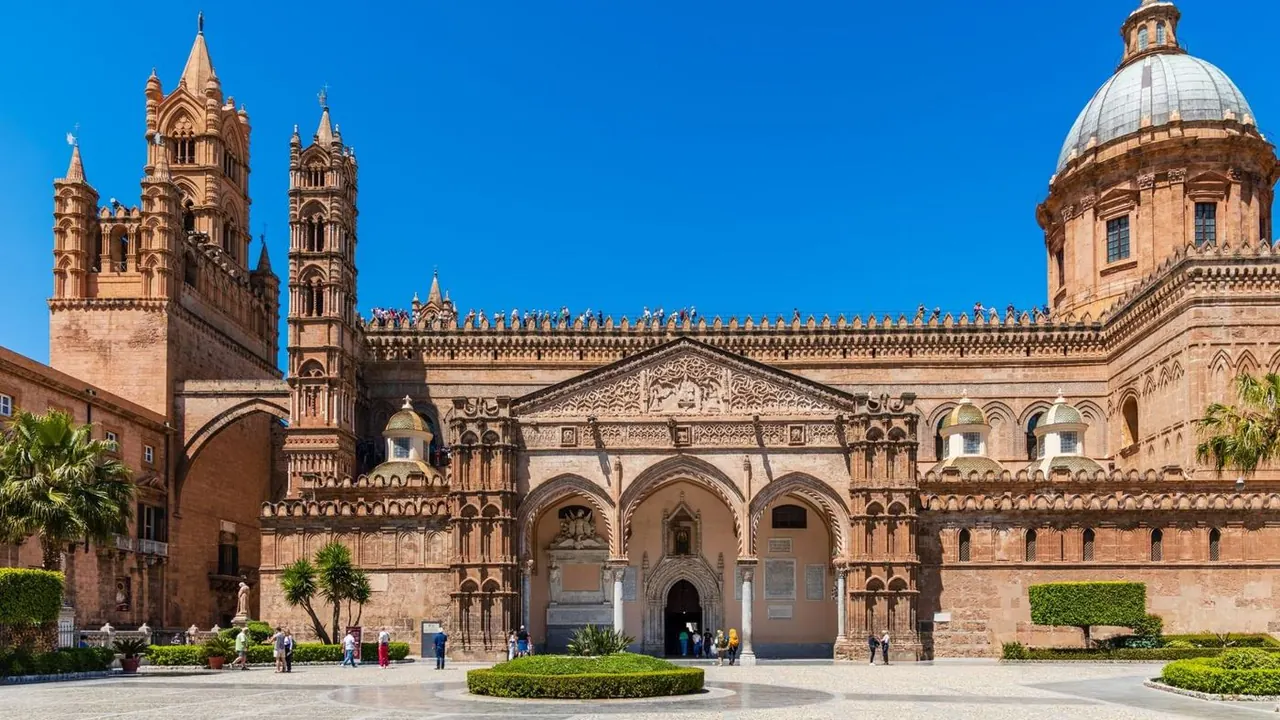
Palermo Cathedral
- Day trips84
- Food & drink81
- Culture & sights80
Photo: Antonino Giangrasso, Pexels License
Match
62
Every category weighted equally
- Beach & sun63
- Culture & arts65
- Food & nightlife63
- Family trip62
- Outdoors66
- Relax & unwind61
- Shopping & style60
- On a budget62
Palermo in twelve categories
Our verdict on each, scored 0 to 100 against the same fixed benchmark cities, so a score means the same thing on every page.
Beaches & swimming. Scores 77 out of 100.
Food & drink. Scores 81 out of 100.
Culture & sights. Scores 80 out of 100.
Nightlife. Scores 58 out of 100.
Nature & outdoors. Scores 72 out of 100.
Day trips. Scores 84 out of 100.
Good for families. Scores 44 out of 100.
Getting around. Scores 50 out of 100.
Shopping & style. Scores 44 out of 100.
Affordability. Scores 63 out of 100.
Live music & performing arts. Scores 62 out of 100.
Wellness & relaxation. Scores 30 out of 100.
Palermo category by category
Beaches & swimming
77Palermo's harbour front is not for swimming, but Mondello, a half-moon of pale sand under Monte Pellegrino, is about half an hour away by bus. The water there is shallow, clear and turquoise, and reaches about 25°C in August, so the sea stays warm enough from June into October. On summer weekends half the city goes there, and the bay fills with rented cabins, loungers and families.
For rockier, quieter swimming, the coast north towards Sferracavallo and the Capo Gallo reserve has ladders and flat rocks into deep water. Cefalù's long town beach is about an hour away by train. Palermo suits people who want a city stay with good swimming close by. It is less suited to anyone who wants to step out of the hotel onto the sand.
Food & drink
81Palermo eats on the street. The old markets of Ballarò, the Capo and the Vucciria are full of fryers making panelle (chickpea fritters), crocchè and arancine, and there are stalls selling pani ca' meusa, a spleen sandwich that locals defend fiercely. Sfincione, a thick onion and anchovy pizza, is sold from three-wheeled vans. The city's cooking shows its Arab past in raisins, pine nuts, saffron and sweet-and-sour sauces, as in pasta con le sarde and caponata.
Sweets are just as serious: cannoli filled to order, cassata, almond pastries from convent recipes, and brioche with granita for a summer breakfast. Sit-down meals happen in family trattorie and fish restaurants by the old port, and Sicilian wines such as Nero d'Avola, Grillo and Marsala are on every list. The fine-dining tier is small and there is little non-Italian food.
Culture & sights
80Palermo's great heritage comes from the twelfth century, when Norman kings employed Byzantine mosaicists and Arab craftsmen. The Palatine Chapel inside the Norman Palace is covered in gold mosaic under a carved Islamic wooden ceiling. With the cathedral, the red-domed San Giovanni degli Eremiti and La Martorana, it belongs to the city's UNESCO-listed Arab-Norman route. On top of that come baroque churches and oratories with Serpotta's white stucco figures, the Quattro Canti crossroads, and the Fontana Pretoria.
The museums are strong too: the Salinas archaeological museum, with the carved metopes from Selinunte, and Palazzo Abatellis, home of Antonello da Messina's Annunciata. The Capuchin catacombs, with their rows of mummified bodies, are not for everyone. Much of the old centre is crumbling, which adds to its character but can make some streets feel neglected.
Nightlife
58Going out in Palermo means being on the street. At night the Vucciria market turns into an open-air drinking spot, with cheap beer, grills smoking and music from small bars. The Kalsa and the streets off Via Maqueda have wine bars and cocktail bars that fill up after a late dinner. On warm nights people are still out well past midnight.
There are few clubs, and in summer the dancing moves to beach venues around Mondello and the coast. Winter weeknights can be quiet. Palermo suits people who like a loose, sociable evening of drinks outdoors more than anyone looking for big clubs.
Nature & outdoors
72Palermo sits in the Conca d'Oro, a bowl of limestone mountains open to the sea. Monte Pellegrino rises right above the city, and an old switchback path climbs to the sanctuary of Santa Rosalia, with views across the bay. The Capo Gallo reserve has cliff paths and good snorkelling and diving off its rocks.
West of the city, the Zingaro reserve near Scopello has a coastal trail past coves and dwarf palms, about an hour and a quarter by car. Inland, the Madonie park has beech woods, upland villages and peaks close to 2,000m, with good hiking in spring and autumn and occasional snow in winter. Summer heat makes midday walking hard, and most of these places are much easier to reach with a car.
Day trips
84Monreale, with its cathedral and its golden mosaics and cloister, is only half an hour up the hill. Cefalù, a seaside town under a rock headland with its own Norman cathedral, is about an hour east by train. Bagheria's baroque villas are closer still. To the west, the Doric temple and hilltop theatre of Segesta stand alone in open country, and Erice is a medieval stone town high above Trapani and its salt pans. Marsala's wine cellars are a little further along the coast.
Agrigento's Valley of the Temples, one of the great Greek sites anywhere, is about two hours away, and so are the ruins of Selinunte. The island of Ustica is a hydrofoil ride offshore. Trains and buses reach the main towns, but a car makes the ancient sites much easier to visit.
Good for families
44Sicilians love children, and families are welcome in restaurants late into the evening. Gelato and granita are reliable rewards. Mondello's shallow, sandy bay is the best thing in Palermo for young children, and the puppet theatres put on short shows of knights and Saracens that older children often enjoy.
The rest is harder going. There are few attractions built for children, scooters and cars squeeze through narrow lanes without pavements, and the city is hot from June to September. Families with a pushchair should expect uneven stone streets. A villa or a seaside base outside the centre often works better than the old town.
Getting around
50The historic centre is compact and mostly flat. The main sights lie along Via Maqueda and Corso Vittorio Emanuele, between the Norman Palace and the sea, and you can walk between all of them. Walking is pleasant on pedestrian stretches and harder in the side lanes, where scooters, parked cars and missing pavements are normal.
Beyond the centre things get harder. City buses are slow and stuck in traffic, and the tram lines mostly serve the suburbs. Mondello is reached by bus, and regional trains run to Cefalù and Bagheria. Driving in Palermo is stressful and parking is scarce. A hire car is still the easiest way to reach Segesta, Erice and the inland areas.
Shopping & style
44Via Libertà and Via Ruggero Settimo, with their nineteenth-century buildings, hold Palermo's Italian fashion shops and a few luxury labels. Via Maqueda and Corso Vittorio Emanuele are lined with everyday chains and souvenir shops. The famous markets are mostly about food, though they are good for spices, capers, pistachio pesto and almond pastes to take home.
For crafts, look for painted Sicilian ceramics, including the moor's-head vases, handmade marionettes from the puppet workshops, and coral and filigree jewellery. The flea market near the cathedral sells antiques and old odds and ends. It is enjoyable browsing, but nobody comes to Palermo to shop.
Affordability
63Palermo is one of Italy's cheaper big cities. Street food is cheap enough to make a meal out of several stops in the markets, and family trattorie, local wine and pastries cost much less than in the north. Guesthouses and apartments in the old centre are fairly priced for most of the year. Many churches charge only small entry fees.
Costs go up in July and August, when seaside rooms and anything at Mondello are in high demand. A hire car for day trips also adds up, and fish restaurants and boutique hotels charge mainland prices.
Live music & performing arts
62The Teatro Massimo, a huge neoclassical opera house at the top of Via Maqueda, is the centre of Palermo's music life. It runs a full season of opera, ballet and concerts, and visitors can get a ticket without much trouble. The Teatro Politeama, a short walk away, is home to the Sicilian symphony orchestra, and jazz has a long-standing local following.
The tradition most worth seeing is the Opera dei Pupi. In small family-run theatres, puppeteers work armoured marionettes through battles from the Charlemagne legends, in shows that last about an hour. Beyond these, the theatre and live music scene is modest, and in summer much of the programme moves outdoors, into cloisters and squares.
Wellness & relaxation
30Palermo is noisy and busy, with scooters, market shouts and traffic, and it has no bathing culture of its own. Wellness in the city means hotel spas and a few day spas. The nearest thermal waters are at Termini Imerese, a spa town about forty minutes east by train, and Sciacca, on the south coast, has a longer spa tradition.
The slower side of the city is in its habits: the long afternoon break, the evening walk along the seafront at the Foro Italico, and quiet hours in the cloisters and the palm-filled Orto Botanico. Visitors who want real rest usually do better in a country house or a coastal hotel outside the city.
When should you go?
Pick a month to see what it is like. The climate figures are measured averages, not a forecast.
Palermo in July
Daytime high, °C
Rainfall in the month, mm
The whole year
Shaded against this city’s own year: the deepest cell is its best month for that figure and the palest its weakest.
Where the figures come from
Palermo has no rain gauge within 25 km of the centre, so its rainfall comes from a gridded climate dataset read at the city rather than from a gauge further away.
Palermo's sunshine is measured 67 km from the centre, at Ustica.
Temperature and rainfall are climate normals, averaged over the years shown. Palermo: 1991-2020 (sunshine 1961-1990) normals, Palermo / Punta Raisi (24.1 km from centre).
Before you go
| Measure | Palermo |
|---|---|
| Official language | Italian |
| Currency | Euro (EUR) |
| Sockets | CFL230 V, 50 Hz |
| Driving side | Right |
| Time zone | UTC+1, UTC+2 in summer |
| Emergency number | 112 |
| Elevation | 14 m |
| Main airport | Falcone–Borsellino Airport (PMO)25 km from centre106 non-stop destinations |
| Public holidays this year | 13 days |
By the numbers
| Measure | Palermo |
|---|---|
| City population | 630,167 |
| People per km² | 3,924 |
| Museums within 10 km | 42 |
| UNESCO World Heritage sites within 50 km | 1 |
| Swim season, months above 21 °C | 5 months |
Compare Palermo with
Every comparison with a written verdict behind it.