Puerto Rico
San Juan
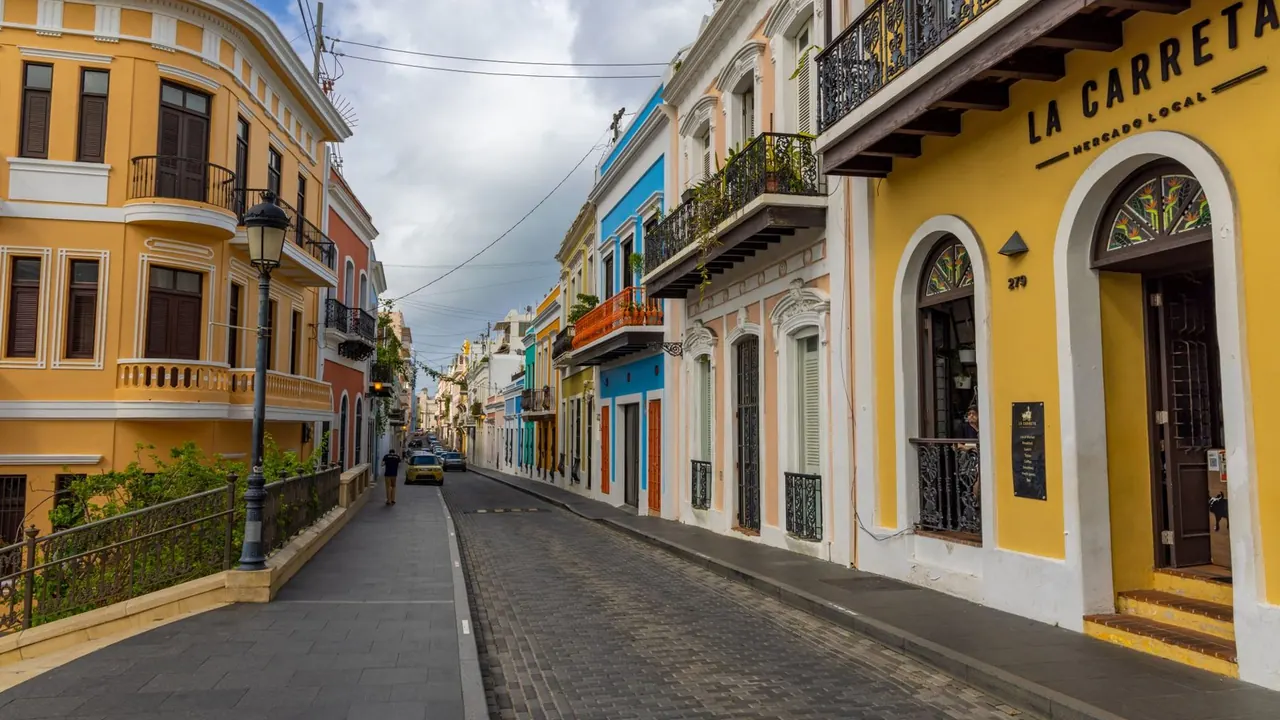
A cobbled street of painted houses in Old San Juan
- Beaches84
- Nature & outdoors74
- Nightlife70
Photo: Mohan Nannapaneni, Pexels License
Match
57
Every category weighted equally
- Beach & sun60
- Culture & arts55
- Food & nightlife57
- Family trip57
- Outdoors59
- Relax & unwind58
- Shopping & style55
- On a budget55
San Juan in twelve categories
Our verdict on each, scored 0 to 100 against the same fixed benchmark cities, so a score means the same thing on every page.
Beaches & swimming. Scores 84 out of 100.
Food & drink. Scores 66 out of 100.
Culture & sights. Scores 64 out of 100.
Nightlife. Scores 70 out of 100.
Nature & outdoors. Scores 74 out of 100.
Day trips. Scores 52 out of 100.
Good for families. Scores 58 out of 100.
Getting around. Scores 38 out of 100.
Shopping & style. Scores 50 out of 100.
Affordability. Scores 38 out of 100.
Live music & performing arts. Scores 55 out of 100.
Wellness & relaxation. Scores 40 out of 100.
San Juan category by category
Beaches & swimming
84Beach life is a big part of a stay here, and the sea is warm all year, around 26°C in winter and nearer 28°C in late summer. Within the city, Condado and Ocean Park line the Atlantic in front of the hotel strip, and Isla Verde has the longest and most sheltered sand, protected by an offshore reef. Balneario El Escambrón, near the old town, sits in a calm reef-protected bay that suits small children and snorkellers.
Not every stretch is safe to swim. Parts of Condado and the open coast towards Piñones get heavy waves and strong currents, so the public balnearios with lifeguards are the safer choice. Luquillo, about 45 minutes east, has a palm-backed crescent of calm water and is the classic day at the beach.
Food & drink
66Puerto Rican cooking is hearty and full of flavour: mofongo made from mashed fried plantain, arroz con gandules, slow-roasted pork, and fried snacks like alcapurrias and bacalaítos. The best casual eating is at the seaside kiosks in Piñones and Luquillo and around the market square of La Placita in Santurce. People drive up into the hills to the roadside pork-roasting stalls of Guavate on weekends.
Santurce and Condado have the more ambitious chef-led restaurants, and Old San Juan has plenty of places to eat, though many of them are set up for cruise passengers. Rum is everywhere, the piña colada is claimed as a local invention, and Puerto Rican coffee grown in the mountains is worth trying in the city's cafés.
Culture & sights
64Old San Juan is the reason to come for sights. Behind its walls is a compact grid of blue-cobbled streets and pastel colonial houses, nearly five centuries old. Castillo San Felipe del Morro guards the harbour mouth from a grassy headland and Castillo San Cristóbal looms over the eastern approach. Together with the small El Cañuelo fort across the bay, the city walls and La Fortaleza, the governor's mansion, they form a UNESCO World Heritage site that you can walk around in a day.
Within the same streets stand the Cathedral of San Juan Bautista, which holds the tomb of Ponce de León, and the Church of San José, one of the oldest in the Americas. Outside the old town there is less. The Museo de Arte de Puerto Rico in Santurce has a good collection of island art, and the surrounding streets are known for large murals. The rest of the city is mostly modern, so two or three days covers the main sights.
Nightlife
70San Juan goes out late and loud. On Thursday to Saturday nights the market square of La Placita in Santurce fills with crowds drinking on the street between small bars, with music spilling out of every doorway until the early hours. In Old San Juan, Calle San Sebastián and the streets around it have dive bars, cocktail bars and dance floors where salsa sits next to reggaeton.
Condado and Isla Verde are smoother, with hotel lounges, casinos and clubs. People come out for the night, dance a lot and stay out late. The weekend is far busier than the rest of the week.
Nature & outdoors
74El Yunque, the only tropical rainforest in the US national forest system, is under an hour's drive east. It has trails through tree ferns and palms, waterfalls and lookout towers over the north coast, though it is often in cloud and rain. Near Fajardo, Laguna Grande glows with bioluminescent plankton on night kayak trips, and catamarans head out to snorkel the reefs of the small offshore cays.
Closer to the city, the mangroves and boardwalk of Piñones are good for cycling and paddling, and the north coast has proper surf in winter. In town, the green slopes around El Morro and the lagoons in Condado give a little open space, but most outdoor days start with a drive.
Day trips
52Ponce, on the south coast about an hour and a half away over the mountains, is the main town trip: a colonial plaza, an old firehouse painted red and black, and one of the Caribbean's finest art museums. Across the bay, a short ferry ride away, Cataño has the big rum distillery, and Loíza to the east is the centre of Afro-Puerto Rican culture, with bomba and a famous saint's festival.
The small islands of Culebra and Vieques have quiet villages and outstanding beaches. You reach them by ferry from Ceiba or by a short flight, so they work better as an overnight trip than a day out. Beyond these, much of the island is countryside and coast rather than towns.
Good for families
58Children tend to enjoy the forts most: El Morro's tunnels and cannons, and the big lawn outside where families fly kites on breezy afternoons. Calm beaches such as Escambrón, the sheltered parts of Isla Verde and Luquillo make easy beach days. El Yunque's short paved trails and waterfalls work for school-age children.
Beyond these, there is little built for children: no big zoo, aquarium or theme park. In practice it is easy to manage, with English widely spoken, familiar US standards, pharmacies and supermarkets, and resort hotels with pools. Midday heat and Old San Juan's steep cobbles are the main things to plan around.
Getting around
38Old San Juan is small and best explored on foot, though the streets are hilly and the cobbles uneven. Condado, Ocean Park and Isla Verde are strung along the coast a short taxi or ride-hail away. The city's one rail line, Tren Urbano, does not reach the old town or the beach districts, and public buses are slow and unreliable.
Most visitors get around by taxi and ride-hailing within the city. For El Yunque, Luquillo, Ponce or the ferries, they hire a car or book a tour. Driving is straightforward but traffic on the main highways is heavy at rush hour.
Shopping & style
50Shopping here is a mix of big US-style malls and local crafts. Plaza Las Américas in Hato Rey is one of the largest malls in the Caribbean, and Ashford Avenue in Condado has a short run of designer boutiques. Old San Juan sells what is most worth taking home: carved santos, vejigante masks from Loíza and Ponce, guayabera shirts, hand-rolled cigars, local coffee and rum.
The old town also has a few small galleries and independent design shops, but many storefronts sell souvenirs and jewellery to cruise passengers. Nobody chooses San Juan for shopping.
Affordability
38San Juan costs about the same as a mid-sized city on the US mainland. Beachfront hotels in Condado and Isla Verde are expensive in the winter high season. Sit-down restaurants in the tourist districts charge mainland prices, with tips and taxes added.
Eating at the kiosks, roadside stalls and local cafés keeps costs down, and the forts charge only a modest fee. Car hire, though, adds up quickly if you plan to see the island. Summer and autumn rooms are noticeably cheaper, though that is hurricane season.
Live music & performing arts
55Live music is part of everyday life. Salsa bands play to packed dance floors in Old San Juan and Santurce, and bomba, the Afro-Puerto Rican tradition of drums, call-and-response singing and dance, has regular open sessions where visitors can watch or join in. The Loíza festivals are its high point.
The formal scene is centred on the Centro de Bellas Artes Luis A. Ferré in Santurce, home to the Puerto Rico Symphony Orchestra and touring theatre and dance. The long-running Casals Festival, founded by the cellist Pablo Casals, brings classical music each year. Big Latin pop and reggaeton concerts fill the large arenas in Hato Rey.
Wellness & relaxation
40San Juan has no bathing or spa tradition of its own. Wellness here means the spas in the large resort hotels of Condado and Isla Verde, plus massage and yoga offered around the beach districts. A slow day by a hotel pool or on the sand is easy to arrange.
Outside the resorts the city is loud, with traffic, music and busy streets, especially on weekends. For real quiet, visitors head to the island's countryside retreats or the small offshore islands.
When should you go?
Pick a month to see what it is like. The climate figures are measured averages, not a forecast.
San Juan in July
Daytime high, °C
Rainfall in the month, mm
The whole year
Shaded against this city’s own year: the deepest cell is its best month for that figure and the palest its weakest.
Temperature and rainfall are climate normals, averaged over the years shown. San Juan: 1991-2020 normals, San Juan / Int., Puerto Rico (12.8 km from centre).
Before you go
| Measure | San Juan |
|---|---|
| Official language | Spanish, English |
| Currency | US Dollar (USD) |
| Sockets | AB120 V, 60 Hz |
| Driving side | Right |
| Time zone | UTC-4 |
| Emergency number | 911 |
| Elevation | 3 m |
| Main airport | Luis Munoz Marin International Airport (SJU)12 km from centre59 non-stop destinations |
| Public holidays this year | 21 days |
By the numbers
| Measure | San Juan |
|---|---|
| City population | 342,259 |
| People per km² | 2,847 |
| Museums within 10 km | 18 |
| UNESCO World Heritage sites within 50 km | 1 |
| Swim season, months above 21 °C | 12 months |
Compare San Juan with
Every comparison with a written verdict behind it.