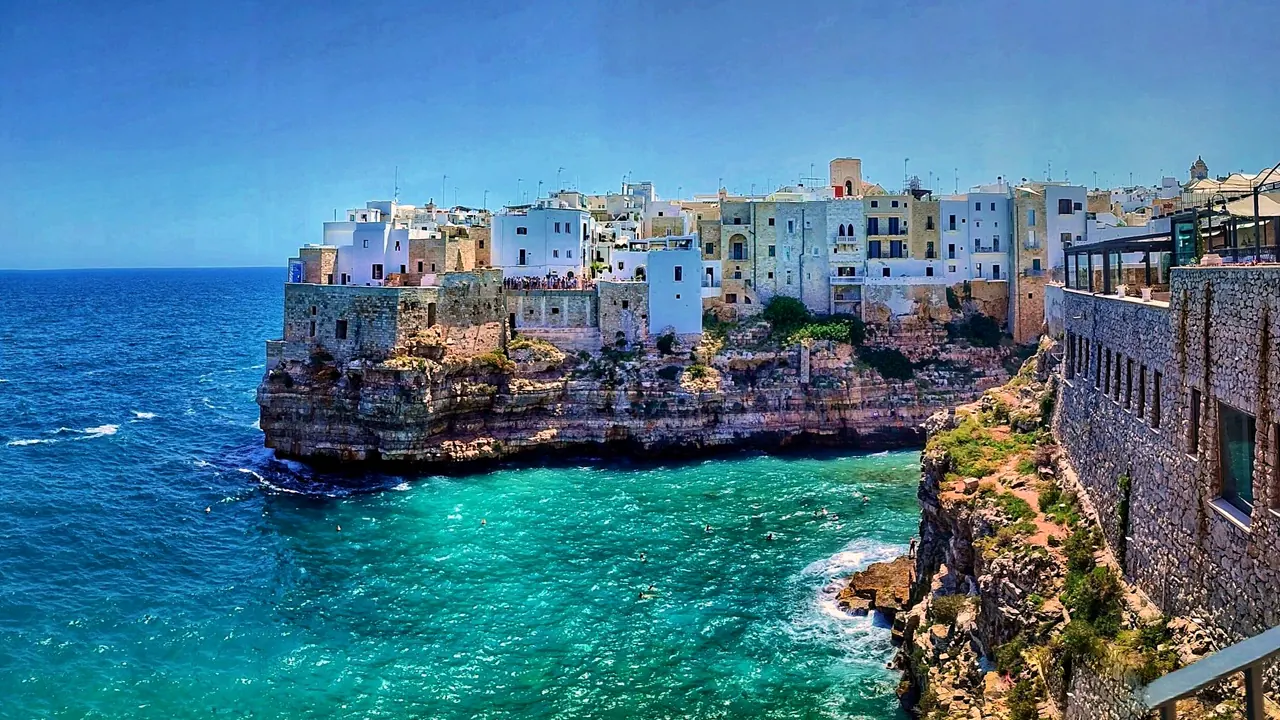
Photos: Puglia by Acquario51, CC BY-SA 4.0, cropped.
Puglia or Umbria?
Our verdict in twelve categories, each scored against the same fixed benchmark cities, and the climate month by month, so you can choose for your trip.
Choose Puglia for
- beaches
- nightlife
- families
Puglia is the choice for a summer trip with the sea at its centre. It has two coasts, sandy and shallow on the Ionian side of the Salento and rocky with coves on the Adriatic, a drier and sunnier summer, and a sea that stays warm into September. Add raw seafood and street food, Gallipoli's beach clubs for late nights, and baroque Lecce and the trulli of Alberobello for days off the sand, and it suits couples and families who want long beach days.
Choose Umbria for
- culture and sights
- nature and the outdoors
- getting around
Travellers who would rather spend the day on frescoes and hill towns than on a lounger will be happier in Umbria. Assisi, Orvieto, Perugia and Gubbio hold art of the first rank close together, and Tuscany and Rome are within easy reach. With truffles, Sagrantino and the Monti Sibillini, it suits a slower inland trip in spring or autumn. It has no sea, and its nights are quiet.
Scoreboard
Twelve categories on one fixed scale from 0 to 100. The shaded stretch is the gap between the two.
Your match
Pick a travel style or drag the sliders, and both match scores follow your weighting.
Wins on beaches and nightlife with your weighting.
Wins on culture and sights and nature and the outdoors with your weighting.
What matters to you?
Category by category
What the scores mean for a trip.
Beaches & swimming
This is the starkest difference between the two. Puglia's summer is built around the sea. The Ionian shore of the Salento has long pale sands and clear shallows from Porto Cesareo to Pescoluse, while the Adriatic side has limestone platforms at Polignano a Mare, bays near Otranto and the cliffs and caves of the Gargano.
Umbria has no coast at all. Lake Trasimeno's small lido beaches are warm and calm but often cloudy and reedy, and the sea is two hours or more away. For most visitors in Umbria, swimming means the farmhouse pool.
Food & drink
Both regions cook simple country food from a few strong products, but Puglia's table is broader. It has both land and sea: raw urchins and octopus on the Bari waterfront, burrata from the Murge, orecchiette, focaccia and panzerotti, and grill houses in the Valle d'Itria where you pick the meat at the counter.
Umbria eats from the hills, with black truffle on strangozzi, Norcia's pork, porchetta and Castelluccio lentils. Its wine estates around Montefalco and Orvieto make tastings a real draw. It has little seafood, though, so the menu feels narrower over a week.
Culture & sights
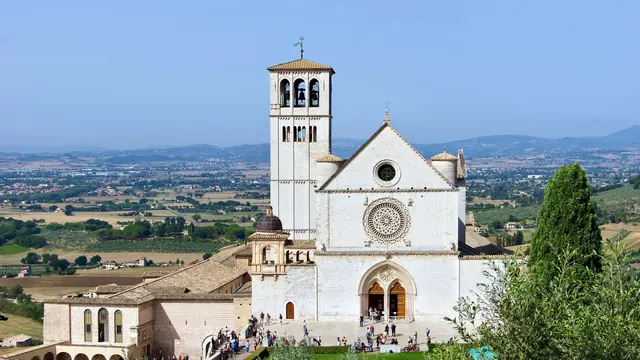
Umbria has the deeper artistic heritage. Assisi's basilica holds frescoes by Giotto and Cimabue, Orvieto's cathedral has Signorelli's Last Judgement, and the Galleria Nazionale in Perugia is rich in Perugino. Gubbio, Spoleto, Spello and Todi are each a complete medieval set piece, close enough to see one or two a day.
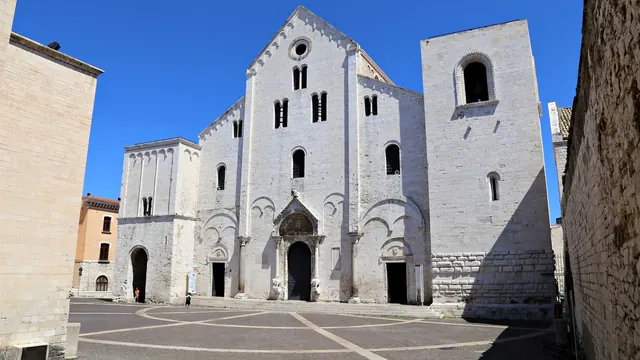
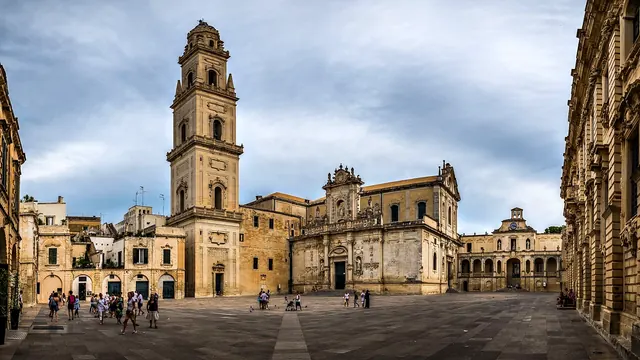
Puglia's sights are more singular than dense: Lecce's honey-coloured baroque, the conical trulli of Alberobello, Castel del Monte and Romanesque cathedrals at Trani and Bari. They are memorable, but they are spread over a long region and take more driving between them.
Nightlife
Puglia has the livelier nights, at least in summer. Gallipoli turns into a party town of beach clubs running into the small hours, the Salento coast has DJ nights in beach bars, and Bari's old town keeps bars going all year.
Umbria's evenings end with dinner and a stroll. Perugia's students fill the cathedral steps and a few wine bars, but there are no clubs, and the countryside goes quiet early.
Nature & outdoors
Umbria offers more to do outdoors. The Monti Sibillini rise above 2,000m, the Castelluccio plain flowers in early summer, and the Valnerina has rafting and canyoning. Add the Marmore Falls and the old Spoleto to Norcia railway path for cycling.
Puglia is mostly gentle olive country, best seen by bicycle in the Valle d'Itria. Its drama is concentrated in the Gargano, with the Foresta Umbra and sea caves, and in the Tremiti islands, where snorkelling and diving give it the sea-based side that Umbria lacks.
Day trips
The real difference is distance. Puglia's towns are strung along a long region, so the base decides which ones are close. From the Valle d'Itria, whitewashed Ostuni, Locorotondo and the sea towns of Polignano a Mare and Monopoli are short drives, Lecce puts Otranto and the Grecia Salentina nearby, and Matera's cave dwellings, about an hour from Bari, are the outing most visitors put first.
Umbria packs more into less ground, which gives it the edge. From Perugia or Spoleto, a different hill town makes each day, from Gubbio and Todi to Spello, Bevagna and the Sagrantino hills of Montefalco. Tuscany's Cortona, Montepulciano and Siena are within reach, and from Orvieto, Rome is a little over an hour by train.
Good for families
Puglia is the easier place to take children. Sandy, shallow Ionian beaches and the calm bays of the Gargano suit small swimmers. The safari and amusement park at Fasano fills a day, and children usually love the trulli of Alberobello.
Umbria works for a quiet farmhouse stay with a pool, plus Lake Trasimeno, the Marmore Falls and an amusement park near Perugia. Beyond that, its frescoed churches and steep, cobbled towns, with parking outside the walls, test young legs and pushchairs.
Getting around
Both regions really need a car, but Umbria is the simpler one to drive. It is compact, and its hill towns are linked to car parks below the walls by escalators, lifts and funiculars, as in Perugia, Orvieto and Spoleto. A regional railway also connects Perugia, Assisi, Spello and Spoleto.
Puglia's roads are good, but the region stretches four to five hours from the Gargano to Santa Maria di Leuca, so seeing both ends needs two bases. Summer coast traffic and beach parking add friction. The main line through Bari, Polignano a Mare, Monopoli and Lecce makes a car-free stay possible along that strip.
Shopping & style
Neither is a fashion destination, and in both the best buys are crafts and food. Puglia offers Grottaglie's ceramic quarter, Lecce's papier-mache figures and Valle d'Itria linen, with olive oil and Primitivo to carry home.
Umbria answers with Deruta majolica, hand-loomed linen from Montefalco and Bevagna, and cashmere outlets near Perugia. Norcia's shops are hung with cured meats and truffles.
Affordability
Costs are much the same overall, but they rise in different places. In Puglia, food and wine are cheap, while summer rooms near the Salento beaches and paid lido loungers push the bill up. June and September or an inland base soften it.
Umbria's farmhouses and small hotels undercut neighbouring Tuscany, and most of its sights are churches that cost little. The extras are a hire car, rooms in Assisi and Orvieto in high season, and truffle dishes.
Live music & performing arts
Both have a quiet stage life outside summer, and both revolve around festivals. Puglia has Bari's large Teatro Petruzzelli for opera all season, an opera festival at Martina Franca and the pizzica folk tradition, which culminates in the Notte della Taranta at Melpignano.
Umbria's highlights are Umbria Jazz, which fills Perugia's streets in July, and Spoleto's Festival dei Due Mondi in its Roman theatre. Jazz and theatre lovers lean to Umbria, folk and opera lovers to Puglia.
Wellness & relaxation
Neither region has a real spa culture, and in both the rest comes from slowing down. In Puglia that means the masseria, an old fortified farmhouse among the olive groves, often with a pool and sometimes a spa of its own, and long lunches followed by empty afternoons in the Valle d'Itria. The sulphur springs in sea caves at Santa Cesarea Terme and the spa at Torre Canne are pleasant extras, not a reason to go.
Umbria's quiet leans more towards retreat. The hermitages on Monte Subasio and an Assisi that empties in the evening draw people looking for silence, and country houses in the wooded hills add yoga or massage. Its small spa towns, such as Nocera Umbra and San Gemini, are known for their mineral waters, so anyone wanting warm pools in the open drives over the border into Tuscany.
When should you go?
Pick your month. The climate figures are measured averages, not a forecast.
Puglia in July
Umbria in July
Daytime high, °C
Rainfall in the month, mm
Where the figures come from
Puglia's temperatures are measured 64 km from the centre, at Brindisi.
Puglia has no rain gauge within 25 km of the centre, so its rainfall comes from a gridded climate dataset read at the destination rather than from a gauge further away.
Umbria's temperatures are measured 53 km from the centre, at Frontone.
Umbria has no rain gauge within 25 km of the centre, so its rainfall comes from a gridded climate dataset read at the destination rather than from a gauge further away.
Temperature and rainfall are climate normals, averaged over the years shown. Puglia: 1991-2020 (sunshine 1981-2010) normals, Brindisi (64.4 km from centre). Umbria: 1991-2020 normals, Frontone (52.9 km from centre).
Both regions are hot in July and August, with daytime highs around 30°C, so the summer months suit the beach better than steep town lanes. Puglia is the more reliable summer destination. It barely rains from June to August and the sun is out for most of the day. The sea is warm enough for swimming from June, reaches 26°C in August and stays pleasant through September. Rain returns in autumn and peaks in November. Winters are mild on the coast, though grey.
Umbria lies inland and is cooler at either end of the year. Winter days reach only around 7°C, and rain falls in every season, heaviest in autumn at nearly 100mm in November. Its best walking months are May, June, September and early October, when the hill towns are warm without being baking. Puglia stays comfortable for sightseeing a little earlier in spring and later into autumn.
Which traveller are you?
On a beach and sun trip, Puglia wins outright. It has sandy Ionian shallows and Adriatic coves, warm sea from June to September and very dry summers. Umbria has no coast at all, only a muddy-bottomed lake and the farmhouse pool.
For a culture and arts trip, Umbria is the stronger choice. Giotto's frescoes in Assisi, Orvieto's cathedral, Perugino in Perugia and a chain of medieval towns lie close together. Puglia's baroque Lecce and Romanesque cathedrals are distinctive but more spread out.
On a family trip with children, Puglia suits better. Shallow sandy beaches, the safari park at Fasano and the trulli give children plenty to do. In Umbria, steep cobbled towns and frescoed churches are hard going, so days revolve around a pool.
Before you go
| Measure | Puglia | Umbria |
|---|---|---|
| Official language | Italian | Italian |
| Currency | Euro (EUR) | Euro (EUR) |
| Sockets | CFL230 V, 50 Hz | CFL230 V, 50 Hz |
| Driving side | Right | Right |
| Time zone | UTC+1, UTC+2 in summer | UTC+1, UTC+2 in summer |
| Emergency number | 112 | 112 |
| Main airport | Bari Karol Wojtyła International Airport (BRI)104 non-stop destinations | Perugia San Francesco d'Assisi – Umbria International Airport (PEG)17 non-stop destinations |
| Public holidays this year | 13 days | 13 days |
By the numbers
| Measure | Puglia | Umbria |
|---|---|---|
| Population | 3,866,174 | 852,085 |
| People per km² | 198 | 101 |
| Swim season, months above 21 °C | 4 months | - |
Where else could you go?
Every comparison below shares a destination with this one, so you can follow Puglia or Umbria somewhere new.
- Tuscanyvs Umbria
- Korčulavs Puglia
- Amalfi Coastvs Puglia
- Cinque Terrevs Umbria
- Hvarvs Puglia
- Caprivs Puglia