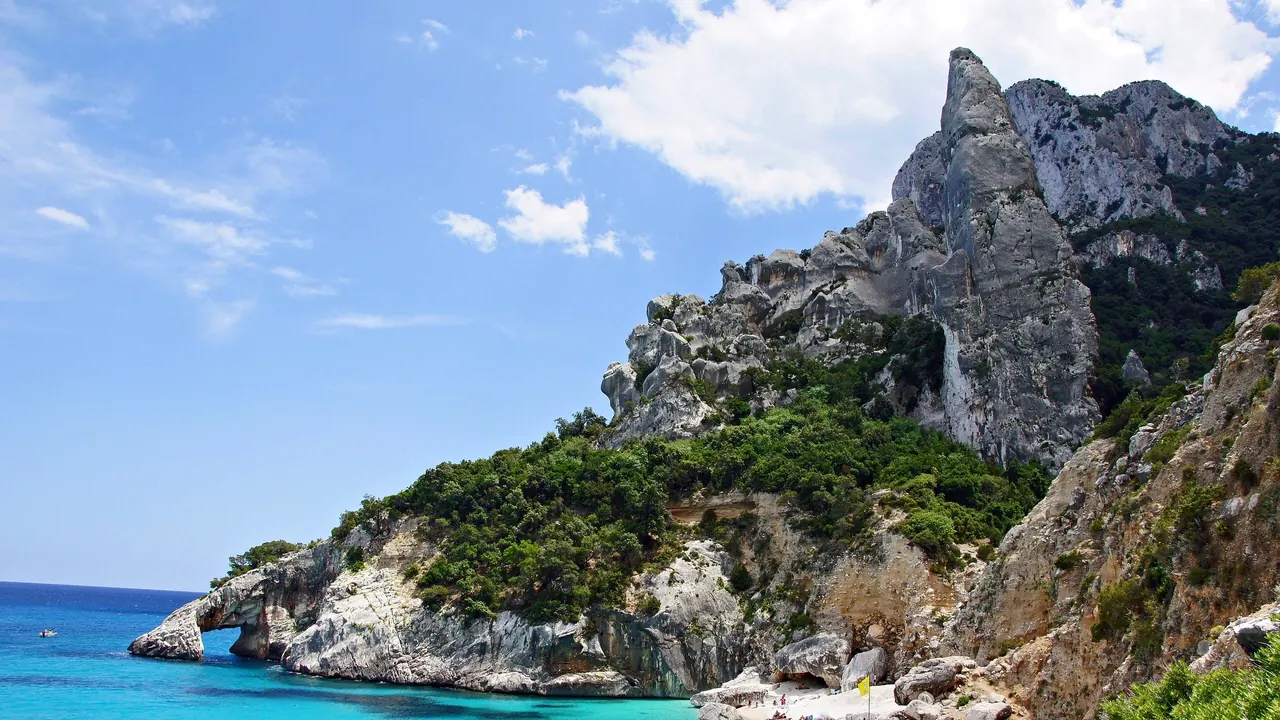
Photos: Sardinia by Yesuitus2001, CC BY-SA 2.5, cropped.
Sardinia or Umbria?
Our verdict in twelve categories, each scored against the same fixed benchmark cities, and the climate month by month, so you can choose for your trip.
Choose Sardinia for
- beaches
- families
- nightlife
Sardinia is the choice when the sea is the point of the trip. The granite coves of the northeast, the cliff-backed bays of the Gulf of Orosei and the shallow sand at Chia make beach days that landlocked Umbria cannot offer, and the wild gorges and sea cliffs suit active travellers. Families with small children and anyone who wants summer nights out in the northeast will also do better here, provided they accept long drives and high August prices.
Choose Umbria for
- day trips
- culture and sights
- getting around
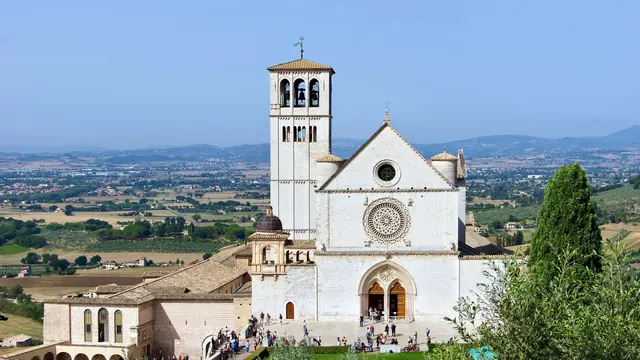
Travellers drawn by art, hill towns and wine will find Umbria the richer and easier trip. Giotto's frescoes in Assisi, Orvieto's cathedral and a different medieval town within short reach every day make it ideal for slow touring from one farmhouse base, with shorter drives, rail links between the main towns and gentler prices. The cost is the sea: swimming here means a pool or Lake Trasimeno.
Scoreboard
Twelve categories on one fixed scale from 0 to 100. The shaded stretch is the gap between the two.
Your match
Pick a travel style or drag the sliders, and both match scores follow your weighting.
Wins on beaches and families with your weighting.
Wins on day trips and culture and sights with your weighting.
What matters to you?
Category by category
What the scores mean for a trip.
Beaches & swimming
This is the widest gap between the two. Sardinia has some of the finest beaches in the Mediterranean, from the pale granite coves of the Costa Smeralda and La Maddalena to the boat-access pebble bays of the Gulf of Orosei and the shallow sand of Chia and Tuerredda, and when the mistral blows there is usually a sheltered side.
Umbria has no coast at all. Lake Trasimeno's lidos are warm and calm but often cloudy and soft underfoot, so most visitors swim in a farmhouse pool, and the sea is two hours or more away.
Food & drink
Sardinia cooks from the sheepfold and the sea, Umbria from the oak woods and the vineyard. On the island that means suckling pig roasted over myrtle wood, pane carasau, culurgiones and pecorino inland, and bottarga, Alghero lobster and Carloforte tuna on the coast. The best of it often comes as long farm menus at agriturismi in the hills.
Umbria's kitchen has little seafood. Its strengths are black truffle shaved over strangozzi, the pork butchery of Norcia, Castelluccio lentils and porchetta from market vans. Its wine is more of a reason to travel, with Sagrantino tasted at estates around Montefalco and the whites of Orvieto. Neither offers much range beyond its own regional cooking.
Culture & sights
Umbria is the stronger choice for sights. Its hill towns hold art of the first rank: Giotto and Cimabue in Assisi's basilica, Signorelli in Orvieto's cathedral and Perugino in Perugia's gallery. The towns are close enough together to see several in a few days.
Sardinia's heritage is older and stranger. It has Bronze Age nuraghi such as Su Nuraxi, the Mont'e Prama giants in Cagliari's archaeological museum and the seaside ruins of Nora and Tharros. These are spread thinly across a large island, though, and seeing them takes a lot of driving.
Nightlife
Neither is a nightlife destination, but Sardinia has more going on in summer. In July and August the beach clubs and late nightclubs around Porto Cervo draw a dressy, expensive crowd, while Cagliari's Marina wine bars and Alghero's ramparts fill on warm evenings.
In Umbria an evening means dinner and a stroll. Perugia's student bars and crowded cathedral steps are the only real exception, and there are no clubs.
Nature & outdoors
Both reward time outdoors, but Sardinia's landscapes are wilder and include the sea. The Supramonte cliffs, the Gorropu gorge and the Selvaggio Blu trek are for serious walkers. The island adds diving in the Maddalena marine park, kayaking into sea caves from Cala Gonone and kitesurfing at Porto Pollo.
Umbria is gentler, wooded and rolling, until the Monti Sibillini and the flowering Castelluccio plain in the east, with rafting in the Valnerina and the Marmore Falls near Terni. In both, spring and autumn are the seasons for walking.
Day trips
Umbria is far ahead here. It is small and packed with towns, so from one base near Perugia or Spoleto a different hill town can fill each day: Gubbio, Todi, Spello, Norcia. Cortona, Montepulciano and Siena are close over the Tuscan border, and Rome is about an hour by train from Orvieto.
Sardinia's outings are pleasant, among them Bonifacio by ferry, Bosa and Capo Caccia, and the Barbagia villages. The island is large and the roads are slow, though, so what you can reach depends on where you stay.
Good for families
Sardinia is the better family base, as long as you choose the coast with care. The south and the Gallura in the north have beaches you can drive close to. The cliff coves of the Gulf of Orosei mean steep walks or a boat, which is hard going with small children. Away from the sea there are only a few water parks and boat trips out to the islands, and in July and August the long drives and midday heat mean planning swims for the cooler ends of the day.
In Umbria a family vacation is quieter and centres on the farmhouse itself, with its pool, animals and space to run. Outings are to Lake Trasimeno's warm, calm lidos and the Marmore Falls. The towns are harder work, because cars park below the walls and pushchairs struggle on the stairs and cobbles. Families who need a programme of attractions will run out of them within a few days.
Getting around
Both need a car, but Umbria is much easier to get around. Distances are short and traffic is light. The hill towns have escalators, lifts and funiculars up from car parks below the walls. A rail line links Perugia, Assisi, Spello and Spoleto, and Orvieto is on the main Rome to Florence line.
Sardinia's winding coastal and mountain roads take longer than they look, and trains and buses rarely reach the beaches. Boats are the only practical way into many of the Orosei coves, and flying into the airport nearest your base saves hours.
Shopping & style
Neither is a shopping destination, and in both the best buys are crafts and food. Sardinia has Alghero's red coral, filigree gold, Pattada shepherd's knives and bottarga. In summer, luxury boutiques also open in Porto Cervo's piazzetta.
Umbria's crafts are Deruta's painted majolica, hand-loomed linen from Montefalco and Bevagna, cashmere outlets around Perugia and Norcia's hams and truffles. It has no luxury street like Porto Cervo's.
Affordability
Umbria is the cheaper of the two. Farmhouse stays and small hotels cost less than across the Tuscan border. Trattoria set lunches and local wine are good value, and most sights are churches that cost little or nothing to enter.
Sardinia can be moderately priced around Cagliari, Alghero and inland, but the Costa Smeralda in high summer is among the most expensive coasts in the Mediterranean. Car hire, ferries and rooms all climb steeply in August, and going in June or September narrows the gap.
Live music & performing arts
Umbria has the stronger stage life, though most of it comes in early summer. Umbria Jazz fills Perugia's squares in July, and the Festival dei Due Mondi brings opera, theatre and dance to Spoleto's Roman theatre. Small towns keep jewel-box theatres from the 1800s.
Sardinia's formal season centres on Cagliari's Teatro Lirico. Its more memorable performances are traditional ones: canto a tenore singing, launeddas pipes and the Sant'Efisio procession, plus the Time in Jazz festival in Berchidda.
Wellness & relaxation
Sardinia's idea of rest is the sea. Spa stays mostly mean thalassotherapy at the large beach resorts of the south and the Costa Smeralda, and the slow pace of Ogliastra's long-lived villages and the inland agriturismi does the rest. Warm water still runs beside the Roman baths at Fordongianus, and Sardara has thermal hotels, though few visitors come for them.
Umbria's calm comes from the countryside and from retreat. Farmhouses add yoga, massage and a pool to days of long lunches and olive grove views, and Assisi and the hermitages on Monte Subasio draw people looking for silence. Its spa towns, San Gemini and Nocera Umbra, are small and better known for their mineral water than for bathing.
When should you go?
Pick your month. The climate figures are measured averages, not a forecast.
Sardinia in July
Umbria in July
Daytime high, °C
Rainfall in the month, mm
Where the figures come from
Sardinia has no rain gauge within 25 km of the centre, so its rainfall comes from a gridded climate dataset read at the destination rather than from a gauge further away.
Umbria's temperatures are measured 53 km from the centre, at Frontone.
Umbria has no rain gauge within 25 km of the centre, so its rainfall comes from a gridded climate dataset read at the destination rather than from a gauge further away.
Temperature and rainfall are climate normals, averaged over the years shown. Sardinia: 1991-2020 normals, Olbia / Costa Smeralda (3.1 km from centre). Umbria: 1991-2020 normals, Frontone (52.9 km from centre).
Sardinia is a summer island. On the coast where most visitors stay, the sea is warm enough to swim from June to early October and reaches about 25°C in August. July and August are almost rainless but hot, around 32°C, which makes inland walking and sightseeing hard work at midday. Rain returns in October and stays through the winter, which is mild but no good for the beach. Late May, June and September are the best months for combining the sea with time on foot.
Around Umbria's main towns the pattern is more inland and seasonal. Winters are cold, with daytime highs around 7°C in January, and the valleys are hot in July, though a little less so than Sardinia. Autumn is the wettest stretch, building to 97mm in November, and showers are more common in spring and early summer than on the island. Late April to June and September are the most comfortable months for walking the hill towns.
Which traveller are you?
On a beach and sun trip, Sardinia is the clear answer. Turquoise coves in the Maddalena archipelago, white pebble bays on the Gulf of Orosei and shallow sand at La Pelosa give a different shore each day, while Umbria offers only lake lidos and farmhouse pools.
For a culture and arts trip, Umbria wins. Giotto in Assisi, Signorelli's Last Judgement in Orvieto and Perugia's Galleria Nazionale lie in hill towns a short drive apart, and the summer festivals in Perugia and Spoleto add music. Sardinia's nuraghi are fascinating but widely scattered.
On a family trip with young children, Sardinia suits better. Shallow sandy water at Chia, the Costa Rei and Stintino lets small children paddle safely, and resort villages have pools and children's clubs. Umbria's frescoed churches and steep cobbled towns hold young children's attention far less.
Before you go
| Measure | Sardinia | Umbria |
|---|---|---|
| Official language | Italian | Italian |
| Currency | Euro (EUR) | Euro (EUR) |
| Sockets | CFL230 V, 50 Hz | CFL230 V, 50 Hz |
| Driving side | Right | Right |
| Time zone | UTC+1, UTC+2 in summer | UTC+1, UTC+2 in summer |
| Emergency number | 112 | 112 |
| Main airport | Olbia Costa Smeralda Airport (OLB)79 non-stop destinations | Perugia San Francesco d'Assisi – Umbria International Airport (PEG)17 non-stop destinations |
| Public holidays this year | 13 days | 13 days |
By the numbers
| Measure | Sardinia | Umbria |
|---|---|---|
| Population | 1,628,384 | 852,085 |
| People per km² | - | 101 |
| Swim season, months above 21 °C | 3 months | - |
Where else could you go?
Every comparison below shares a destination with this one, so you can follow Sardinia or Umbria somewhere new.
- Tuscanyvs Umbria
- Corsicavs Sardinia
- Cinque Terrevs Umbria
- Ischiavs Umbria
- Lake Gardavs Umbria
- Caprivs Umbria