Uzbekistan
Samarkand
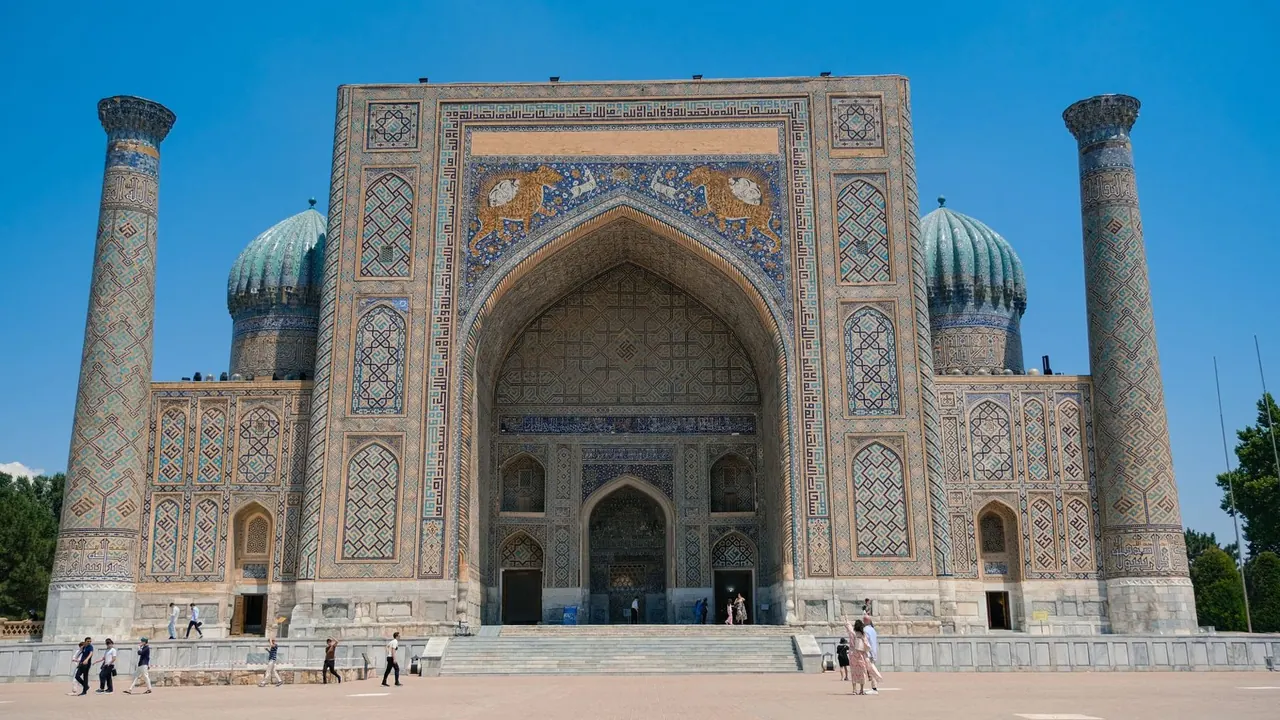
A madrasa and its minarets on the Registan
- Culture & sights84
- Affordable cities80
- Day trips72
Photo: Yaşar Başkurt, Pexels License
Match
45
Every category weighted equally
- Beach & sun40
- Culture & arts52
- Food & nightlife44
- Family trip47
- Outdoors48
- Relax & unwind42
- Shopping & style46
- On a budget48
Samarkand in twelve categories
Our verdict on each, scored 0 to 100 against the same fixed benchmark cities, so a score means the same thing on every page.
Beaches & swimming. Scores 4 out of 100.
Food & drink. Scores 54 out of 100.
Culture & sights. Scores 84 out of 100.
Nightlife. Scores 14 out of 100.
Nature & outdoors. Scores 40 out of 100.
Day trips. Scores 72 out of 100.
Good for families. Scores 30 out of 100.
Getting around. Scores 58 out of 100.
Shopping & style. Scores 42 out of 100.
Affordability. Scores 80 out of 100.
Live music & performing arts. Scores 24 out of 100.
Wellness & relaxation. Scores 32 out of 100.
Samarkand category by category
Beaches & swimming
4Samarkand is about as far from the sea as a city can be, in one of only two countries in the world that are doubly landlocked. Locals cool off in the shallow Zarafshan river or irrigation channels outside town, but neither is anything a visitor plans around. If swimming matters on a summer trip, choose a hotel with a pool.
Food & drink
54Eating here centres on plov, the rice dish cooked in huge cauldrons, and the city has its own version, layered rather than stirred and best eaten at lunchtime when it is freshly made. Samarkand non, a dense, glazed round bread, is famous across Central Asia, and Siab Bazaar beside Bibi-Khanym is the place to see it stacked alongside dried apricots, nuts, melons and halva. Shashlik grilled over charcoal, somsa from tandoor ovens and green tea in a chaikhana fill out the day.
The range is narrow. Beyond Uzbek and Russian cooking there is little choice, menus repeat from place to place, and fine dining barely exists. The local wine tradition, with a winery dating from the nineteenth century, makes for an interesting tasting rather than a wine culture.
Culture & sights
84Samarkand holds some of the finest Islamic architecture anywhere. The Registan, three madrasas facing each other across a square under tiled portals and turquoise domes, is one of the great urban ensembles of the world. Shah-i-Zinda, a narrow avenue of mausoleums climbing a hillside, has the most intricate tilework in the city, and Gur-e-Amir, Timur's tomb, glows with gold inside its ribbed dome. The vast, partly rebuilt Bibi-Khanym mosque shows the scale of his ambitions.
Around these sit Ulugh Beg's fifteenth-century observatory, the Afrasiyab site with its museum of seventh-century murals, and the old Jewish quarter. Museums are modest in number, and between the monuments much of the city is Soviet-era avenues, so three or four days covers it well.
Nightlife
14Evenings in Samarkand mean a long dinner, often in a large restaurant where wedding parties dance to loud live bands, followed by a stroll past the illuminated Registan. There are a few hotel bars and a small number of lounges in the Russian-era part of town, but no club scene to speak of, and the streets empty well before midnight. Visitors who want to go out late should save it for Tashkent.
Nature & outdoors
40The city sits in the irrigated Zarafshan valley, with the Zarafshan range rising to the south. About an hour away, the Aman-Kutan valley and the hills above Urgut offer juniper woods, walnut groves, streams and walking trails through Tajik-speaking villages, and further out the Nuratau mountains suit longer homestay treks. These are pleasant rather than dramatic, and the high Fann Mountains lie across the border. Summer is hot and dry, often near 40°C, so spring, with green hills and wildflowers, and autumn are the times for walking. Inside the city, green space is limited to shaded parks and boulevards.
Day trips
72Samarkand's best day trip is Bukhara, about an hour and a half away by high-speed train, an intact old town of madrasas, trading domes and the Kalyan minaret. Many visitors stay a night, but a long day works. Shakhrisabz, Timur's birthplace, is a drive of about an hour and a half or two over a mountain pass to the ruined gateway of his White Palace and the Dorut Tilavat complex.
Closer to home, the Sunday bazaar at Urgut is one of the region's largest, with old suzani embroidery among the produce, and the paper-making village of Konigil sits just outside town. Tashkent is about two hours by train. Beyond these, the choices thin out fast.
Good for families
30Uzbeks are warm towards children, and the centre is safe and calm, with wide pedestrian streets around the Registan and parks with simple rides. Beyond that, little here is made for young visitors: the sights are mausoleums and madrasas, distances between them are long in the heat, and summer afternoons are too hot to spend outdoors. Older children with an interest in history or tilework will get the most from it; in spring and autumn the city is manageable for families.
Getting around
58The main sights line up conveniently. A pedestrian street runs from the Registan past Bibi-Khanym and Siab Bazaar towards Shah-i-Zinda, and Gur-e-Amir is a short walk the other way, so most of a visit happens on foot. The observatory, Afrasiyab and the station are further out and are easiest by taxi, ordered through an app at fixed fares. Buses and marshrutka minibuses exist but are hard for visitors to read. Summer heat shortens how far anyone wants to walk, and no car is needed.
Shopping & style
42Shopping in Samarkand is about crafts. Madrasa cells in the Registan and Shah-i-Zinda have become small workshops and stalls selling suzani embroidery, ikat silk, painted ceramics, knives and miniature paintings, though quality varies and souvenirs crowd out the best pieces. Hand-knotted carpets are made in the city, and at Konigil paper is still pressed from mulberry bark in the old way. Siab Bazaar sells spices, dried fruit and bread to carry home. There are no fashion streets or department stores worth a visit.
Affordability
80Samarkand is cheap for most of what a visitor spends money on. Bazaar food, plov at local eateries, taxis and tea cost very little, family-run guesthouses are good value, and monument entry fees are modest. Hotels at the upper end, especially around the Registan in spring and autumn, are where costs climb, and imported alcohol is not cheap. Overall it is an easy city to travel well in on a modest budget.
Live music & performing arts
24Performance here is mostly staged for visitors. Evening shows of costume and folk dance trace the history of local dress, and the Registan is lit for sound-and-light performances. The Sharq Taronalari festival, held in the square in some years, brings musicians from across the East and is the highlight of the calendar. The city has a musical drama theatre, but its programme is in Uzbek and Russian and rarely aimed at outsiders. Classical Central Asian maqom music is easier to hear by chance at a wedding than in a concert hall.
Wellness & relaxation
32Bathing is a minor thread here. An old domed bathhouse near Bibi-Khanym keeps the Central Asian hammam tradition alive with steam and massage, and several upscale hotels have spas, but there is no bathing culture woven into a visit. The restorative side lies more in the pace: long afternoons on a raised topchan in a shaded chaikhana with green tea, and quiet courtyards in the old quarter once the tour groups leave.
When should you go?
Pick a month to see what it is like. The climate figures are measured averages, not a forecast.
Samarkand in July
Daytime high, °C
Rainfall in the month, mm
The whole year
Shaded against this city’s own year: the deepest cell is its best month for that figure and the palest its weakest.
Temperature and rainfall are climate normals, averaged over the years shown. Samarkand: 1991-2020 normals, Samarkand (10 km from centre).
Before you go
| Measure | Samarkand |
|---|---|
| Official language | Uzbek |
| Currency | Uzbekistan Sum (UZS) |
| Sockets | CFI220 V, 50 Hz |
| Driving side | Right |
| Time zone | UTC+5 |
| Emergency number | 112 |
| Elevation | 702 m |
| Main airport | Samarkand International Airport (SKD)5 km from centre29 non-stop destinations |
By the numbers
| Measure | Samarkand |
|---|---|
| City population | 546,303 |
| People per km² | 5,058 |
| Museums within 10 km | 11 |
| UNESCO World Heritage sites within 50 km | 1 |
Compare Samarkand with
Every comparison with a written verdict behind it.