Vietnam
Ho Chi Minh City
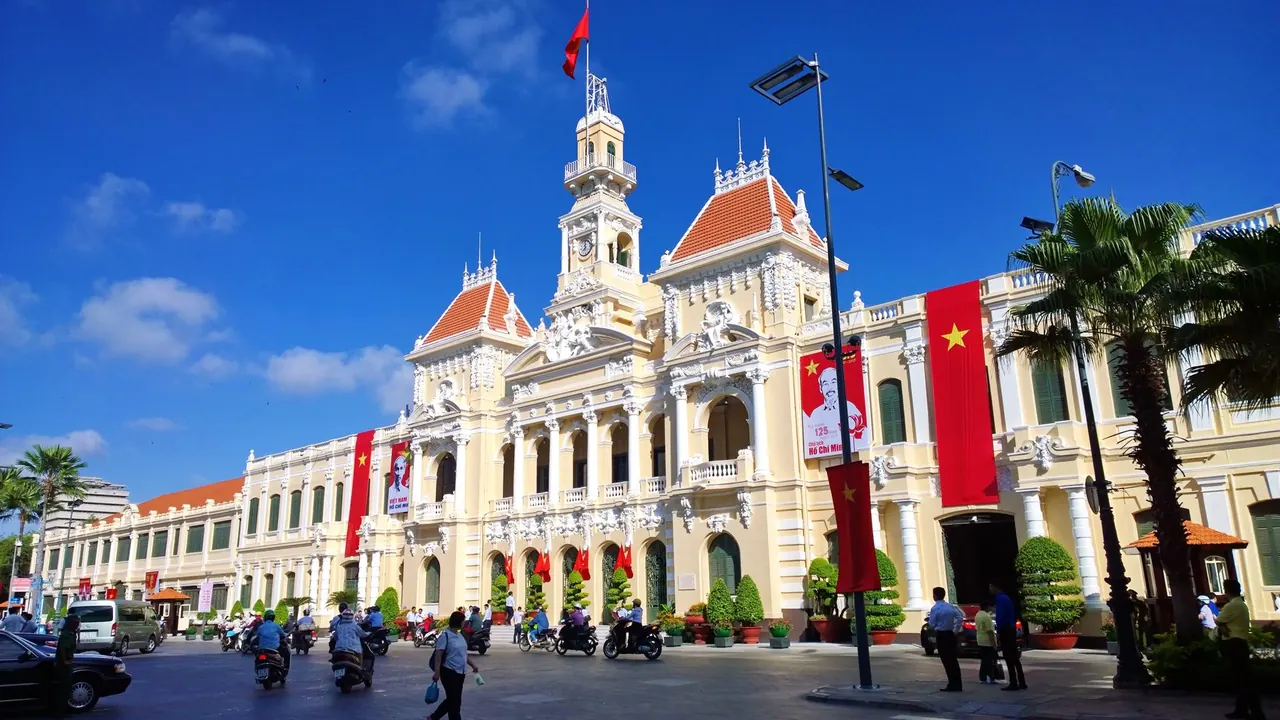
The City Hall of Ho Chi Minh City
- Affordable cities92
- Food & drink86
- Nightlife70
Photo: trungydang, CC BY 3.0, cropped
Match
53
Every category weighted equally
- Beach & sun53
- Culture & arts56
- Food & nightlife60
- Family trip50
- Outdoors51
- Relax & unwind52
- Shopping & style57
- On a budget58
Ho Chi Minh City in twelve categories
Our verdict on each, scored 0 to 100 against the same fixed benchmark cities, so a score means the same thing on every page.
Beaches & swimming. Scores 18 out of 100.
Food & drink. Scores 86 out of 100.
Culture & sights. Scores 55 out of 100.
Nightlife. Scores 70 out of 100.
Nature & outdoors. Scores 28 out of 100.
Day trips. Scores 58 out of 100.
Good for families. Scores 40 out of 100.
Getting around. Scores 38 out of 100.
Shopping & style. Scores 55 out of 100.
Affordability. Scores 92 out of 100.
Live music & performing arts. Scores 40 out of 100.
Wellness & relaxation. Scores 60 out of 100.
Ho Chi Minh City category by category
Beaches & swimming
18This is not a beach city. Ho Chi Minh City sits on a river some way inland, and the coast nearest to it is the mangrove fringe of Can Gio, where the shore is grey and muddy rather than a place to swim. The closest proper beach town is Vung Tau, about two hours away by road or by fast boat down the Saigon River. The sea there is warm all year, around 28°C, but the water is often cloudy and the beaches fill with weekend crowds from the city.
If beach time matters, treat it as a separate leg of the trip. Visitors fly or take the train on to the coast further north or out to the islands rather than trying to swim from a Saigon base. In the city itself, swimming means a hotel pool or a rooftop pool.
Food & drink
86Eating is the main reason many people come, and most of it happens on low plastic stools at the edge of the pavement. Southern Vietnamese cooking is sweeter and more herb-laden than the north's: broken-rice plates with grilled pork, banh mi from carts, bowls of hu tieu noodles, banh xeo pancakes wrapped in mustard leaves, and whole streets of snail and shellfish stalls that fill up after dark. Ben Thanh and the markets of Cholon, the old Chinese quarter, show the range of produce, and the Chinese-Vietnamese food there is a cuisine of its own.
Coffee is a culture rather than a drink. Strong drip coffee over condensed milk and ice, coconut coffee and egg coffee are served in everything from street corners to cafés hidden on the upper floors of old apartment blocks. Above the street level there is a serious tier of modern Vietnamese restaurants, French bistros left from the colonial past, and an international scene centred on the riverside neighbourhood of Thao Dien. Craft beer and cheap fresh draught beer round it out.
Culture & sights
55The city's sights tell the story of the twentieth century more than of deep antiquity. The War Remnants Museum is the one most visitors find hardest to forget, and the Reunification Palace, kept much as it was in 1975, makes the end of the war tangible. Around Dong Khoi street the French colonial city survives in a cluster of landmarks: the red-brick Notre-Dame Cathedral, the Central Post Office with its iron vaulting, the Opera House and the ornate City Hall.
For older heritage, head to Cholon, where Chinese assembly halls such as the Thien Hau Temple are thick with incense coils, and to the Jade Emperor Pagoda. The Fine Arts Museum and the History Museum fill a further afternoon. The core can be seen in two or three days; much of the city around it is modern and dense rather than historic.
Nightlife
70Evenings start on the street. Beer is drunk at pavement tables across the city, and Bui Vien in the Pham Ngu Lao backpacker area turns into a loud, neon-lit walking street of bars and pumping speakers every night. It is the easiest place to find a crowd and the least subtle.
Around Dong Khoi and Nguyen Hue there are rooftop bars with skyline views, speakeasy-style cocktail bars tucked up the stairwells of old apartment blocks, and clubs that draw a young local crowd as well as visitors. Thao Dien, across the river, has a quieter expatriate bar scene. Things run late by regional standards but most venues wind down in the small hours rather than going on to morning.
Nature & outdoors
28The city is flat, hot and built up, with green space limited to a few parks such as Tao Dan and the old botanical garden, where locals exercise at dawn. Beyond it the land stays low and watery. The Can Gio mangrove forest, a protected biosphere where the Saigon River meets the sea, is the closest real nature, with boardwalks, waterways and troops of macaques.
The Mekong Delta begins about two hours south, a landscape of coconut palms, rice paddies and narrow canals best seen from a small boat or a bicycle along the dykes. There are no mountains within reach, and hiking country means a longer trip to national parks several hours away. Heat and the wet season make outdoor effort hard work for much of the year.
Day trips
58The classic outing is to the Cu Chi tunnels, about an hour and a half northwest, where a network of wartime tunnels can be crawled through and the camouflaged trapdoors and traps are shown in the forest. Many visitors combine it with Tay Ninh, a little further on, for the Holy See of the Cao Dai faith, a pastel temple where the midday ceremony is open to watch.
South, the Mekong Delta towns of My Tho and Ben Tre are about two hours away, with floating trade, coconut candy workshops, orchards and boat trips through the canals; the larger floating markets around Can Tho really need an overnight stay. Vung Tau, the old seaside town with its hilltop Christ statue and lighthouse, is the other easy escape. Beyond these the choice thins quickly.
Good for families
40Vietnamese culture is openly fond of children, and staff in cafés and restaurants will often fuss over them. The attractions made for them are modest: the old Saigon Zoo and Botanical Garden in the centre, the Dam Sen park with its rides and water park, and Suoi Tien, a sprawling and eccentric Buddhist-themed amusement park on the city's edge.
The hard part is the street. Rivers of motorbikes, pavements taken over by parked bikes and food stalls, and humid heat make walking with a pushchair or small children tiring, and crossing the road needs nerve. Families tend to do best with a hotel pool, short outings by ride-hailing car and the cooler mornings for sightseeing.
Getting around
38The historic core around Dong Khoi, Ben Thanh and the Opera House is compact enough to walk, and many of the main sights lie within it. Beyond that, walking gets hard: pavements are used for parking and cooking, the heat is heavy and the traffic is a dense, constant flow of motorbikes that pedestrians learn to cross slowly and steadily.
The metro line running east from Ben Thanh is clean and easy, but it covers only one corridor of a huge city, and the bus network is hard for a visitor to read. Most people get around with ride-hailing apps, by car or on the back of a motorbike taxi, which is cheap and quick. A river bus along the Saigon River is a pleasant alternative for some trips. Bag snatching from passing motorbikes is a known risk, so phones are best kept away from the kerb.
Shopping & style
55Shopping here is strongest at the market and craft end. Ben Thanh Market, under its clock tower, sells everything from coffee beans and dried fruit to silk and souvenirs, with prices pitched for haggling, while Binh Tay Market in Cholon is the wholesale heart of the city and far more local. Tailors will make suits and ao dai to measure within days, and lacquerware, embroidery and Song Be ceramics are the crafts worth carrying home.
For brands, the malls and department stores around Dong Khoi and Le Loi carry international luxury and fashion labels, and Thao Dien has small design shops and boutiques. Copies and counterfeit goods are everywhere in the tourist markets, so the quality of what is sold as genuine varies.
Affordability
92This is one of the cheapest major cities a visitor can choose. Street food, coffee and draught beer cost very little, ride-hailing cars and motorbike taxis are inexpensive, and comfortable mid-range hotels in the centre are a fraction of what they are in Western cities. Museum entry fees are low.
As the country's business capital it has a more expensive layer than the rest of Vietnam: international hotels, rooftop bars, imported wine and smart restaurants charge closer to Western prices. A visitor who eats where locals eat will find it hard to spend much.
Live music & performing arts
40The French-built Opera House is the centre of formal performance, home to the city's ballet and symphony orchestra and to acrobatic shows built around southern Vietnamese village life, staged for visitors most evenings. Water puppetry, a northern tradition with musicians playing beside a pool stage, has regular performances in the centre too.
Cai luong, the southern reformed opera with its sentimental songs, survives in a few theatres and is a real local form, though hard to follow without Vietnamese. There are small jazz rooms and bars with live bands and acoustic sets. It is a modest scene: enough for an evening or two, not a reason to plan a trip.
Wellness & relaxation
60Massage and the hair-wash salon are how this city rests, and both are part of ordinary life rather than something kept for hotels. Foot massage parlours and body massage spas line the streets of the centre and stay open well into the evening. They are cheap enough to become a daily habit after hours in the heat. The local speciality is the long reclining shampoo with scalp, neck and face massage, herbal water and warm towels. Locals treat it as a regular ritual, and visitors take to it quickly. Larger hotels and day spas add longer treatments with herbal steam and hot stones.
There is no hammam or thermal bathing tradition, and the pools belong to hotels. What holds the city back is the world outside the treatment room. Traffic, horns and humid heat make the streets tiring, so calm comes in pockets: early mornings in the parks when locals do tai chi, quiet temple courtyards, leafy cafés up the alleys and the slower riverside streets of Thao Dien. Being looked after is easy here. Finding a quiet place to sit afterwards takes a little more looking.
When should you go?
Pick a month to see what it is like. The climate figures are measured averages, not a forecast.
Ho Chi Minh City in July
Daytime high, °C
Rainfall in the month, mm
The whole year
Shaded against this city’s own year: the deepest cell is its best month for that figure and the palest its weakest.
Where the figures come from
Ho Chi Minh City has no rain gauge within 25 km of the centre, so its rainfall comes from a gridded climate dataset read at the city rather than from a gauge further away.
Temperature and rainfall are climate normals, averaged over the years shown. Ho Chi Minh City: 1991-2020 normals, Ho Chi Minh (6 km from centre).
Before you go
| Measure | Ho Chi Minh City |
|---|---|
| Official language | Vietnamese |
| Currency | Dong (VND) |
| Sockets | ACFG220 V, 50 Hz |
| Driving side | Right |
| Time zone | UTC+7 |
| Emergency number | Police 113, ambulance 115, fire 114 |
| Elevation | 13 m |
| Main airport | Tan Son Nhat International Airport (SGN)7 km from centre90 non-stop destinations |
By the numbers
| Measure | Ho Chi Minh City |
|---|---|
| City population | 14,002,598 |
| People per km² | 2,068 |
| Museums within 10 km | 9 |
| UNESCO World Heritage sites within 50 km | 0 |
| Swim season, months above 21 °C | 12 months |
Compare Ho Chi Minh City with
Every comparison with a written verdict behind it.