Canadian Rockies or Swiss Alps?
Our verdict in twelve categories, each scored against the same fixed benchmark cities, and the climate month by month, so you can choose for your trip.
Choose Canadian Rockies for
- prices
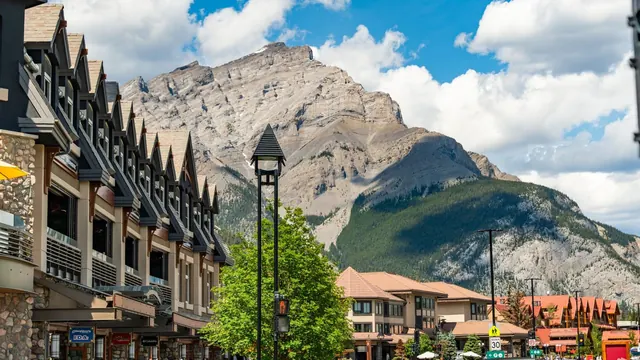
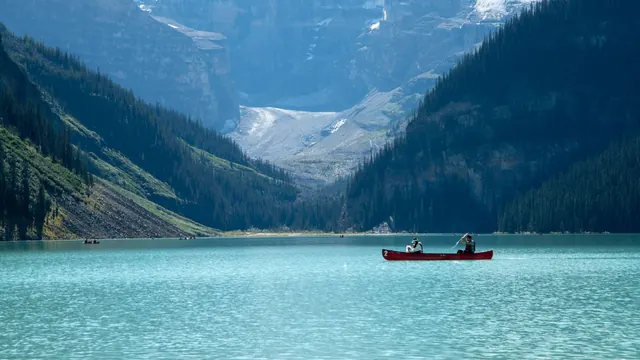
The Canadian Rockies suit travellers who want wilderness on a big scale and are happy to drive through it. The draw is the open road along the Icefields Parkway, elk and bears seen from the car, campgrounds by turquoise lakes and backcountry trails that feel truly remote. Towns are few and small, and evenings are simple. It is still not cheap, but campers and self-caterers can keep the cost down in a way the Swiss mountains don't allow.
Choose Swiss Alps for
- day trips
- getting around
- wellness
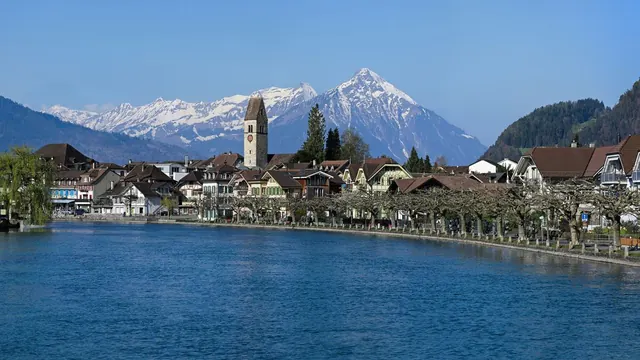
Pick the Swiss Alps for mountains you can reach by train and cable car, then end the day in an old village with a thermal bath, a cheese supper and a glass of Valais wine. The Swiss side does better on almost everything around the landscape: food, spas, summer music festivals, castles and easy rail outings to Bern or Lucerne. The cost is a very large bill.
Scoreboard
Twelve categories on one fixed scale from 0 to 100. The shaded stretch is the gap between the two.
Your match
Pick a travel style or drag the sliders, and both match scores follow your weighting.
Wins on prices with your weighting.
Wins on day trips and getting around with your weighting.
What matters to you?
Category by category
What the scores mean for a trip.
Beaches & swimming
Neither region is a place for a beach trip, but the Swiss Alps give a swimmer more. Lakeside lidos have lawns and diving boards, Lake Thun and Lake Brienz warm to about 20°C in a good August, and Lake Lugano and Lake Maggiore in Ticino get warmer still.
In the Rockies the famous lakes, Lake Louise and Moraine Lake, are fed by glaciers and far too cold to swim in. A summer swim means the shallow, sandy lakes near Jasper or Johnson Lake near Banff. For a proper warm beach day you have to drive down to Lake Windermere in the Columbia Valley.
Food & drink
The Swiss Alps eat better, mainly because the food belongs to the place: fondue and raclette on hut terraces at the top of the lifts, air-dried Graubünden beef, and Valais wines such as Petite Arvine that rarely leave the country. Zermatt, St Moritz and Gstaad add high-end cooking, and Ticino adds polenta and Merlot.
Rockies dining is resort fare built around Alberta beef, bison, elk and lake trout, served in steakhouses and lodge dining rooms. Canmore, with its bakeries and small breweries, is the more relaxed place to eat. Neither region has much street food.
Culture & sights
The Swiss Alps have more history to see, spread across the valleys: sgraffito houses in Guarda and Zuoz, the twin castles of Sion, the three castles of Bellinzona, the Carolingian frescoes at Müstair and the World Heritage lines of the Rhaetian Railway. None of it adds up to a cultural trip on its own, but there is plenty for an afternoon.
In the Rockies the story is younger and narrower. It covers the birth of Canada's national parks at Cave and Basin, the climbers and painters in the Whyte Museum, the grand railway hotels and First Nations heritage at the Buffalo Nations Luxton Museum.
Nightlife
Banff is almost the whole of the Rockies' night scene. A young crowd of ski-hill and hotel workers keeps a few pubs and small clubs on Banff Avenue going late, which is fun for a night or two, while Canmore and Jasper offer little beyond a brewpub.
Winter is the season for going out in the Swiss Alps, and then there is more choice, spread over several resorts. Verbier has slope-side terraces and late clubs, Zermatt has bars at the foot of the pistes, and St Moritz has glossier hotel bars. Outside the ski season the villages go to bed early.
Nature & outdoors
Both are world-class mountain landscapes, so the real difference is how they feel. The Rockies are wilderness on a continental scale: four national parks, the Columbia Icefield beside the road, grizzlies and elk, multi-day routes in the backcountry and dark-sky nights at Jasper. Bear awareness comes with every hike.
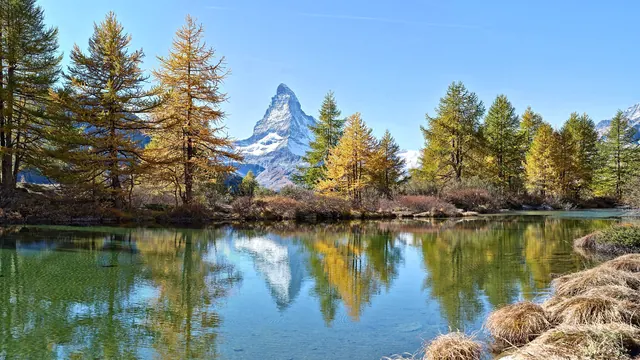
The Swiss Alps are mountains people have lived in for centuries. Cable cars lift you onto marked trails between huts below the Eiger and the Matterhorn, the Aletsch Glacier is in easy reach, and winter brings some of the finest ski areas anywhere. There is less wildness, but much less effort to reach high country.
Day trips
This is one of the widest gaps between the two. From the Bernese Oberland, trains reach Bern in under an hour, as well as Thun, Lucerne, Gruyères, the Lavaux vineyards and the Château de Chillon. Ticino adds Lugano and Locarno, so a different town each day is easy.
In the Rockies the outings are into the landscape rather than to other places. Canmore, Field and Golden make half-days, and Calgary, about an hour and a half from Banff, is the only real city nearby.
Good for families
Both work well for children, in different ways. In the Rockies the highlights are wildlife seen from the car, gondola rides, canoeing calm lakes and summers at the campground. The drawbacks are long drives between sights and keeping small children close on bear-country trails.
The Swiss Alps offer more ready-made fun: big ski schools in Grindelwald or Saas-Fee, summer toboggan runs and adventure playgrounds at the top stations, and car-free Zermatt and Wengen, where children can wander safely. Neither region has a large theme park.
Getting around
The Swiss Alps are far easier without a car. Trains, postbuses, lake steamers and cable cars run on connected timetables, and resorts such as Zermatt and Mürren ban private cars altogether. The catch is that crossing between big regions, say from Zermatt to the Engadine, takes a long day.
The Rockies are road-trip country. Hire a car, drive the Trans-Canada Highway and the Icefields Parkway, about four hours from Lake Louise to Jasper without stops, and use buses and park shuttles only around Banff, Canmore and the busiest lakes.
Shopping & style
Banff Avenue is about the extent of shopping in the Rockies: outdoor clothing, Canadian souvenirs, landscape galleries and some Indigenous art. It is fine for a warm jacket or a gift.
For anything beyond that, the Swiss resorts are the better hunting ground, with luxury boutiques in St Moritz and Gstaad and watches and serious mountain gear in Zermatt and Interlaken. The best things to take home are edible, though: cheese from the dairy, Valais wine and Graubünden air-dried meat.
Affordability
Neither is cheap, but the Canadian Rockies cost clearly less. Banff and Lake Louise charge resort rates in summer, yet Canmore and Golden are cheaper bases, the campgrounds are a genuine budget option, and a self-catering hiker spends little once there.
The Swiss Alps are among the most expensive places in the world for a vacation. The cable cars and mountain railways can cost more than the hotel. Travel passes, supermarket picnics and quieter valleys such as Goms or Ticino help, but only up to a point.
Live music & performing arts
For music lovers the Swiss Alps have the stronger summer. The Verbier Festival brings top soloists for several weeks in July, the Menuhin Festival fills the Saanenland churches around Gstaad, and Davos, the Engadine and Zermatt hold smaller classical seasons.
The Rockies have one serious venue, the Banff Centre for Arts and Creativity, with summer concerts and its autumn Mountain Film and Book Festival. For theatre or opera, both regions send you to a city.
Wellness & relaxation
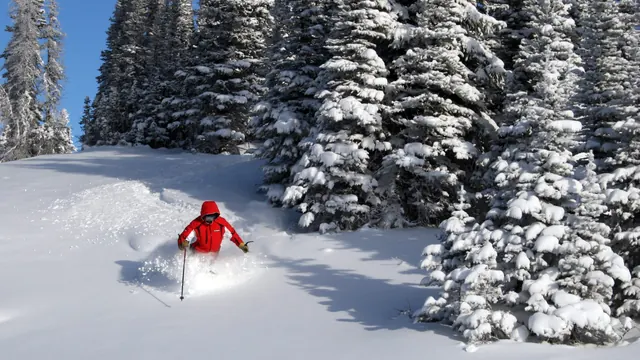
The Rockies' hot springs are memorable mostly for their settings. Banff Upper sits high on Sulphur Mountain looking across the valley, Radium lies in a narrow canyon in Kootenay, and Miette near Jasper is the hottest in the range. A soak in falling snow after a day's skiing is the classic evening, and Kananaskis has a Nordic-style spa with outdoor pools.
In the Swiss Alps bathing is a whole culture rather than an evening out. Leukerbad is a village of thermal pools under sheer cliffs, Vals has its stone bath cut into the hillside, and Bad Ragaz and Scuol have drawn bathers for centuries. The grand hotels of St Moritz and Gstaad add full spas on top.
When should you go?
Pick your month. The climate figures are measured averages, not a forecast.
Canadian Rockies in July
Swiss Alps in July
Daytime high, °C
Rainfall in the month, mm
Where the figures come from
Swiss Alps has no rain gauge within 25 km of the centre, so its rainfall comes from a gridded climate dataset read at the destination rather than from a gauge further away.
Swiss Alps's sunshine is measured 66 km from the centre, at Sion.
Temperature and rainfall are climate normals, averaged over the years shown. Canadian Rockies: 1991-2020 normals, Banff (1.9 km from centre). Swiss Alps: 2005-2020 (sunshine 1961-1990, rainfall 1991-2020) normals, Meiringen / Unterbach (19.5 km from centre).
Both regions are at their best for hiking from late June to September, and July is the warmest month in each, about 23°C in the Rockies and 24°C in the Alps. The Rockies are the drier of the two all year, and even June, their wettest month, brings only modest rain. Where most visitors stay in the Alps, summer is the wettest season, with roughly 125mm a month from June to August, so afternoon showers are common. July is also the sunniest month there, though. In both regions only July and August are warm enough for a lake swim.
Winter is harder in the Rockies. Daytime highs stay below freezing from December to February and fall to about -4°C in December, with November only just above zero. That makes walking around town cold work, though the dry snow suits skiing. The Swiss valleys stay a few degrees above freezing through the winter. Spring and autumn are milder there too, so May and October are more comfortable for walking in the Alps than around Banff or Jasper.
Which traveller are you?
On a trip with a tight budget, the Canadian Rockies are the more forgiving choice. Campgrounds, cheaper bases in Canmore or Golden and free trails keep costs down. In the Swiss Alps, simple mountain meals and the cable cars you need to reach high country add up fast.
For a relaxing and wellness trip, the Swiss Alps are the stronger choice. People have been coming to their spas for centuries, and the car-free villages are quiet at night. The Rockies offer a fine soak after a hike, but less to build a restful week around.
For a trip built around watching wildlife, the Canadian Rockies have the edge. Elk, bighorn sheep, black bears and even grizzlies are often seen from the road. In the Alps you can watch ibex and chamois in the national park, but you won't see anything like a bear from the car.
Before you go
| Measure | Canadian Rockies | Swiss Alps |
|---|---|---|
| Official language | French, English | French, German, Italian, Romansh |
| Currency | Canadian Dollar (CAD) | Swiss Franc (CHF) |
| Sockets | AB120 V, 60 Hz | CJ230 V, 50 Hz |
| Driving side | Right | Right |
| Time zone | UTC-7, UTC-6 in summer | UTC+1, UTC+2 in summer |
| Emergency number | 911 | 112 |
| Main airport | Calgary International Airport (YYC)102 non-stop destinations | Zürich Airport (ZRH)226 non-stop destinations |
| Public holidays this year | 13 days | 10 days |
Where else could you go?
Every comparison below shares a destination with this one, so you can follow Canadian Rockies or Swiss Alps somewhere new.
- French Alpsvs Swiss Alps
- Lake Comovs Swiss Alps
- Black Forestvs Swiss Alps
- Lake Gardavs Swiss Alps
- Austrian Alpsvs Swiss Alps
- Cinque Terrevs Swiss Alps