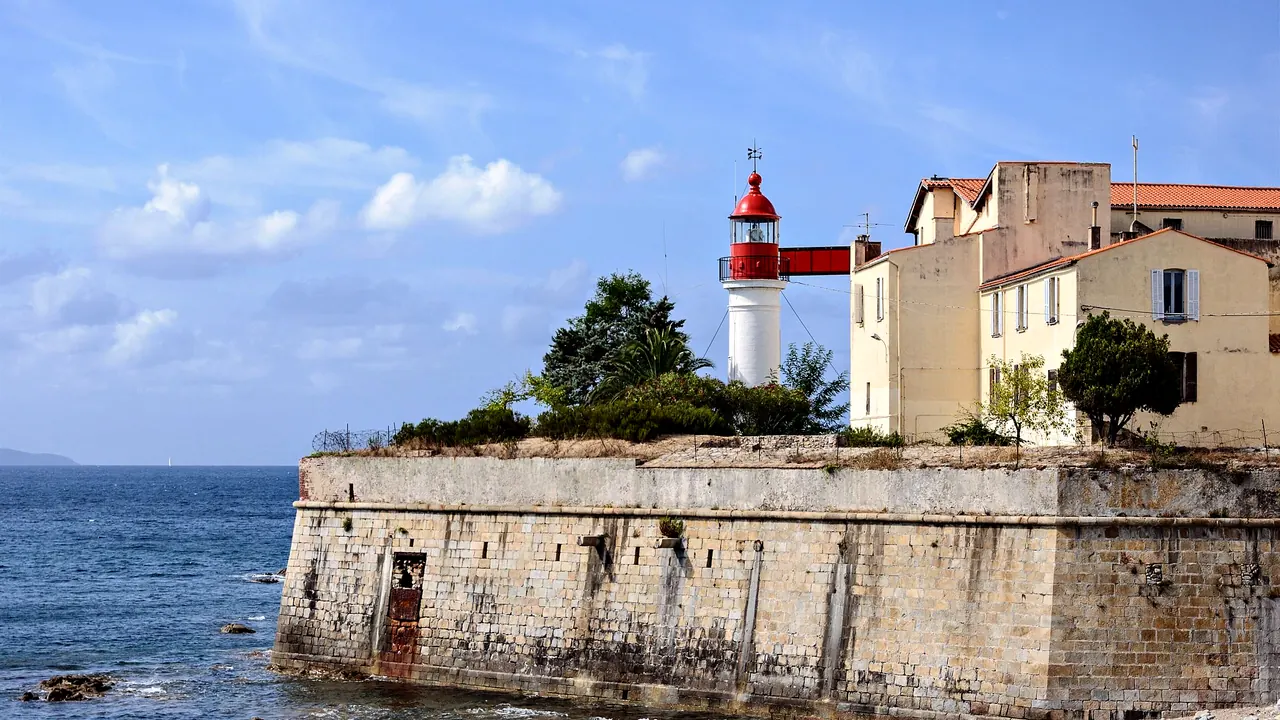
Photos: Corsica by Myrabella, CC BY-SA 3.0, cropped.
Corsica or French Riviera?
Our verdict in twelve categories, each scored against the same fixed benchmark cities, and the climate month by month, so you can choose for your trip.
Choose Corsica for
- nature and the outdoors
- beaches
- prices
Corsica is for travellers who care more about wild scenery and long sandy beaches than about towns. It suits walkers drawn to the GR20 or the needles of Bavella, families happy with one calm bay and a hire car, and couples who like a quiet evening over village food. In return you give up easy transport, real shopping and most of the nightlife, and you will spend time behind the wheel on slow mountain roads.
Choose French Riviera for
- shopping
- nightlife
- getting around
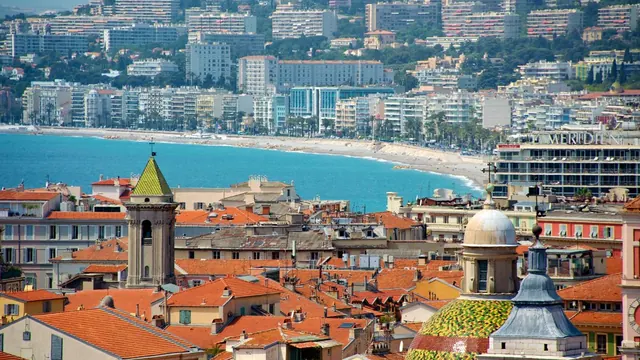
The French Riviera suits people who want a beach vacation with a city attached. From a base in Nice you have markets, modern art museums, bars that stay open all year and a coastal railway to Monaco and Menton, so a swim can share a day with Matisse, a hill village or an evening at the opera. It is the more polished of the two and the more crowded, and its mountains are a backdrop rather than the reason to go.
Scoreboard
Twelve categories on one fixed scale from 0 to 100. The shaded stretch is the gap between the two.
Your match
Pick a travel style or drag the sliders, and both match scores follow your weighting.
Wins on nature and the outdoors and beaches with your weighting.
Wins on shopping and nightlife with your weighting.
What matters to you?
Category by category
What the scores mean for a trip.
Beaches & swimming
Both coasts give excellent summer swimming, so the real difference is the kind of beach. Corsica has a slight edge for sand and for space. In the far south there are Palombaggia, Santa Giulia and Rondinara, the Agriates beaches can only be reached by boat or a long track, and granite coves run down the west coast.
The Riviera's shore is more urban. Nice and Menton sit on pebbles, the sand is at Cannes, Juan-les-Pins and Pampelonne, and private beach concessions take much of it. In return you can swim straight from town and walk back to dinner.
Food & drink
Corsica's table is narrower but very much its own, mountain food rather than seaside food: lonzu and figatellu, brocciu in omelettes and fiadone, wild boar and dishes made with chestnut flour. It is best eaten in inland village inns with a bottle from Patrimonio, and there is little beyond Corsican and French cooking.
The Riviera eats better and with more range. Nice has a cuisine of its own, with socca from wood ovens, pissaladière and stuffed vegetables, and the morning market on the Cours Saleya sells olives, citrus and goat's cheese. Serious restaurants sit close together from Menton to Cannes, so a food lover can plan a whole trip around them. On both coasts, the seafront menus are the ones to avoid.
Culture & sights
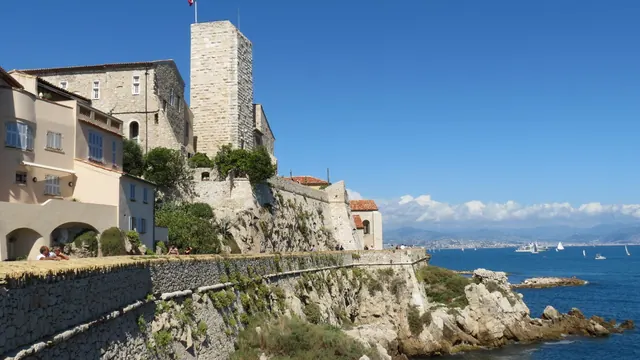
For sightseeing the Riviera is the richer choice. It is built around modern art made on this coast: Matisse and Chagall in Nice, Picasso in the castle at Antibes and the Fondation Maeght. Monaco's palace and the Belle Epoque front of Nice add to it.
Corsica's history is of a different kind: Genoese citadels and watchtowers, Bonifacio on its white cliffs, the upper town of Corte and the carved stones of Filitosa. It rewards a road trip, but there is no museum circuit to compare.
Nightlife
A night out is far easier on the Riviera. The bars in Nice's old town and port keep going all year, and in summer Saint-Tropez, Monaco, Cannes and Juan-les-Pins add beach clubs and late bars. Corsica's evenings are long dinners and harbour terraces. In summer there are a few open-air clubs behind Porto-Vecchio and some busy bars in Calvi, and little else.
Nature & outdoors
Corsica has the wilder landscape. Peaks of more than 2,700m rise close to the shore, the GR20 runs along the island's spine, and there are the Calanques de Piana, the sea cliffs of Scandola, Bavella and the lakes above the Restonica, with rivers for canyoning in between.
The Riviera's scenery is fine but tamer: cape paths past villa gardens, the red rock of the Esterel, and the Mercantour about one and a half hours from Nice. It fits easily into a city stay but is less of an adventure in itself.
Day trips
Outings from the Riviera are quicker and more varied. The coastal train makes Villefranche, Monaco and Menton easy half-days, the hill villages and Grasse are just inland, and Sanremo and Dolceacqua in Italy are close by.
On Corsica each base has its own handful of trips. From the south there is Sartène or the ferry to Sardinia, from Calvi the Balagne villages, from Bastia Cap Corse, and Corte is reachable by the railway. Slow mountain roads put the rest of the island out of reach in a day.
Good for families
For families, both work best as a beach vacation and neither is perfect. Corsica offers calm, shallow water at Santa Giulia, campsites and resort villages with pools, river pools and a safe, unhurried feel. The costs are long, twisting drives and almost nothing built for children.
The Riviera has gently shelving sand at Juan-les-Pins, Cannes and Fréjus, and it also has places made for children: the aquarium in Monaco's Oceanographic Museum, Parc Phoenix and the water parks near Antibes. Against that come summer crowds, expensive family rooms and hill villages that no pushchair can manage.
Getting around
The Riviera is much simpler to get around. A railway along the shore links Cannes, Antibes, Nice, Monaco and Menton, and Nice has a tram to the airport, so if you stay near a station you do not need a car.
Corsica almost requires one. Its roads are narrow and slow and buses are rare. The scenic little railway between Ajaccio, Corte, Bastia and Calvi never reaches the south, where the best beaches are.
Shopping & style
The Riviera is the place to shop. There are luxury boutiques in Cannes, Monte-Carlo and Saint-Tropez and department stores in Nice, and you can buy perfume in Grasse, glass in Biot and pottery in Vallauris. Corsica's shopping is mostly things to take home: charcuterie, cheese, wine, honey and hand-forged knives from the Ajaccio and Bastia markets, or crafts from the Balagne villages.
Affordability
Neither is cheap in summer, and they are about equally hard on a budget, for different reasons. In Corsica the costs come from coastal rooms in Porto-Vecchio, Bonifacio and Calvi and from the car and ferry you can hardly do without. Campsites and inland villages are where it gets cheaper.
On the Riviera the trains and buses are the one bargain, while Saint-Tropez, Monaco and Cannes are among the most expensive places to stay in Europe. Nice is the sensible base. In both places, travelling in June or September helps.
Live music & performing arts
The Riviera has a real stage life. The opera house in the Monte-Carlo casino building, the Monte-Carlo Philharmonic and the Ballets de Monte-Carlo perform in winter, Nice has its own opera and orchestra, and summer brings jazz at Juan-les-Pins and in Place Masséna.
Corsica's own tradition is polyphonic singing in village churches, and summer adds jazz in Calvi and guitar evenings near Patrimonio. Outside summer there is little to go to.
Wellness & relaxation
The two offer rest of different kinds, with the Riviera slightly ahead for anyone who wants treatments. It has thalassotherapy centres in Monaco and on the capes and large spas in the grand hotels of Cap Ferrat and Cap d'Antibes, though the resorts are loud in July and August.
Corsica has few spas and only modest springs such as Pietrapola. Its slow pace, siestas and quiet mountain villages make it easy to unwind without any treatment at all.
When should you go?
Pick your month. The climate figures are measured averages, not a forecast.
Corsica in July
French Riviera in July
Daytime high, °C
Rainfall in the month, mm
Temperature and rainfall are climate normals, averaged over the years shown. Corsica: 1991-2020 normals, Ajaccio (5.1 km from centre). French Riviera: 1991-2020 normals, Nice (9.8 km from centre).
The two share almost the same sea. Swimming is comfortable in either from June to September, and the water is warmest in August at about 25°C. Corsica has the drier and sunnier summer: July is nearly rainless and daytime highs reach 29°C, hot enough to make walking at low altitude hard work, so May, June and September are the better months for the mountains. Rain returns in autumn and is heaviest in November.
The French Riviera runs about a degree cooler through most of the year, and its autumn is wetter. October and November are the rainiest months, at up to 138mm, so September is the safer end of the beach season. In winter, with days of about 14°C, the Riviera gets slightly more sunshine than Corsica, which helps a trip built around museums and old towns once the beaches are out of season.
Which traveller are you?
On an outdoors trip, Corsica is the clear pick. It has the GR20 and the gentler Mare e Monti trails, the needles of Bavella, rivers for canyoning and sea kayaking around Scandola and the Lavezzi islands, wilder country than anything the Riviera's cape paths offer.
For a culture and arts trip, choose the French Riviera. Matisse, Chagall, Picasso and the Fondation Maeght are a short train or bus ride apart, and Monaco adds opera and ballet in winter. Corsica has citadels and church polyphony but nothing on that scale.
On a food and nightlife trip, the French Riviera wins too. Nice's socca and markets, serious restaurants towards Monaco and Cannes and old-town bars that run all year beat Corsica's village charcuterie and early nights, which get quieter still once summer ends.
Before you go
| Measure | Corsica | French Riviera |
|---|---|---|
| Official language | French | French |
| Currency | Euro (EUR) | Euro (EUR) |
| Sockets | CE230 V, 50 Hz | CE230 V, 50 Hz |
| Driving side | Right | Right |
| Time zone | UTC+1, UTC+2 in summer | UTC+1, UTC+2 in summer |
| Emergency number | 112 | 112 |
| Main airport | Ajaccio Napoléon Bonaparte airport (AJA)29 non-stop destinations | Nice-Côte d'Azur Airport (NCE)130 non-stop destinations |
| Public holidays this year | 11 days | 11 days |
By the numbers
| Measure | Corsica | French Riviera |
|---|---|---|
| Population | 355,486 | - |
| People per km² | 41 | - |
| Swim season, months above 21 °C | 4 months | 4 months |
Where else could you go?
Every comparison below shares a destination with this one, so you can follow Corsica or French Riviera somewhere new.
- Sardiniavs Corsica
- Provencevs French Riviera
- Cinque Terrevs French Riviera
- Cinque Terrevs Corsica
- French Alpsvs French Riviera
- Tuscanyvs Corsica