France
Nice
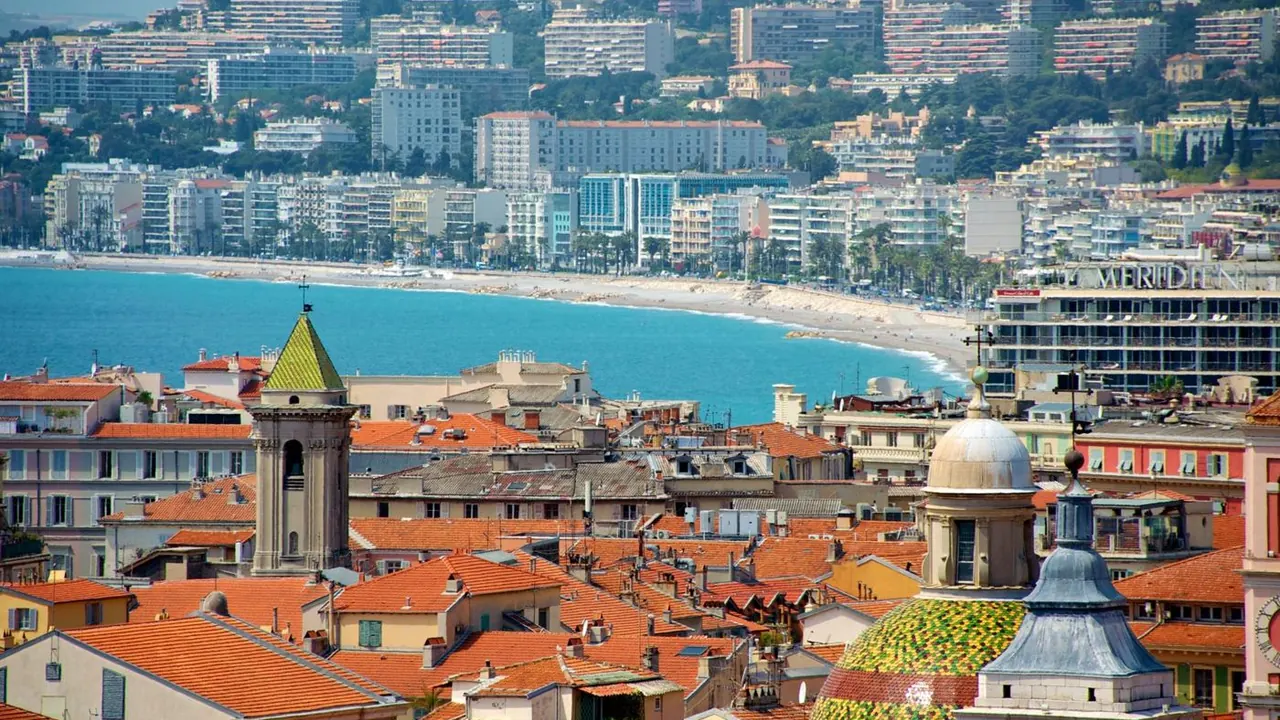
Vieux Nice and the Baie des Anges
- Day trips87
- Nature & outdoors80
- Beaches75
Photo: Daniel Stockman, CC BY-SA 2.0, cropped
Match
60
Every category weighted equally
- Beach & sun61
- Culture & arts61
- Food & nightlife58
- Family trip63
- Outdoors66
- Relax & unwind61
- Shopping & style59
- On a budget58
Nice in twelve categories
Our verdict on each, scored 0 to 100 against the same fixed benchmark cities, so a score means the same thing on every page.
Beaches & swimming. Scores 75 out of 100.
Food & drink. Scores 66 out of 100.
Culture & sights. Scores 64 out of 100.
Nightlife. Scores 47 out of 100.
Nature & outdoors. Scores 80 out of 100.
Day trips. Scores 87 out of 100.
Good for families. Scores 57 out of 100.
Getting around. Scores 74 out of 100.
Shopping & style. Scores 55 out of 100.
Affordability. Scores 35 out of 100.
Live music & performing arts. Scores 45 out of 100.
Wellness & relaxation. Scores 40 out of 100.
Nice category by category
Beaches & swimming
75The beach is the city's front garden. The pebble shore runs below the Promenade des Anglais for about 7km, from the airport to the foot of Castle Hill, and the water is clear, blue and warm enough to swim from June into October, reaching about 25°C in August. Public stretches alternate with private beach clubs that rent loungers and mattresses, which makes a real difference on the stones. Water shoes help too.
For sand and calmer water, the coast east of the port has better options: Villefranche's bay, the small coves around Cap Ferrat and Paloma beach, and the beaches at Beaulieu, all a short bus or train ride away. West of the city, the sandy beaches of Juan-les-Pins and Antibes are within an hour. In July and August the city shore fills early. Late spring and September are the easiest months for swimming.
Food & drink
66Nice has a cuisine of its own, closer to Liguria than to Paris. Socca, the chickpea pancake baked in wide pans in wood ovens, is the local street food, eaten hot with pepper in the old town. Alongside it come pissaladière with onions and anchovies, stuffed vegetables, pan bagnat, daube and the salade niçoise, which locals hold strong opinions about. The Cours Saleya market sells flowers, produce, olives and Provençal goods most mornings, and the small Bellet vineyards on the hills above the city make wine that is rarely seen elsewhere.
The best eating is in modest family places in Vieux Nice and around the port, and in a handful of serious kitchens in the hills and along the coast. The weak spots are the terraces on the promenade and on the main old town squares, where set menus cater to passing crowds. It is a very good place to eat well and simply, but it lacks the depth and range of a major food capital.
Culture & sights
64Nice's sights reflect two histories: the Italianate old town of the counts of Savoy, and the Belle Époque winter resort built for British and Russian visitors. Vieux Nice is a maze of ochre and red facades, baroque chapels and the Cathedral of Sainte-Réparate, below Castle Hill with its views over the Baie des Anges. Along the Promenade des Anglais and in the Cimiez hills stand grand hotels and villas from the resort era, and the onion domes of the Russian Orthodox Cathedral rise in the west of the city.
Art is the real strength. The Matisse Museum sits among Roman ruins in Cimiez, the Chagall Museum holds his biblical cycle, and MAMAC covers the Nouveau Réalistes and Yves Klein. Add the Massena villa museum and the archaeological site of Cemenelum, and there is enough for two or three full days without any sight on a world scale.
Nightlife
47Evenings centre on Vieux Nice, where narrow lanes fill with pubs, wine bars and cocktail bars that spill onto the streets, and the crowd is a mix of students, locals and visitors. The port has a few more grown-up bars, and in summer the beach clubs and the promenade keep people out late. Clubs are few and fairly ordinary, and the glossier nights of the coast take place in Monaco and Cannes rather than here. Outside summer, the city goes quiet earlier, and most visitors find dinner and a few drinks in the old town is the night out.
Nature & outdoors
80Nice sits where the Alps come down to the sea, and that gives it a wider outdoor range than most beach cities. Within the city, Castle Hill and Mont Boron offer short walks with views over the bay. Just east, the coastal paths around Cap Ferrat and Cap d'Ail follow rocky shores past pines and villas. The corniches above the coast are classic road-cycling routes, and the hills behind the city lead to perched villages and limestone gorges.
Inland, the Mercantour National Park, with its larch forests, high lakes and ibex, is within about two hours. The ski resorts of Isola 2000 and Auron are about an hour and a half away in winter, so on a good day you can ski in the morning and see the sea in the afternoon. West of the city, the red rocks of the Esterel are good for hiking. On the water, sailing, kayaking, diving and paddleboarding are all easy to arrange. Summer heat makes walking hard in the middle of the day, so spring and autumn are the best seasons.
Day trips
87Day trips are one of the best reasons to stay in Nice. The coastal railway and buses link a run of towns that each feel different. Villefranche and Beaulieu are a few minutes east, with Monaco's palace, casino and Oceanographic Museum about twenty minutes away. Menton's lemon-coloured old town is close to the Italian border. Above the coast, Èze sits on its rock with gardens looking out to sea, and Cap Ferrat has the Villa Ephrussi de Rothschild.
To the west are the ramparts and Picasso Museum of Antibes, the Croisette in Cannes and the Lérins islands just offshore with their monastery. Inland are the perfume houses of Grasse and the walled art village of Saint-Paul-de-Vence with the Fondation Maeght. Italy is close too: Sanremo and the Friday market at Ventimiglia are an easy train ride away. Most of these places take under an hour to reach, and you need no car for any of them.
Good for families
57Nice is a relaxed, manageable place to bring children. The long flat promenade suits pushchairs and bikes, and the Promenade du Paillon, a park strip through the centre, has big playgrounds and shallow water jets where children splash on hot days. Parc Phoenix near the airport combines a botanical garden, greenhouses and small animals, and Castle Hill has a waterfall and play areas. The Oceanographic Museum in Monaco makes an easy half-day trip.
The main drawbacks are the pebble beaches, which are harder on small feet, and the lack of a big zoo or theme park in the city. July and August bring crowds and strong heat. The old town's steps and narrow lanes are fine on foot but awkward with a pushchair. Children are welcome in restaurants, especially at lunch.
Getting around
74Nice is easy to manage without a car. The old town, the promenade, Place Massena, the port and the main shopping streets are all within a flat half-hour walk of each other. The trams run east to west across the city and connect the airport directly with the centre and the port. Buses climb to Cimiez, where the Matisse and Chagall museums sit on the hill, and to Mont Boron.
For trips along the coast, the regional trains to Monaco, Menton, Antibes and Cannes are the simplest option, and buses serve the perched villages such as Èze and Saint-Paul-de-Vence. In summer, trains and buses on the coast can be packed, and roads along the Riviera are slow. You only need a car for the mountains inland.
Shopping & style
55Shopping in Nice comes in three kinds. Avenue Jean Médecin is the main high street, with chain stores and a branch of Galeries Lafayette. The streets around rue Paradis and avenue de Verdun have the luxury fashion houses. Vieux Nice is the place for olive oil, soaps, Provençal fabrics, candied fruit and local spirits, alongside a lot of souvenir stalls.
The Cours Saleya changes through the week: food and flowers on most days and a flea and antiques market on Mondays. The port area has a few antique dealers. It is pleasant browsing rather than a shopping destination. Visitors looking for serious luxury tend to look in Monaco and Cannes.
Affordability
35Nice is an expensive city by southern European standards, and summer pushes prices up. Hotel rooms near the sea and in the old town cost a lot from June to September, and private beach loungers and promenade terraces add up quickly. Local transport is cheap, though: the trams and the regional trains along the coast make day trips affordable, and many of the city's own museums cost little to enter. Socca, market picnics and simple lunch menus keep food costs down for visitors who avoid the seafront. Spring and late autumn are noticeably easier on the budget.
Live music & performing arts
45Nice has a proper, if regional, performing arts calendar. The Opéra de Nice, a red-and-gold nineteenth-century house close to the old town, puts on opera, ballet and concerts by the Nice Philharmonic through the season. The Théâtre National de Nice stages drama, mostly in French. The Nice Jazz Festival, one of the oldest in Europe, brings big names to the city every July, and the Carnival in February is a long tradition of parades and flower battles.
Outside those events, live music mostly means small bars in the old town and summer concerts outdoors. It is enough for an evening or two, but it is not a reason to choose the city.
Wellness & relaxation
40Nice has no bathing tradition of its own. Spa time means the treatment rooms in the larger seafront hotels, or one of the thalassotherapy centres along the coast towards Monaco and Antibes. What the city does offer is a gentle Riviera rhythm: an early swim before the crowds arrive, a long lunch, an evening walk along the promenade as the light fades over the bay. Out of season it is a calm, mild place to slow down. In high summer the crowds and heat make it busier and less restful.
When should you go?
Pick a month to see what it is like. The climate figures are measured averages, not a forecast.
Nice in July
Daytime high, °C
Rainfall in the month, mm
The whole year
Shaded against this city’s own year: the deepest cell is its best month for that figure and the palest its weakest.
Temperature and rainfall are climate normals, averaged over the years shown. Nice: 1991-2020 normals, Nice (8 km from centre).
Before you go
| Measure | Nice |
|---|---|
| Official language | French |
| Currency | Euro (EUR) |
| Sockets | CE230 V, 50 Hz |
| Driving side | Right |
| Time zone | UTC+1, UTC+2 in summer |
| Emergency number | 112 |
| Elevation | 0 m |
| Main airport | Nice-Côte d'Azur Airport (NCE)6 km from centre130 non-stop destinations |
| Public holidays this year | 11 days |
By the numbers
| Measure | Nice |
|---|---|
| City population | 357,737 |
| People per km² | 4,975 |
| Museums within 10 km | 17 |
| UNESCO World Heritage sites within 50 km | 2 |
| Swim season, months above 21 °C | 4 months |
Compare Nice with
Every comparison with a written verdict behind it.