Mexico
Cancun
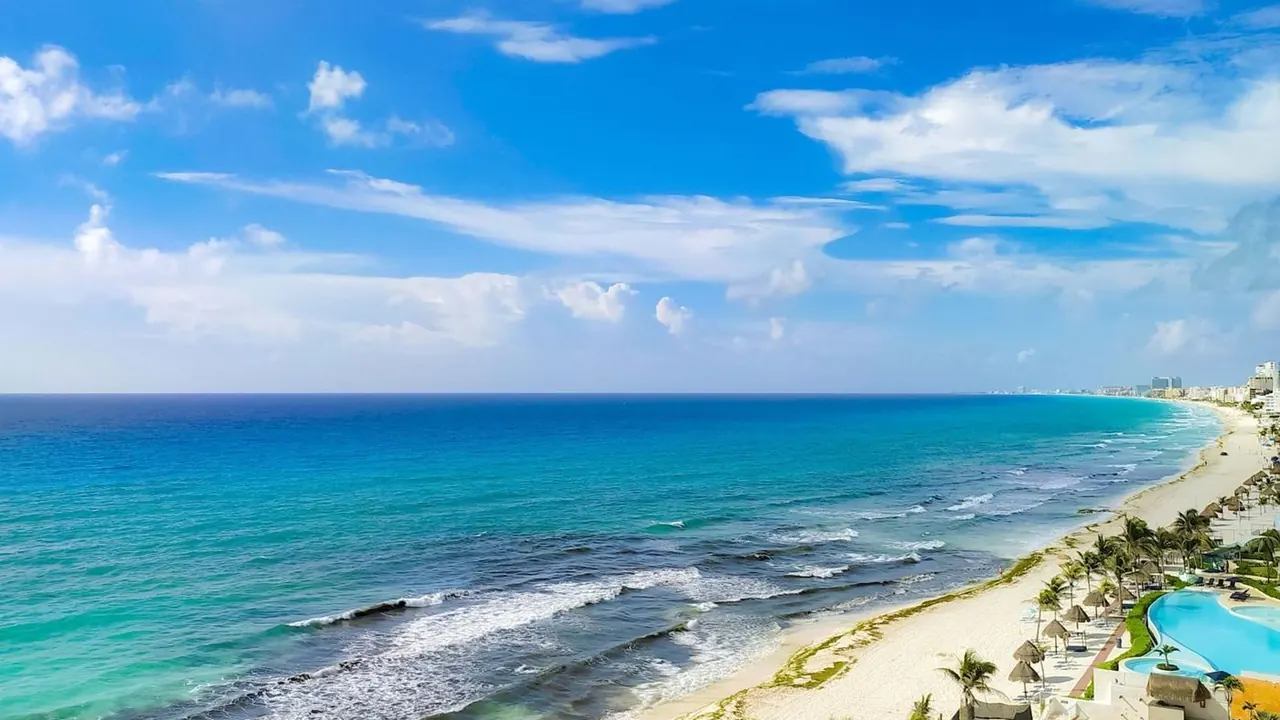
The coastline of the Hotel Zone
- Beaches98
- Families78
- Nightlife70
Photo: Tellez Erik, Pexels License
Match
52
Every category weighted equally
- Beach & sun60
- Culture & arts40
- Food & nightlife45
- Family trip56
- Outdoors57
- Relax & unwind55
- Shopping & style45
- On a budget51
Cancun in twelve categories
Our verdict on each, scored 0 to 100 against the same fixed benchmark cities, so a score means the same thing on every page.
Beaches & swimming. Scores 98 out of 100.
Food & drink. Scores 44 out of 100.
Culture & sights. Scores 15 out of 100.
Nightlife. Scores 70 out of 100.
Nature & outdoors. Scores 66 out of 100.
Day trips. Scores 65 out of 100.
Good for families. Scores 78 out of 100.
Getting around. Scores 25 out of 100.
Shopping & style. Scores 40 out of 100.
Affordability. Scores 46 out of 100.
Live music & performing arts. Scores 17 out of 100.
Wellness & relaxation. Scores 55 out of 100.
Cancun category by category
Beaches & swimming
98Beach life is the reason Cancun exists. The Hotel Zone is a long, thin strip of land shaped like the number seven, and along it runs about 22km of fine, pale coral sand that stays cool underfoot even at midday. The water is warm all year, around 27°C in winter and closer to 29°C in summer, and has the turquoise colour that ends up on postcards.
The two sides of the seven are quite different. The northern arm, facing the bay towards Isla Mujeres, has calm, shallow water around Playa Langosta and Playa Tortugas that suits children and weaker swimmers. From Punta Cancun at the bend, the long eastern shore runs south past Gaviota Azul, Chac Mool, Marlin, Ballenas and Delfines, facing the open Caribbean with bigger waves and stronger currents, so watch the flags. Isla Mujeres, a short ferry ride away, adds the gentle shelf of Playa Norte. In some summers sargassum seaweed washes up on the eastern beaches, and the bay side is the usual fallback.
Food & drink
44How well you eat in Cancun depends on whether you leave the Hotel Zone. Along the beach strip most meals come from resort buffets, steakhouses and international menus pitched at visitors, competent but rarely memorable. Downtown, a short bus ride inland, is where the city eats: taco stands working into the night, the food stalls around Parque de las Palapas, and the market halls of Mercado 28 and Mercado 23.
The regional cooking is Yucatecan, which is distinct from what most visitors know as Mexican food: cochinita pibil slow-cooked in achiote and banana leaf, sopa de lima, panuchos and salbutes, and fiery habanero salsas. Fresh ceviche and grilled fish are easy to find near the lagoon. There is little depth beyond this, and fine dining is mostly confined to the larger hotels.
Culture & sights
15Cancun was planned as a resort and built from the 1970s onwards, so it has almost no historic fabric of its own. The one sight worth an afternoon is the Maya Museum in the Hotel Zone, with a well-presented collection of finds from across the peninsula and the small San Miguelito ruins in its grounds. The modest El Rey and El Meco sites add a little more. Visitors who care about Maya heritage treat Cancun as a base and travel out to the great sites.
Nightlife
70Cancun's nightlife is concentrated in one place and it is loud. Around the bend of the Hotel Zone known as the Party Center, enormous clubs put on acrobatic shows, confetti drops and tribute acts, open-bar wristbands are standard, and the crowds stay until four or five in the morning. Spring break gave the place its reputation, and the energy stays high for much of the year.
What it lacks is variety and character. Most venues aim at the same vacation crowd, and quiet cocktail bars or a local scene are harder to find. Downtown, around Avenida Tulum and the streets near Parque de las Palapas, has cheaper bars where residents drink. Many guests at all-inclusive resorts never leave the hotel bar.
Nature & outdoors
66The landscape is flat limestone covered in low tropical scrub, so the outdoors here means water. The Mesoamerican Reef runs along the coast, with snorkelling and diving off Puerto Morelos and Isla Mujeres and the sculptures of the underwater museum, MUSA, sinking into the reef off the shore. Inland, the Ruta de los Cenotes leads to sinkholes and caverns filled with clear fresh water. Between June and September, boats go out to swim with whale sharks.
The Nichupte lagoon behind the Hotel Zone has mangrove channels for kayaking and paddleboarding, and kitesurfing is popular on the windier shore. Isla Contoy is a protected bird island reached by boat. There is no hiking of any real kind, and the heat makes long cycling hard work.
Day trips
65Cancun's heritage lies outside the city, and it is the usual base for the Maya sites of the Yucatan, though the greatest of them are a stretch. Chichen Itza, with the great pyramid of El Castillo, is about two and a half hours away by road. That makes a long, early day, often combined with the colonial town of Valladolid and a cenote. Ek Balam and Coba, where jungle still surrounds the ruins, are each about two hours away and work better as a pair or as part of a longer loop.
The places closest to hand are along the coast. Isla Mujeres is a short ferry ride away, a small island town of golf carts and painted houses. Playa del Carmen, with its pedestrian street, is about an hour south, and Tulum, whose ruins stand on a cliff above the sea, is nearer two. Cozumel is reached by ferry from Playa del Carmen. Holbox, a sandy-streeted island on the north coast, is too far for a day and needs a night.
Good for families
78Cancun works well with children, mostly because so much of it is built around the resort. Large all-inclusive hotels have kids' clubs, shallow pools and buffets that suit fussy eaters, and the calm bay beaches on the northern stretch of the Hotel Zone are gentle enough for small swimmers. Snorkelling in the shallow reef and lagoon water is an easy first try for older children.
Beyond the beach there is an aquarium in the Hotel Zone, and south along the coast are large eco-parks built around underground rivers, lagoons and animal encounters, which can fill whole days. The difficulties are the summer heat and humidity, the strong currents on the eastern shore, and the fact that everything outside the hotel needs a bus, taxi or tour.
Getting around
25The Hotel Zone is one long road, Boulevard Kukulcan, and the frequent local buses that run along it, on to downtown, are the simplest way to get about. Walking is pleasant only for short stretches near your hotel: distances are long, the pavements are patchy and the heat is heavy. Taxis are everywhere but agree the fare before getting in.
For anything further, the ADO coach network is comfortable and reliable to Playa del Carmen, Tulum and Valladolid, and ferries leave for Isla Mujeres from several points. Most visitors still rely on organised tours or hire a car to reach cenotes and ruins, and the roads on the peninsula are straight and easy to drive.
Shopping & style
40Shopping in Cancun mostly means malls. Large air-conditioned centres along the Hotel Zone carry international fashion, luxury labels, duty-free and the usual beachwear. They are convenient on a hot afternoon but much like malls anywhere. Downtown, Mercado 28 is the place for crafts and souvenirs: embroidered huipiles, hammocks, silver, Talavera-style ceramics, tequila and vanilla. Expect to bargain, and expect the same stock from one stall to the next, with little that was made by the person selling it. Independent boutiques and local designers are rare, so buyers looking for fine handmade work will find slim pickings in the city itself.
Affordability
46Cancun is one of the pricier places in Mexico, and the Hotel Zone is priced for international visitors rather than locals. Beachfront hotels, resort restaurants, drinks in the Party Center and organised tours to the ruins and eco-parks add up quickly. An all-inclusive package makes the cost of a stay predictable, if not low.
The gap between the beach strip and downtown is wide. Taco stands, market food, local buses and ADO coaches cost a fraction of resort prices, and small downtown hotels are far cheaper than anything on the sand. Rates fall noticeably outside the winter peak and the main vacation weeks.
Live music & performing arts
17There is little formal performing arts life in Cancun. What a visitor will find is staged for visitors: folkloric dinner shows with mariachi and regional dances, nightly entertainment in the resorts, and large evening spectacles of Mexican music and dance at the eco-parks down the coast. Downtown has a small theatre and live music in the squares on some evenings, but there is no opera, orchestra or theatre scene worth planning a trip around.
Wellness & relaxation
55Wellness in Cancun is largely a resort affair, but a well-developed one. The big hotels along the Hotel Zone have extensive spas with hydrotherapy circuits, ocean-view treatment rooms and massages on the sand, and an all-inclusive stay lends itself to doing very little. The one tradition that is genuinely local is the temazcal, a Maya sweat lodge ritual led by a guide with herbs, steam and chanting, offered by many spas and by eco-retreats on the coast.
The Hotel Zone itself is not especially restful, with traffic on the boulevard and noise around the Party Center. Those after quiet tend to choose the far southern end of the strip, or Isla Mujeres and Puerto Morelos nearby.
When should you go?
Pick a month to see what it is like. The climate figures are measured averages, not a forecast.
Cancun in July
Daytime high, °C
Rainfall in the month, mm
The whole year
Shaded against this city’s own year: the deepest cell is its best month for that figure and the palest its weakest.
Where the figures come from
Cancun has no weather station within reach, so its figures come from a gridded climate model rather than a measured record, and read a broad area rather than the city itself.
Temperature and rainfall are climate normals, averaged over the years shown. Cancun: 2001-2020 normals, NASA POWER reanalysis grid, no weather station within 90 km.
Before you go
| Measure | Cancun |
|---|---|
| Official language | Spanish, Nahuatl, Yucatec Maya |
| Currency | Mexican Peso (MXN) |
| Sockets | AB127 V, 60 Hz |
| Driving side | Right |
| Time zone | UTC-5 |
| Emergency number | 911 |
| Elevation | 5 m |
| Main airport | Cancún International Airport (CUN)14 km from centre135 non-stop destinations |
| Public holidays this year | 9 days |
By the numbers
| Measure | Cancun |
|---|---|
| City population | 888,797 |
| Museums within 10 km | 1 |
| UNESCO World Heritage sites within 50 km | 0 |
| Swim season, months above 21 °C | 12 months |
Compare Cancun with
Every comparison with a written verdict behind it.