Mexico
San Miguel de Allende
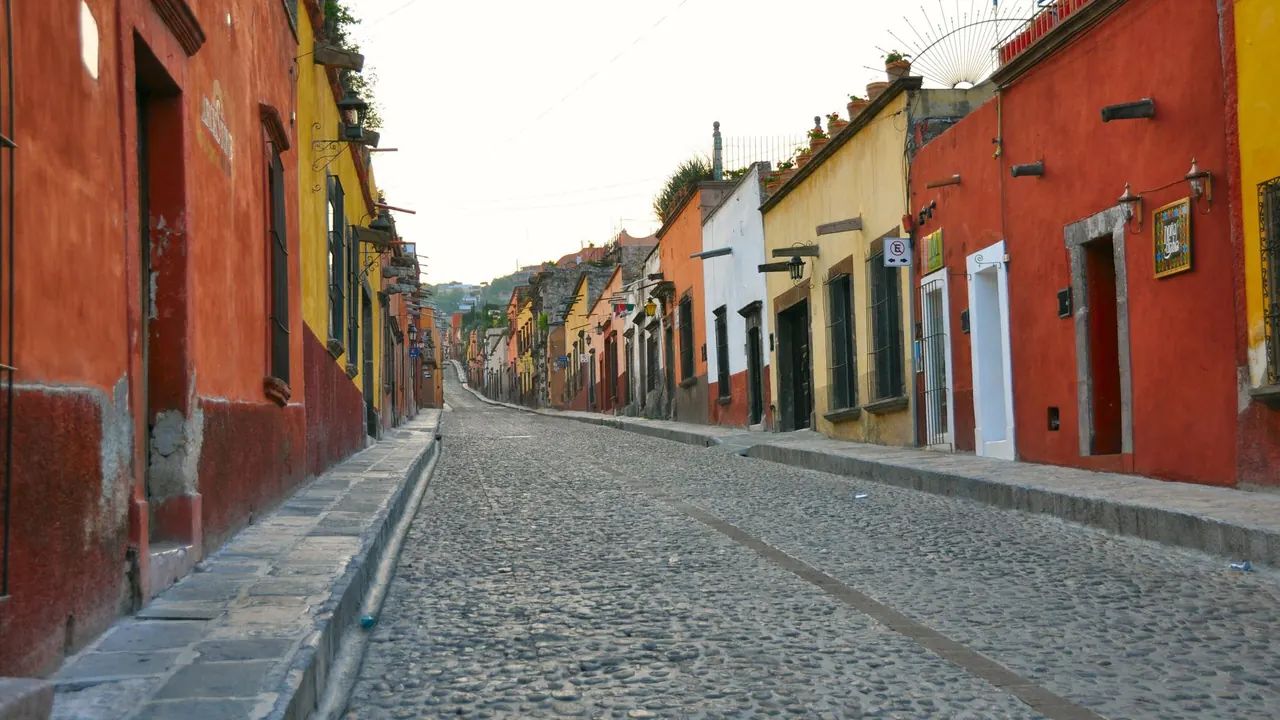
A cobbled street of painted houses in the old town
- Day trips77
- Wellness & relaxation66
- Food & drink62
Photo: Russ Bowling, CC BY 2.0, cropped
Match
48
Every category weighted equally
- Beach & sun44
- Culture & arts53
- Food & nightlife50
- Family trip45
- Outdoors49
- Relax & unwind48
- Shopping & style51
- On a budget48
San Miguel de Allende in twelve categories
Our verdict on each, scored 0 to 100 against the same fixed benchmark cities, so a score means the same thing on every page.
Beaches & swimming. Scores 4 out of 100.
Food & drink. Scores 62 out of 100.
Culture & sights. Scores 62 out of 100.
Nightlife. Scores 38 out of 100.
Nature & outdoors. Scores 40 out of 100.
Day trips. Scores 77 out of 100.
Good for families. Scores 32 out of 100.
Getting around. Scores 48 out of 100.
Shopping & style. Scores 55 out of 100.
Affordability. Scores 50 out of 100.
Live music & performing arts. Scores 40 out of 100.
Wellness & relaxation. Scores 66 out of 100.
San Miguel de Allende category by category
Beaches & swimming
4San Miguel de Allende sits on the high central plateau, many hours' drive from the Pacific or the Gulf, so there is no beach life at all. Swimming means a hotel pool or the warm spring-fed pools in the countryside nearby, which are a place to soak rather than swim. Anyone who wants sea and sand should plan a separate leg of the trip.
Food & drink
62For a town of its size San Miguel eats remarkably well. Around the Jardín and the streets that run off it there are rooftop terraces looking over the Parroquia, courtyard restaurants in colonial houses and chefs reworking Bajío ingredients such as nopal, mesquite and local cheeses. At the cheaper end there are gorditas and tamales from street stalls, the evening taco carts, the Mercado Ignacio Ramírez and the Sunday tianguis, where weekenders and local families eat side by side.
Mezcal and tequila bars are everywhere, and the wineries of Guanajuato's high desert supply a fair share of the wine lists. The cooking is good rather than deep, though. A large part of the scene caters to foreign residents and weekend visitors, and after a week the menus start to look alike.
Culture & sights
62The town itself is the attraction. Its UNESCO-listed centre is a hillside grid of cobbled streets, ochre and terracotta façades, carved doorways and quiet courtyards, and it is dominated by the pink neo-Gothic spires of the Parroquia de San Miguel Arcángel on the main square. Within a few blocks are the baroque Oratorio de San Felipe Neri, the church of San Francisco, the Templo de la Concepción with its tall dome, and the Casa de Allende museum in the birthplace of the independence hero.
The former convent that houses the Centro Cultural Ignacio Ramírez, known as Bellas Artes, has an unfinished Siqueiros mural, and art schools and galleries are part of the town's identity. Major museums are missing, though, and a visitor can cover the main sights in two unhurried days.
Nightlife
38Evenings here start with a drink on a rooftop as the Parroquia lights up, then move to mezcal bars and cantinas in the streets around the Jardín. On Friday and Saturday nights, when visitors arrive from Mexico City and Querétaro, the centre stays busy until late and a few dance bars keep going into the early hours. During the week, and for the many older residents, the night tends to end soon after dinner. It is a sociable, pleasant place for drinks, but anyone looking for a real club scene will find very little.
Nature & outdoors
40The town looks out over the semi-arid highlands of the Bajío, a landscape of scrub, cactus and mesquite under a big dry-season sky. On the edge of town El Charco del Ingenio is a botanical garden and nature reserve built around a canyon, with walking trails among cacti and views over the Allende reservoir. Horse riding on the ranches, mountain biking on dirt roads and dawn hot-air balloon flights over the valley are the main outdoor activities.
The summer rains turn the hills briefly green, and the clear, mild winters are the best time for walking. There are no real mountains, forests or water sports, so outdoor time works best as a morning out between days in town.
Day trips
77Day trips are one of the best reasons to stay here. Guanajuato, a silver-mining city of painted houses packed into a ravine and threaded by underground roads, is a little over an hour away. The colonial centre of Querétaro, with its aqueduct and baroque convents, is about an hour away. Closer still is the Sanctuary of Atotonilco, a church whose interior is covered in folk-baroque murals and which shares the town's UNESCO listing.
Dolores Hidalgo, where the independence war began and where talavera pottery is made, is under an hour north. You can also visit the half-ruined mining town of Mineral de Pozos, the pyramid site of Cañada de la Virgen, Bernal at the foot of its great monolith, and the vineyards of the Guanajuato and Querétaro wine country. Buses link the cities, but the smaller places need a car or a driver.
Good for families
32San Miguel is an adult town of galleries, restaurants and rooftop bars, with almost nothing designed for children. The steep cobbled streets and narrow, uneven pavements make pushchairs hard work. On the other hand, the centre is small and relaxed, the Jardín is full of balloon sellers and families in the evening, and Mexican culture welcomes children everywhere. Older children will enjoy the warm spring pools, a horse ride or the fireworks and parades of the town's many fiestas, but younger ones may soon run out of things to do.
Getting around
48The historic centre is small enough that everything a visitor wants is within a walk of the Jardín. The walking itself takes effort, though. The streets are steep and paved with uneven stones, the pavements are narrow and the altitude of about 1,900m makes the climbs feel harder, so flat, sturdy shoes matter. Local buses exist but visitors rarely use them, and taxis are cheap for trips up the hill or to the hot springs. There is no airport in town, so arrival means a shuttle from Querétaro or León, and most day trips beyond the bus routes to Guanajuato and Querétaro need a driver, a tour or a hire car.
Shopping & style
55Shopping here means crafts, art and things for the house, not fashion. The Mercado de Artesanías runs down a stepped lane full of punched tin lanterns, blown glass, papier-mâché, embroidered textiles and silver jewellery. Around the centre, design shops sell carved furniture, talavera tiles, rugs and folk art from across Mexico, often of high quality. A former textile mill on the north edge of town is filled with artists' studios, galleries and antique dealers. There are no big brands or department stores, and the best of the décor shops are aimed at buyers furnishing a second home.
Affordability
50San Miguel is one of the more expensive places to visit in Mexico. Much of its accommodation is in boutique hotels in colonial houses, and restaurants around the Jardín charge prices aimed at foreign residents and weekend visitors from the capital. Rooms are dearest at weekends and during the big festivals. Costs drop quickly away from the centre, though. Street food, market lunches, local cantinas and taxis are still cheap, and most of the sights are churches and streets that cost nothing to enjoy.
Live music & performing arts
40For its size, the town has a lot of music. The Teatro Ángela Peralta, a nineteenth-century theatre, hosts concerts, dance and visiting productions, and long-established chamber music and jazz festivals fill the calendar in their seasons. Every evening mariachi bands play for hire on the Jardín, and many bars and restaurants have live guitar, son or rock. The big fiestas, especially the Alborada for the patron saint and the processions of Holy Week, bring street music and traditional dance. Outside the festivals, the formal programme is thin and mostly amateur or touring.
Wellness & relaxation
66Much of San Miguel's appeal is its pace. Mornings are spent with coffee in a courtyard and afternoons on a quiet rooftop, and the dry, mild climate suits doing very little. The main draw for wellness is the warm mineral springs in the valley towards Atotonilco, about fifteen minutes away. There, open-air pools and domed grottoes fed by naturally hot water make a relaxing half day, best on a weekday morning. In town, day spas, massage studios, temazcal sweat lodges and yoga classes cater to the large resident community. Weekend crowds and church bells are the only real disturbance.
When should you go?
Pick a month to see what it is like. The climate figures are measured averages, not a forecast.
San Miguel de Allende in July
Daytime high, °C
Rainfall in the month, mm
The whole year
Shaded against this city’s own year: the deepest cell is its best month for that figure and the palest its weakest.
Where the figures come from
San Miguel de Allende's temperatures are measured 54 km from the centre, at Guanajuato, Gto..
San Miguel de Allende has no rain gauge within 25 km of the centre, so its rainfall comes from a gridded climate dataset read at the city rather than from a gauge further away.
Temperature and rainfall are climate normals, averaged over the years shown. San Miguel de Allende: 1991-2020 normals, Guanajuato, Gto. (53.7 km from centre).
Before you go
| Measure | San Miguel de Allende |
|---|---|
| Official language | Spanish, Nahuatl, Yucatec Maya |
| Currency | Mexican Peso (MXN) |
| Sockets | AB127 V, 60 Hz |
| Driving side | Right |
| Time zone | UTC-6 |
| Emergency number | 911 |
| Elevation | 1,900 m |
| Main airport | Guanajuato International Airport (BJX)77 km from centre22 non-stop destinations |
| Public holidays this year | 9 days |
By the numbers
| Measure | San Miguel de Allende |
|---|---|
| City population | 69,811 |
| Museums within 10 km | 2 |
| UNESCO World Heritage sites within 50 km | 2 |
Compare San Miguel de Allende with
Every comparison with a written verdict behind it.