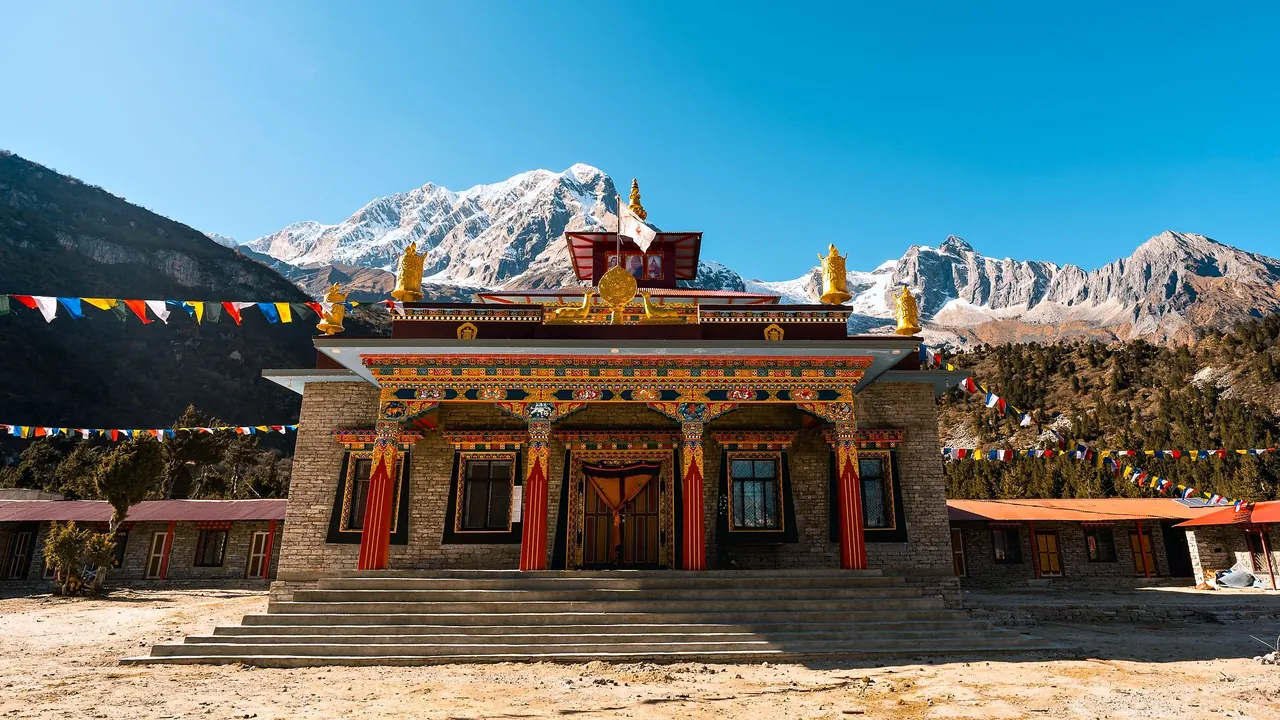
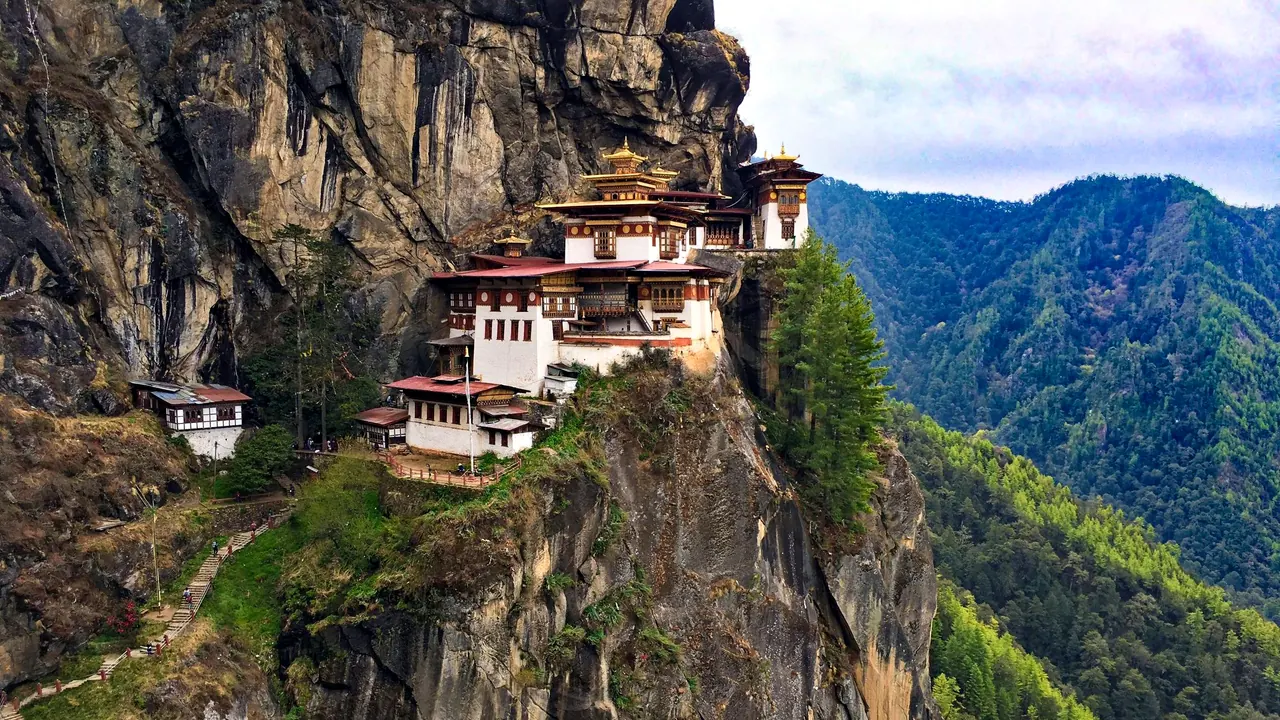
Photos: Nepal by Arjay Neyra, Pexels License; Bhutan by Peng Lim, Pexels License.
Nepal or Bhutan?
Our verdict in twelve categories, each scored against the same fixed benchmark cities, and the climate month by month, so you can choose for your trip.
Choose Nepal for
- prices
- food and drink
- day trips
Nepal suits travellers who want freedom and range for little money. Its Himalaya has the widest choice of treks anywhere, from Poon Hill to Everest base camp. The temples and Durbar Squares of the Kathmandu Valley sit close enough together to explore day by day, and guesthouses and dal bhat cost very little. The roads between Kathmandu, Pokhara and Chitwan are slow and tiring, but you get more to eat, buy and do in the evenings.
Choose Bhutan for
- live music and the arts
- wellness
- getting around
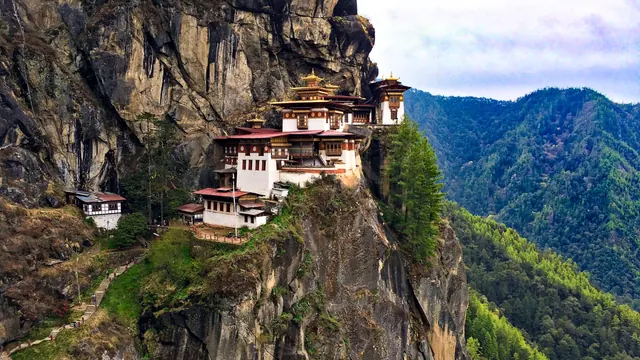
For a calmer, more ordered journey, Bhutan is the better pick, as long as you accept its fixed daily cost. A guide and driver handle the logistics, and the western valleys of Paro, Thimphu and Punakha lie close together. The dzongs, the Tiger's Nest and the masked tshechu festivals give a trip a clear shape. Farmhouse stone baths, light traffic and slow valleys such as Bumthang make it the more restful of the two.
Scoreboard
Twelve categories on one fixed scale from 0 to 100. The shaded stretch is the gap between the two.
Your match
Pick a travel style or drag the sliders, and both match scores follow your weighting.
Wins on prices and food and drink with your weighting.
Wins on live music and the arts and wellness with your weighting.
What matters to you?
Category by category
What the scores mean for a trip.
Beaches & swimming
Neither country has a coast, so this is a draw by absence. Only the use of the water differs: Nepal's Phewa Lake at Pokhara is for rowing boats and mountain reflections and its rivers are for rafting, while Bhutan's high lakes are sacred and left alone. In both cases, time by the sea means a separate trip.
Food & drink
Nepal gives you more to eat. Beyond dal bhat and momos, the Newari cooking of Patan, Bhaktapur and old Kathmandu offers beaten rice, spiced buffalo and Bhaktapur's thick sweet yoghurt. In Pokhara and up the Kali Gandaki valley you find Thakali sets, a more refined take on the national meal, and Thamel and Lakeside have broad menus when you want a change.\n\nBhutan's cooking is narrower and hotter, built around ema datshi, red rice and butter tea, and guided tours tend to serve mild buffets unless you ask for local food. Its highlights are Thimphu's weekend market and Bumthang's buckwheat noodles and apple brandy. Neither country is a place to travel to for fine dining.
Where in Nepal: Kathmandu Valley, Bhaktapur, Pokhara
Where in Bhutan: Thimphu, Paro, Bumthang
Culture & sights
The two are evenly matched, but their heritage is laid out differently. Nepal's is concentrated. Three Durbar Squares in Kathmandu, Patan and Bhaktapur, plus Swayambhunath, Boudhanath and Pashupatinath, all lie within one valley, so a few days from a single base cover a great deal. Patan's museum is also better than anything in Bhutan's modest collections.
Bhutan's heritage is spread from valley to valley, with a fortress-monastery at the centre of each: Punakha Dzong, Rinpung above Paro, Trongsa along its ridge. The cliff-hung Tiger's Nest and Bumthang's ancient temples are the high points, and the chortens and painted farmhouses keep the tradition visible everywhere rather than gathered in one place.
Where in Nepal: Kathmandu Valley, Patan, Bhaktapur, Lumbini
Where in Bhutan: Paro, Punakha, Bumthang, Thimphu
Nightlife
Neither is a place for late nights, but Nepal at least has somewhere to go. Thamel's rooftop bars and cover bands fill with trekkers celebrating a finished route, and Pokhara's Lakeside offers a quieter drink by the water. In Bhutan the evening usually ends with dinner. Thimphu's weekend karaoke rooms and drayang dance bars are the whole scene, and Paro has little beyond hotel bars.
Where in Nepal: Thamel, Kathmandu, Lakeside, Pokhara
Where in Bhutan: Thimphu
Nature & outdoors
Both are superb mountain countries, but Nepal offers more variety and more freedom. The Everest and Annapurna regions, Langtang, Manaslu and the dry heights of Upper Mustang have treks from a few days to several weeks, with teahouses along the way. In the lowlands you can see rhinos and tigers in Chitwan, raft the Trishuli or paraglide over Pokhara.
Bhutan's wild country feels emptier and more heavily forested. Day hikes from the Paro and Haa valleys, the Jomolhari trek and the very hard Snowman route are the main walks. The black-necked cranes of the Phobjikha valley are a winter sight Nepal cannot match, though Bhutan's high peaks are closed to climbing.
Where in Nepal: Annapurna region, Everest region, Chitwan National Park, Langtang
Where in Bhutan: Paro and Haa valleys, Jomolhari, Phobjikha valley, Punakha
Day trips
Nepal works better for outings from a fixed base. From Kathmandu, Kirtipur, Bungamati, Changu Narayan and Panauti are easy half or full days out, as is Dhulikhel combined with Namobuddha. The old hill bazaar of Bandipur is about two hours from Pokhara.
Bhutan's itineraries follow one road from valley to valley, so day trips are fewer. From Paro, the classics are Thimphu and the drive over Chele La to the Haa valley, and from Thimphu or Punakha the Dochula pass and Chimi Lhakhang are short drives. Further east, the distances stretch any outing well past a comfortable day.
Where in Nepal: Kathmandu Valley, Panauti and Dhulikhel, Bandipur
Where in Bhutan: Paro, Thimphu, Punakha
Good for families
Neither country is built around children, but Nepal has more to keep them busy. Pokhara's lake boats and landing paragliders, and Chitwan's jeep and canoe outings past rhinos and crocodiles, are real highlights. Against them weigh dusty Kathmandu, long road days and frequent stomach upsets.
Bhutan is safe and calm, yet most days are temples, drives and steep walks. The Paro valley makes the best base, with river walks, village archery and the Tiger's Nest climb, where older children can ride ponies for part of the way. Thimphu's takin preserve is a good outing too.
Where in Nepal: Pokhara, Chitwan National Park
Where in Bhutan: Paro, Thimphu, Punakha
Getting around
Both countries are slow to cross, but Bhutan is the less tiring. A guide and driver take care of the logistics, and the western valleys of Paro, Thimphu and Punakha lie close together, with small towns you can walk. Only heading east commits you to several long road days.
In Nepal you arrange more yourself. The drive from Kathmandu to Pokhara takes most of a day and mountain roads get blocked in the monsoon. Cloud often delays the flights to Lukla, Pokhara and Bharatpur, so most visitors leave spare days.
Where in Nepal: Kathmandu Valley, Pokhara
Where in Bhutan: Paro, Thimphu, Punakha
Shopping & style
Both are craft countries with no fashion shopping, but Nepal has the wider range. You can browse Patan's cast bronzes, Bhaktapur's pottery and carved wood, Boudhanath's thangkas and the pashmina, singing bowls and trekking gear in Thamel's lanes. Much of what Thamel sells is mass-produced, though, and haggling is expected.
Bhutan's best buys are narrower in range: handwoven textiles, from kira and gho cloth to Bumthang's yathra wool. Thimphu's craft bazaar and workshops are the best place to buy them, and Paro's main street sells masks and prayer flags.
Where in Nepal: Patan, Bhaktapur, Thamel, Kathmandu, Boudhanath
Where in Bhutan: Thimphu, Bumthang, Paro
Affordability
This is the widest gap between the two. Nepal is about as cheap as travel gets, with guesthouses, meals and taxis in Kathmandu and Pokhara costing very little. The real costs are permits, guides, mountain flights and Chitwan's safari lodges.
Bhutan makes cheap travel impossible by design. Most foreign visitors pay a daily development fee on top of hotels and a licensed guide and driver, which sets a high minimum cost for every day of the trip, however simple your tastes.
Live music & performing arts
Bhutan is the better choice here, as long as you time your visit. The tshechu festivals in Paro and Thimphu in spring and autumn, with masked cham dances in dzong courtyards over several days, are worth planning a whole trip around. Smaller festivals take place in Bumthang through the year, and Thimphu's Royal Academy of Performing Arts preserves the dances.
In Nepal, performance is more something you come across. There is devotional singing at Swayambhunath and Pashupatinath, folk dance shows over dinner, Tharu stick dances near Chitwan, and Valley festivals such as Indra Jatra if your dates happen to coincide.
Where in Nepal: Kathmandu Valley, Chitwan National Park
Where in Bhutan: Paro, Thimphu, Bumthang
Wellness & relaxation
Bhutan is the more restful country. Its own bathing ritual, the hot-stone dotsho, is easy to try in Paro farmhouses. The lodges of Paro and Punakha run serious spas with Himalayan herbs, and Bumthang's wide valleys and light traffic make doing nothing feel natural.
In Nepal you find rest away from noisy Kathmandu. Pokhara has yoga centres and a slow lakeside pace, and the monasteries around Boudhanath run meditation courses. Cheap massage for tired trekking legs is everywhere, and there are a few rustic hot springs such as Tatopani.
Where in Nepal: Pokhara, Boudhanath, Kathmandu Valley, Annapurna region
Where in Bhutan: Paro, Punakha, Bumthang
When should you go?
Pick your month, and for a country the place in it. The climate figures are measured averages, not a forecast.
Where in Nepal
Kathmandu (Nepal) in July
Thimphu (Bhutan) in July
Daytime high, °C
Rainfall in the month, mm
Where the figures come from
Thimphu (Bhutan) has no weather station within reach, so its figures come from a gridded climate model rather than a measured record, and read a broad area rather than one spot.
Temperature and rainfall are climate normals, averaged over the years shown. Kathmandu (Nepal): 1991-2020 normals, Kathmandu Airport (4.7 km from centre). Thimphu (Bhutan): 1991-2020 normals, TerraClimate 4 km grid at the town, no weather station within 90 km.
Neither country has a beach season, so the calendar is about clear skies and dry trails. Nepal is at its best in October and November. The monsoon has passed, Kathmandu sees almost no rain by November and the long sunny days bring the clearest mountain views. March and April are the second window, warm in Kathmandu and Pokhara, with rhododendrons in bloom. From June to September the monsoon takes over. Kathmandu gets about 384mm in July and Pokhara far more, close to 674mm, and the peaks disappear behind cloud.
Bhutan follows the same pattern but is cooler. Daytime highs in Thimphu run from about 12°C in January to 23°C at the height of summer, so winters are crisp, while Kathmandu stays pleasant for walking the streets in December and January. Thimphu's monsoon is lighter than Nepal's but still makes July and August wet, and the roads less reliable. Spring and autumn suit both countries, and from late October Bhutan adds the wintering cranes of the Phobjikha valley.
Which traveller are you?
For a relaxing and wellness trip, Bhutan does it better. Hot-stone dotsho baths in Paro farmhouses, spa lodges in Punakha and the slow valleys of Bumthang build rest into the trip. Nepal has yoga in Pokhara and meditation near Boudhanath, but no bathing tradition.
On an outdoors trip, Nepal comes out ahead on sheer choice. The Everest and Annapurna regions, quieter Langtang and the rhino country of Chitwan offer treks of every length with teahouses along the way. Bhutan's Jomolhari route and Paro valley hikes are fewer and usually guided.
More comparisons
Each shares a side with Nepal or Bhutan.
Where else could you go?
Set Nepal or Bhutan against any other country.