South Korea
Gyeongju
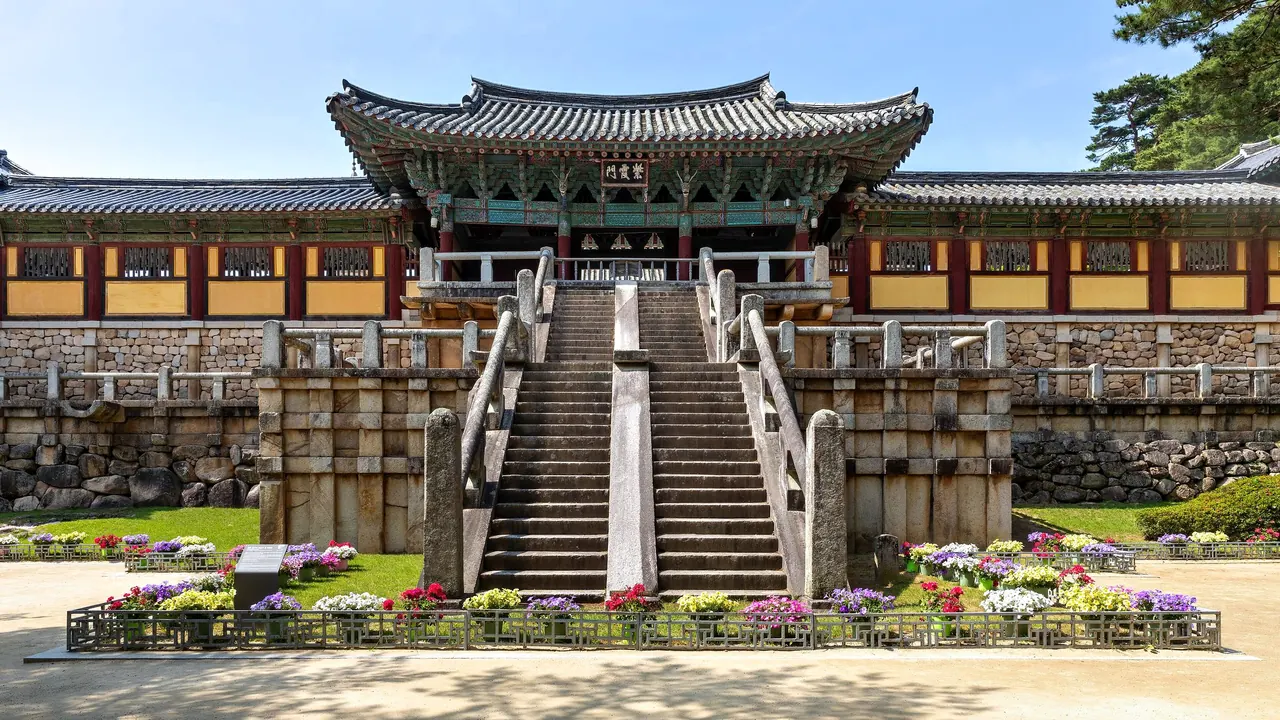
The stone stairways at the entrance to Bulguksa Temple
- Culture & sights80
- Day trips72
- Nature & outdoors62
Photo: Basile Morin, CC BY-SA 4.0, cropped
Match
49
Every category weighted equally
- Beach & sun48
- Culture & arts51
- Food & nightlife42
- Family trip54
- Outdoors55
- Relax & unwind51
- Shopping & style45
- On a budget50
Gyeongju in twelve categories
Our verdict on each, scored 0 to 100 against the same fixed benchmark cities, so a score means the same thing on every page.
Beaches & swimming. Scores 30 out of 100.
Food & drink. Scores 42 out of 100.
Culture & sights. Scores 80 out of 100.
Nightlife. Scores 15 out of 100.
Nature & outdoors. Scores 62 out of 100.
Day trips. Scores 72 out of 100.
Good for families. Scores 58 out of 100.
Getting around. Scores 55 out of 100.
Shopping & style. Scores 28 out of 100.
Affordability. Scores 60 out of 100.
Live music & performing arts. Scores 20 out of 100.
Wellness & relaxation. Scores 60 out of 100.
Gyeongju category by category
Beaches & swimming
30Gyeongju is an inland city of tombs and temples, but its territory reaches east to the coast of the East Sea, about forty minutes away by bus or car. Small sandy and pebbly beaches line the shore at Bonggil, Jeonchon and Gampo, and the sea reaches around 24°C at the height of summer. The official swimming season is short, little more than July and August, and the water is cold for the rest of the year.
The most famous stretch is Bonggil, where the rocks of Daewangam, the underwater tomb of King Munmu, sit just offshore. It makes a good half-day out, but nobody plans a stay here around the beach.
Food & drink
42Eating in Gyeongju is satisfying rather than deep. The local signature is ssambap, a table of a dozen or more side dishes with leaves for wrapping rice and grilled meat, served in the clusters of restaurants near the royal tombs. Hwangnam bread, a small round pastry filled with sweet red bean, is baked all over the centre and carried home by the box, and Gyochon village brews beopju, a clear, mellow rice wine.
Jungang and Seongdong markets have stalls for soups, rice cakes and fried snacks, and the hanok lanes of Hwangnidan-gil are full of cafés and casual places. Beyond Korean cooking the choice is thin, and fine dining is largely confined to the Bomun resort hotels.
Culture & sights
80For almost a thousand years Gyeongju was the capital of the Silla kingdom, and the city has been called a museum without walls. In the centre, the grassy burial mounds of Daereungwon rise between houses and streets, and Tumuli Park lets you walk into a tomb chamber. Nearby stand Cheomseongdae, one of Asia's oldest surviving observatories, the reconstructed pavilions of Donggung Palace on Wolji Pond, and the vast foundations of Hwangnyongsa temple. The Gyeongju National Museum holds gold crowns and the great bronze Emille Bell.
On the slopes of Tohamsan sit Bulguksa temple, with its stone stairways and pagodas, and the Seokguram grotto, whose granite Buddha is a masterpiece of East Asian sculpture. Both are UNESCO-listed. Allow two or three days for it all.
Nightlife
15Evenings in Gyeongju are quiet. Visitors come out to see the floodlit Donggung Palace and Wolji Pond, and afterwards the hanok lanes of Hwangnidan-gil have a few wine and cocktail bars along with places serving makgeolli and pub food. The older downtown has the usual Korean drinking restaurants with soju and grilled meat. There are no clubs to speak of, and most of the town is in bed early. A real night out means the train to Busan or Daegu.
Nature & outdoors
62The landscape around Gyeongju is green, rolling and studded with heritage. Namsan, the low mountain south of the centre, is crossed by trails past dozens of Buddhas and pagodas carved into the rock, so a half-day hike doubles as a walk through Silla belief. Tohamsan, above Bulguksa, is a little higher and wooded, and its ridges are known for sunrise views towards the sea.
The flat valley around the tombs and Bomun Lake is ideal for cycling, and the lake shore has a long path lined with cherry trees. The city looks its best in early April, when the blossom comes out, and in the autumn colour of late October and November. On the coast, the Yangnam shore has a walking path past columnar basalt formations.
Day trips
72Gyeongju is well placed in the southeast of Korea. From Singyeongju station the high-speed train reaches Busan, with its port, fish markets and seaside temples, in about half an hour, and Daegu takes even less. Yangdong, a UNESCO-listed village of aristocratic clan houses that is still lived in, is about forty minutes north, and Tongdosa, one of Korea's great monasteries, is a similar distance south.
Further afield, Andong's Hahoe folk village and Haeinsa temple, which keeps the woodblocks of the Tripitaka Koreana, are each roughly an hour and a half to two hours by road. Ulsan and the steel and seafood port of Pohang are close but mostly of local interest.
Good for families
58Gyeongju works well for families, largely thanks to the Bomun Lake resort area. It has a large amusement park with roller coasters and a water park, swan pedal boats and lakeside paths, and a bird park. Korea treats school groups as part of the landscape, so children are expected everywhere and the city is safe and clean.
In the centre, the grassy royal tombs and the flat paths around them are easy with a buggy, and renting a family bike or tandem is a classic outing. Children usually enjoy the gold crowns in the National Museum, the hands-on corners at the tomb sites and dressing up in hanbok. Bulguksa and Seokguram involve hills and steps, and the heritage focus can wear thin on younger children over several days.
Getting around
55The historic centre is the easy part. The tombs, Cheomseongdae, Wolji Pond, the National Museum and Hwangnidan-gil lie close together on flat ground, linked by footpaths and cycle lanes, and are best explored on foot or by rented bike. City buses run from the downtown terminals to Bomun Lake and Bulguksa, and on to the coast.
The main difficulty is distance. The high-speed station, Singyeongju, sits outside town, so arriving means a bus or taxi ride, and Seokguram, Yangdong and the sea are each a long bus journey on infrequent routes. Taxis are plentiful, and many visitors use them to link the outlying sites or hire a car for a day.
Shopping & style
28Shopping here is small-scale. Hwangnidan-gil, the lanes of tiled hanok houses near the tombs, has small shops selling stationery, ceramics, accessories and souvenirs designed around Silla motifs, and the bakeries do a brisk trade in boxed Hwangnam bread. Jungang and Seongdong markets sell dried seafood, local produce and everyday goods. Beyond that there are the usual chain stores downtown and the gift shops at the main sites. Serious shopping means Busan or Daegu.
Affordability
60Gyeongju costs less than Korea's big cities. Most of the historic centre, including the tomb parks and Wolji Pond surroundings, is free or nearly so, entry fees at the temples and museum are modest, and buses and bike hire cost little. Local meals in markets and simple restaurants are fair value, and hanok guesthouses and motels in the centre are reasonably priced on weekdays.
Costs rise at weekends, during cherry blossom and autumn foliage, and in the Bomun resort hotels, which are priced for domestic family breaks. Taxis between outlying sites add up quickly.
Live music & performing arts
20Live performance is a minor part of a visit. In the warmer months, traditional music and dance are staged in the open air in the Bomun Lake resort area, and costumed shows and evening spectacles on Silla themes are put on for tourists nearby. The municipal arts centre hosts touring concerts and Korean performances, mostly aimed at local audiences, and there is no regular opera, theatre or live music scene.
The moment to see performance here is the Silla Cultural Festival, held each autumn since the 1960s, when processions, court music, drumming and folk dance fill the streets around the royal tombs for several days.
Wellness & relaxation
60Gyeongju is one of the calmer places to stay in Korea. Hot-spring water feeds bathhouses and the spa floors of resort hotels around Bomun Lake, and the neighbourhood mogyoktang and jjimjilbang, with hot and cold pools, saunas and heated floors, are part of ordinary life here as anywhere in the country.
The deeper draw is the slow pace. Bulguksa and Golgulsa, a cave temple known for sunmudo martial arts and meditation, offer temple stays with early chanting, vegetarian meals and quiet. Mornings among the tombs, before the tour buses arrive, are gently restorative. Weekends and blossom season fill the town and break the calm.
When should you go?
Pick a month to see what it is like. The climate figures are measured averages, not a forecast.
Gyeongju in July
Daytime high, °C
Rainfall in the month, mm
The whole year
Shaded against this city’s own year: the deepest cell is its best month for that figure and the palest its weakest.
Where the figures come from
Gyeongju's temperatures are measured 25 km from the centre, at Pohang.
Gyeongju has no rain gauge within 25 km of the centre, so its rainfall comes from a gridded climate dataset read at the city rather than from a gauge further away.
Temperature and rainfall are climate normals, averaged over the years shown. Gyeongju: 1991-2020 normals, Pohang (25.3 km from centre).
Before you go
| Measure | Gyeongju |
|---|---|
| Official language | Korean, Korean Sign Language |
| Currency | Won (KRW) |
| Sockets | CF220 V, 60 Hz |
| Driving side | Right |
| Time zone | UTC+9 |
| Emergency number | Police 112, ambulance 119, fire 119 |
| Elevation | 46 m |
| Main airport | Gimhae International Airport (PUS)79 km from centre49 non-stop destinations |
| Public holidays this year | 18 days |
By the numbers
| Measure | Gyeongju |
|---|---|
| City population | 245,365 |
| People per km² | 185 |
| Museums within 10 km | 3 |
| UNESCO World Heritage sites within 50 km | 6 |
| Swim season, months above 21 °C | 4 months |
Compare Gyeongju with
Every comparison with a written verdict behind it.