United States
Sonoma
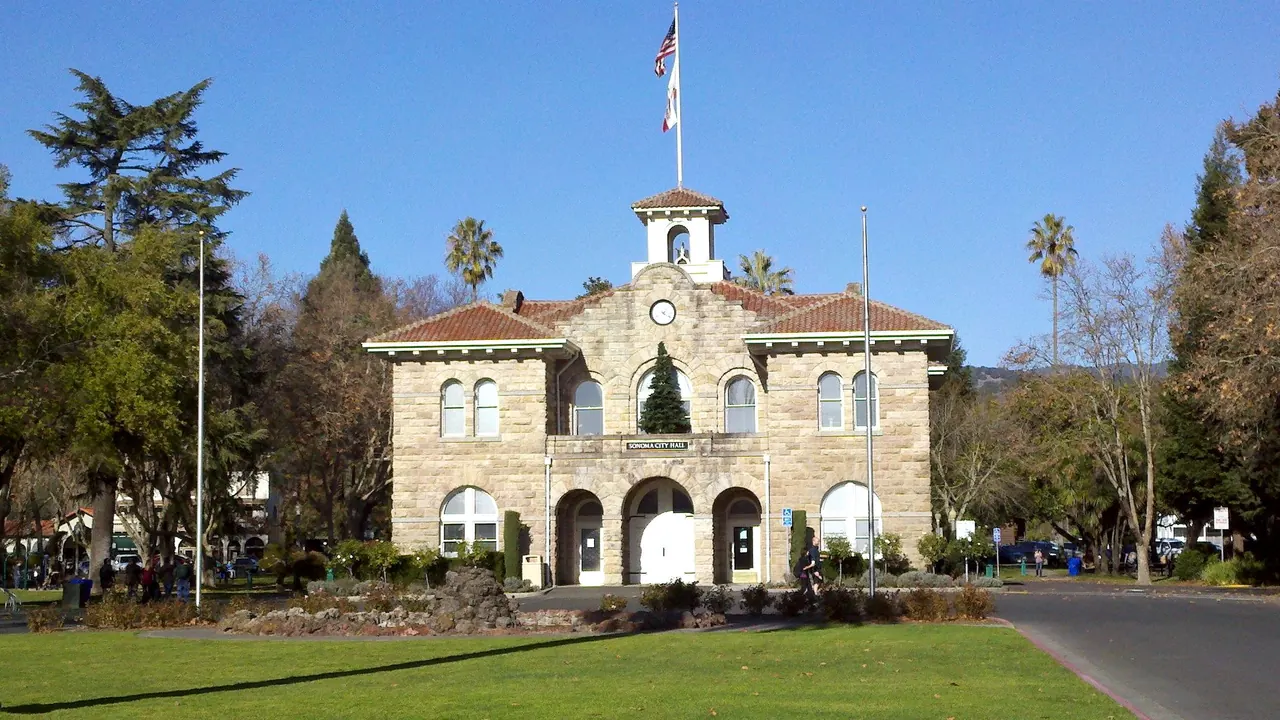
City Hall on Sonoma Plaza
- Day trips72
- Nature & outdoors68
- Food & drink64
Photo: Cullen328, CC BY-SA 3.0, cropped
Match
36
Every category weighted equally
- Beach & sun36
- Culture & arts36
- Food & nightlife34
- Family trip36
- Outdoors45
- Relax & unwind41
- Shopping & style36
- On a budget33
Sonoma in twelve categories
Our verdict on each, scored 0 to 100 against the same fixed benchmark cities, so a score means the same thing on every page.
Beaches & swimming. Scores 12 out of 100.
Food & drink. Scores 64 out of 100.
Culture & sights. Scores 30 out of 100.
Nightlife. Scores 10 out of 100.
Nature & outdoors. Scores 68 out of 100.
Day trips. Scores 72 out of 100.
Good for families. Scores 28 out of 100.
Getting around. Scores 24 out of 100.
Shopping & style. Scores 30 out of 100.
Affordability. Scores 12 out of 100.
Live music & performing arts. Scores 28 out of 100.
Wellness & relaxation. Scores 55 out of 100.
Sonoma category by category
Beaches & swimming
12Sonoma is an inland valley town, and the sea plays no part in a stay. The nearest coast, around Bodega Bay, is well over an hour's drive. It is a dramatic shore of headlands and coves, but the Pacific there stays around 12°C to 14°C, with strong currents and sneaker waves, so people visit to look rather than to swim.
In summer, swimming means a hotel pool or a drive to the gravel beaches of the Russian River, where the water warms up enough for a lazy afternoon. Anyone for whom swimming matters should treat it as an extra, not as a reason to come.
Food & drink
64Eating and drinking are the main reason most people come to Sonoma. The town is the historic heart of a wine valley, with tasting rooms around the plaza and dozens of wineries within a short drive. Cabernet, Zinfandel from old vines, Chardonnay and Pinot Noir from the cooler Carneros hills to the south are all a short drive away. The food matches the wine: seasonal Californian cooking built on local produce, cheese, olive oil and oysters from the nearby coast.
The limits come from size. This is a small town with a modest number of restaurants clustered around the plaza and in Glen Ellen, and there is little street food, late eating or variety of cuisines. It suits a couple on a long, slow lunch with a good bottle much better than a visitor who wants a different neighbourhood and cuisine every night.
Culture & sights
30Sonoma has a small but real historic core. The town grew up around its broad plaza, one of the largest in California, where the Bear Flag Revolt of 1846 briefly declared a California Republic. Facing it are Mission San Francisco Solano, the last and northernmost of the state's Franciscan missions, and the adobe Sonoma Barracks, both part of a state historic park. A short walk away is Lachryma Montis, General Vallejo's Gothic-style house set in its gardens.
Add a small art museum, old stone wineries and the ruins of Jack London's Wolf House in nearby Glen Ellen, and you have a pleasant half day of history rather than a cultural destination.
Nightlife
10Evenings in Sonoma are built around dinner. A few wine bars, a brewpub and a couple of saloons around the plaza keep some life going into the evening, and summer nights on the square can be pleasant. By late evening the town is quiet. There are no clubs and nothing runs late, and visitors who want a proper night out drive to Santa Rosa or go back to San Francisco.
Nature & outdoors
68The valley itself is the landscape: rolling vineyards between the Mayacamas range and the Sonoma Mountains, with oak woodland on the slopes and golden grass in the dry months. Trails start almost from the plaza, up to the Sonoma Overlook and into the hill parks around town. Jack London State Historic Park and Sugarloaf Ridge, with redwood groves, meadows and views from Bald Mountain, are a short drive up the valley. Quiet back roads through the vines are good for cycling, and hot-air balloons rise over the valley on calm mornings.
Spring, with green hills and wildflowers, and autumn harvest are the best times. In high summer the valley floor bakes, and the fire season can bring smoke. Within about an hour are the wild Sonoma Coast headlands, Point Reyes and the redwoods of Marin.
Day trips
72Sonoma sits well for day trips. San Francisco is about an hour's drive, close enough for a full day of the city's sights and neighbourhoods before returning to the quiet of the valley. Napa and its wine towns, Yountville and St Helena among them, are across the hills in under an hour. To the north, Healdsburg has a handsome plaza of its own and the Dry Creek and Alexander valleys around it.
Closer still are Petaluma, with its Victorian river town, Glen Ellen, and Sausalito and Tiburon on the bay. The catch is variety. Apart from San Francisco, most outings are another wine town or valley, and you will usually need a car.
Good for families
28Sonoma is safe, calm and easy to manage, but it is built around wine tasting, which leaves children with little to do. The plaza has a playground and plenty of space to run, and a miniature railway park just south of town is a favourite with small children. A wildlife park of African animals in the hills near Santa Rosa makes a good outing.
Beyond that, days revolve around tasting rooms and long lunches. Families usually do better making San Francisco their base and coming here for a day.
Getting around
24The historic centre around the plaza is compact and easy on foot, and a fair number of tasting rooms lie within a few blocks. Everything else, from wineries along the valley and up in the hills to the parks and the coast, is spread out. Local buses are infrequent and of little use to visitors. Most people hire a car, book a driver or join a tour for tasting days, which also solves the problem of who drives after the wine. Cycling on the flat valley roads is a pleasant alternative for nearby wineries.
Shopping & style
30Shopping in Sonoma means a slow stroll round the plaza and through its small arcades. You will find independent boutiques, home and kitchen shops, art galleries, olive oil and cheese, and above all wine, bought direct from the tasting rooms and wineries. It is pleasant and well stocked for gifts and food to take home, and the weekly summer farmers' market adds local produce. There is little fashion and no department stores, and nothing on a scale that makes shopping a reason to come.
Affordability
12Sonoma is an expensive place to stay. Rooms in town are few and priced for wine-country weekends, especially in summer and during the autumn harvest. Restaurants are aimed at a well-off visitor, and winery tasting fees mount up quickly over a few days. A car or a driver is close to essential, which adds more. Visitors on a tighter budget often stay in Santa Rosa or Petaluma, picnic among the vines and keep tastings to a few chosen wineries.
Live music & performing arts
28Sonoma's performing arts are mostly seasonal and small in scale. In summer, Broadway-style concerts are staged outdoors among the ruins and oaks of Jack London State Historic Park, and wineries host outdoor concerts. The 1930s theatre on the plaza mixes film with some live performances and festivals. For serious classical music, the Green Music Center at Sonoma State University, about half an hour away, has a fine concert hall that draws touring orchestras and soloists. Outside the summer months there is little to attend, and anyone after opera or theatre goes to San Francisco.
Wellness & relaxation
55Sonoma has one real bathing tradition, and it is small. At Boyes Hot Springs, on the northern edge of town, natural hot mineral water has drawn visitors for well over a century. It feeds the pools of a large historic resort spa that also sells day passes to non-guests. Beyond that, wellness means inn spas and massage studios around the valley. There is no public bathhouse culture, and nearly all bathing comes at resort prices. For mud baths and more hot springs, Calistoga is about an hour's drive over the hills.
What the town does well is pace. Mornings on a quiet plaza, long afternoons on a shaded terrace and early, silent evenings make it an easy place to rest for a few days. It suits a couple looking for a calm break with a spa day included, more than someone travelling for the bathing itself.
When should you go?
Pick a month to see what it is like. The climate figures are measured averages, not a forecast.
Sonoma in July
Daytime high, °C
Rainfall in the month, mm
The whole year
Shaded against this city’s own year: the deepest cell is its best month for that figure and the palest its weakest.
Where the figures come from
Sonoma has no rain gauge within 25 km of the centre, so its rainfall comes from a gridded climate dataset read at the city rather than from a gauge further away.
Sonoma's sunshine is measured 87 km from the centre, at Sacramento Executive Airport.
Temperature and rainfall are climate normals, averaged over the years shown. Sonoma: 1991-2020 (sunshine 1981-2010) normals, Napa / Middleton (17.8 km from centre).
Before you go
| Measure | Sonoma |
|---|---|
| Currency | US Dollar (USD) |
| Sockets | AB120 V, 60 Hz |
| Driving side | Right |
| Time zone | UTC-8, UTC-7 in summer |
| Emergency number | 911 |
| Elevation | 26 m |
| Main airport | Charles M. Schulz Sonoma County Airport (STS)39 km from centre14 non-stop destinations |
| Public holidays this year | 13 days |
By the numbers
| Measure | Sonoma |
|---|---|
| City population | 10,739 |
| People per km² | 1,513 |
| Museums within 10 km | 7 |
| UNESCO World Heritage sites within 50 km | 0 |
| Swim season, months above 21 °C | None |
Compare Sonoma with
Every comparison with a written verdict behind it.
- Alta, Utah
- Anaheim
- Bend
- Big Bear Lake
- Carmel-by-the-Sea
- Deer Valley
- Flagstaff
- Huntington Beach
- Jackson Hole
- Laguna Beach
- Las Vegas
- Los Angeles
- Mammoth Lakes
- Moab
- Monterey
- Napa
- Newport Beach
- Page, Arizona
- Palm Desert
- Palm Springs
- Park City
- Phoenix
- Portland
- Salt Lake City
- San Diego
- San Francisco
- San Jose
- Santa Barbara
- Santa Monica
- Scottsdale
- Seattle
- Sedona
- Snowbird
- South Lake Tahoe
- Sun Valley