China
Chengdu
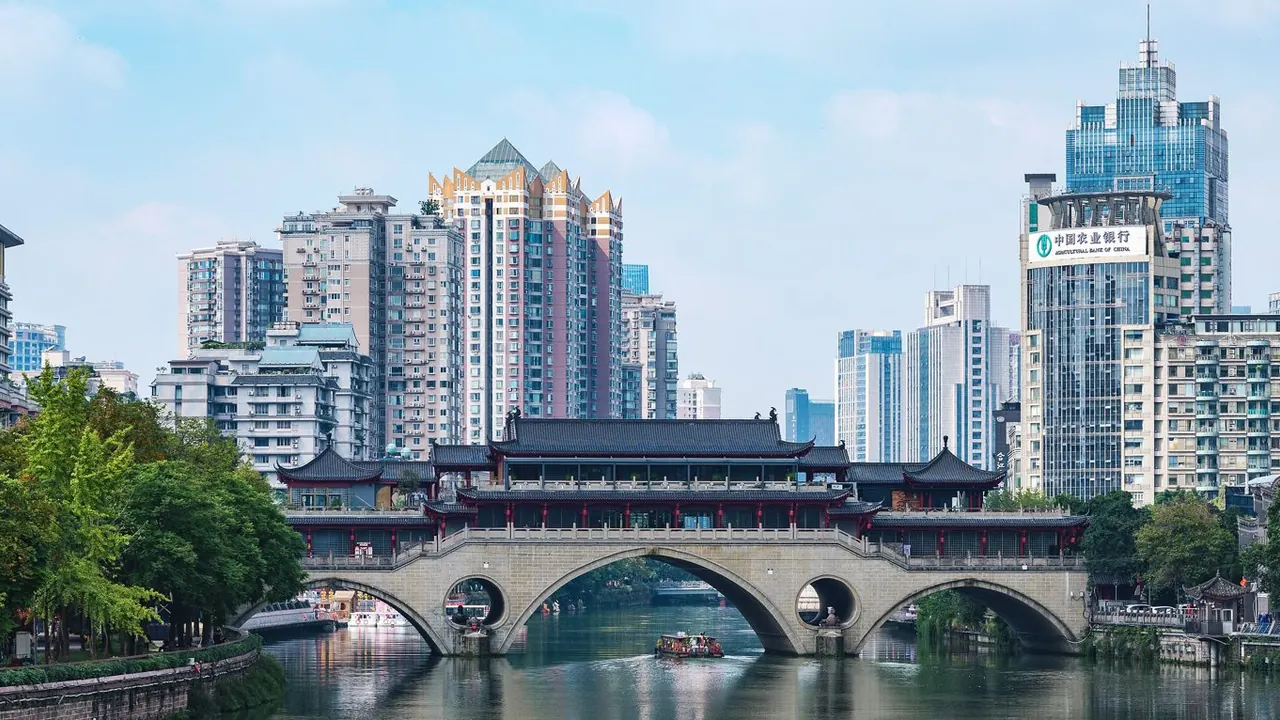
The Anshun Bridge over the Jin River
- Food & drink86
- Day trips80
- Affordable cities80
Photo: TurnOnTheNight, CC BY-SA 4.0, cropped
Match
63
Every category weighted equally
- Beach & sun59
- Culture & arts67
- Food & nightlife66
- Family trip62
- Outdoors65
- Relax & unwind60
- Shopping & style66
- On a budget65
Chengdu in twelve categories
Our verdict on each, scored 0 to 100 against the same fixed benchmark cities, so a score means the same thing on every page.
Beaches & swimming. Scores 5 out of 100.
Food & drink. Scores 86 out of 100.
Culture & sights. Scores 60 out of 100.
Nightlife. Scores 68 out of 100.
Nature & outdoors. Scores 68 out of 100.
Day trips. Scores 80 out of 100.
Good for families. Scores 65 out of 100.
Getting around. Scores 74 out of 100.
Shopping & style. Scores 64 out of 100.
Affordability. Scores 80 out of 100.
Live music & performing arts. Scores 50 out of 100.
Wellness & relaxation. Scores 58 out of 100.
Chengdu category by category
Beaches & swimming
5Chengdu sits in the middle of the Sichuan Basin, a very long way from any coast, so there is no beach life at all. Swimming means a hotel pool or one of the city's leisure water parks in the hot, humid summer. Anyone who wants sea and sand should plan it as a separate leg of the trip.
Food & drink
86Eating is the main reason many people come to Chengdu. This is the home of Sichuan cooking, built on the numbing tingle of Sichuan pepper and layered chilli heat: mapo tofu, twice-cooked pork, dan dan noodles, cold dishes dressed in red oil and the bubbling beef-tallow hotpot that the city eats late into the night. Skewers cooked in broth, spicy rabbit head and sweet tangyuan come from small family counters in every residential lane.
The range goes well beyond the fierce dishes, with many milder, sweet-and-sour and smoky preparations. Wet markets show off the region's produce, and teahouses in the parks serve jasmine tea poured from long-spouted kettles. International food and polished fine dining exist, but in less depth than the local kitchen. Visitors who cannot handle spice should ask for less heat, since the default is serious.
Culture & sights
60Chengdu is a mostly modern city with a set of good sights rather than a historic core. The Wuhou Shrine honours the Three Kingdoms statesman Zhuge Liang, the Du Fu Thatched Cottage is a garden memorial to the Tang poet, and the Wenshu Monastery and the Taoist Qingyang Palace are working places of worship. The Jinsha Site Museum shows the gold and jade of an ancient Shu kingdom, and the Sichuan Museum covers the province in depth.
The Kuanzhai Xiangzi lanes and Jinli street are rebuilt old quarters of grey-brick courtyards, pleasant but more setting than survival. Three or four days cover the city's own sights; the most famous heritage of the region needs a day out.
Nightlife
68Chengdu has a reputation within China as a city that stays out late. Evenings often begin with a long hotpot or skewer dinner and drift on to the bar streets along the Jin River around Jiuyanqiao, where neon-lit bars and clubs fill on weekends, or to the quieter craft-beer and cocktail spots of the consulate and Yulin districts. Late-night snack streets keep going well past midnight.
The mood is sociable and relaxed rather than edgy, and the big clubs lean towards table service and loud commercial music. It is a good place for a long night out with food at the centre, less so for anyone after a distinctive underground club culture.
Nature & outdoors
68The city itself lies on the flat, often hazy floor of the Sichuan Basin, with riverside greenways and parks for strolling and cycling. The landscape rises sharply to the west. Qingcheng Mountain, about an hour away, has forested Taoist trails and quiet back valleys, and Emeishan, a sacred peak above 3,000m, offers a long climb through cloud forest with wild monkeys on the paths.
The mountains towards Wolong hold panda reserves and bamboo forest, and the high plateau scenery of western Sichuan begins beyond them, though that needs several days. Summer is hot and humid and winter grey; spring and autumn are the best seasons for hiking.
Day trips
80Chengdu is a strong base for days out. The Leshan Giant Buddha, a Tang-era figure carved into a riverside cliff, is about an hour by high-speed train. Dujiangyan, an irrigation system in use for more than two thousand years, sits next to Qingcheng Mountain, and the Sanxingdui Museum, with its startling bronze masks from an ancient Shu culture, is around an hour north.
Closer in, old market towns such as Huanglongxi, Jiezi and Pingle keep wooden shophouses and teahouses along their streams. Emeishan's temples make a long day, and Chongqing, a very different hillside megacity, is under two hours by fast train for those who want a taste of it.
Good for families
65The Giant Panda Breeding Research Base is the highlight for children: pandas of all ages climbing, eating and sleeping in large wooded enclosures, best seen early in the morning when they are active. The city also has a zoo, an ocean-themed aquarium park, amusement parks on the outskirts and big parks where local families gather at weekends.
Chinese culture is warm towards children and the streets feel safe. The difficulties are practical: muggy summer heat, food that is spicy by default, distances across a huge city, and signs and menus that are often only in Chinese, so a parent who plans ahead with translation and payment apps will manage far more easily.
Getting around
74Chengdu's metro is extensive, clean and easy to follow, with signs and announcements in English, and it reaches the panda base area, the main sights, both airports and the high-speed rail stations. Ride-hailing and taxis fill the gaps cheaply, and shared bikes are everywhere on the flat streets.
The city is enormous, though, and sights sit far apart, so a day usually mixes long metro rides with walking. Daily life runs on mobile payment and Chinese-language apps, which a visitor should set up before arriving. The centre around Tianfu Square and Chunxi Road is pleasant on foot, with wide pavements and leafy side streets.
Shopping & style
64Shopping centres on Chunxi Road and the streets around it, where large malls carry international luxury and fashion brands, and on the low-rise shopping quarter of traditional-style buildings beside the Daci Temple. Chengdu is a fashion-conscious city, and the big malls are among the busiest in western China.
For something local, look for Shu brocade and Sichuan embroidery, both long-standing regional crafts, panda-themed everything, Sichuan pepper and chilli bean paste, and green teas from the surrounding mountains, sold in the tea markets on the city's edge. Independent boutiques and design shops exist in pockets but are not the main draw.
Affordability
80Chengdu is a very affordable city for a visitor. Comfortable and even upscale hotels cost far less than in Western capitals or in China's big coastal cities, a bowl of noodles or a plate of dumplings from a neighbourhood counter costs very little, and the metro and taxis are cheap. Most temples and museums charge modest fees or none.
Spending rises with imported wine and cocktails, international restaurants and the luxury malls, and popular hotpot places charge more than street stalls. Getting to the region's main day-trip sights adds train fares and entry tickets, but overall the money goes a long way.
Live music & performing arts
50Sichuan opera is the local performing tradition, and its face-changing, where performers swap masks in a flash, along with fire-spitting, puppetry and comic sketches, is staged nightly in variety shows for visitors. These are fun and accessible, if more showcase than full opera; the longer traditional pieces are harder to find.
Chengdu also has one of China's liveliest small-venue music scenes, with livehouses hosting indie bands, folk and the city's well-known Sichuan-dialect hip-hop. Classical concerts and touring productions play at the large theatres, but the formal scene is modest for a city of this size.
Wellness & relaxation
58Chengdu is known across China for an unhurried way of life, and visitors feel it most in the teahouses. In People's Park and the temple gardens, people spend whole afternoons in bamboo chairs over a bottomless cup of tea, playing mahjong or having their ears cleaned by roving specialists with long metal tools. Foot massage and Chinese massage parlours are on almost every street and cost little.
There is no historic bathing culture in the city itself; hot-spring resorts lie on the outskirts and in the hills towards Qingcheng. The streets, traffic and crowds of a megacity sit around these calm pockets, so rest here comes in stretches of an afternoon rather than as the rhythm of the whole stay.
When should you go?
Pick a month to see what it is like. The climate figures are measured averages, not a forecast.
Chengdu in July
Daytime high, °C
Rainfall in the month, mm
The whole year
Shaded against this city’s own year: the deepest cell is its best month for that figure and the palest its weakest.
Temperature and rainfall are climate normals, averaged over the years shown. Chengdu: 1991-2020 normals, Chengdu (4.5 km from centre).
Before you go
| Measure | Chengdu |
|---|---|
| Official language | Putonghua |
| Currency | Yuan Renminbi (CNY) |
| Sockets | ACI220 V, 50 Hz |
| Driving side | Right |
| Time zone | UTC+8 |
| Emergency number | Police 110, ambulance 120, fire 119 |
| Elevation | 500 m |
| Main airport | Chengdu Shuangliu International Airport (CTU)16 km from centre77 non-stop destinations |
| Public holidays this year | 6 days |
By the numbers
| Measure | Chengdu |
|---|---|
| City population | 20,937,757 |
| People per km² | 1,456 |
| Museums within 10 km | 10 |
| UNESCO World Heritage sites within 50 km | 0 |
Compare Chengdu with
Every comparison with a written verdict behind it.