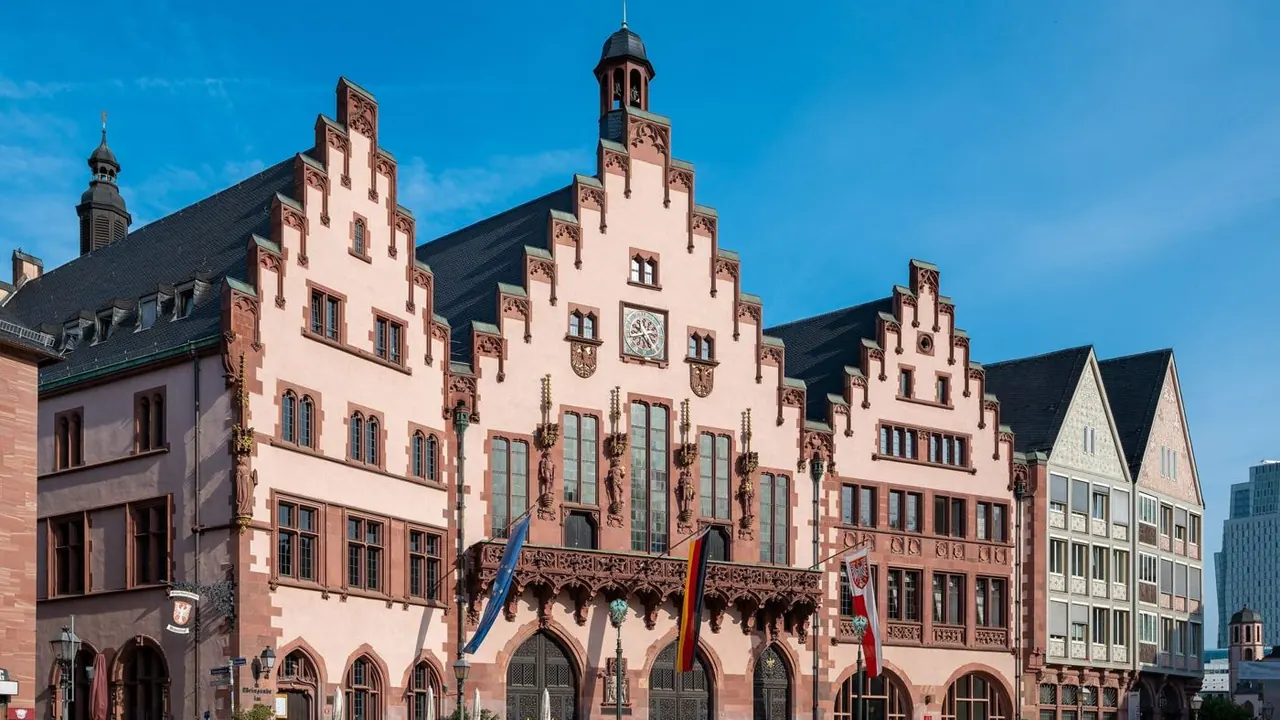
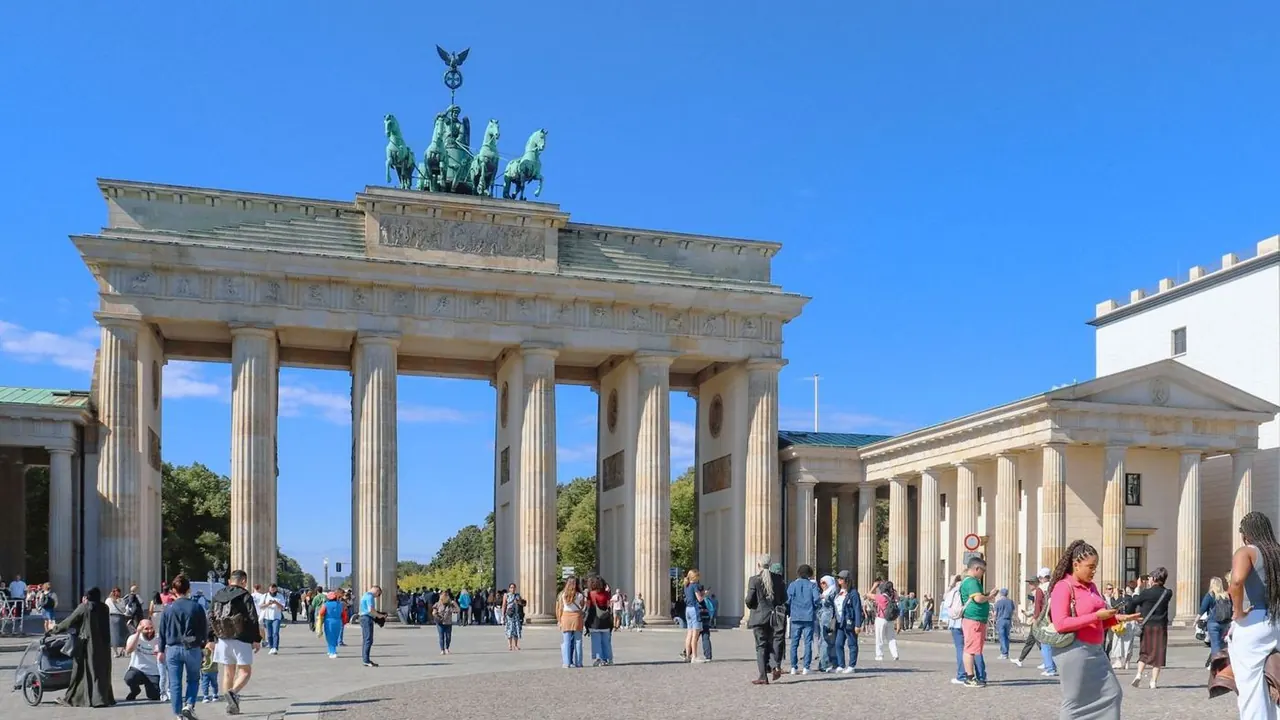
Photos: Frankfurt by Thomas Wolf, CC BY-SA 3.0 DE, cropped; Berlin by Claudia Solano, Pexels License.
Frankfurt or Berlin?
Our verdict in twelve categories, each scored against the same fixed benchmark cities, and the climate month by month, so you can choose for your trip.
Choose Frankfurt for
- day trips
- nature and the outdoors
Frankfurt works better as a base than as a destination in its own right. The compact old centre and the museums along the Main fill two or three days. After that the rail network takes over, with Heidelberg, the Rhine Gorge, Cologne and the Rheingau vineyards all within about an hour. Walkers and cyclists have the Taunus hills just outside the city, and anyone flying in lands a short train ride from the centre.
Choose Berlin for
- nightlife
- beaches
- culture and sights
Berlin suits travellers who want the city itself to be the trip. It has clubs and bars that carry on through the weekend, and Museum Island sits beside the places where the Wall and the Nazi era left their mark. There are three opera houses and the Philharmonic, and the food scene is built on its range of cooking. It also goes further on a moderate budget, and families do well with two large zoos and hands-on museums.
Scoreboard
Twelve categories on one fixed scale from 0 to 100. The shaded stretch is the gap between the two.
Your match
Pick a travel style or drag the sliders, and both match scores follow your weighting.
Wins on day trips and nature and the outdoors with your weighting.
Wins on nightlife and beaches with your weighting.
What matters to you?
Category by category
What the scores mean for a trip.
Beaches & swimming
Neither city has a sea, but Berlin makes much more of its lakes. Strandbad Wannsee, a historic lido with a long sandy shore, the Müggelsee and the forest lakes such as Schlachtensee and Plötzensee are all reachable by S-Bahn or bus. On a warm day, swimming in them is a real part of a Berlin summer.
Frankfurt has outdoor pools and gravel-pit lakes on its edge, of which the Langener Waldsee in the southern forest is the best, but nobody swims in the Main. In both cities the swimming season is July and August, and in neither is it a reason to choose the city.
Food & drink
Berlin eats better because of its range. Turkish bakeries and grill houses fill Kreuzberg and Neukölln, Vietnamese, Levantine and Korean cooking are everywhere, and there is a serious fine-dining tier. Market-hall street-food evenings and beer gardens fill in the rest.
Frankfurt has the stronger local tradition, though its menu is short. An evening in an apple-wine tavern in Sachsenhausen means long shared tables, tart Apfelwein from stoneware jugs, and Grüne Soße or Handkäs mit Musik. Beyond that and the Kleinmarkthalle, its international eating is solid rather than special.
Culture & sights
Berlin is in a different league here. Museum Island alone, with Nefertiti and the Pergamon collections, could fill a Frankfurt-length trip, and the Gemäldegalerie and Charlottenburg Palace come on top of that. What sets it apart is the twentieth century, seen at the Reichstag, the Wall Memorial on Bernauer Strasse and the Topography of Terror, all standing where the events took place.
Frankfurt's strength is concentrated on the Museumsufer, where the Städel is the one collection of international standing. The rebuilt Römer, the cathedral, the Paulskirche and Goethe's birthplace all sit within a short walk, with a skyline of towers above them. It is a satisfying two or three days, not a week.
Nightlife
Berlin is one of the cities people travel to just to go out. Its techno clubs in former factories and power stations have strict doors and no closing time, and parties run from Saturday night into Monday. Friedrichshain and Kreuzberg have corner Kneipen, cocktail bars and canal-side drinking for every other night of the week.
Frankfurt shares some of that electronic heritage through its history with Offenbach, but its club scene is small and only busy at weekends. The most interesting evenings are in the rough-edged Bahnhofsviertel and the cider taverns of Alt-Sachsenhausen, and early in the week the city is quiet.
Nature & outdoors
Frankfurt has the better countryside on its doorstep, because it has hills. The Taunus rises just beyond the suburbs to the Großer Feldberg at about 880m, with beech forest, Roman frontier trails and mountain-bike routes. The Stadtwald and the vineyard paths of the Rheingau add gentler walking.
Berlin's outdoors is mostly about water and open space. You can sail on the Havel, paddle on the Müggelsee, cycle the old Tempelhof runways or follow the Wall Trail around the former West. It is green and pleasant, but entirely flat.
Day trips
This is where Frankfurt pulls ahead. It sits at the centre of Germany's high-speed rail network, so Heidelberg, the castles of the Rhine Gorge and Cologne Cathedral are each about an hour away. Mainz, Wiesbaden and Darmstadt are closer still, and a week of trips would not use them all up.
Berlin has one outstanding outing in the palaces and gardens of Potsdam, plus Wittenberg, Leipzig, the Spreewald and the Sachsenhausen memorial. Dresden makes a long day, and beyond these the choice soon runs thin.
Good for families
Berlin gives children more to do. It has two big zoos: the Zoologischer Garten with its aquarium, and the leafy Tierpark in the east, which can fill a whole day. The Museum of Technology is full of trains and planes, and there are dedicated children's museums. Flat streets, playgrounds and lakes make the days easy.
Frankfurt's dinosaur hall at the Senckenberg is its star attraction, and the central zoo, the Palmengarten glasshouses and boat trips past the skyline fill a few days. Its compact centre is easier with small legs, but there is less to keep a family busy for a week.
Getting around
Both cities are easy without a car, but in different ways. Berlin is big, with Mitte, Kreuzberg, Prenzlauer Berg and Charlottenburg as separate centres linked by the S-Bahn Ring, trams and trains that run all night at weekends. It is completely flat, so cycling is often the nicest way to get between them.
Frankfurt's sights are packed into a centre you can cross on foot in minutes. One ticket network reaches out to the Taunus, Wiesbaden and Mainz, the airport is a quarter of an hour away by train, and the zones take a little getting used to.
Shopping & style
Berlin is the better place for independent and second-hand shopping. The Sunday flea markets at Mauerpark and Boxhagener Platz turn up East German curios, vinyl and old furniture. Mitte, Prenzlauer Berg and Kreuzberg are full of concept stores, record shops and vintage clothing, and KaDeWe's food hall is worth a visit on its own.
Frankfurt is more practical, with chain stores and malls on the Zeil and boutiques along Berger Straße. Oddly, it beats Berlin for luxury, since the jewellery and fashion houses of Goethestraße serve the banking crowd.
Affordability
Berlin is the cheaper city, mainly because its hotels are good value for a capital. Döner, Vietnamese canteens and corner bars make cheap eating easy. Museums and fine dining are the costs that add up.
Frankfurt's hotels are priced for business travellers and become scarce and expensive during the big trade fairs. Weekends and summer are noticeably cheaper, and the cider taverns and the Museumsufer pass help, so timing your trip matters more here than in Berlin.
Live music & performing arts
Berlin has far more on stage. The Staatsoper, the Deutsche Oper and the Komische Oper make three full opera houses, the Berlin Philharmonic plays in Scharoun's tent-like hall, and the Konzerthaus on the Gendarmenmarkt adds another classical calendar. Most plays at the Berliner Ensemble or the Volksbühne are in German, so visitors tend to choose opera, dance or the Friedrichstadt-Palast revue, and the jazz cellars and experimental music spaces fill the late evenings.
Frankfurt has only one opera company, but it is highly respected and known for bold productions. Concerts at the rebuilt Alte Oper, contemporary dance at Mousonturm and a long-running English-language theatre add a few good evenings. That theatre gives visitors who do not speak German something Berlin's drama stages rarely do. The season runs from autumn to early summer, so there is less on during a July or August trip.
Wellness & relaxation
The two are about even, but the relaxation is found in different places. Berlin's is in town: big clothes-free sauna complexes with infusion rituals, the columned halls of the Stadtbad Neukölln, and slow Sundays in café gardens.
Frankfurt has little of its own, but the old spa towns around it are excellent. Wiesbaden's Art Nouveau Kaiser-Friedrich-Therme runs on hot springs, and Bad Homburg's thermal baths sit at the foot of the Taunus. For real spring water, Frankfurt has more to offer.
When should you go?
Pick your month. The climate figures are measured averages, not a forecast.
Frankfurt in July
Berlin in July
Daytime high, °C
Rainfall in the month, mm
Temperature and rainfall are climate normals, averaged over the years shown. Frankfurt: 1991-2020 normals, Frankfurt Westend (2 km from centre). Berlin: 1991-2020 normals, Berlin / Alexanderplatz (0.9 km from centre).
The two cities have much the same central European climate and are at their best at the same time. From June to August daytime highs reach about 25°C in Berlin and 26°C in Frankfurt. That is warm enough for lake swimming in July and August, but summer also brings the most rain, and Berlin's July is its wettest month at 76mm. May and September are the most comfortable months for walking the streets, mild and sunny without the midsummer heat.
Frankfurt warms up a few weeks sooner and is already around 12°C in March, so an early spring trip is more pleasant on the Main than on the Spree. From November to February both cities are cold, grey and short of sunshine, with highs of only a few degrees. That is weather for museums, concerts and saunas rather than parks. Frankfurt's winter is also the wetter of the two.
Which traveller are you?
For a food and nightlife trip, Berlin is the clear choice. Its techno clubs in old power stations run from Saturday into Monday, and the Kneipen and canal-side bars hardly close. Kreuzberg's Turkish grills keep you fed in between, while Frankfurt only really fills up on Friday and Saturday.
On a culture and arts trip, Berlin gives you much more to see. There are Museum Island and the Gemäldegalerie, and memorials to the Wall and the Holocaust stand where those events happened. You can see opera at three houses or hear the Philharmonic. Frankfurt's Städel is excellent, but the city fills fewer days.
For an outdoors trip, Frankfurt has the advantage. The beech forests of the Taunus and the Großer Feldberg are under an hour away, flat cycle paths follow the Main, and the vineyard paths of the Rhine Gorge are an easy train ride. Berlin's lakes are lovely but the land is flat.
Before you go
| Measure | Frankfurt | Berlin |
|---|---|---|
| Official language | German | German |
| Currency | Euro (EUR) | Euro (EUR) |
| Sockets | CF230 V, 50 Hz | CF230 V, 50 Hz |
| Driving side | Right | Right |
| Time zone | UTC+1, UTC+2 in summer | UTC+1, UTC+2 in summer |
| Emergency number | 112 | 112 |
| Elevation | 101 m | 34 m |
| Main airport | Frankfurt Main Airport (FRA)13 km from centre281 non-stop destinations | Berlin Brandenburg Airport (BER)19 km from centre161 non-stop destinations |
| Public holidays this year | 10 days | 10 days |
By the numbers
| Measure | Frankfurt | Berlin |
|---|---|---|
| City population | 760,656 | 3,700,577 |
| People per km² | 3,063 | 4,153 |
| Museums within 10 km | 53 | 157 |
| UNESCO World Heritage sites within 50 km | 4 | 4 |
Where else could you go?
Every comparison below shares a destination with this one, so you can follow Frankfurt or Berlin somewhere new.
- Heidelbergvs Frankfurt
- Leipzigvs Berlin
- Stuttgartvs Frankfurt
- Colognevs Frankfurt
- Baden-Badenvs Frankfurt
- Dresdenvs Berlin