India
Kochi
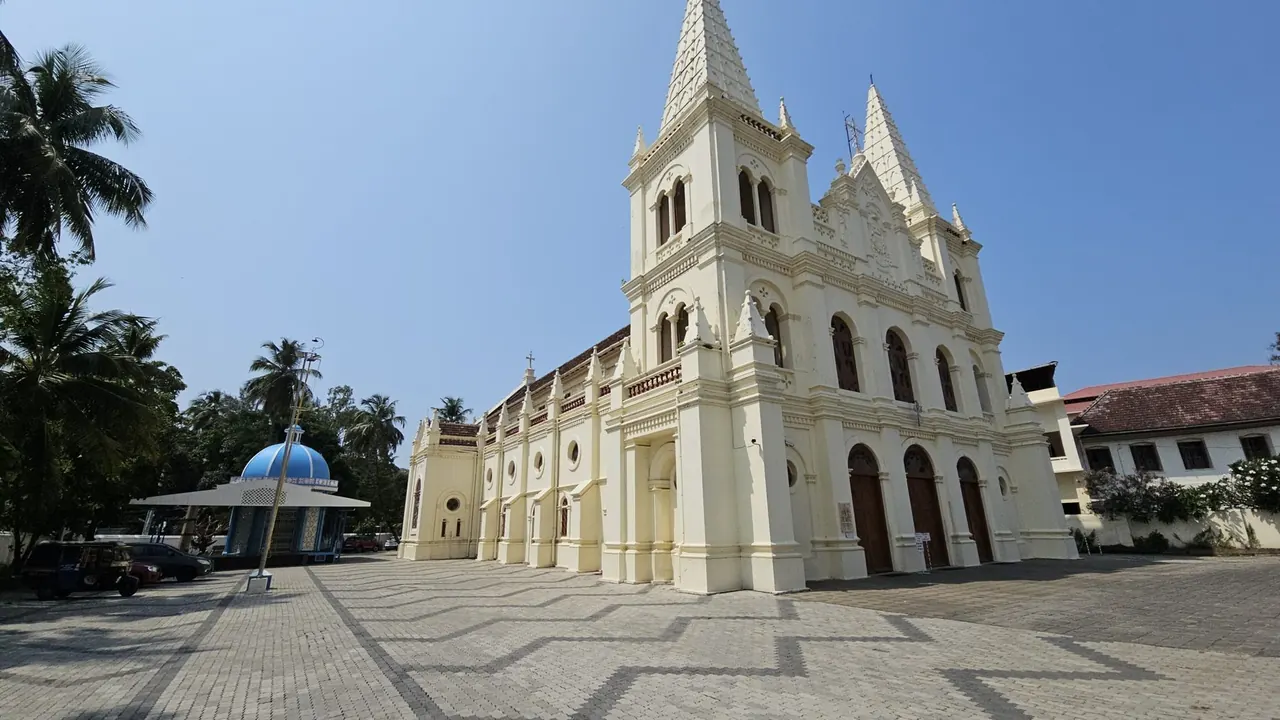
The Santa Cruz Cathedral Basilica in Fort Kochi
- Affordable cities88
- Wellness & relaxation70
- Food & drink66
Photo: Vis M, CC BY-SA 4.0, cropped
Match
52
Every category weighted equally
- Beach & sun53
- Culture & arts52
- Food & nightlife49
- Family trip54
- Outdoors55
- Relax & unwind56
- Shopping & style51
- On a budget56
Kochi in twelve categories
Our verdict on each, scored 0 to 100 against the same fixed benchmark cities, so a score means the same thing on every page.
Beaches & swimming. Scores 38 out of 100.
Food & drink. Scores 66 out of 100.
Culture & sights. Scores 62 out of 100.
Nightlife. Scores 18 out of 100.
Nature & outdoors. Scores 55 out of 100.
Day trips. Scores 52 out of 100.
Good for families. Scores 40 out of 100.
Getting around. Scores 44 out of 100.
Shopping & style. Scores 45 out of 100.
Affordability. Scores 88 out of 100.
Live music & performing arts. Scores 40 out of 100.
Wellness & relaxation. Scores 70 out of 100.
Kochi category by category
Beaches & swimming
38Kochi sits on the Arabian Sea, but it isn't a beach city. The strip of sand at Fort Kochi is for evening walks past the fishing nets, not for swimming. The water there is churned by harbour traffic and the shore is often littered. For a swim, people go to Cherai Beach on Vypeen island, about an hour north by road. It is a long, palm-backed stretch where the sea reaches about 28°C, with a backwater lagoon just behind the sand.
Timing matters. From roughly June to September the southwest monsoon brings heavy surf and strong currents, and swimming is unsafe along this coast. Even in the calm months from November to March, the beaches are something to fit into a stay rather than the reason for it.
Food & drink
66Kochi is one of the best places to eat Kerala food, and the cooking is unlike that of the rest of India. Coconut, curry leaf, black pepper and tamarind run through everything. Breakfast is appam with a mild coconut stew, or puttu with chickpea curry. Lunch is a rice meal served on a banana leaf. Seafood is the strength: pearl spot fried in a banana-leaf wrap, prawns roasted dry with shallots, and fish curry soured with kudampuli. The city's old communities each left a cuisine behind. Syrian Christian cooks make beef fry and duck roast, and Muslim kitchens make biryani and the rich Malabar snacks.
In Fort Kochi, stalls by the Chinese fishing nets sell the day's catch and cook it for you nearby. Ernakulam has the busy local meals halls and the better restaurants. Toddy shops on the edge of the backwaters serve palm wine with spicy food. Drinking is limited, though: alcohol is tightly controlled in Kerala, so a wine or cocktail culture hardly exists outside hotels.
Culture & sights
62Kochi's heritage is in Fort Kochi and Mattancherry, two neighbourhoods at the tip of the peninsula. Five centuries of spice trade built them. St Francis Church is one of the oldest European churches in India, and Vasco da Gama was first buried there. Santa Cruz Basilica stands a short walk away, among Dutch and Portuguese houses and old British bungalows. In Mattancherry, the Paradesi Synagogue of 1568 has a floor of hand-painted Chinese tiles. It stands at the end of Jew Town's lanes of former spice warehouses. Nearby, the Mattancherry Palace has some of the finest Hindu murals in Kerala.
The cantilevered Chinese fishing nets along the waterfront are the city's best-known image. Across the water in Tripunithura, the Hill Palace holds the collections of the former Cochin royal family. The Kochi-Muziris Biennale fills the old warehouses with contemporary art in the years it is held. Most sights are small and can be seen in two or three unhurried days. There is no large museum here.
Nightlife
18Going out is not part of a visit to Kochi. Kerala controls alcohol strictly, so drinking mostly happens in hotel bars and a small number of licensed lounges in Ernakulam. There are hardly any clubs, and the city is quiet by late evening. In Fort Kochi, an evening means a sunset walk along the waterfront, a long dinner and an early night. Many visitors are up early anyway for the fishing nets or the backwaters.
Nature & outdoors
55Kochi is built among lagoons, canals and islands, and water is its landscape. Kayaks and country boats go through the narrow canals of Kumbalangi and the villages around Vembanad Lake. They pass coconut groves, paddy fields and fishermen working Chinese nets. Mangalavanam, a small mangrove reserve in the city, draws herons and cormorants. The Thattekad bird sanctuary is about an hour and a half inland, in the forested foothills of the Western Ghats. Athirappilly, Kerala's largest waterfall, is a similar distance north.
The real hill country, with tea estates and mountain trekking around Munnar, is about four hours away and needs an overnight stay. The climate is hot and humid all year. The monsoon turns everything green and makes the falls dramatic, but it also stops a lot of outdoor plans.
Day trips
52The best-known outing is south to Alappuzha, about an hour and a half by road or train. It is a canal town and the usual starting point for a day on the backwaters by houseboat or local ferry. North of the city, the Muziris Heritage sites around Kodungallur and Paravur trace the ancient port that traded with Rome. They take in old synagogues, a very early mosque and small museums. Thrissur, about two hours away, is built around the great Vadakkunnathan temple and is the centre of Kerala's temple culture. Kottayam and the lakeside villages of Kumarakom are also within reach.
These are pleasant, characterful places rather than famous sights. Roads are congested and journeys often take longer than the distance suggests.
Good for families
40Children are welcomed warmly in Kerala, and the slow pace of Fort Kochi makes the old quarter easy to handle with them. Ferry crossings, boat trips through the backwaters and the fishing nets being hauled in all hold young children's attention. A large amusement and water park on the city's eastern edge is the main attraction built for them.
Otherwise there is little made for children. Heat and humidity are constant, pavements are broken or missing, and traffic in Ernakulam is heavy. Families need to be careful with food and water. Most families do better with a pool hotel and short outings planned around the cooler mornings.
Getting around
44Kochi is split by water. Fort Kochi and Mattancherry, where most of the sights are, sit on a peninsula. Ernakulam, the commercial centre with the main railway stations, lies across the harbour. Public ferries and a modern water metro make the crossing a pleasant part of the day, and a single metro line runs north to south through Ernakulam.
The old quarter is compact and flat. It is easy to walk or cycle, though slowly in the heat. For everything else, auto-rickshaws and app taxis are the usual answer, and the roads are congested and noisy. The airport is a long drive north. Day trips are usually made by hired car and driver.
Shopping & style
45The shopping worth doing is in Mattancherry. The old Jew Town warehouses are full of antique dealers selling carved doors, temple bells, Dutch-era furniture and plenty of reproductions. Nearby, wholesale spice merchants still trade pepper, cardamom and ginger by the sack and sell smaller packs to visitors. In Ernakulam, Broadway is a dense market street for spices, cloth and everyday goods. Kerala handloom is the craft to look for: cream-and-gold kasavu saris and mundu cloths.
One of the country's largest shopping malls sits in the north of the city, for international brands. Beyond that, there is little fashion or design shopping, and souvenir shops in Fort Kochi repeat each other.
Affordability
88Kochi is very cheap for most visitors. Family-run homestays in Fort Kochi, banana-leaf meals, ferry crossings and rickshaw rides all cost very little. Most of the sights are free or charge a token entry. The costs that add up are optional ones: restored colonial heritage hotels, private houseboats on the backwaters and residential Ayurvedic treatments. These are priced well above everything else. Alcohol is expensive and hard to find, which keeps evening spending low anyway.
Live music & performing arts
40Kochi's performance tradition is Kathakali, Kerala's classical dance-drama. Small theatres in Fort Kochi stage it every evening in shortened versions for visitors. You can usually arrive early to watch the performers put on their elaborate green-and-red make-up. The same venues often show Mohiniyattam dance and Kalaripayattu, the local martial art. In the festival season, temples around the city fill with chenda drumming ensembles and the occasional all-night performance.
Outside this, there is little: no opera, no regular orchestra and almost no theatre or live music aimed at visitors. The Kathakali evenings are worth doing once, but they are not a performing-arts scene.
Wellness & relaxation
70Kerala is the home of Ayurveda, and in Kochi it is a living medical tradition, not a hotel add-on. Treatment centres are everywhere, from small clinics in Fort Kochi to doctor-led programmes in heritage hotels. Many offer warm-oil massage and shirodhara, where warm oil is poured in a steady stream over the forehead. Longer stays start with a consultation and a course of treatments that can run for one to three weeks. The monsoon months are traditionally thought best for treatment.
Fort Kochi has a slow, shaded pace, with quiet lanes, old courtyards and evenings by the water. Ernakulam is hot and noisy. Visitors who want real stillness often move on to the backwater resorts for the end of their trip.
When should you go?
Pick a month to see what it is like. The climate figures are measured averages, not a forecast.
Kochi in July
Daytime high, °C
Rainfall in the month, mm
The whole year
Shaded against this city’s own year: the deepest cell is its best month for that figure and the palest its weakest.
Where the figures come from
Kochi has no weather station within reach, so its figures come from a gridded climate model rather than a measured record, and read a broad area rather than the city itself.
Temperature and rainfall are climate normals, averaged over the years shown. Kochi: 2001-2020 normals, NASA POWER reanalysis grid, no weather station within 90 km.
Before you go
| Measure | Kochi |
|---|---|
| Official language | Hindi, English |
| Currency | Indian Rupee (INR) |
| Sockets | CM230 V, 50 Hz |
| Driving side | Left |
| Time zone | UTC+5:30 |
| Emergency number | 108 or 112 |
| Elevation | 0 m |
| Main airport | Cochin International Airport (COK)24 km from centre36 non-stop destinations |
By the numbers
| Measure | Kochi |
|---|---|
| City population | 677,381 |
| People per km² | 7,138 |
| Museums within 10 km | 4 |
| UNESCO World Heritage sites within 50 km | 0 |
| Swim season, months above 21 °C | 12 months |
Compare Kochi with
Every comparison with a written verdict behind it.