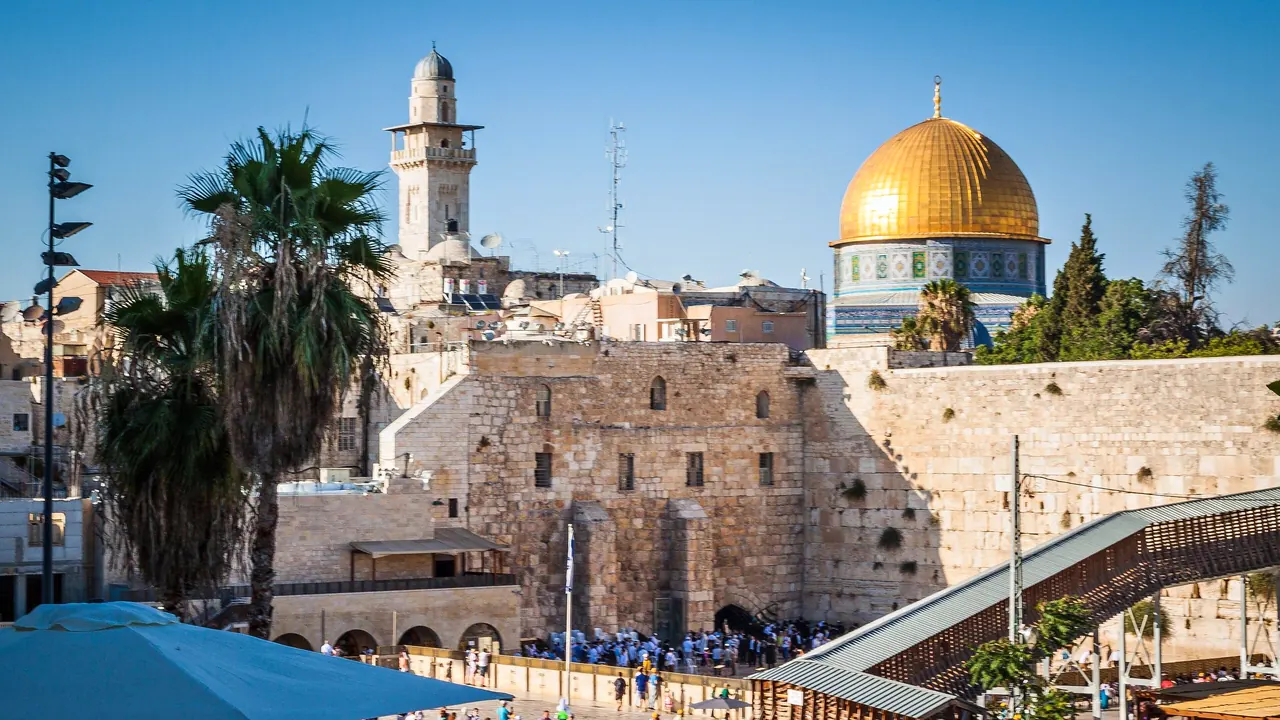
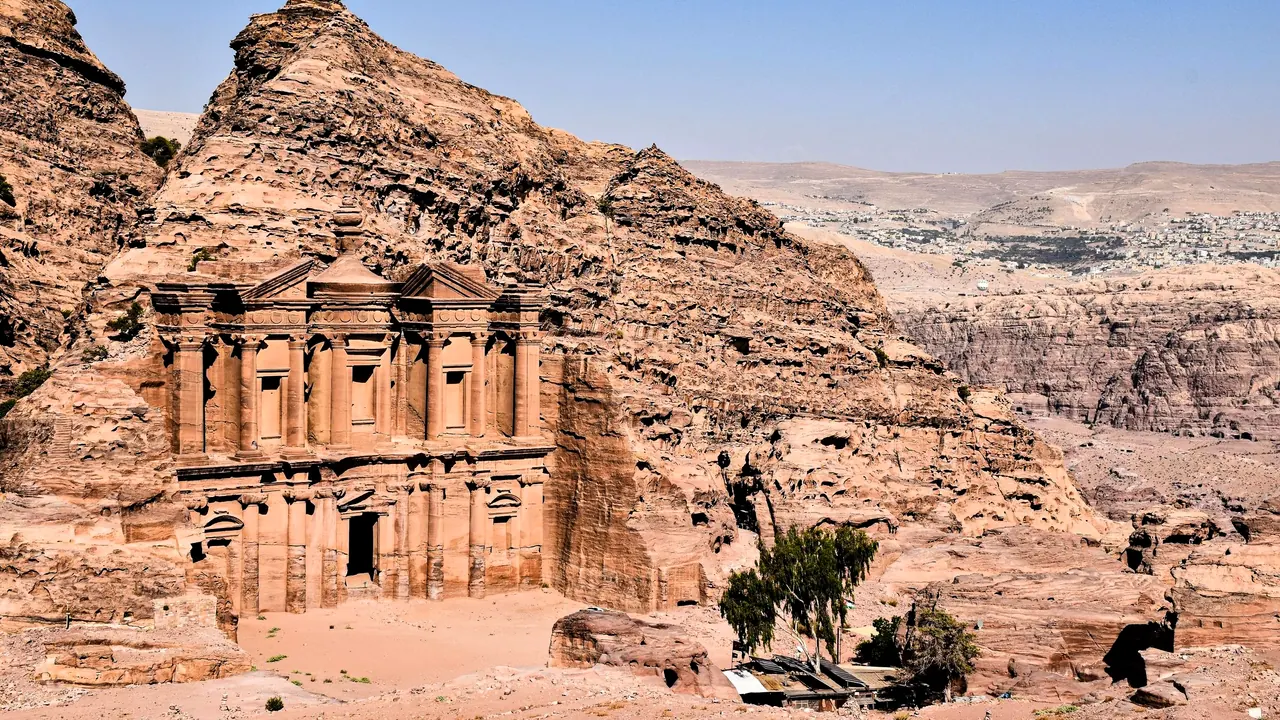
Photos: Israel by Edmund Gall, CC BY-SA 2.0, cropped; Jordan by AXP Photography, Pexels License.
Israel or Jordan?
Our verdict in twelve categories, each scored against the same fixed benchmark cities, and the climate month by month, so you can choose for your trip.
Choose Israel for
- nightlife
- live music and the arts
- beaches
Israel suits a trip that mixes faith, food and the shore. You can spend days in Jerusalem's Old City and evenings on Tel Aviv's long seafront, eat the more varied cooking of the two and go out late, and trains link the main cities. It is the better choice for travellers who want beaches, restaurants and nightlife as much as the sights, and who can accept that it is the dearer country.
Choose Jordan for
- prices
- nature and the outdoors
Jordan is the place for desert and stone on a grand scale. Petra, Jerash and the red valleys of Wadi Rum are what a trip is built around, and the hiking, canyoning and camp nights are wilder than anything on the Israeli side. It costs noticeably less, though it is not cheap. In return you need a hired car or driver, and the evenings are quiet.
Scoreboard
Twelve categories on one fixed scale from 0 to 100. The shaded stretch is the gap between the two.
Your match
Pick a travel style or drag the sliders, and both match scores follow your weighting.
Wins on nightlife and live music and the arts with your weighting.
Wins on prices and nature and the outdoors with your weighting.
What matters to you?
Category by category
What the scores mean for a trip.
Beaches & swimming
Israel has a real beach culture and Jordan does not. Tel Aviv runs on a continuous strip of lifeguarded sand where people swim before work and at sunset, and quieter stretches carry on north at Herzliya, Caesarea and below Mount Carmel at Haifa. In winter you can swim at Eilat instead.
Jordan's coast is a short stretch of the Gulf of Aqaba. The beaches are narrow, the better ones belong to resorts at Tala Bay, and the town beaches are crowded and conservative in dress. The water is the draw, with coral a few metres from shore, and most visitors treat it as a rest after Petra. Both countries offer a float in the Dead Sea, but neither treats it as a beach.
Food & drink
Israel eats more widely and better. Its cooking draws on Jewish kitchens from North Africa to Eastern Europe as well as Arab and Druze traditions. Tel Aviv has chef-led small plates and serious bakeries, Jerusalem has grazing at Mahane Yehuda, and Akko adds seafood. Wineries in the Galilee and the Judean Hills round it out.
Jordan's food is hearty Levantine and Bedouin cooking, with mansaf, maqluba and zarb lifted from the sand in Wadi Rum camps. Amman's downtown hummus counters and hot knafeh, and Madaba's family kitchens, are where it shines. Away from them the choice thins fast, and Petra and the Dead Sea mostly serve buffets.
Culture & sights
Both countries hold heritage of the first rank, but of different kinds. Israel's is a living one, concentrated in Jerusalem. The Western Wall, the Holy Sepulchre and the Dome of the Rock stand within a walk of each other, with the Dead Sea Scrolls and Yad Vashem in the newer city, then Bauhaus Tel Aviv, Crusader Akko and the Baha'i gardens of Haifa.
Jordan's is ancient cities set in open landscape. Petra's rock-cut tombs fill two days, Jerash keeps its colonnaded Roman streets, and Madaba's mosaics, the Crusader castles of Kerak and Shobak and the painted desert castles mean more driving between sites. In Israel, plan around Friday and Saturday closures. In Jordan, plan around summer heat at the southern sites.
Nightlife
Tel Aviv alone puts Israel far ahead. Bars fill the streets around Rothschild Boulevard, Florentin has rough-edged dance bars, and clubs in the port and old industrial buildings keep going until morning, with beach bars on summer nights. Jerusalem's Mahane Yehuda adds a second, smaller scene.
In Jordan, a night out means Amman's rooftop lounges on Rainbow Street and a few pubs in Weibdeh. Most evenings revolve around late dinners and shisha. Alcohol is costly, and outside the capital the night is a hotel bar or a campfire in Wadi Rum.
Nature & outdoors
Jordan's landscapes are bigger and wilder. Wadi Rum's red sand and sandstone mountains can be explored by jeep, camel or on foot, with rock bridges to scramble up and camps to sleep in. The Dana reserve drops through gorges towards Petra, and Wadi Mujib offers canyoning up a river siq.
Israel packs more variety into short distances: the crater of Makhtesh Ramon, the springs of Ein Gedi, and a green north of Galilee hills and Carmel woods. The Hula Valley's autumn and winter crane migration has no match across the border. Both countries share easy shore snorkelling on the Red Sea reefs, from Eilat on one side and Aqaba on the other.
Where in Israel: Negev, Dead Sea and Ein Gedi, Galilee, Eilat
Where in Jordan: Wadi Rum, Dana Biosphere Reserve, Wadi Mujib, Aqaba
Day trips
Israel has the edge mainly because it is so compact and has trains. From Tel Aviv or Jerusalem you can reach Masada and a Dead Sea float, Roman Caesarea, Akko with Haifa, or Nazareth and the Sea of Galilee. The two cities are only half an hour apart by rail, so either works as a base.
Amman is a good hub too, with Jerash and Ajloun, Umm Qais above the Sea of Galilee, Ottoman Salt and Madaba with Mount Nebo all within two hours. Wadi Musa adds Little Petra and Shobak. Almost all of it needs a car or driver.
Where in Israel: Jerusalem, Masada, Caesarea, Nazareth
Where in Jordan: Amman, Wadi Musa
Good for families
Israel is easier with children. Tel Aviv's calm, lifeguarded beaches with playgrounds make a ready base, and the Ramat Gan Safari, Jerusalem's Biblical Zoo and Eilat's underwater observatory give days built for them.
Jordan's family appeal is adventure: a jeep ride and camp night in Wadi Rum, a donkey ride through Petra, snorkelling off Aqaba. Long walks on uneven, shadeless stone and hours in the car make it better suited to older children who like walking than to toddlers.
Getting around
Israel is the simpler country to travel without a car. A fast train joins Jerusalem and Tel Aviv, the coastal line runs up to Haifa and Akko, and buses reach nearly every town. The catch is that most services stop from Friday afternoon to Saturday evening.
Jordan has no passenger trains. A reliable coach runs between Amman, Petra and Aqaba, but elsewhere minibuses leave when full, so most visitors hire a car or driver. Amman itself sprawls over steep hills with few pavements, and taxis do the work that Tel Aviv's flat seafront lets you do on foot or by bike.
Shopping & style
Israel gives more to browse. Jerusalem's Old City is one long covered souk of spices, Judaica and olive wood, and the Armenian quarter sells painted pottery. Tel Aviv adds the Nahalat Binyamin crafts fair, Jaffa's flea market with designers' studios, and local fashion and jewellery in Neve Tzedek.
Jordan's shopping is narrower and more handmade. Amman has a gold souk, and Weibdeh sells embroidery and rugs from village cooperatives. Madaba is the place for mosaics, and Bedouin silver turns up around Petra, where haggling is expected. Dead Sea mud and salts are the classic thing to take home from either country.
Affordability
Jordan is clearly the gentler on cost. A Bedouin camp night with dinner, a family guesthouse in Wadi Musa or Madaba, and Amman's cheap falafel and taxis keep daily spending reasonable. Petra's steep entry fee, resort prices at Aqaba and the Dead Sea, and the near-essential hired car are what push the total up.
Israel is one of the dearer places to travel. Tel Aviv's rooms and restaurants match the priciest Western capitals. Cheap street food, fairly priced trains and free beaches help, and Haifa or a Galilee village stay soften the bill, but no part of the country comes cheap.
Where in Israel: Galilee, Haifa, Jerusalem
Live music & performing arts
Israel has a full performing calendar, almost all of it in Tel Aviv. The Israel Philharmonic, a year-round opera season and Batsheva's contemporary dance are reasons to book an evening, and the live-music scene runs from rock and Mizrahi pop to jazz. Theatre, being in Hebrew, is the weak spot.
Jordan offers little to plan around. The summer Jerash Festival brings Arab singers and folk troupes into the Roman theatres, and Amman has a modest programme at the Royal Cultural Centre. Otherwise, performances are mostly Bedouin music evenings in Wadi Rum camps.
Where in Israel: Tel Aviv, Jerusalem, Eilat
Where in Jordan: Jerash, Amman
Wellness & relaxation
Both countries rest on the same lake, Israel from its western shore and Jordan from its eastern, so the floating, the mud and the dry, heavy air of the Dead Sea come with either trip. Israel has a slight edge because a slow stay is easier to arrange there. Ein Bokek's hotels sit together along the water, with a spa and a float only a short walk apart, and Neve Zohar has a few quieter places to the south. Further north, the springs at Hamat Gader, the old baths at Tiberias and Galilee guesthouses with small spas of their own give you a second place to unwind.
Jordan's Dead Sea resorts are larger and just as focused on mud and mineral pools, and most visitors take their rest there. The extras are good ones: warm waterfalls and pools at Ma'in in the hills above the shore, a hammam steam and scrub in Amman or Wadi Musa after the dust of Petra, and a silent night in a Wadi Rum camp. What differs is the pace. Early starts and long drives leave a Jordan itinerary with fewer idle days than Israel's mix of spa shore and northern springs.
Where in Israel: Ein Bokek, Neve Zohar, Hamat Gader, Tiberias
Where in Jordan: Dead Sea, Ma'in Hot Springs, Wadi Musa, Wadi Rum
When should you go?
Pick your month, and for a country the place in it. The climate figures are measured averages, not a forecast.
Where in Israel
Where in Jordan
Tel Aviv (Israel) in July
Amman (Jordan) in July
Daytime high, °C
Rainfall in the month, mm
Temperature and rainfall are climate normals, averaged over the years shown. Tel Aviv (Israel): 1991-2020 (sunshine 1961-1990) normals, Bet Dagan (9.5 km from centre). Amman (Jordan): 1994-2020 (sunshine 1981-2010, rainfall 1981-2010) normals, Amman Airport (6 km from centre).
Spring and autumn suit both countries best. April, May and October are warm enough for Jerusalem's streets, Amman's hills and long days at Petra without the summer heat. In July and August Petra reaches 35°C, and Eilat and Aqaba, which share the same gulf and the same climate, reach 40°C. That rules out most desert walking and makes the Dead Sea shores hard going. For a beach trip, Tel Aviv is the place from June to October, when the Mediterranean warms to 28°C.
Winter splits the two coasts. Tel Aviv gets most of its rain then, about 140mm in January, and Jerusalem and Amman turn cool and grey. Down on the Red Sea, Eilat and Aqaba stay dry and mild at around 21°C, with water still warm enough to snorkel. A winter week by the sea works equally well on either side of the border.
Which traveller are you?
For a food and nightlife trip, Israel is the clear choice. Tel Aviv's small-plate kitchens, bakeries and Carmel Market give way to bars around Rothschild Boulevard and clubs that run until morning, while Jordan's evenings mostly end with dinner, coffee and shisha.
More comparisons
Each shares a side with Israel or Jordan.
Where else could you go?
Set Israel or Jordan against any other country.