Jordan
Petra
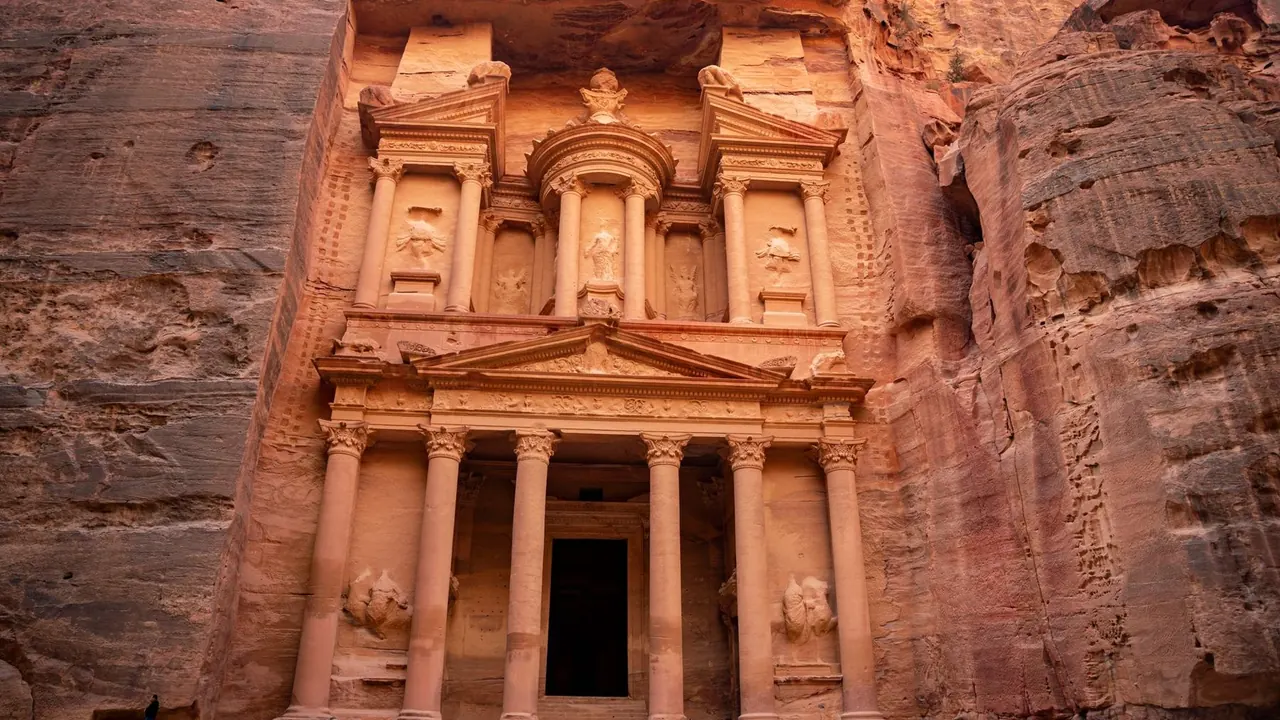
The Treasury, Al-Khazneh, cut into the rock
- Culture & sights85
- Nature & outdoors78
- Affordable cities45
Photo: Yasir Gürbüz, Pexels License
Match
31
Every category weighted equally
- Beach & sun29
- Culture & arts35
- Food & nightlife25
- Family trip34
- Outdoors38
- Relax & unwind32
- Shopping & style28
- On a budget33
Petra in twelve categories
Our verdict on each, scored 0 to 100 against the same fixed benchmark cities, so a score means the same thing on every page.
Beaches & swimming. Scores 5 out of 100.
Food & drink. Scores 22 out of 100.
Culture & sights. Scores 85 out of 100.
Nightlife. Scores 5 out of 100.
Nature & outdoors. Scores 78 out of 100.
Day trips. Scores 30 out of 100.
Good for families. Scores 25 out of 100.
Getting around. Scores 25 out of 100.
Shopping & style. Scores 18 out of 100.
Affordability. Scores 45 out of 100.
Live music & performing arts. Scores 10 out of 100.
Wellness & relaxation. Scores 28 out of 100.
Petra category by category
Beaches & swimming
5Petra sits in the mountains of southern Jordan, and there is nowhere to swim within easy reach. The nearest sea is the Red Sea at Aqaba, about two hours' drive south, where the water is warm and clear and the coral reefs are close to shore. That works as a separate stop on a tour of Jordan, not as a beach day from Petra. In Wadi Musa itself, swimming means a hotel pool, and only some hotels have one.
Food & drink
22Wadi Musa, the town that serves Petra, feeds visitors well enough but has no food scene of its own. Many travellers eat at hotel buffets, and the restaurants along the main road serve the Jordanian standards: mezze with hummus and mutabbal, mansaf (lamb cooked in fermented yoghurt), maqluba, and zarb, the Bedouin dish of meat and vegetables cooked in an underground pit. In town there are falafel and shawarma counters, bakeries and sweet shops for knafeh.
The best eating is often the simplest: sweet sage tea poured at stalls inside the site, or a Bedouin meal in the hills nearby. Cooking classes on local dishes are popular. Alcohol is available in hotels and a few restaurants, but it is not part of local life.
Culture & sights
85Petra is a reason to cross the world. The Nabataean city was carved into rose and ochre sandstone more than two thousand years ago, and you enter it through the Siq, a narrow gorge more than a kilometre long that opens onto the Treasury. Beyond it the site spreads across valleys and ridges: the Street of Facades, the theatre, the Royal Tombs along the cliff, the colonnaded street, the Great Temple and Byzantine church mosaics. About 800 rock-cut steps lead up to the Monastery, which is even bigger than the Treasury.
It takes two or three days to do justice to the High Place of Sacrifice, the back trails and the tombs away from the main path. Little Petra, a small caravan stop a short drive north, makes a quieter coda, and the Petra Museum by the entrance puts the finds in context. Outside the archaeological park, Wadi Musa itself has nothing to see.
Nightlife
5There is almost no nightlife. Days at Petra start early and end tired, and Wadi Musa is a conservative town where evenings mean dinner, a shisha on a terrace and an early night. A few hotels have a bar, and one or two places serve beer to visitors, but nothing stays open late and there are no clubs. Visitors who want a night out should save it for Amman.
Nature & outdoors
78Petra lies in the Sharah mountains, a broken land of sandstone domes, gorges and wadis that drop towards the Arava valley, and the site itself is a hiking ground. Trails climb to the High Place of Sacrifice, run through Wadi Muthlim and Wadi al-Farasa, and reach the summit of Jebel Haroun with its views over the desert. The back route from Little Petra to the Monastery is one of the finest walks in the region, and the long-distance Jordan Trail passes through on its way from Dana.
The Dana Biosphere Reserve, about an hour north, adds juniper slopes, ibex and descents into Wadi Feynan. Wadi Rum's red sand valleys and granite and sandstone peaks are about ninety minutes south, for jeep trips, scrambling, climbing and camping under the stars. Spring and autumn are best, as summer heat makes long hikes hard and winter nights can bring frost and even snow.
Day trips
30Beyond Petra itself, the places to visit nearby are few. Shobak, a Crusader castle on a lonely hilltop, is about forty minutes north and can be combined with the stone village of Dana, which overlooks the reserve of the same name. Kerak, a larger and better-kept Crusader fortress, is about two hours up the King's Highway, a road better driven slowly on the way to or from Amman than as a return trip.
Aqaba, about two hours south, offers a seafront town and the Red Sea. Wadi Rum is the most popular outing, though it is a landscape to explore rather than a place to visit. The great sights of the north, Jerash, Madaba and the Dead Sea, are too far for a day out and are best seen from Amman.
Good for families
25Petra suits families with older, sturdy children far more than those with toddlers. Clambering into tombs and walking through the Siq feels like an adventure, and Jordanians are warm towards children. But the site involves long walks over sand and rock with little shade, the climb to the Monastery is hard, and summer heat is fierce. Strollers are of little use beyond the main path.
There is nothing made for children in Wadi Musa: no parks, attractions or play areas. Many families ride camels or donkeys, but the animals are worked hard and not always well treated, so it is worth choosing carefully or walking.
Getting around
25Inside the archaeological park, the only way to get around is on foot, and the distances are large: from the gate to the Treasury and then to the Monastery and back is a long day of walking and climbing. Electric carts and animals cover part of the main route. Wadi Musa climbs steeply up a hillside away from the entrance, so hotels further up are a taxi ride from the site.
There is no local public transport worth relying on. Buses and minibuses link the town to Amman and Aqaba, but Wadi Rum, Dana and the castles are reached by taxi, a hired driver or a rental car, and many visitors see southern Jordan on a road trip.
Shopping & style
18Shopping is souvenirs. Bedouin families sell silver and bead jewellery, old coins of doubtful age, and sandstone trinkets from stalls along the trails, and the shops of Wadi Musa repeat the offer with scarves, ceramics and bottles of coloured sand worked into desert scenes. A few cooperative shops sell embroidery and handmade goods by local women, and these are the best buys. For anything more, wait for Amman.
Affordability
45Petra is not a budget stop, mainly because of the site itself, which charges foreign visitors among the steepest entry fees of any heritage site in the world. A multi-day ticket, or a combined pass bought before arrival in Jordan, softens this considerably. Wadi Musa has rooms at every level, from simple guesthouses to well-priced mid-range hotels, and falafel, shawarma and local restaurants are cheap.
Costs rise with hotel buffets, imported alcohol, and the drivers and tours that are needed to reach anything beyond town. Overall, the price level is moderate.
Live music & performing arts
10The one performance most visitors attend is Petra by Night, when the Siq and the square before the Treasury are lit by candles in paper bags and Bedouin musicians play the rababa and flute under the cliffs. It is atmospheric, though crowded, and depends heavily on how quiet the audience keeps. Beyond that, music is limited to hotel dinner shows and the occasional song around a fire at a Bedouin camp, and there are no theatres or concert venues.
Wellness & relaxation
28After a long day on the trails, many visitors head to one of the Turkish-style bathhouses in Wadi Musa for steam, a scrub and a massage. These are built for tourists, not a local tradition, but they do the job for tired legs. Some of the larger hotels have small spas.
The town is quiet and the desert evenings are calm, but a stay here is physically demanding rather than restful. The Dead Sea's resorts and mud are a long drive north, so they belong to another part of the trip.
When should you go?
Pick a month to see what it is like. The climate figures are measured averages, not a forecast.
Petra in July
Daytime high, °C
Rainfall in the month, mm
The whole year
Shaded against this city’s own year: the deepest cell is its best month for that figure and the palest its weakest.
Where the figures come from
Petra's temperatures are measured 34 km from the centre, at Ma'An.
Petra's station stands 219 m above the city centre, so the centre is likely a little warmer than the figures say.
Petra has no rain gauge within 25 km of the centre, so its rainfall comes from a gridded climate dataset read at the city rather than from a gauge further away.
Temperature and rainfall are climate normals, averaged over the years shown. Petra: 1991-2020 normals, Ma'An (33.9 km from centre).
Before you go
| Measure | Petra |
|---|---|
| Official language | Arabic |
| Currency | Jordanian Dinar (JOD) |
| Sockets | BCFGJ230 V, 50 Hz |
| Driving side | Right |
| Time zone | UTC+3 |
| Emergency number | 911 |
| Elevation | 850 m |
| Main airport | King Hussein International Airport (AQJ)90 km from centre5 non-stop destinations |
By the numbers
| Measure | Petra |
|---|---|
| Museums within 10 km | 2 |
| UNESCO World Heritage sites within 50 km | 1 |
Compare Petra with
Every comparison with a written verdict behind it.