Israel
Tel Aviv
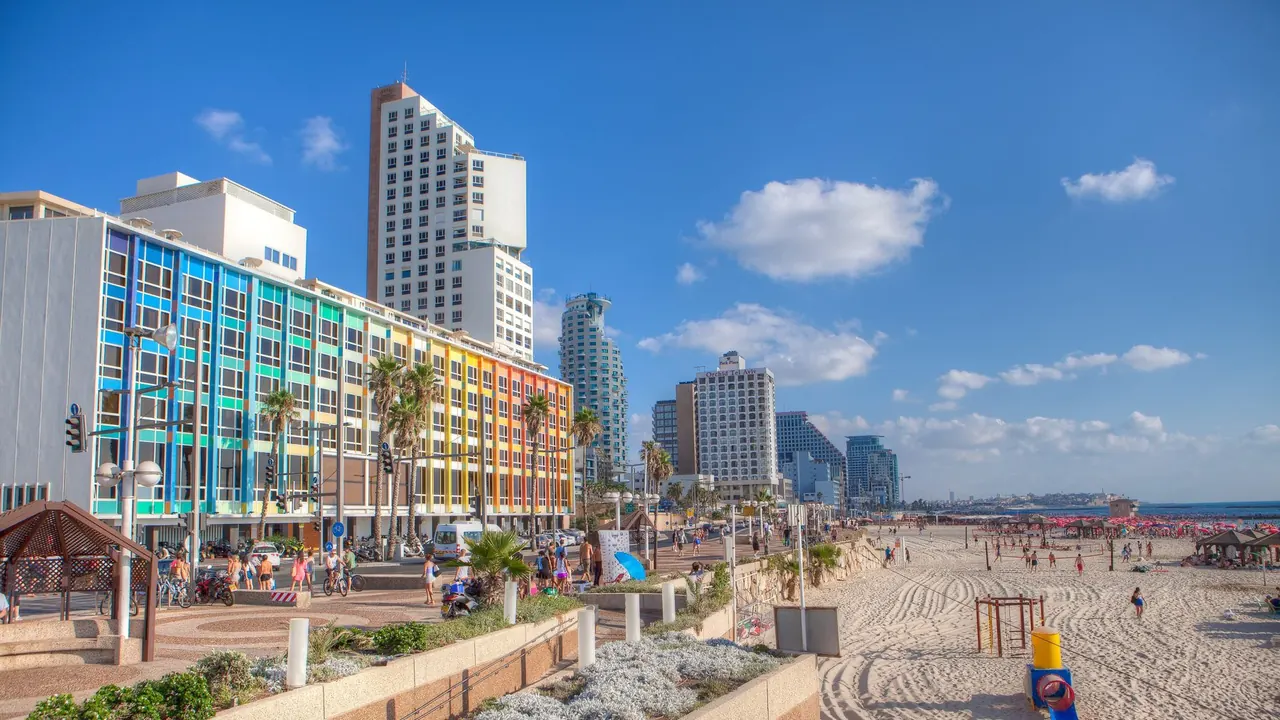
The beach promenade in Tel Aviv
- Beaches86
- Day trips84
- Nightlife82
Photo: israeltourism, CC BY-SA 2.0, cropped
Match
62
Every category weighted equally
- Beach & sun62
- Culture & arts63
- Food & nightlife66
- Family trip61
- Outdoors62
- Relax & unwind60
- Shopping & style63
- On a budget57
Tel Aviv in twelve categories
Our verdict on each, scored 0 to 100 against the same fixed benchmark cities, so a score means the same thing on every page.
Beaches & swimming. Scores 86 out of 100.
Food & drink. Scores 80 out of 100.
Culture & sights. Scores 57 out of 100.
Nightlife. Scores 82 out of 100.
Nature & outdoors. Scores 52 out of 100.
Day trips. Scores 84 out of 100.
Good for families. Scores 68 out of 100.
Getting around. Scores 64 out of 100.
Shopping & style. Scores 55 out of 100.
Affordability. Scores 14 out of 100.
Live music & performing arts. Scores 70 out of 100.
Wellness & relaxation. Scores 35 out of 100.
Tel Aviv category by category
Beaches & swimming
86The whole western edge of the city is beach, a near-continuous strip of fine pale sand running from the old port in the north past Gordon, Frishman and Bograshov down to the rocks below Jaffa. You reach it on foot from almost any central hotel. Breakwaters calm the water at many points, lifeguard stations are spaced along the shore, and some stretches have their own character: Hilton Beach has a gay-friendly section and a dog beach, and Nordau keeps separate bathing days for religious men and women.
The sea reaches about 28-29°C in late summer and stays swimmable from May into November. Locals use the beach morning and evening, for paddle-ball games, sunset swims and early runs, not only on days off. The midsummer sun is fierce, and the busiest stretches fill up on Fridays and Saturdays. Currents can be strong away from the guarded spots.
Food & drink
80Eating here mixes Levantine street food with the cooking of a dozen immigrant traditions: hummus counters that close when the pot runs out, sabich and falafel stands, Yemenite soups, Bukharan pastries and Iraqi kubbeh. Above that is a confident chef-driven scene, where open kitchens serve charred vegetables, raw fish and big shared plates, and loud, crowded dining rooms are the norm. Produce is the strong point, especially tomatoes, herbs, tahini and citrus.
Carmel Market and the Levinsky Market streets are the places to graze, and Jaffa adds old bakeries and Arab fish restaurants by the port. Cafés line every residential street and stay full all day, and breakfast is a serious meal. Wine from the Galilee and Golan hills is good, and craft beer is common. Many restaurants close for Shabbat, and kosher rules apply only in some places.
Culture & sights
57The city's chief sight is its architecture. The White City, a UNESCO-listed spread of several thousand 1930s Bauhaus and International Style buildings, is best seen on foot along Rothschild Boulevard, around Dizengoff Square and on Bialik Street. In the south, Jaffa's old stone quarter climbs over the port, with St Peter's Church, the clock tower and narrow lanes of galleries, while Neve Tzedek keeps the low houses of the first Jewish neighbourhood outside Jaffa's walls.
The Tel Aviv Museum of Art has a strong modern collection, ANU, the Museum of the Jewish People, tells the story of the diaspora, and the Eretz Israel Museum covers archaeology and folk crafts. Independence Hall marks where the state was declared. It is a short list for a city its size, and the country's great historic sites are elsewhere.
Nightlife
82Going out is part of how the city sees itself. Evenings begin late on the boulevards, with drinks along Rothschild and in the streets around Lilienblum and Allenby, where crowded cocktail bars and wine bars spill onto the pavement past midnight. Thursday is the big night, Friday afternoons start early, and many places stay busy until dawn.
The club scene leans towards house and techno, in basements and warehouse spaces in the south of the city and around the old port. There is also an established gay scene that is among the most open in the region. Beach bars and Jaffa's courtyard bars give gentler options. The crowd is young, informal and loud, and dress codes barely exist.
Nature & outdoors
52The city is flat and built up, and its outdoor life runs along the sea. A promenade and cycle path follows the whole coast from the northern port to Jaffa, and surfing, paddleboarding, kitesurfing and sailing all happen just off the beaches. Yarkon Park runs along the river in the north, with lawns, rowing and long cycling routes. Hot summers push most activity to early morning and evening.
Real landscape means driving. The Carmel ridge, with its pine-covered trails above the sea, is about an hour north. The Judean Desert, the cliffs above the Dead Sea and the canyon hikes of Ein Gedi are around one and a half to two hours away. Spring brings wildflowers to the hills and good migrating-bird watching.
Day trips
84Jerusalem is the obvious outing, about half an hour by fast train, with the Old City, the Western Wall, the Church of the Holy Sepulchre, the Dome of the Rock and the Israel Museum. Many visitors make it several separate days. North along the coast, the Roman port and amphitheatre of Caesarea are under an hour away, and Haifa, with the terraced Baha'i Gardens, is about an hour by train. A little further, the Crusader old city of Acre is a UNESCO site.
Zichron Ya'akov and the hills around it make an easy wine-tasting day. Heading south-east, Masada and a float in the Dead Sea fill a long but manageable day. Nazareth and the Sea of Galilee are at the edge of the range. Public transport stops for Shabbat, so Saturday trips need a car or a tour.
Good for families
68Israeli culture is very relaxed about children, who are welcome in restaurants late into the evening and fill every playground and beach. The calm, lifeguarded city beaches are the easiest day out, and Yarkon Park has open lawns, boating and a small amusement park, Luna Park. The Ramat Gan Safari, just east of the city, combines a drive-through African park with a zoo. The Israel Children's Museum in Holon and the hands-on science exhibits at the Eretz Israel Museum add rainy-day options.
The flat centre is good with a pushchair, and the seafront promenade makes for long, car-free walks. Midsummer heat and humidity are the main difficulty, so spring and autumn are the easiest seasons with young children.
Getting around
64The centre is flat and compact, and walking covers most of what a visitor wants, from the northern port through the White City to Neve Tzedek and Jaffa. The seafront path makes the coast an easy walk or ride, and bike-share and e-scooters are everywhere, with cycle lanes on the main boulevards. A light-rail line and a dense bus network cover the wider city, though buses crawl in rush-hour traffic, and fast trains run to Jerusalem, Haifa and the airport.
The big exception is Shabbat. Most buses and trains stop from Friday afternoon until Saturday night, leaving taxis, shared minibuses and your own feet. A car helps for day trips but is a burden in the centre, where parking is scarce.
Shopping & style
55Shopping here means local designers rather than luxury flagships. Small boutiques selling Israeli fashion, jewellery and ceramics line the northern end of Dizengoff Street, Sheinkin and the lanes of Neve Tzedek. On fair days, the Nahalat Binyamin crafts market spreads handmade work along a pedestrian street beside Carmel Market. In Jaffa, the flea market mixes real antiques and old furniture with junk, and the surrounding streets are full of small design studios and vintage shops.
Large malls in the centre and the north cover the international chains. There is little high-end luxury, and prices are high. Good things to bring home are Judaica, spices, tahini, Dead Sea cosmetics and local design.
Affordability
14This is one of the most expensive cities in the Mediterranean region. Hotels are costly at every level, with few genuinely cheap options near the beach, and a sit-down meal or a round of cocktails costs as much as in the priciest Western European capitals. Supermarket groceries and alcohol are also expensive.
The savings come from street food: hummus, falafel and sabich make filling, cheap meals, and market stalls and bakeries help too. Buses and trains are fairly priced, and the beaches, the promenade and walking the White City cost nothing. A visitor on a tight budget will need to plan carefully.
Live music & performing arts
70The city's cultural institutions are stronger than its size suggests. The Israel Philharmonic plays a long season at the Charles Bronfman Auditorium, and the Israeli Opera performs at the Tel Aviv Performing Arts Center, which shares a cultural square with Habima, the national theatre. Contemporary dance is the standout: the Batsheva company is internationally famous, and the Suzanne Dellal Centre in Neve Tzedek is a dedicated home for dance.
Most theatre is in Hebrew, though some productions offer English surtitles. Live music is easy to find, with rock, indie, Mizrahi pop and jazz in clubs around the south of the city. In summer, concerts move outdoors, with stages in Yarkon Park and by the sea.
Wellness & relaxation
35The city has no bathing tradition of its own, and spa options are mostly in the large seafront hotels plus a scattering of day spas and massage studios. The rest of the week runs loud and fast, with traffic, construction noise and crowded cafés.
The calm moments come from the rhythm of the place. Shabbat empties the streets from Friday afternoon, and long walks or slow mornings on the seafront promenade are part of local life. Yoga and fitness classes are common. For real restorative bathing, visitors go to the mineral pools and mud spas on the Dead Sea shore, about one and a half hours away.
When should you go?
Pick a month to see what it is like. The climate figures are measured averages, not a forecast.
Tel Aviv in July
Daytime high, °C
Rainfall in the month, mm
The whole year
Shaded against this city’s own year: the deepest cell is its best month for that figure and the palest its weakest.
Temperature and rainfall are climate normals, averaged over the years shown. Tel Aviv: 1991-2020 normals, Bet Dagan (9.5 km from centre).
Before you go
| Measure | Tel Aviv |
|---|---|
| Official language | Hebrew |
| Currency | New Israeli Sheqel (ILS) |
| Sockets | CHM230 V, 50 Hz |
| Driving side | Right |
| Time zone | UTC+2, UTC+3 in summer |
| Emergency number | Police 100, fire 102 |
| Elevation | 5 m |
| Main airport | Ben Gurion International Airport (TLV)13 km from centre111 non-stop destinations |
By the numbers
| Measure | Tel Aviv |
|---|---|
| City population | 467,875 |
| People per km² | 8,998 |
| Museums within 10 km | 98 |
| UNESCO World Heritage sites within 50 km | 2 |
| Swim season, months above 21 °C | 7 months |
Compare Tel Aviv with
Every comparison with a written verdict behind it.