Israel
Jerusalem
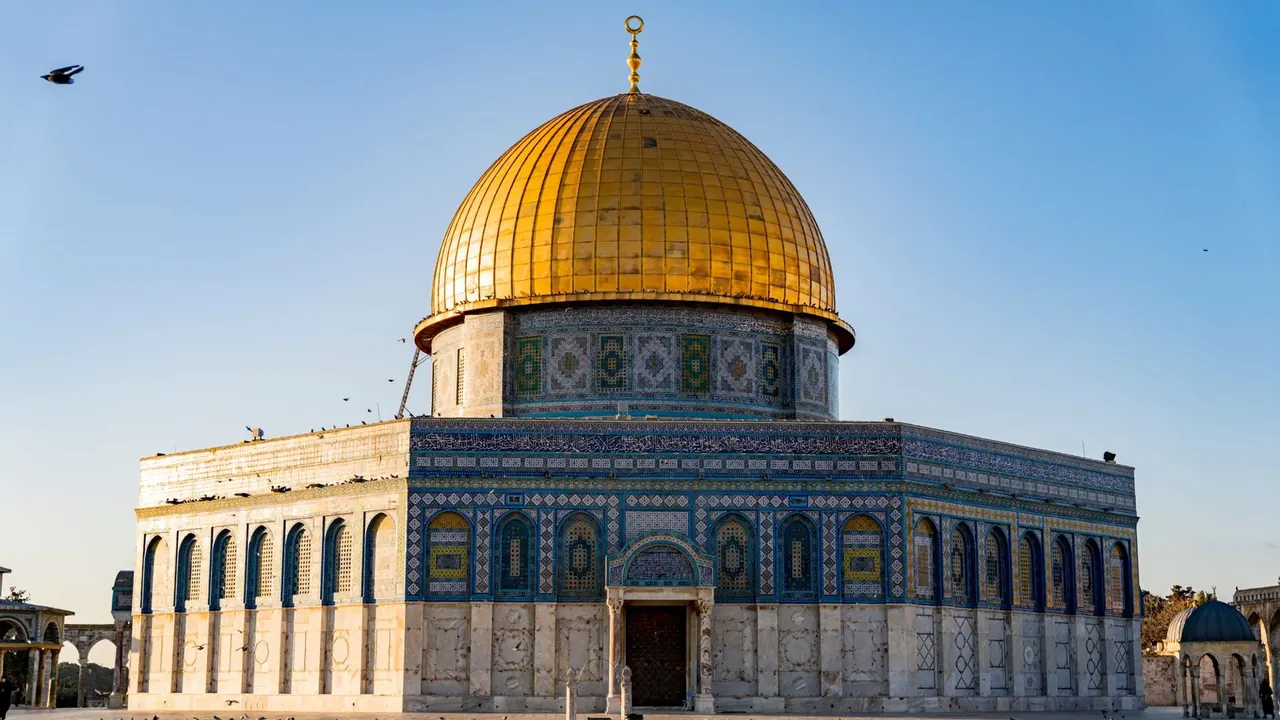
The golden Dome of the Rock
- Culture & sights92
- Day trips80
- Food & drink66
Photo: Yasir Gürbüz, Pexels License
Match
53
Every category weighted equally
- Beach & sun49
- Culture & arts58
- Food & nightlife52
- Family trip53
- Outdoors56
- Relax & unwind52
- Shopping & style54
- On a budget49
Jerusalem in twelve categories
Our verdict on each, scored 0 to 100 against the same fixed benchmark cities, so a score means the same thing on every page.
Beaches & swimming. Scores 40 out of 100.
Food & drink. Scores 66 out of 100.
Culture & sights. Scores 92 out of 100.
Nightlife. Scores 38 out of 100.
Nature & outdoors. Scores 60 out of 100.
Day trips. Scores 80 out of 100.
Good for families. Scores 52 out of 100.
Getting around. Scores 55 out of 100.
Shopping & style. Scores 48 out of 100.
Affordability. Scores 20 out of 100.
Live music & performing arts. Scores 40 out of 100.
Wellness & relaxation. Scores 42 out of 100.
Jerusalem category by category
Beaches & swimming
40Jerusalem sits high in the hills, so there is no swimming in the city. The nearest good beaches are on the Mediterranean in Tel Aviv: about half an hour by fast train and then a short ride to the shore, roughly an hour door to door. Once there, the sand is long and the sea is warm, reaching about 28°C in late summer and staying swimmable from late spring well into autumn. It is a full day out, though, not something to fit between sights.
The other choice is the Dead Sea, about an hour east and downhill through the Judean Desert. The water is so salty that you float rather than swim, and the shore is rocky and salt-crusted rather than sandy. It is strange and worth doing once. Both trips are good breaks from the city, but neither makes Jerusalem a place to choose for the beach.
Food & drink
66Eating in Jerusalem centres on Mahane Yehuda, the covered market off Jaffa Road. By day it sells spices, halva, pastries and produce, and after dark it fills with small grills and bars. In the Old City and East Jerusalem the Arab tradition shows in hummus counters that close once the morning batch is gone, ka'ak bread rings sold from carts, knafeh and strong cardamom coffee. Jewish kitchens add Kurdish kubbeh soups, Iraqi sabich and Yemenite breads, and the Armenian Quarter has its own short list of dishes.
Many restaurants are kosher, so a menu serves either meat or dairy, never both. Most of West Jerusalem shuts from Friday afternoon to Saturday evening, while the Arab neighbourhoods stay open. Wine from the Judean Hills is worth trying, but the high-end restaurant scene is smaller than you might expect for a city of this fame.
Culture & sights
92The walled Old City packs three thousand years of history into about one square kilometre. Inside the Ottoman walls are the Western Wall, the Church of the Holy Sepulchre, the Dome of the Rock on the Temple Mount and the Via Dolorosa. The Jewish, Christian, Muslim and Armenian quarters each have their own churches, synagogues, madrasas and lanes. Underneath, excavations such as the Western Wall tunnels and the City of David reach back to the Bronze Age, and the Tower of David citadel tells the city's story from its ramparts.
Beyond the walls is the Mount of Olives, with its tombs and churches, and the stone-built neighbourhoods of the nineteenth century. Two institutions stand out: the Israel Museum, home of the Dead Sea Scrolls and a large model of the Second Temple city, and Yad Vashem, the national Holocaust memorial. The Bible Lands Museum and the Rockefeller Museum add more archaeology. It is an intense, layered city that takes several days and repays them.
Nightlife
38Jerusalem goes out modestly. Most nights happen in a few places: the Mahane Yehuda market, whose stalls become small bars and grills after closing, the pubs around the Nahalat Shiva lanes and Jaffa Road, and the bars of the German Colony and Emek Refaim. Students keep a few spots busy late on weekdays. Clubs are few, and the Old City and religious neighbourhoods go dark early.
Friday nights are quiet across much of West Jerusalem because of Shabbat, though a handful of secular venues stay open. Visitors who want a big night out usually take the train to Tel Aviv.
Nature & outdoors
60Jerusalem stands on a ridge between two very different landscapes. To the west are the Judean Hills, with pine forest, terraced slopes and spring-fed trails around Sataf and Ein Karem that are pleasant to walk in spring and autumn. To the east the land falls fast into the Judean Desert, where Wadi Qelt cuts a canyon toward Jericho and an old monastery clings to the cliff.
About an hour or so further down, the Ein Gedi nature reserve has waterfalls, ibex and hyrax in a desert oasis above the Dead Sea, and walkers can climb the Snake Path up to Masada at dawn. In the city, the Haas Promenade and the Mount of Olives give wide views over the hills. Summer heat makes the desert a sunrise activity, and there are no high mountains or watersports to speak of.
Day trips
80The range of places within reach is a real strength. Bethlehem and the Church of the Nativity are just south of the city, and Tel Aviv with old Jaffa is about half an hour away by train. Masada, Herod's mountaintop fortress above the Dead Sea, is a classic day out and is often combined with the caves of Qumran, where the Dead Sea Scrolls were found. Jericho is closer still.
To the west, the Beit Guvrin caves and Roman remains are about an hour away. Herod's harbour at Caesarea lies along the coast, and the Crusader port of Acre and the terraced Baha'i gardens in Haifa can be reached in about two hours. Nazareth and the Sea of Galilee are on the edge of that range. Some West Bank sites mean crossing a checkpoint, so many visitors go with a guide.
Good for families
52Israeli culture is very welcoming to children, and big families with strollers are part of everyday street life. The best attractions for children are the Biblical Zoo, a large hillside park with animals from biblical tradition, the national aquarium next to it, and the hands-on Bloomfield Science Museum. In the Old City, older children usually enjoy walking the ramparts and wading through the water of Hezekiah's Tunnel.
Still, this is an adult city with a serious mood at its holy sites. The Old City is a maze of stepped, crowded lanes where a stroller is useless. Summer afternoons are hot, and Shabbat closes much of West Jerusalem for a day each week.
Getting around
55Central Jerusalem is fairly compact. The Old City, the area around Jaffa Road and Mahane Yehuda are all within walking distance of each other, though the city is built on hills and the Old City is all steps and uneven stone. The light rail runs along Jaffa Road past the Old City walls and on to Mount Herzl and Yad Vashem, and a large bus network covers the rest. A fast train links the city to Tel Aviv and the airport.
The big exception is Shabbat. Public transport stops from Friday afternoon to Saturday evening, and you are left with taxis or your feet. Traffic is heavy at peak times. A car is useful for the desert, but not for the city.
Shopping & style
48Shopping in Jerusalem is mostly about crafts and religious objects. The Old City souq runs through the Muslim and Christian quarters, where olive-wood carvings, spices, embroidery and a great many souvenirs are sold, and bargaining is expected. The Armenian Quarter is known for hand-painted ceramics, and the shops around Ben Yehuda Street and the Jewish Quarter sell Judaica in silver and glass.
Mamilla, the open-air promenade below Jaffa Gate, has the main international brands, and Mahane Yehuda is good for spices, tea and edible gifts. There is little fashion or luxury shopping beyond that.
Affordability
20Jerusalem is an expensive city to visit. Hotels cost a lot, especially during the Jewish festivals and the main pilgrimage seasons, and sit-down restaurants and alcohol are priced well above most of the Mediterranean. Many of the holy sites are free, the light rail and buses are reasonable, and hummus, falafel and market food keep lunches cheap. Eating in the Arab neighbourhoods also tends to cost less. Even so, a comfortable stay adds up quickly.
Live music & performing arts
40The performing-arts scene is respectable but small. The Jerusalem Symphony Orchestra and the Jerusalem Theatre complex anchor the year, a few smaller theatres stage Hebrew drama, and visiting ensembles play the YMCA auditorium and the churches of the Old City. The Israel Festival brings dance, theatre and music each year, and summer concerts are held in the Sultan's Pool amphitheatre below the walls.
Most plays are in Hebrew. Jazz and live-music venues are few, and the country's opera, much of its dance and its busiest club circuit are in Tel Aviv.
Wellness & relaxation
42Jerusalem is not a restful city. The Old City is crowded and noisy, and the atmosphere at the holy sites is charged. Inside the city, wellness is mostly limited to hotel spas. The main reason to come for it is the Dead Sea, about an hour away, where spa resorts and beach facilities offer mineral mud, sulphur pools and a float in the warm, dense water.
The city has one unusual calm. From Friday evening to Saturday evening, West Jerusalem goes quiet: traffic stops, shops close and the streets fill with walkers. Quiet gardens on the Mount of Olives and in the Armenian and Christian compounds also offer a break from the crowds.
When should you go?
Pick a month to see what it is like. The climate figures are measured averages, not a forecast.
Jerusalem in July
Daytime high, °C
Rainfall in the month, mm
The whole year
Shaded against this city’s own year: the deepest cell is its best month for that figure and the palest its weakest.
Where the figures come from
Jerusalem has no rain gauge within 25 km of the centre, so its rainfall comes from a gridded climate dataset read at the city rather than from a gauge further away.
Temperature and rainfall are climate normals, averaged over the years shown. Jerusalem: 1991-2020 normals, Jerusalem (1.8 km from centre).
Before you go
| Measure | Jerusalem |
|---|---|
| Official language | Hebrew |
| Currency | New Israeli Sheqel (ILS) |
| Sockets | CHM230 V, 50 Hz |
| Driving side | Right |
| Time zone | UTC+2, UTC+3 in summer |
| Emergency number | Police 100, fire 102 |
| Elevation | 754 m |
| Main airport | Ben Gurion International Airport (TLV)42 km from centre111 non-stop destinations |
By the numbers
| Measure | Jerusalem |
|---|---|
| City population | 1,050,151 |
| People per km² | 8,374 |
| Museums within 10 km | 69 |
| UNESCO World Heritage sites within 50 km | 7 |
| Swim season, months above 21 °C | 7 months |
Compare Jerusalem with
Every comparison with a written verdict behind it.