United Kingdom
Edinburgh
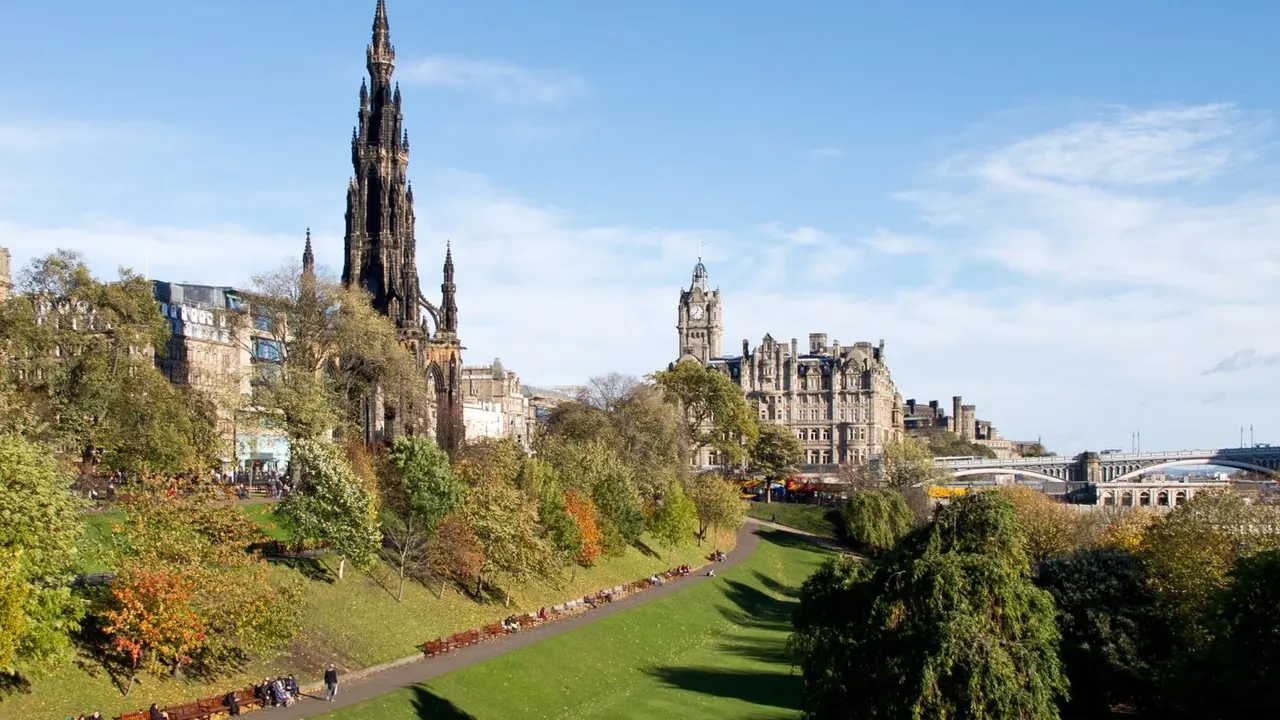
The Scott Monument and Princes Street Gardens
- Culture & sights75
- Nature & outdoors75
- Day trips75
Photo: Carlos Delgado, CC BY-SA 3.0, cropped
Match
56
Every category weighted equally
- Beach & sun49
- Culture & arts62
- Food & nightlife56
- Family trip55
- Outdoors58
- Relax & unwind52
- Shopping & style57
- On a budget53
Edinburgh in twelve categories
Our verdict on each, scored 0 to 100 against the same fixed benchmark cities, so a score means the same thing on every page.
Beaches & swimming. Scores 22 out of 100.
Food & drink. Scores 53 out of 100.
Culture & sights. Scores 75 out of 100.
Nightlife. Scores 50 out of 100.
Nature & outdoors. Scores 75 out of 100.
Day trips. Scores 75 out of 100.
Good for families. Scores 62 out of 100.
Getting around. Scores 74 out of 100.
Shopping & style. Scores 50 out of 100.
Affordability. Scores 30 out of 100.
Live music & performing arts. Scores 72 out of 100.
Wellness & relaxation. Scores 34 out of 100.
Edinburgh category by category
Beaches & swimming
22Edinburgh has a real seaside, but not a beach vacation. Portobello, a Victorian resort suburb a short bus ride east of the centre, has a long sandy beach and a promenade, and on clear summer days it fills with families and dog walkers. Further along the coast, the East Lothian beaches at Gullane, Yellowcraig and North Berwick are wide and handsome, about half an hour to an hour away.
The water is the problem. The North Sea reaches about 14°C at the height of summer, and warm days are rare. A hardy group of year-round sea swimmers, often in wetsuits, keeps a cold-water swimming habit going at Portobello and the small harbour beach at Wardie Bay. Most visitors walk the sand instead of swimming.
Food & drink
53Edinburgh eats well, but it is not a food destination. Its strength is the Scottish larder: hand-dived scallops, langoustines and oysters from the west coast, Highland beef and lamb, venison and grouse in autumn, and soft fruit in summer. The best cooking is modern rather than traditional, found in a small group of ambitious dining rooms in Leith, the old port, and in the New Town and Stockbridge. Haggis, Cullen skink and cranachan are everywhere, though on the streets around the Royal Mile they come at their most ordinary.
Whisky is the most distinctive part of eating and drinking here, with bars that carry hundreds of single malts and staff who will guide a tasting. Beyond that the offer is thin for a capital. Street food and cheap local eating are scarce, the weekend farmers' markets are pleasant rather than memorable, and prices are high for the UK. A visitor eats well enough by choosing carefully, but few would plan a trip around the table.
Culture & sights
75Edinburgh's heritage is the city itself. The Old Town runs down a volcanic ridge from the castle on its rock to the Palace of Holyroodhouse. Along the Royal Mile, tall tenements, narrow closes and St Giles' Cathedral keep the medieval street plan. Across the valley of Princes Street Gardens, the Georgian New Town is one of the finest planned townscapes in Europe, with its crescents, squares and stone terraces. Both parts make up a single UNESCO World Heritage Site, and Calton Hill's monuments look out over it.
The national collections add depth without being overwhelming. The National Museum of Scotland covers everything from Pictish stones to Dolly the sheep, the Scottish National Gallery holds a fine set of old masters, and the Portrait Gallery and two modern art galleries complete the set, most of them free. The Royal Yacht Britannia is moored in Leith. It is a strong few days rather than an inexhaustible city.
Nightlife
50Going out in Edinburgh mostly means the pub, and the pubs are good: wood-panelled Victorian bars on Rose Street and in the New Town, old drinking dens in the Grassmarket under the castle, and harbour pubs in Leith. The Cowgate, a deep street running beneath the Old Town's bridges, is the student and late-night strip, with a handful of clubs and loud bars. Cocktail bars in the Georgian basements around George Street cater to a smarter crowd.
For most of the year it is a good-natured but fairly early city, and the club scene is small. August is different, when the festivals keep bars open into the small hours and the whole centre stays out late.
Nature & outdoors
75Few cities have a wild hill in the middle. Arthur's Seat, an extinct volcano in Holyrood Park, rises to 251m within a short walk of the Royal Mile, with crags, lochs and views over the Firth of Forth. The Water of Leith walkway follows a wooded river through the city to the sea, and the Pentland Hills on the southern edge offer proper ridge walking and mountain biking within half an hour.
Further out, the East Lothian coast has dunes and cliff paths, and boat trips from North Berwick go out to the gannet colony on the Bass Rock. Loch Lomond, the Trossachs and the edge of the Highlands are within about two hours. The weather is cool, windy and changeable all year, and the best walking light comes in the long days of late spring and summer.
Day trips
75Edinburgh is a good base for seeing more of Scotland. Glasgow, with its Victorian centre, museums and very different character, is under an hour away by train. Stirling's castle and old town, scene of the Wars of Independence, are about as close, and Linlithgow Palace, birthplace of Mary Queen of Scots, is on the way. St Andrews, with its ruined cathedral, university and famous Old Course, is about an hour and a half away.
To the south, the Borders abbeys at Melrose, Dryburgh and Jedburgh and Walter Scott's house at Abbotsford make a fine day by train and bus. Rosslyn Chapel is a short trip from the city. The fishing villages of Fife and the Forth Bridges at South Queensferry, a UNESCO site, add easy half-days.
Good for families
62Edinburgh works well with children for a few days. The castle, with its cannons and soldiers' stories, is a hit. The National Museum of Scotland has hands-on galleries and enough animals, machines and dinosaurs to fill a rainy morning, and Dynamic Earth tells the story of the planet under a tented roof below Arthur's Seat. Camera Obscura's tower of optical illusions sits at the top of the Royal Mile, and Edinburgh Zoo spreads over a hillside to the west.
The centre is compact and feels safe, the buses take buggies, and Holyrood Park, the Botanic Garden and Portobello's sands give room to run. On the other hand, the Old Town is all steep steps and cobbles, the weather turns quickly, and there is no theme park. In August the festival crowds make everything harder work.
Getting around
74Most of what a visitor wants is within walking distance. The Old Town, the New Town, Calton Hill and Holyrood Park all sit within about 2km of each other, and Stockbridge and Dean Village are an easy stroll beyond. The catch is the terrain: the city is built on hills and ridges joined by bridges and stairways, and the cobbles and steep closes off the Royal Mile take some effort.
The Lothian bus network is dense and easy to use with a contactless card, and a single tram line runs from the airport through Princes Street to Leith and Newhaven. Waverley station sits in the valley in the very centre, which makes rail day trips simple. A car is a hindrance in town, though it helps for the Highlands.
Shopping & style
50The shopping is pleasant but limited. Princes Street has the high-street chains and castle views, George Street and the lanes off St Andrew Square have the upmarket labels, and the curving, colourful Victoria Street below the castle has independent shops. Stockbridge has small boutiques, delicatessens and a Sunday market.
What visitors usually take home is Scottish: cashmere and knitwear, tweed, tartan from specialist kiltmakers, and whisky from shops with deep selections of single malts. The Royal Mile is lined with tartan souvenir shops of very mixed quality. There is no luxury depth or major market district, so it is not a city to visit for the shopping alone.
Affordability
30Edinburgh is an expensive city for a visitor, mostly because of rooms. Central hotels are pricey all year, and during the August festivals and at Hogmanay they reach extreme levels and sell out far ahead, so many visitors stay in Leith or out of town. Restaurants and drinks cost what they do in other big British cities.
Some things help. The national museums and galleries are free, so are Arthur's Seat and the city's best views, and bus fares are modest. Ticketed sights such as the castle and Holyroodhouse add up quickly. Late autumn and winter, outside the Christmas weeks, are much kinder on the budget.
Live music & performing arts
72For one month a year, Edinburgh is the busiest performing arts city on earth. In August the Edinburgh Festival Fringe fills hundreds of venues, from churches and lecture halls to cellars and tents, with comedy, theatre, cabaret and music from morning until after midnight. Alongside it, the Edinburgh International Festival brings leading orchestras, opera and dance companies, and the Military Tattoo is staged on the castle esplanade.
The rest of the year is smaller but solid. The Usher Hall and the Queen's Hall host the Royal Scottish National Orchestra and the Scottish Chamber Orchestra. The Festival Theatre takes Scottish Opera and Scottish Ballet, and the Royal Lyceum and the Traverse produce strong drama. Traditional music sessions in Old Town and Leith pubs are easy to drop into, and the jazz and blues festival fills July.
Wellness & relaxation
34Edinburgh is not a spa city, but it has a few nods to bathing. The Victorian Turkish baths at Portobello's municipal swim centre, with hot rooms, a steam room and a plunge pool under old tiles, are an unusual survival. The Royal Commonwealth Pool is a fine modernist swimming hall. A committed cold-water swimming crowd, with saunas on the shore, gathers at Portobello and Wardie Bay. Beyond these, wellness means hotel spas.
The pace depends on the season. Out of season, a morning in the Botanic Garden, a walk along the Water of Leith or an afternoon in a New Town café is quietly restorative. In August the centre is crowded and loud, and it is no place to rest.
When should you go?
Pick a month to see what it is like. The climate figures are measured averages, not a forecast.
Edinburgh in July
Daytime high, °C
Rainfall in the month, mm
The whole year
Shaded against this city’s own year: the deepest cell is its best month for that figure and the palest its weakest.
Where the figures come from
Edinburgh has no rain gauge within 25 km of the centre, so its rainfall comes from a gridded climate dataset read at the city rather than from a gauge further away.
Edinburgh's sunshine is measured 52 km from the centre, at Leuchars.
Temperature and rainfall are climate normals, averaged over the years shown. Edinburgh: 1991-2020 normals, Edinburgh Airport (10 km from centre).
Before you go
| Measure | Edinburgh |
|---|---|
| Official language | English |
| Currency | Pound Sterling (GBP) |
| Sockets | G230 V, 50 Hz |
| Driving side | Left |
| Time zone | UTC, UTC+1 in summer |
| Emergency number | 112 or 999 |
| Elevation | 47 m |
| Main airport | Edinburgh Airport (EDI)11 km from centre163 non-stop destinations |
| Public holidays this year | 10 days |
By the numbers
| Measure | Edinburgh |
|---|---|
| City population | 488,050 |
| People per km² | 1,884 |
| Museums within 10 km | 32 |
| UNESCO World Heritage sites within 50 km | 3 |
| Swim season, months above 21 °C | None |
Compare Edinburgh with
Every comparison with a written verdict behind it.