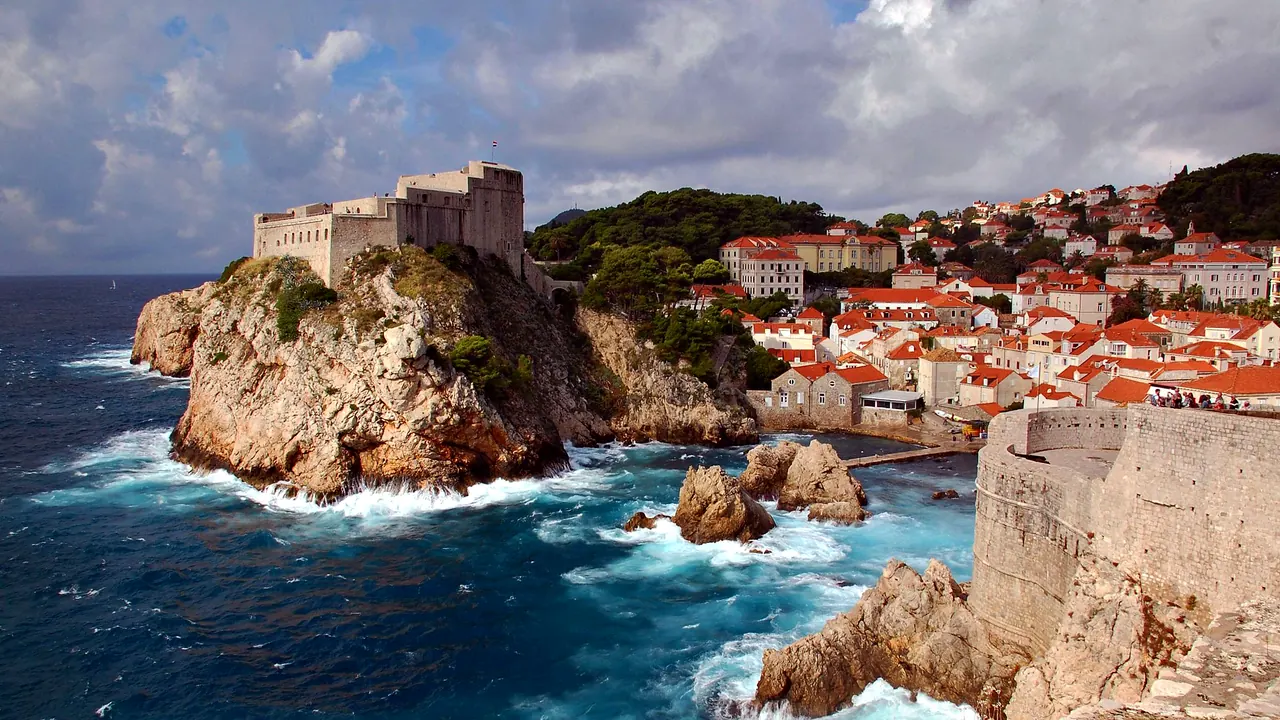
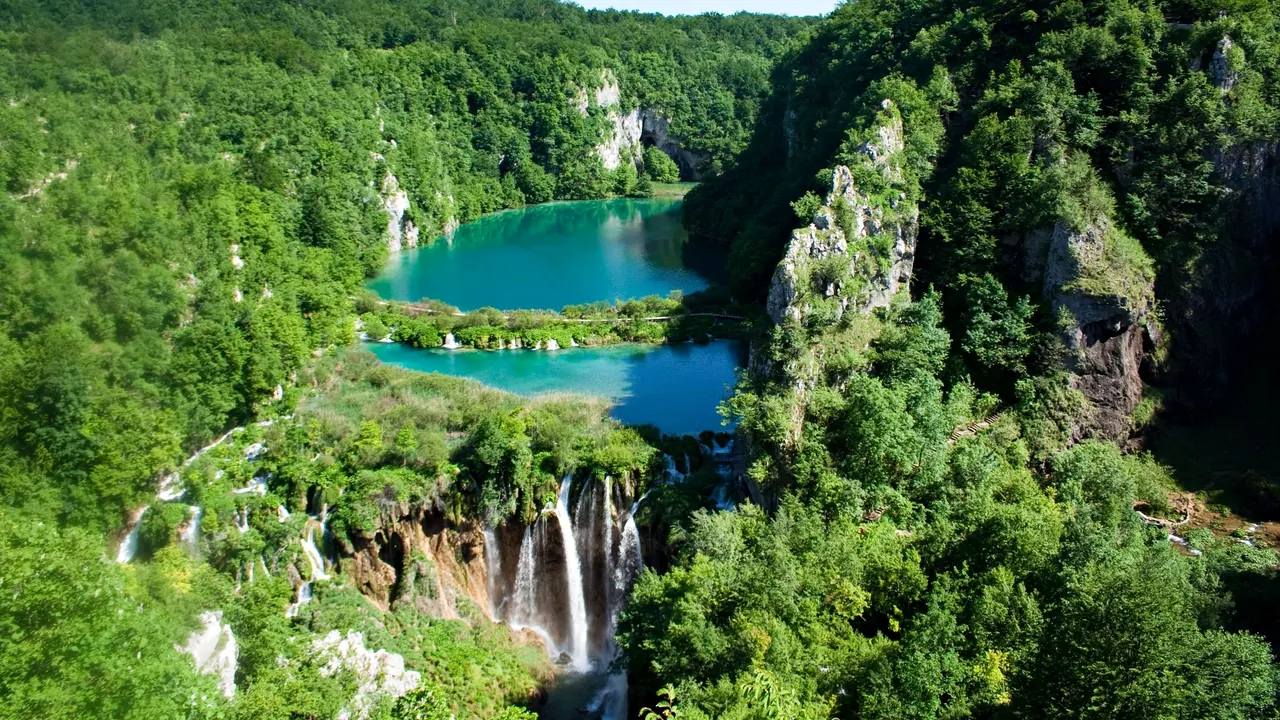
Photos: Dalmatia by Edwardwexler at English Wikipedia, CC BY-SA 3.0, cropped; Plitvice Lakes by Pablo BM from London, England, CC BY 2.0, cropped.
Dalmatia or Plitvice Lakes?
Our verdict in twelve categories, each scored against the same fixed benchmark cities, and the climate month by month, so you can choose for your trip.
Choose Dalmatia for
- beaches
- culture and sights
- nightlife
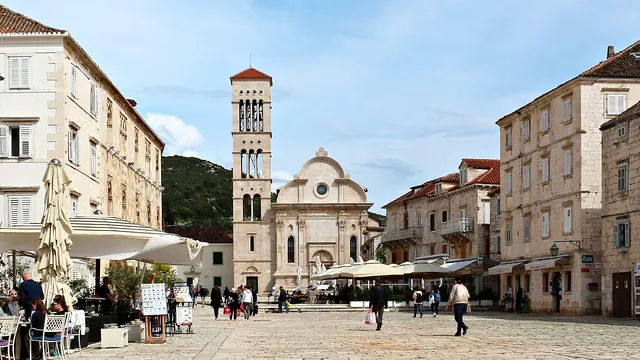
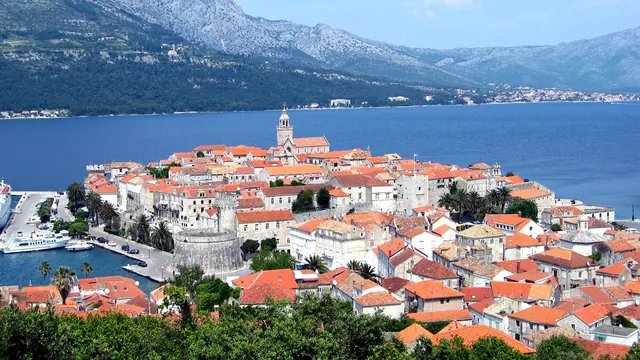
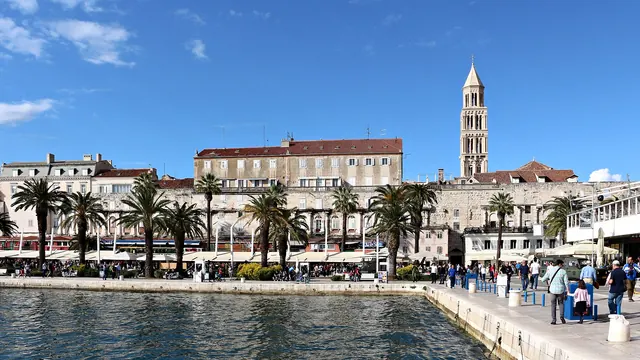
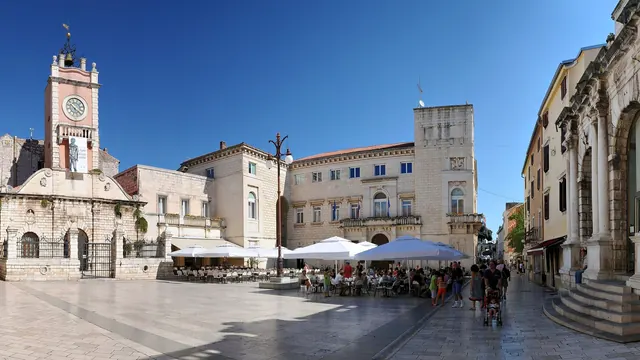
Dalmatia is the choice for a full summer vacation by the sea. It has clear water and pebble coves, walled towns such as Split and Dubrovnik, konoba cooking with good local wine, and summer evenings in Hvar town or Split's palace lanes. You can easily fill a week or two moving between islands, and it suits anyone who wants swimming, sightseeing and going out on the same trip.
Choose Plitvice Lakes for
- prices
- nature and the outdoors
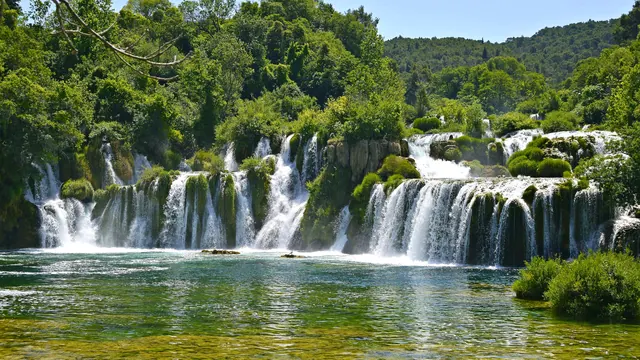
Plitvice Lakes is a single natural spectacle: terraced turquoise lakes, waterfalls and beech forest, best walked early in the morning and slept on in a quiet village guesthouse. Choose it for walking among the falls, and accept that there is no swimming, little to see that is built and almost nothing to do after dark. Most people give it a night or two on the road between Zagreb and the coast rather than a whole stay.
Scoreboard
Twelve categories on one fixed scale from 0 to 100. The shaded stretch is the gap between the two.
Your match
Pick a travel style or drag the sliders, and both match scores follow your weighting.
Wins on beaches and culture and sights with your weighting.
Wins on prices and nature and the outdoors with your weighting.
What matters to you?
Category by category
What the scores mean for a trip.
Beaches & swimming
Dalmatia is one of the Mediterranean's great swimming coasts. The water is calm and transparent over pebbles and rock shelves, there is Zlatni Rat at Bol, there are sandy bays near Nin and on Lopud, and there are countless coves you reach by boat.
Plitvice offers nothing like it. The lakes are off limits to swimmers, so a summer dip means the cool, green Korana river around Korana village or Slunj, and the sea is a full day's round trip away.
Food & drink
Dalmatia eats far better. It has grilled fish with chard, pašticada, peka, Ston oysters, morning markets in Split and Zadar, and serious wine from Pelješac, Hvar and Korčula. The harbourfront tourist menus are the weak point.
Around Plitvice the cooking is Lika country food: spit-roast lamb and suckling pig, river trout, cheese and brandy, served in roadside inns that often cater to coach groups. It makes a good dinner after a day on the trails, but the range is too narrow to plan a trip around.
Culture & sights
The gap is wide. Dalmatia has a whole coast of first-rank townscape: Diocletian's Palace in Split, the walls of Dubrovnik, Trogir, Šibenik's stone cathedral and Zadar's forum. To see the best you have to move from town to town.
Plitvice is World Heritage for its landscape, not its buildings. Rastoke's water mills, the ruins of Drežnik fortress and the 1991 war memorials are worth an afternoon, but there is little more.
Nightlife
Dalmatia has real summer nightlife: cocktail bars on the Hvar harbour, beach clubs on the islets, and crowded bars in Split's old lanes, though most of it ends by mid September. Plitvice has none at all. The villages go quiet after dinner because everyone is up early for the trails.
Nature & outdoors
The two are level, but the landscapes are very different. Dalmatia's nature is on the sea: sailing among a thousand islands, the bare Kornati archipelago, Mljet's saltwater lakes, rafting in the Cetina gorge and climbing in Paklenica. It is spread along the coast and needs a boat or a car.
Plitvice packs its nature into one valley of lakes, travertine barriers and waterfalls under beech and fir. It changes strongly with the seasons, and the forests around it are home to bears, wolves and lynx. It is better for walking, as long as you start before the crowds arrive.
Day trips
Dalmatia is built for day trips. Ferries and catamarans from Split reach Hvar, Brač and Vis, and Dubrovnik has the Elaphiti islands, Ston and Pelješac close by, with Kotor and Mostar within reach.
From Plitvice the choices are thinner: Rastoke, Bihać and Una National Park across the Bosnian border, and the Tesla birthplace at Smiljan. Anything bigger, such as Zadar or Zagreb, is about two hours away.
Good for families
Dalmatia works better for families. It has calm, tideless sea, shallow bays and resorts such as Baška Voda where the shore is a short walk away, though pebbles call for water shoes and the stepped old towns are hard with a pushchair.
Plitvice charms school-age children with its boardwalks, fish, boats and the little train, but it fills only a day or two. Without railings, the boardwalks need close watching with toddlers, and there is no swimming to fall back on.
Getting around
Dalmatia is slightly easier, though only on its main routes. Its old towns are car-free and walkable, buses link the main towns and ferries serve the islands, but the long coast, the August queues and the slow coastal road all call for planning.
Plitvice is simple inside the park, with signed circuits, electric boats and trains, and coaches between Zagreb and the coast stop at the gates. Outside the park, almost everything needs a car.
Shopping & style
Neither is a shopping destination, but Dalmatia has at least something to browse. There are Split's main streets and green market, plus olive oil, Hvar lavender, Pag lace and island wine to bring home. Plitvice has entrance kiosks and roadside stalls selling cheese, honey and brandy, and that is all.
Affordability
The two cost about the same, but in different ways. In Dalmatia the cost depends on where you stay. Dubrovnik and Hvar town are expensive in summer, while private rooms around Zadar and Šibenik, mainland resorts and June or September dates keep it reasonable.
At Plitvice, village guesthouses and big inn portions are fair value. The summer park fee and the hotels near the gates push costs up, so spring or autumn is the cheaper time to go.
Live music & performing arts
Dalmatia has a real stage and Plitvice has none. On the coast it is mostly a summer affair, when the festivals in Dubrovnik and Split turn palace courtyards, fortress terraces and the Roman Peristyle into open-air venues. The sound you are most likely to remember is klapa, close-harmony singing without instruments, which you might hear in a church or an old-town square.
Around the lakes there is nothing to plan an evening around. A village festival with Lika folk music is the most you might come across, and for a concert or a play you would have to drive to Zagreb or Zadar.
Wellness & relaxation
Neither place has a spa tradition, so rest here means slowing down rather than treatments. Dalmatia has more ways to do it, with spa rooms in its larger resort hotels and, above all, the car-free Elaphiti islands, Vis and Lastovo, where an unhurried afternoon by the water is the local custom.
Plitvice offers forest quiet, clean air and silent evenings in an outlying farmhouse guesthouse. It is restful as long as you avoid the boardwalks at midday in summer.
When should you go?
Pick your month. The climate figures are measured averages, not a forecast.
Dalmatia in July
Plitvice Lakes in July
Daytime high, °C
Rainfall in the month, mm
Where the figures come from
Dalmatia's temperatures are measured 53 km from the centre, at Split / Marjan.
Dalmatia has no rain gauge within 25 km of the centre, so its rainfall comes from a gridded climate dataset read at the destination rather than from a gauge further away.
Dalmatia's sunshine is measured 53 km from the centre, at Split / Marjan.
Plitvice Lakes has no weather station within reach, so its figures come from a gridded climate model rather than a measured record, and read a broad area rather than one spot.
Temperature and rainfall are climate normals, averaged over the years shown. Dalmatia: 1991-2020 (sunshine 1971-2000) normals, Split / Marjan (53.2 km from centre). Plitvice Lakes: 2001-2020 normals, NASA POWER reanalysis grid, no weather station within 90 km.
Dalmatia is a summer coast. The sea is warm enough for easy swimming from June to September, reaching about 25°C in August, and July and August are the sunniest months. Daytime highs of around 31°C make midday sightseeing in the stone old towns hard work. May and late September are better for walking and for the inland trails. Rain sets in from September, and November is the wettest month, at around 135mm. Winters are mild but grey and quiet.
Plitvice Lakes, up in the hills, is cooler and wetter all year. Summer highs stay in the high 20s, which makes July and August comfortable for walking, though that is also when the boardwalks are busiest. Spring brings the fullest waterfalls, and autumn turns the forest red and gold, but September to November is also the wettest stretch. Winter days barely rise above freezing, and the falls can freeze under snow.
Which traveller are you?
On a beach and sun trip, Dalmatia is the only real choice. It has warm, clear Adriatic water, pine-backed pebble beaches on the Makarska Riviera and island coves on Vis and Hvar. Swimming is banned in the Plitvice lakes, and the nearest sea is a two-hour drive over the mountains.
For a food and nightlife trip, Dalmatia is well ahead. It has peka and black risotto in stone konobas, Plavac Mali and Pošip from the islands, then harbourside bars in Hvar and crowded palace lanes in Split. At Plitvice, evenings mean one lamb dinner and then silence.
On an outdoors trip built around walking, Plitvice Lakes is the more concentrated choice. Boardwalks run over the cascades, trails climb through beech forest, and the Korana offers rafting. Dalmatia matches it for scenery but suits sailors, kayakers and climbers more than people who simply want to walk.
Before you go
| Measure | Dalmatia | Plitvice Lakes |
|---|---|---|
| Official language | Croatian | Croatian |
| Currency | Euro (EUR) | Euro (EUR) |
| Sockets | CF230 V, 50 Hz | CF230 V, 50 Hz |
| Driving side | Right | Right |
| Time zone | UTC+1, UTC+2 in summer | UTC+1, UTC+2 in summer |
| Emergency number | 112 | 112 |
| Main airport | Split Saint Jerome Airport (SPU)69 non-stop destinations | Zagreb Franjo Tuđman International Airport (ZAG)66 non-stop destinations |
| Public holidays this year | 14 days | 14 days |
By the numbers
| Measure | Dalmatia | Plitvice Lakes |
|---|---|---|
| Population | 852,068 | - |
| People per km² | 70 | - |
| Swim season, months above 21 °C | 4 months | - |
Where else could you go?
Every comparison below shares a destination with this one, so you can follow Dalmatia or Plitvice Lakes somewhere new.
- Krkavs Plitvice Lakes
- Istriavs Plitvice Lakes
- Kotorvs Dalmatia
- Bračvs Plitvice Lakes
- Hvarvs Plitvice Lakes
- Korčulavs Plitvice Lakes