Croatia
Zadar
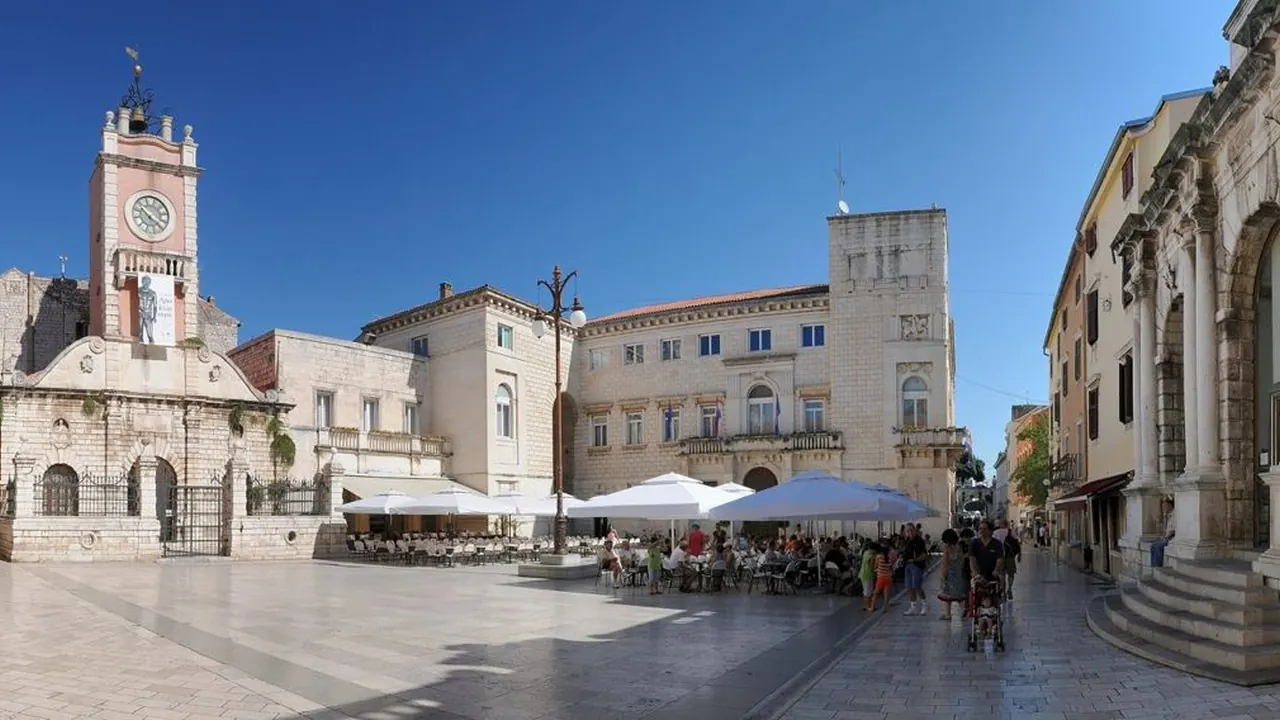
People's Square (Narodni trg)
- Nature & outdoors82
- Beaches72
- Day trips70
Photo: Böhringer Friedrich, CC BY-SA 2.5, cropped
Match
51
Every category weighted equally
- Beach & sun54
- Culture & arts49
- Food & nightlife46
- Family trip57
- Outdoors60
- Relax & unwind53
- Shopping & style46
- On a budget51
Zadar in twelve categories
Our verdict on each, scored 0 to 100 against the same fixed benchmark cities, so a score means the same thing on every page.
Beaches & swimming. Scores 72 out of 100.
Food & drink. Scores 45 out of 100.
Culture & sights. Scores 55 out of 100.
Nightlife. Scores 38 out of 100.
Nature & outdoors. Scores 82 out of 100.
Day trips. Scores 70 out of 100.
Good for families. Scores 55 out of 100.
Getting around. Scores 58 out of 100.
Shopping & style. Scores 27 out of 100.
Affordability. Scores 52 out of 100.
Live music & performing arts. Scores 28 out of 100.
Wellness & relaxation. Scores 35 out of 100.
Zadar category by category
Beaches & swimming
72Swimming is a daily part of a summer stay. The water along the Zadar Riviera is clear and reaches about 24°C in August, and locals swim straight off the stone promenade on the peninsula's western edge. Kolovare, a short walk from the old town, and the pine-shaded shore at Borik are the main city beaches. Both are pebble or concrete platforms rather than sand, and both get busy.
The better beaches are a short trip away. Nin, about 20 minutes north, has long, shallow sandy beaches that suit children. Ferries from the harbour reach Ugljan and Pašman for quieter coves, and Sakarun on Dugi Otok, with its pale sand and turquoise water, makes a full day out. The season runs from June to September. Outside it the sea is too cool for most people.
Food & drink
45Eating here means Dalmatian coastal cooking: grilled fish and squid, black risotto, octopus or lamb slow-cooked under a peka bell, and plates of Pag cheese and pršut to start. Zadar is also the home of Maraschino, the cherry liqueur once distilled here for European courts, and the local wine lists lean on Dalmatian and northern Adriatic grapes. The fish and produce market by the old town walls is worth a morning visit.
The range is narrow, though. Konobas and seafood restaurants on the peninsula serve much the same menu, and the cheapest places along the main streets cater to passing visitors. There is little international cooking and only a modest fine-dining tier. It is pleasant to eat here, but nobody chooses Zadar for the food.
Culture & sights
55The old town fills a small walled peninsula, and three thousand years of history sit close together. The Roman forum lies open in the centre. Next to it is the round, ninth-century Church of St Donatus, the city's emblem, and the Romanesque Cathedral of St Anastasia, whose bell tower you can climb. The Venetian fortifications, with the Land Gate and the Square of Five Wells, are part of a UNESCO listing.
The museums are small but good. The Museum of Ancient Glass and the Archaeological Museum both stand out, and the permanent display of church gold and silver is a quiet surprise. The best-known modern sights are on the waterfront: the Sea Organ, whose pipes play with the waves, and the solar-panelled Greeting to the Sun. Two full days covers everything.
Nightlife
38In summer, evenings start at sunset on the Riva by the Sea Organ. From there people drift to café-bars along Kalelarga and the old town lanes, and to a few garden and terrace bars on the walls and the waterfront. Locals and visitors stay out fairly late on warm nights, but the scene is small and relaxed rather than wild.
For real clubbing, the young crowd heads to the party beach at Zrće on the island of Pag, about an hour away, which runs through high summer. From October to May the town is quiet, and going out mostly means a drink in a café-bar.
Nature & outdoors
82Zadar is a fine base for the outdoors. To the east, the Velebit range rises steeply behind the coast, and Paklenica National Park, about 45 minutes away, has limestone gorges for serious hiking and some of the best rock climbing in Croatia. Out to sea lie hundreds of islands. Boat trips and sailing charters run to the bare, stark Kornati archipelago and to Telašćica on Dugi Otok, with its cliffs and salt lake.
Krka's travertine waterfalls are about an hour south, and Plitvice Lakes are around two hours inland, an early start in summer. Closer in, the Vrana lake reserve draws birdwatchers, and sea kayaking and cycling along the coast and islands are easy to arrange. Spring and autumn are the best seasons for hiking. In midsummer the heat makes high-ground walks hard work.
Day trips
70Šibenik is the best day out, about an hour south by road. Its old town climbs a hillside above a channel to the Cathedral of St James, which is UNESCO-listed, and there are fortresses with wide views. Nin, just 20 minutes away, is a tiny island town of medieval Croatian kings, with the miniature Church of the Holy Cross and old salt pans.
Split, with Diocletian's Palace, and the walled island town of Trogir are each about an hour and a half by motorway. That is a long day, but a rewarding one. Pag town and its lace-making tradition make a quieter outing. Ferries from the harbour reach the island villages of Ugljan, Pašman and the car-free Silba. A car or organised excursions make all of this much easier.
Good for families
55Zadar is relaxed and safe, and the old town is car-free and flat, so it is easy to manage with children. The Sea Organ and the Greeting to the Sun, whose tiles light up after dark, delight most children. The broad waterfront promenade suits pushchairs and scooters, and evenings out with children are normal in Croatian culture.
There is little made just for children, though: no zoo, aquarium or theme park. Family days are mostly spent at the sea. Nin's shallow sandy beaches are the best for small children, and short ferry rides to the islands feel like an adventure. Midsummer heat and crowded city beaches can be tiring, so June and September are easier months.
Getting around
58The old town is a small, flat, pedestrian peninsula. You can walk across it in a quarter of an hour, and a footbridge links it to the mainland side of the harbour. Kolovare beach is within walking distance. Local buses cover the suburbs and Borik, though they are basic and not much use for anything beyond.
Ferries to the nearby islands leave from the edge of the old town, which makes island hopping straightforward. For the national parks, Nin, Šibenik and the wider coast, a hire car or organised excursions are far more practical than regional buses. Parking near the peninsula is tight in summer.
Shopping & style
27Shopping here is small-scale. Kalelarga, the marble main street of the old town, and the lanes around it have jewellers, fashion chains, souvenir shops and a few galleries. The things worth taking home are local: Maraschino liqueur, Pag cheese, olive oil, figs and the fine lace made on Pag. The open-air market by the walls is the most enjoyable place to browse. Beyond that, there are malls on the edge of town, and anyone who wants serious shopping will be disappointed.
Affordability
52Zadar costs about what a mid-range Western European city does. It is noticeably easier on the budget than the better-known Dalmatian towns further south. Private apartments are the usual stay and give good value outside July and August, while high-summer rooms on or near the peninsula cost much more. Meals at konobas and bakeries are fair, but restaurant prices along the main old town streets reflect the visitors they serve. Ferries and local buses are inexpensive. National park entry and boat excursions add up quickly. June and September give the best balance of price and weather.
Live music & performing arts
28The highlight of the year is the Musical Evenings in St Donatus, a long-running summer series of early and chamber music in the ninth-century church. The setting is unforgettable. Concerts also take place in other churches and squares in July and August, and you may hear klapa, the unaccompanied Dalmatian harmony singing. A small national theatre stages Croatian-language drama during the season. Otherwise there is little to attend, and outside summer the cultural calendar is thin.
Wellness & relaxation
35There is no bathing or spa culture to speak of. Wellness means hotel spas, mostly in the resort area at Borik, plus the shallow lagoon at Nin, where people have long coated themselves in mineral-rich mud. What Zadar does offer is a slow pace. Long café mornings, an afternoon siesta and the evening ritual of watching the sun set over the islands from the steps of the Sea Organ make it an easy place to unwind, especially in the quieter months before and after high summer.
When should you go?
Pick a month to see what it is like. The climate figures are measured averages, not a forecast.
Zadar in July
Daytime high, °C
Rainfall in the month, mm
The whole year
Shaded against this city’s own year: the deepest cell is its best month for that figure and the palest its weakest.
Where the figures come from
Zadar has no rain gauge within 25 km of the centre, so its rainfall comes from a gridded climate dataset read at the city rather than from a gauge further away.
Temperature and rainfall are climate normals, averaged over the years shown. Zadar: 1999-2020 (rainfall 1991-2020) normals, Zadar / Zemunik (9.9 km from centre).
Before you go
| Measure | Zadar |
|---|---|
| Official language | Croatian |
| Currency | Euro (EUR) |
| Sockets | CF230 V, 50 Hz |
| Driving side | Right |
| Time zone | UTC+1, UTC+2 in summer |
| Emergency number | 112 |
| Elevation | 5 m |
| Main airport | Zadar Airport (ZAD)10 km from centre66 non-stop destinations |
| Public holidays this year | 14 days |
By the numbers
| Measure | Zadar |
|---|---|
| City population | 70,779 |
| Museums within 10 km | 1 |
| UNESCO World Heritage sites within 50 km | 2 |
| Swim season, months above 21 °C | 4 months |
Compare Zadar with
Every comparison with a written verdict behind it.
- Amalfi
- Belgrade
- Bled
- Bologna
- Bratislava
- Budapest
- Dubrovnik
- Florence
- Innsbruck
- Kotor
- La Spezia
- Ljubljana
- Milan
- Mostar
- Naples
- Pisa
- Portofino
- Positano
- Rome
- Rovinj
- Salerno
- Salzburg
- Sarajevo
- Siena
- Sorrento
- Split
- Tirana
- Venice
- Verona
- Vienna
- Zagreb