Croatia
Split
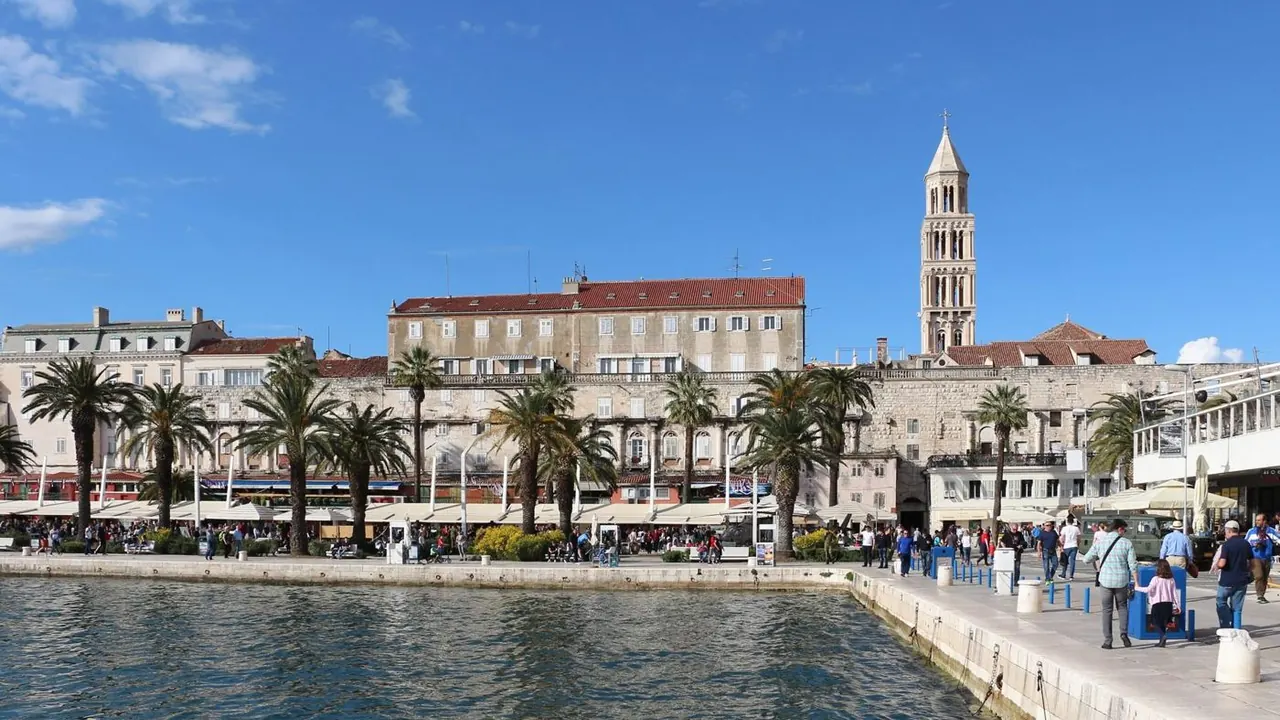
The Riva in front of Diocletian's Palace
- Day trips78
- Nature & outdoors77
- Beaches75
Photo: Bernard Gagnon, CC BY-SA 4.0, cropped
Match
57
Every category weighted equally
- Beach & sun58
- Culture & arts56
- Food & nightlife54
- Family trip60
- Outdoors63
- Relax & unwind57
- Shopping & style53
- On a budget55
Split in twelve categories
Our verdict on each, scored 0 to 100 against the same fixed benchmark cities, so a score means the same thing on every page.
Beaches & swimming. Scores 75 out of 100.
Food & drink. Scores 57 out of 100.
Culture & sights. Scores 66 out of 100.
Nightlife. Scores 52 out of 100.
Nature & outdoors. Scores 77 out of 100.
Day trips. Scores 78 out of 100.
Good for families. Scores 54 out of 100.
Getting around. Scores 67 out of 100.
Shopping & style. Scores 32 out of 100.
Affordability. Scores 45 out of 100.
Live music & performing arts. Scores 37 out of 100.
Wellness & relaxation. Scores 40 out of 100.
Split category by category
Beaches & swimming
75The sea is the reason many people base themselves in Split. From June to September the Adriatic is clear and warm, usually around 23°C to 25°C in high summer, and you can walk to a swim from the old town. Bačvice, a shallow sandy bay just east of the harbour, is the city's social beach, where locals play picigin, a ball game in knee-deep water. Kašjuni, Bene and the rocky coves around the Marjan peninsula are quieter, with pine shade and deeper water.
Most of the shore is pebble or concrete platforms, and the city beaches fill up in July and August. Many visitors take a ferry or catamaran to Brač, Šolta or Hvar for longer beaches and calmer coves, or go down the coast to Omiš and the Makarska Riviera. The water stays pleasant into early October.
Food & drink
57Eating in Split means Dalmatian cooking: grilled fish and squid, black risotto, slow-braised pašticada with gnocchi, and meat or octopus baked under an iron bell (peka), which usually has to be ordered ahead. The fish market near the western edge of the old town and the green market (Pazar) by the palace walls show what is in season, and the local wines, red Plavac Mali and white Pošip, are good with all of it.
The best meals are in family-run konobas in Varoš and the streets behind the Riva. Inside the palace walls, many menus are aimed at a summer crowd. Burek and bakery snacks cover breakfast, and long coffees on the waterfront are a local habit. There is little international range or fine dining, and the scene is much quieter in winter.
Culture & sights
66Split grew up inside a Roman emperor's retirement palace, and that is its great sight. Diocletian's Palace, built around 300 AD, is not a ruin but a lived-in neighbourhood. Medieval houses, shops and churches fill the old walls, and the Peristyle courtyard leads to the Cathedral of St Domnius, which was once the emperor's mausoleum. The vaulted substructures under the palace show the original floor plan, and the bell tower gives a view over the roofs.
Around the palace you will find Venetian-era streets, Narodni Trg square and the Gregory of Nin statue. The Meštrović Gallery on the Marjan slopes is a fine museum devoted to the sculptor, and the Archaeological Museum is solid. Beyond that the list is short, and most visitors have seen the city's sights in two days.
Nightlife
52In summer, Split's evenings start on the Riva and move into the palace, where small bars fill stone alleys and stairways and the crowd spills outside until late. Around Bačvice there are beach bars and a few clubs that run into the early hours, and a younger crowd moves between them and the old town. Some of the party crowd heads out to Hvar instead.
The season matters. From October to May the scene shrinks to a handful of bars, and going out becomes a coffee or a glass of wine with locals rather than a night out.
Nature & outdoors
77Split sits between bare limestone mountains and an island-studded sea, and both are easy to use. Marjan Hill, a pine-covered forest park at the western end of the city, has trails, viewpoints, cliffs and old hermitage chapels a short walk from the old town. Behind the city, Mosor and Kozjak offer proper ridge hikes with views over the coast.
About an hour south, the Biokovo range rises to over 1,700m above Makarska. At Omiš, the Cetina river canyon is used for rafting, canyoning and zip lines, and Krka National Park, with its travertine waterfalls, is about an hour north. On the water there is sea kayaking around Marjan, and sailing and island-hopping among Brač, Šolta, Hvar and Vis. High summer is hot for hiking, so spring and autumn are best.
Day trips
78Split is one of the easiest bases on the Adriatic for day trips by bus, ferry or car. Trogir, a medieval island town with a UNESCO-listed core and a fine Romanesque portal, is about half an hour away. Šibenik, whose Renaissance Cathedral of St James is also UNESCO-listed, is about an hour. Close to the city you can visit the Roman ruins of Salona at Solin, the clifftop Klis Fortress and the small castle towns of Kaštela.
By sea, Hvar town has a Venetian square and a hilltop fortress, Brač has the stone villages of Supetar and Bol, and Vis is a further island trip. Omiš and the Makarska Riviera lie down the coast. In summer the ferries make these trips simple, but they need more planning in winter.
Good for families
54Split is easy with children in a simple way. The centre is compact and safe, Bačvice is shallow enough for small children to paddle, and Marjan offers shade, trails and space to run. A ferry ride to one of the islands is often the highlight of the trip. The palace's underground halls and the Roman walls hold some interest for older children.
There is little made specifically for children, with no aquarium or theme park worth the name. July and August bring strong heat and packed streets and beaches. Many families stay in an apartment in a residential area or on the coast just outside the city, and come in for the old town.
Getting around
67The heart of Split is small and car-free. The palace, the Riva, Varoš, the markets and Bačvice are all within about fifteen minutes' walk of each other, and Marjan is on foot from the centre too. The ferry port, the intercity bus station and the railway station sit together at the harbour, so leaving for islands or coastal towns is simple.
Local buses reach the suburbs, Solin and Trogir, but the network is basic. In summer, traffic on the coast road is slow and parking is scarce. You do not need a car in the city, though one helps for inland trips and mountain trailheads. The palace streets are polished stone and full of steps, which matters with a pushchair or heavy luggage.
Shopping & style
32Shopping is not a reason to come to Split. Inside the palace, most shops sell souvenirs, lavender, olive oil, coral and Croatian ties, alongside a few galleries and jewellers. Marmontova street and the lanes behind the Riva hold the mainstream fashion chains, and larger malls on the edge of the city serve residents.
The Pazar green market by the palace's east gate is the most enjoyable place to browse, with produce, dried figs, honey and local brandies. Dalmatian wine and olive oil are the best things to take home.
Affordability
45Split is a mid-priced Mediterranean destination that feels expensive in high summer. In July and August, rooms in and near the old town cost about what you would pay in a large Western European city, and waterfront restaurants charge a lot for fish sold by weight. Ferries to the islands add up for a family.
Other costs are lower. Bakeries, the green market, local buses and the palace sights are inexpensive, and konobas away from the Riva are fairly priced. In May, June and late September, rooms cost far less, and in winter Split is a modestly priced city.
Live music & performing arts
37The Croatian National Theatre in Split, a 19th-century house just outside the palace, puts on opera, ballet and drama through the season. Plays are in Croatian, but opera and ballet need no translation. Every summer the Split Summer Festival stages opera and concerts in the open air, with the Peristyle courtyard of the palace as its best-known stage.
The local sound is klapa, unaccompanied male harmony singing. You can often hear it in the domed vestibule of the palace or at summer evening performances. Beyond that, live music mostly means bar bands and occasional concerts, and the calendar is thin outside summer.
Wellness & relaxation
40Split has no bathing tradition, so spa time means hotel spas and massage studios, many of them in the larger resorts along the coast east of the centre. What it does have is a local attitude to time. Dalmatians call it fjaka, an unhurried idleness best seen in the hour-long coffees on the Riva and the empty streets in the afternoon heat.
That calm is easiest to find in May, June and September, or in the residential streets and pine woods around Marjan. In midsummer the old town is crowded and loud late into the night, and anyone looking for real rest is better off on one of the islands.
When should you go?
Pick a month to see what it is like. The climate figures are measured averages, not a forecast.
Split in July
Daytime high, °C
Rainfall in the month, mm
The whole year
Shaded against this city’s own year: the deepest cell is its best month for that figure and the palest its weakest.
Temperature and rainfall are climate normals, averaged over the years shown. Split: 1991-2020 normals, Split / Marjan (0.9 km from centre).
Before you go
| Measure | Split |
|---|---|
| Official language | Croatian |
| Currency | Euro (EUR) |
| Sockets | CF230 V, 50 Hz |
| Driving side | Right |
| Time zone | UTC+1, UTC+2 in summer |
| Emergency number | 112 |
| Elevation | 0 m |
| Main airport | Split Saint Jerome Airport (SPU)12 km from centre69 non-stop destinations |
| Public holidays this year | 14 days |
By the numbers
| Measure | Split |
|---|---|
| City population | 160,577 |
| Museums within 10 km | 11 |
| UNESCO World Heritage sites within 50 km | 4 |
| Swim season, months above 21 °C | 4 months |
Compare Split with
Every comparison with a written verdict behind it.