France
Flaine
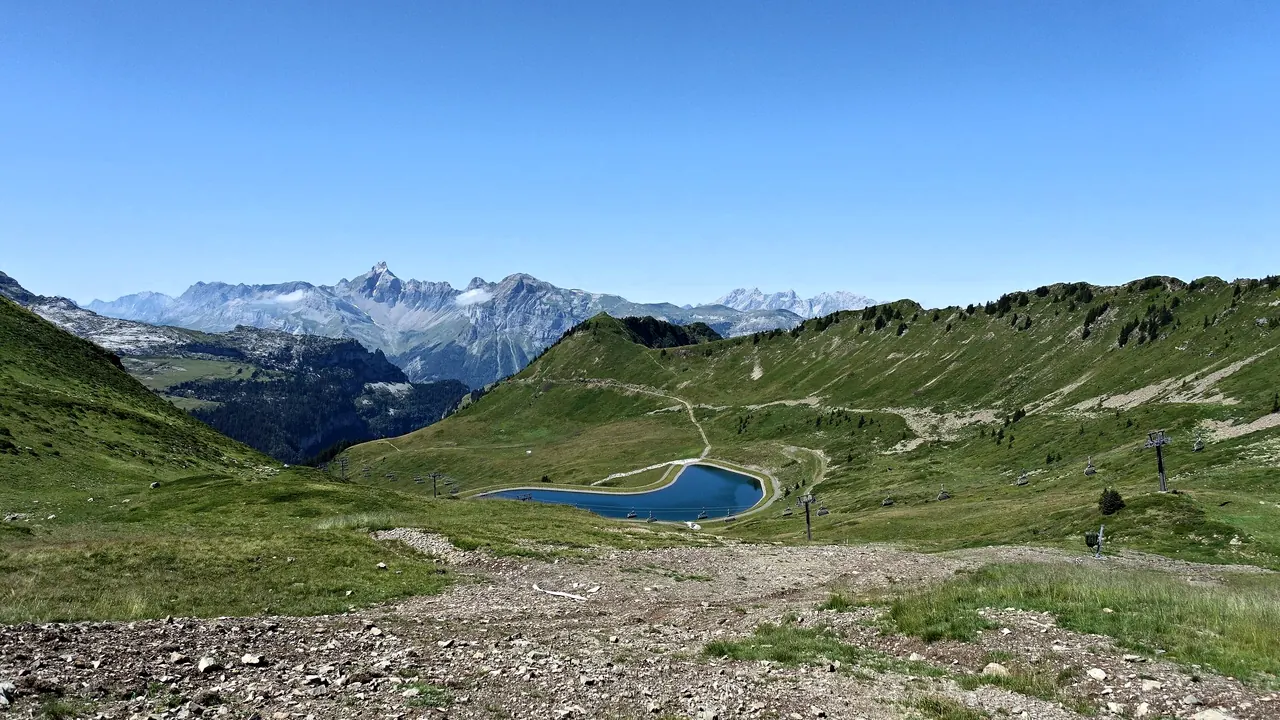
The lake at Flaine below jagged peaks in summer
- Nature & outdoors84
- Families62
- Day trips58
Photo: Guilhem Vellut, CC BY 2.0, cropped
Flaine lies in French Alps, which has its own page.
Match
33
Every category weighted equally
- Beach & sun32
- Culture & arts31
- Food & nightlife25
- Family trip40
- Outdoors44
- Relax & unwind34
- Shopping & style28
- On a budget33
Flaine in twelve categories
Our verdict on each, scored 0 to 100 against the same fixed benchmark cities, so a score means the same thing on every page.
Beaches & swimming. Scores 6 out of 100.
Food & drink. Scores 23 out of 100.
Culture & sights. Scores 22 out of 100.
Nightlife. Scores 14 out of 100.
Nature & outdoors. Scores 84 out of 100.
Day trips. Scores 58 out of 100.
Good for families. Scores 62 out of 100.
Getting around. Scores 55 out of 100.
Shopping & style. Scores 8 out of 100.
Affordability. Scores 30 out of 100.
Live music & performing arts. Scores 5 out of 100.
Wellness & relaxation. Scores 30 out of 100.
Flaine category by category
Beaches & swimming
6Flaine is a high mountain resort at about 1,600m, and swimming is not part of a stay here. The small lake below the resort is for walking around and picnics rather than bathing, and the nearest real lakeside beaches, on Lake Geneva and Lake Annecy, are a long drive down the valley. In summer, visitors who want to swim use a hotel or residence pool, or go down to the lakes in the lower valleys for the day.
Food & drink
23Eating in Flaine means Savoyard mountain food: fondue, raclette, tartiflette and croziflette, charcuterie and the local cheeses, Reblochon, Abondance and Tomme de Savoie, served in resort restaurants and in slope-side huts where skiers stop for lunch on a sunny terrace. Many visitors stay in self-catering apartments and cook for themselves, using the resort's small supermarkets and cheese counters.
There are a few places for a more careful dinner, but the range is narrow and closes down outside the ski season. For a proper restaurant scene or a market morning, you have to go down to the valley towns or Annecy.
Culture & sights
22Flaine is unusual for a ski resort because the resort itself is the sight. It was planned in the 1960s by the Bauhaus architect Marcel Breuer as one modernist whole, with concrete blocks stepped along a rocky bowl, a cantilevered building jutting out over the cliff and a small modernist chapel. The founders scattered monumental art across the resort, and you can walk around Picasso's tall Sylvette, Dubuffet's black-and-white Boqueteau and a work by Vasarely.
That is the whole list, and an hour or two covers it. There are no museums or historic quarters, so it suits people who like architecture or design. Anyone looking for heritage will find it in the valley villages or further afield.
Nightlife
14Evenings in Flaine are low-key. In winter a handful of bars around the Forum fill up for après-ski as the lifts close, and one or two keep going later with a DJ at the weekend. Still, the resort is known for families and serious skiers, not for partying, and most people are back in their apartments soon after dinner. Out of season there is almost nothing open at night.
Nature & outdoors
84Flaine sits in a limestone bowl at the heart of the Grand Massif, one of the largest linked ski areas in the French Alps. Lifts reach about 2,500m at the Grandes Platières, where the view opens onto Mont Blanc, and from there the pistes run down to Samoëns, Morillon and Les Carroz, with a long tree-lined run ending in Sixt. Because the bowl faces north, snow holds well, and the off-piste and ski touring are good.
In summer the karst plateau of the Désert de Platé, with its fissured rock pavements, gives some of the strangest hiking in the Alps. There are via ferratas, mountain biking and paragliding too. The summer season is short, though, and outside it the lifts close.
Day trips
58With a car, Flaine is a reasonable base for days out in Haute-Savoie. Annecy, with its canal-lined old town and lake, is about an hour and a quarter away. Geneva is about an hour, and so is Chamonix, a busy mountain town below Mont Blanc. Closer by, Samoëns is a listed mountain village with a stone-built centre and alpine garden, and Sixt-Fer-à-Cheval has its old abbey. The medieval lakeside village of Yvoire is within reach too.
The catch is the long winding road down to the Arve valley, which every outing starts with, and in winter it can be slow. Without a car, day trips are hard work.
Good for families
62Flaine was built with families in mind, and it works well for a ski week with children. The centre is free of cars, most apartments are close to the snow, and nursery slopes, ski schools and snow gardens sit right by the lodgings. Wide gentle runs make it a good place for children to progress, and there is sledging and snowshoeing for those who would rather not ski.
Apart from the snow, there are no attractions made for children, and in summer there is less to keep them busy. At the top of the lifts it can be very cold and windy, and the drive up can be tiring for small children.
Getting around
55Inside the resort, getting around is easy. Flaine is compact and car-free, its parts (Forum, Forêt and Front de Neige) are linked by lifts and a shuttle bus, and much of the accommodation is ski-in ski-out, so once you arrive the car can stay parked all week.
Getting there and leaving is the hard part. The nearest train station is down in the valley at Cluses, and most visitors either drive up the long mountain road or take a transfer from Geneva airport. Some buses run, but for day trips you really need a car.
Shopping & style
8Shopping in Flaine means ski hire and gear shops, a few supermarkets and delis selling local cheese and charcuterie, and a handful of souvenir counters in the Forum. A Savoyard cheese or a bottle of local wine is about as far as it goes. Anyone who wants proper shopping goes to Annecy or Geneva.
Affordability
30A ski week in Flaine is expensive, and for most visitors the lift pass, ski hire and lessons are the largest costs. Eating on the mountain is also expensive, especially lunch on the slope-side terraces. Accommodation is the part you can control. The resort is mostly self-catering apartments, which are more modest than those in the most exclusive French resorts, and cooking for yourself keeps costs down.
Timing makes a big difference. French school vacation weeks cost noticeably more than January or late March, and summer is much cheaper, when the lift pass is no longer the main cost.
Live music & performing arts
5There is next to nothing here in the way of performance. Apart from the odd concert or show in the ski season and some live music at après-ski, Flaine has no theatre, concert hall or regular programme. For an evening of music or theatre you have to go to Annecy or Geneva.
Wellness & relaxation
30Flaine has no bathing tradition of its own. Wellness here means the pools, saunas, steam rooms and massage rooms in the larger residences and hotels, which are welcome after a day on the slopes but not a reason to come. What the resort does offer is calm: no cars, clean mountain air and quiet evenings. Anyone after a proper thermal bath goes down to the spa towns of the Chablais and Lake Geneva.
When should you go?
Pick a month to see what it is like. The climate figures are measured averages, not a forecast.
Flaine in July
Daytime high, °C
Rainfall in the month, mm
The whole year
Shaded against this destination’s own year: the deepest cell is its best month for that figure and the palest its weakest.
Where the figures come from
Flaine has no weather station within reach, so its figures come from a gridded climate model rather than a measured record, and read a broad area rather than one spot.
Temperature and rainfall are climate normals, averaged over the years shown. Flaine: 2001-2020 normals, NASA POWER reanalysis grid, no weather station within 90 km.
Before you go
| Measure | Flaine |
|---|---|
| Official language | French |
| Currency | Euro (EUR) |
| Sockets | CE230 V, 50 Hz |
| Driving side | Right |
| Time zone | UTC+1, UTC+2 in summer |
| Emergency number | 112 |
| Elevation | 1,600 m |
| Main airport | Geneva International Airport (GVA)52 km from centre150 non-stop destinations |
| Public holidays this year | 11 days |
By the numbers
| Measure | Flaine |
|---|---|
| Museums within 10 km | 0 |
| UNESCO World Heritage sites within 50 km | 2 |
Compare Flaine with
Every comparison with a written verdict behind it.
- Adelboden
- Alpe d'Huez
- Andermatt
- Arosa
- Avoriaz
- Chamonix
- Châtel
- Courchevel
- Crans-Montana
- Davos
- Engelberg
- Grindelwald
- Gstaad
- Klosters
- La Clusaz
- La Plagne
- La Rosière
- Laax
- Le Grand-Bornand
- Lenzerheide
- Les Arcs
- Les Deux Alpes
- Les Gets
- Les Menuires
- Leukerbad
- Megève
- Méribel
- Montgenèvre
- Morzine
- Mürren
- Saas-Fee
- Saint-Gervais-les-Bains
- Samnaun
- Samoëns
- Serre Chevalier
- St. Moritz
- Tignes
- Val Cenis
- Val d'Isère
- Val Thorens
- Verbier
- Wengen
- Zermatt