India
Jaipur
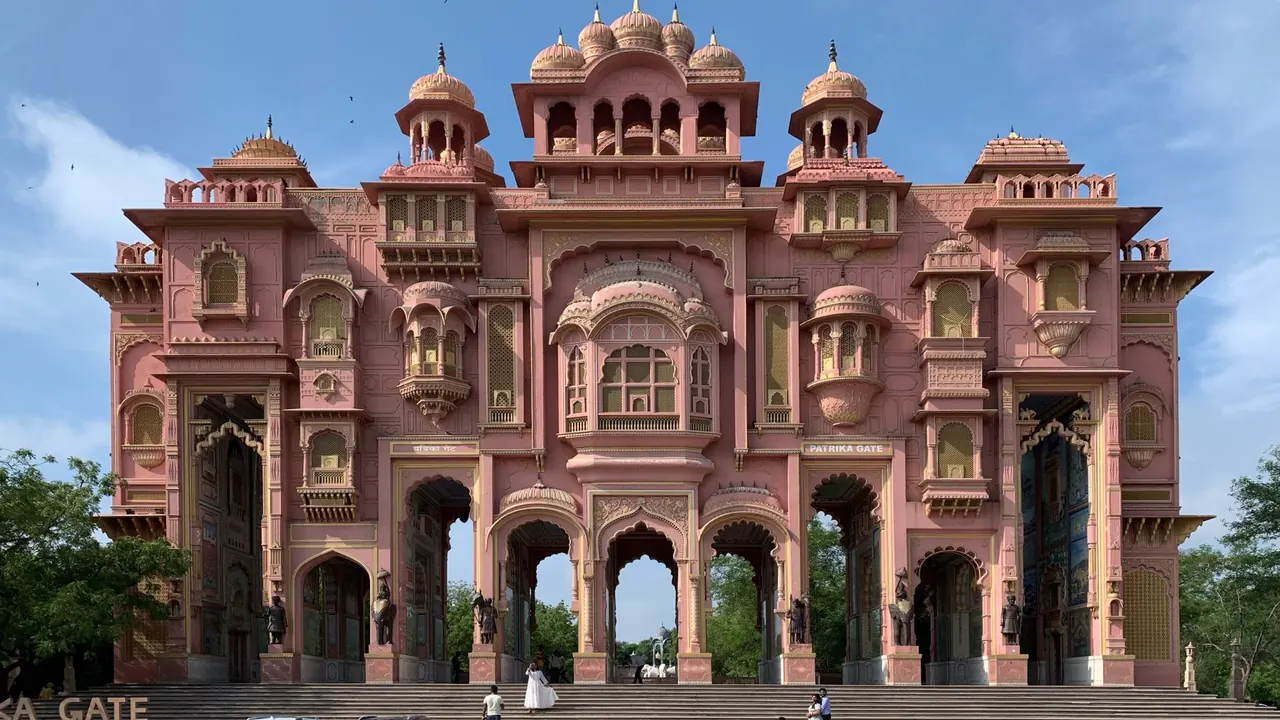
Patrika Gate
- Affordable cities88
- Culture & sights80
- Shopping74
Photo: Chainwit., CC BY-SA 4.0, cropped
Match
46
Every category weighted equally
- Beach & sun41
- Culture & arts52
- Food & nightlife48
- Family trip44
- Outdoors46
- Relax & unwind43
- Shopping & style50
- On a budget50
Jaipur in twelve categories
Our verdict on each, scored 0 to 100 against the same fixed benchmark cities, so a score means the same thing on every page.
Beaches & swimming. Scores 3 out of 100.
Food & drink. Scores 66 out of 100.
Culture & sights. Scores 80 out of 100.
Nightlife. Scores 25 out of 100.
Nature & outdoors. Scores 38 out of 100.
Day trips. Scores 55 out of 100.
Good for families. Scores 25 out of 100.
Getting around. Scores 30 out of 100.
Shopping & style. Scores 74 out of 100.
Affordability. Scores 88 out of 100.
Live music & performing arts. Scores 35 out of 100.
Wellness & relaxation. Scores 28 out of 100.
Jaipur category by category
Beaches & swimming
3Jaipur is deep inland in Rajasthan, a long way from any coast, and it has no lake where people swim. Swimming means a hotel pool, which many heritage and mid-range hotels have. That matters most in the hot months, when the pool may be the only comfortable place by the afternoon.
Food & drink
66Rajasthani cooking is the draw: dal baati churma, gatte ki sabzi, ker sangri made from desert beans and berries, and laal maas, a fiery mutton curry from the old royal kitchens. Breakfast is a street affair of pyaaz kachori, mirchi vada and thick lassi served in clay cups, and the sweet shops turn out ghevar, a honeycombed disc soaked in syrup and eaten in the monsoon, feeni in winter and a long counter of milk sweets.
The best everyday eating is in the walled city around Johari Bazaar, at long-established vegetarian canteens and sweet counters, and along MI Road just outside the southern walls, known for its lassi and kachori stalls. Heritage hotels serve thali feasts in palace courtyards. The city leans vegetarian, alcohol is limited mostly to hotels and licensed bars, and there is little depth in international cooking.
Culture & sights
80Jaipur was laid out in 1727 as a planned city, and the walled Pink City still keeps its grid of wide bazaars, colour-washed facades and gateways. At its heart sit the City Palace, part of it still the royal residence, the honeycomb facade of the Hawa Mahal, and Jantar Mantar, an open-air observatory of giant stone instruments that is a UNESCO site in its own right.
Above the city, the Amber Fort climbs a ridge over Maota Lake with mirrored halls and courtyards, linked by walls to Jaigarh Fort, while Nahargarh looks down over the rooftops. The Albert Hall Museum, the Galta temple complex in a rocky gorge and the royal cenotaphs at Gaitore fill out a dense set of sights that rewards three days.
Nightlife
25Evenings in Jaipur are mostly about a rooftop dinner with a view of the forts lit up, then an early night. Drinking happens in hotel bars, a handful of rooftop lounges in the old city and a few clubs and lounges in the newer C-Scheme area, busier at weekends and in the wedding season. There is no bar street or late culture, and travellers after a night out will find little to choose from.
Nature & outdoors
38The low, rocky Aravalli hills wrap around Jaipur, and the walk or drive up to Nahargarh gives wide views over the city and the scrubland beyond. The surprise is Jhalana, a leopard reserve on the city's southern edge where jeep safaris regularly find big cats among the thorn forest. Hot-air balloon flights over the fort country, birdlife at Sambhar salt lake and the tiger reserve at Ranthambore, a long journey away, round out the options.
This is a semi-arid landscape, and outdoor activity belongs to the cool months from November to February. From April to June the heat makes anything beyond dawn and dusk a struggle.
Day trips
55The closest outings are rural Rajasthan at its most photogenic: the deep geometric Chand Baori stepwell at Abhaneri, the painted palace at Samode in the hills, and the ruined town of Bhangarh with its ghost stories. The block-printing villages of Sanganer and Bagru make an easy half day.
The bigger names stretch the definition. Pushkar, with its holy lake and ghats, and Ajmer's Sufi shrine are around three hours by road, and Agra with the Taj Mahal is a long day by train or car. Many travellers fit these in, but they are long days rather than easy excursions.
Good for families
25Forts with ramparts, secret passages and step-wells appeal to older children, and a traditional puppet show or a jeep safari at Jhalana can be the highlight of a trip. Indian culture is warm towards children. Beyond that little is made for them, and traffic, uneven pavements, crowds and persistent sellers make the old city tiring. Families do best in the cool season, with a hotel pool as a base and a driver for the day.
Getting around
30Most visitors get around by auto-rickshaw, ride-hailing taxis or a car with driver hired by the day, which is the easiest way to combine the city with Amber, about 11km north. The metro runs only a short line through the centre and misses most of the sights. Inside the Pink City the main bazaars can be walked, but traffic, missing pavements, cows and noise make it slow going, and in summer the heat rules out long walks.
Shopping & style
74Shopping is one of the main reasons people come. The old city bazaars each have a speciality: gems and silver jewellery along Johari Bazaar, lac bangles in Maniharon ka Rasta, textiles and quilts in Bapu Bazaar. Hand block-printed cottons from Sanganer and Bagru, blue pottery, hand-knotted rugs, miniature paintings and leather slippers are made in and around the city, and C-Scheme has design boutiques giving the same crafts a modern cut.
Haggling is expected, and drivers and guides steer visitors to shops that pay them commission. Gem scams aimed at tourists are long established, so buy stones only where you are confident of the seller.
Affordability
88Jaipur is very cheap for most of what a visitor buys. Street snacks, vegetarian thalis, rickshaw rides and simple guesthouses cost a fraction of Western prices, and even a car with driver for the day is modest. Spending rises at the top end, where heritage havelis and palace hotels charge international rates, and foreigners pay a higher entry fee at the main monuments. Alcohol is the one item that feels expensive.
Live music & performing arts
35Jaipur has its own Kathak dance tradition, and Rajasthani folk music, Kalbeliya dance and string puppetry are easy to see, though mostly as evening shows in hotels, restaurants and at the cultural village-style venues on the city edge. Jawahar Kala Kendra, an arts centre designed by Charles Correa, and Ravindra Manch host theatre, classical music and dance, mostly in Hindi or without words. There is no regular concert or theatre season of the kind a visitor would plan a trip around.
Wellness & relaxation
28There is no bathing tradition to speak of, and the old city is loud, crowded and hot. Calm comes from where you stay: heritage havelis and palace hotels with shaded courtyards, gardens and pools, many offering Ayurvedic massage and yoga. Treat Jaipur as a city of early starts and long days, and plan rest around the hotel rather than the town.
When should you go?
Pick a month to see what it is like. The climate figures are measured averages, not a forecast.
Jaipur in July
Daytime high, °C
Rainfall in the month, mm
The whole year
Shaded against this city’s own year: the deepest cell is its best month for that figure and the palest its weakest.
Where the figures come from
Jaipur has no rain gauge within 25 km of the centre, so its rainfall comes from a gridded climate dataset read at the city rather than from a gauge further away.
Temperature and rainfall are climate normals, averaged over the years shown. Jaipur: 1993-2020 (rainfall 1991-2020) normals, Jaipur / Sanganer (11.1 km from centre).
Before you go
| Measure | Jaipur |
|---|---|
| Official language | Hindi, English |
| Currency | Indian Rupee (INR) |
| Sockets | CM230 V, 50 Hz |
| Driving side | Left |
| Time zone | UTC+5:30 |
| Emergency number | 108 or 112 |
| Elevation | 431 m |
| Main airport | Jaipur International Airport (JAI)10 km from centre27 non-stop destinations |
By the numbers
| Measure | Jaipur |
|---|---|
| City population | 3,073,350 |
| Museums within 10 km | 6 |
| UNESCO World Heritage sites within 50 km | 3 |
Compare Jaipur with
Every comparison with a written verdict behind it.