Switzerland
Crans-Montana
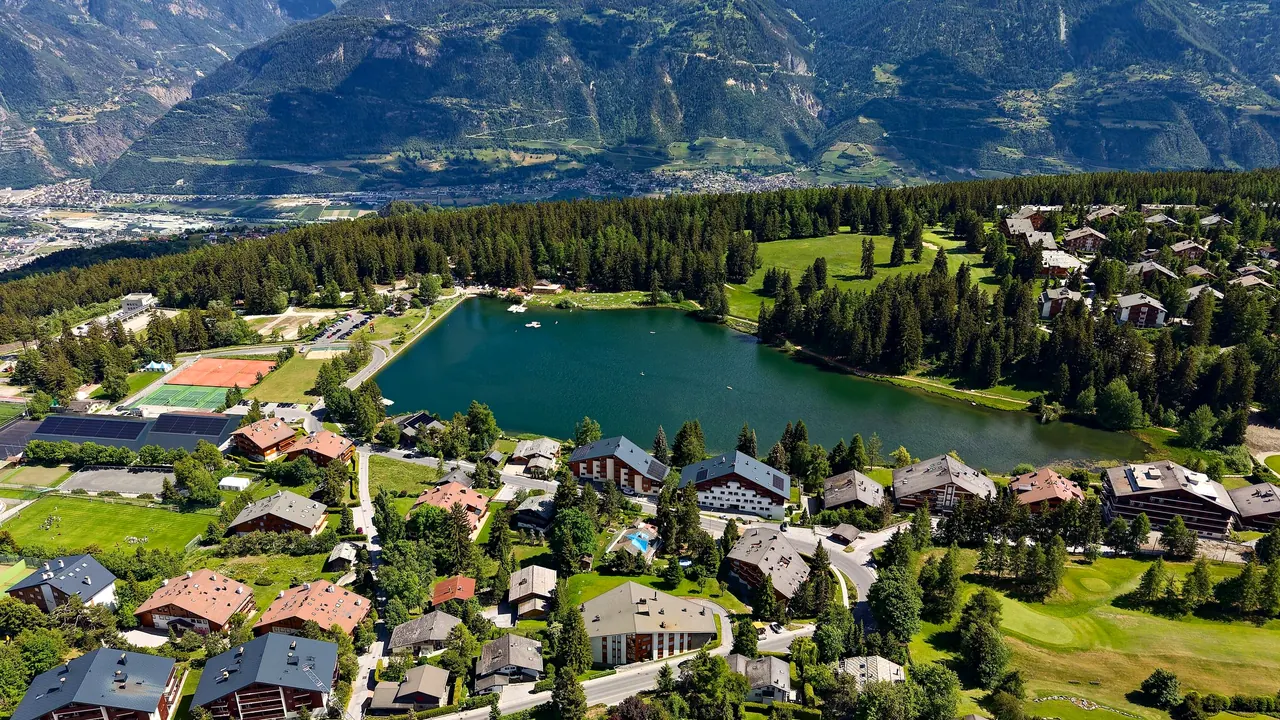
The Étang de la Moubra among chalets and forest
- Nature & outdoors90
- Getting around64
- Day trips62
Photo: Daniel Reust, CC BY-SA 4.0, cropped
Crans-Montana lies in Swiss Alps, which has its own page.
Match
39
Every category weighted equally
- Beach & sun38
- Culture & arts36
- Food & nightlife34
- Family trip42
- Outdoors48
- Relax & unwind42
- Shopping & style38
- On a budget35
Crans-Montana in twelve categories
Our verdict on each, scored 0 to 100 against the same fixed benchmark cities, so a score means the same thing on every page.
Beaches & swimming. Scores 14 out of 100.
Food & drink. Scores 38 out of 100.
Culture & sights. Scores 8 out of 100.
Nightlife. Scores 25 out of 100.
Nature & outdoors. Scores 90 out of 100.
Day trips. Scores 62 out of 100.
Good for families. Scores 55 out of 100.
Getting around. Scores 64 out of 100.
Shopping & style. Scores 38 out of 100.
Affordability. Scores 4 out of 100.
Live music & performing arts. Scores 20 out of 100.
Wellness & relaxation. Scores 52 out of 100.
Crans-Montana category by category
Beaches & swimming
14There is no sea or large lake here, but the plateau holds a string of small lakes, and in high summer Lac Moubra and Lac Grenon turn into bathing spots. The shallow water warms up to around 20°C on good days, and there are lawns to lie on, a few pontoons and families with picnics. It is pleasant for an afternoon. Nobody should plan a stay around it, and outside July and August the water is too cold for most people.
Food & drink
38Eating here is mostly alpine and Valais cooking: raclette scraped straight from the half-wheel, platters of dried meat and rye bread, fondue in mountain huts, and wine from the terraced vineyards a few hundred metres below the resort. Fendant, Petite Arvine and Cornalin are worth asking for by name. A wealthy winter crowd also keeps a handful of ambitious hotel and gastronomic restaurants going, so a special dinner is easy to find.
The middle and cheap end is thin. There is no street food and no market culture, and outside the ski and summer seasons many kitchens close. Food is a pleasure on a stay here, but it is not why people come.
Culture & sights
8Crans-Montana grew from early twentieth-century sanatoriums and grand hotels into a ski and golf resort. Its streets are made up of chalets, apartment blocks and a few period hotels rather than historic buildings. There are small chapels and the odd exhibition, but no museum or monument to plan a day around. Anyone looking for castles, old towns and churches finds them in the Rhône valley below, not on the plateau.
Nightlife
25In the ski season the evening starts with après-ski on terraces near the lifts. From there people move on to hotel bars and piano lounges in Crans, and at weekends a couple of nightclubs stay open late for a well-dressed, well-heeled crowd. The scene is small and expensive, and it is at its busiest over Christmas, New Year and the February school vacation weeks. In summer going out mostly means a drink after golf, and in spring and autumn the resort is quiet by ten.
Nature & outdoors
90The resort sits on a south-facing terrace about 1,500m above the Rhône valley. It gets a lot of sun, and the view runs across the valley to a long line of Valais peaks, from the Matterhorn to Mont Blanc on clear days. In winter the lifts climb to the Plaine Morte glacier at around 3,000m and connect about 140km of mostly sunny, intermediate-friendly pistes, along with cross-country trails and snowshoe routes through larch forest.
In summer there is high-alpine hiking, the bisses, which are old irrigation channels with level paths beside them through forest and over drops, plus mountain-bike trails, paragliding off the plateau and some of the most scenic golf in the Alps. Spring and late autumn are quiet, with many lifts closed.
Day trips
62The funicular down to Sierre connects with the main Rhône valley railway, and that line is what makes outings easy. Sion is a short hop, with its two hilltop castles of Valère and Tourbillon above an old town. The wine villages around Salgesch and along the vineyard slopes of the valley are closer still. Martigny, with its Roman remains and art foundation, and the ancient abbey at Saint-Maurice are a little further on.
Montreux, with the Château de Chillon, and the UNESCO-listed Lavaux terraces above Lake Geneva are about an hour and a half away by train. Car-free Zermatt is possible as a long day out, but with the change at Visp onto the mountain railway it takes about two hours each way. The list is good rather than long, and most of it runs along the same valley.
Good for families
55For families who ski or hike, it works well. The ski schools have dedicated children's areas, the sunny, broad slopes suit beginners, and in summer the plateau lakes have playgrounds, pedalos and easy walks around them. The resort is safe and calm, and the bisse paths are flat enough for small legs. There is little beyond the outdoors, though: no zoo, aquarium or theme park. The villages are spread over a hillside, so with toddlers the free shuttle buses and a well-chosen base matter.
Getting around
64You arrive from Sierre in the valley on a funicular that climbs the slope in about twelve minutes and connects with Swiss mainline trains. That means you can do without a car. On the plateau, Crans, Montana and the outlying lift bases are spread along a hillside several kilometres long, with climbs between them. A network of free resort shuttle buses ties them together, and the lifts start close to both main centres. Each village core is walkable, but going from one end of the resort to the other needs a bus.
Shopping & style
38Crans is known for an unusual concentration of upmarket boutiques for a mountain village. Around its few central streets there are international fashion labels, Swiss watchmakers and jewellers, cashmere and designer ski wear, aimed squarely at the wealthy winter guests. Beyond that the choice is sports shops, delicatessens with Valais wine, cheese and dried meats, and a few gift shops. There are no markets or crafts quarter, and Montana's shops are more everyday.
Affordability
4This is one of the costliest places to spend a vacation in Europe. Hotel rooms and chalet rentals are expensive all year and peak sharply at Christmas and in February. Lift passes, ski hire and lessons add a lot to a winter week, and even a simple meal on a mountain terrace costs well above most of Europe. Self-catering apartments, buying supplies in the valley and visiting in late spring or early autumn soften the cost, but not by much.
Live music & performing arts
20Live performance here comes in festival bursts. Caprices, a long-running spring festival, brings electronic music to the slopes around the end of the ski season, and a summer chamber and classical concert series takes over churches and halls. Outside those weeks there is occasional jazz or a piano player in a hotel bar, and not much else. For theatre or a concert season, the towns in the valley are the nearest option.
Wellness & relaxation
52The plateau was first settled as a place to recover, and the clean air, sunshine and slow pace still suit a restful stay, especially outside the peak weeks. Several large hotels run well-equipped spas with pools, saunas and treatment rooms. Most are open to outside guests for a fee. The resort has no thermal springs of its own, but the alpine hot pools at Leukerbad are under an hour away and make an easy half day. Expect quiet comfort, not a bathing tradition.
When should you go?
Pick a month to see what it is like. The climate figures are measured averages, not a forecast.
Crans-Montana in July
Daytime high, °C
Rainfall in the month, mm
The whole year
Shaded against this destination’s own year: the deepest cell is its best month for that figure and the palest its weakest.
Where the figures come from
Crans-Montana has no weather station within reach, so its figures come from a gridded climate model rather than a measured record, and read a broad area rather than one spot.
Temperature and rainfall are climate normals, averaged over the years shown. Crans-Montana: 2001-2020 normals, NASA POWER reanalysis grid, no weather station within 90 km.
Before you go
| Measure | Crans-Montana |
|---|---|
| Official language | French, German, Italian, Romansh |
| Currency | Swiss Franc (CHF) |
| Sockets | CJ230 V, 50 Hz |
| Driving side | Right |
| Time zone | UTC+1, UTC+2 in summer |
| Emergency number | 112 |
| Elevation | 1,495 m |
| Main airport | Geneva International Airport (GVA)106 km from centre150 non-stop destinations |
| Public holidays this year | 9 days |
By the numbers
| Measure | Crans-Montana |
|---|---|
| Population | 10,447 |
| People per km² | 175 |
| Museums within 10 km | 3 |
| UNESCO World Heritage sites within 50 km | 1 |
Compare Crans-Montana with
Every comparison with a written verdict behind it.
- Adelboden
- Alpe d'Huez
- Andermatt
- Arosa
- Avoriaz
- Chamonix
- Châtel
- Courchevel
- Davos
- Engelberg
- Flaine
- Grindelwald
- Gstaad
- Klosters
- La Clusaz
- La Plagne
- La Rosière
- Laax
- Le Grand-Bornand
- Lenzerheide
- Les Arcs
- Les Deux Alpes
- Les Gets
- Les Menuires
- Leukerbad
- Megève
- Méribel
- Montgenèvre
- Morzine
- Mürren
- Saas-Fee
- Saint-Gervais-les-Bains
- Samnaun
- Samoëns
- Serre Chevalier
- St. Moritz
- Tignes
- Val Cenis
- Val d'Isère
- Val Thorens
- Verbier
- Wengen
- Zermatt