United Kingdom
Glasgow
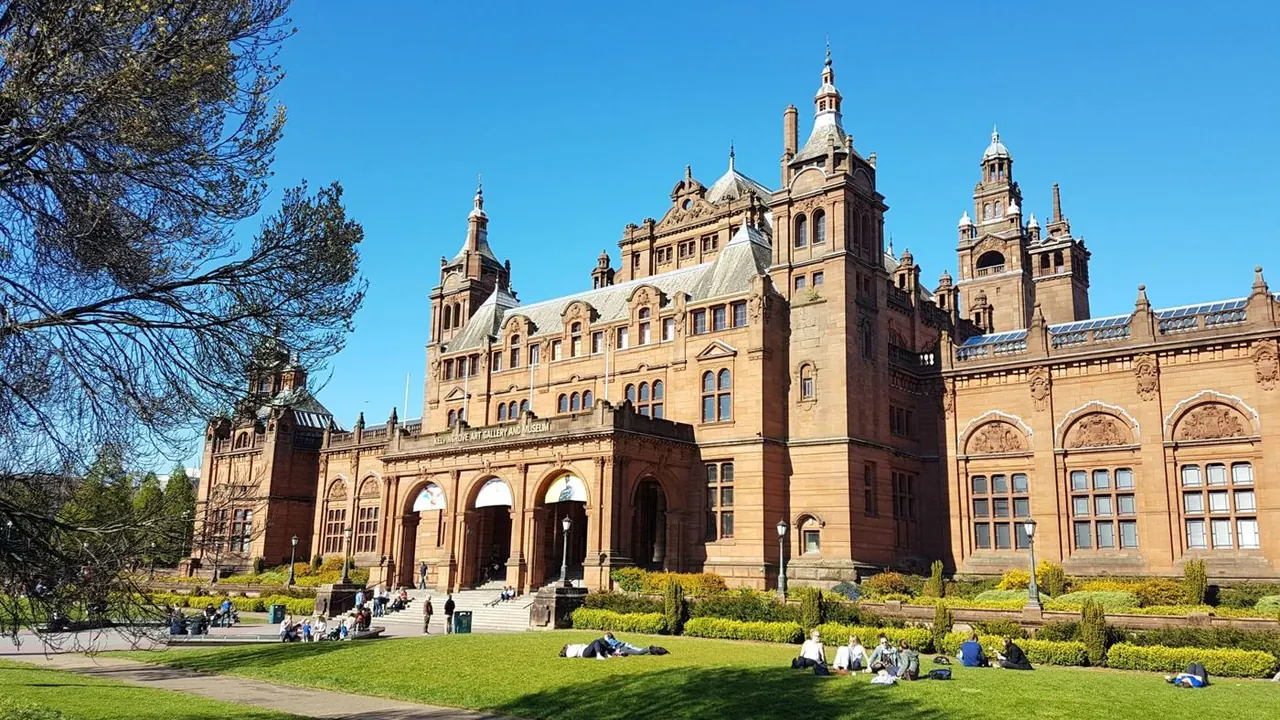
Kelvingrove Art Gallery and Museum
- Day trips76
- Nature & outdoors75
- Live music & the arts72
Photo: Stinglehammer, CC BY-SA 4.0, cropped
Match
57
Every category weighted equally
- Beach & sun49
- Culture & arts61
- Food & nightlife58
- Family trip54
- Outdoors58
- Relax & unwind50
- Shopping & style59
- On a budget55
Glasgow in twelve categories
Our verdict on each, scored 0 to 100 against the same fixed benchmark cities, so a score means the same thing on every page.
Beaches & swimming. Scores 14 out of 100.
Food & drink. Scores 52 out of 100.
Culture & sights. Scores 62 out of 100.
Nightlife. Scores 66 out of 100.
Nature & outdoors. Scores 75 out of 100.
Day trips. Scores 76 out of 100.
Good for families. Scores 58 out of 100.
Getting around. Scores 66 out of 100.
Shopping & style. Scores 64 out of 100.
Affordability. Scores 46 out of 100.
Live music & performing arts. Scores 72 out of 100.
Wellness & relaxation. Scores 28 out of 100.
Glasgow category by category
Beaches & swimming
14Glasgow is not a beach city. The nearest sand is on the Firth of Clyde, where the old seaside towns of Largs, Troon and Ayr are each about an hour away by train, with long promenades and views to Arran. The water is cold, around 13°C to 14°C at the height of summer, and the weather is changeable. A few hardy locals swim, but most visitors treat the coast as a walk with fish and chips and an ice cream, not a place to spend a day in the water.
Food & drink
52Glasgow eats well without having a cuisine of its own. Its strongest suit is South Asian food, with a long tradition of curry houses that claim a hand in inventing chicken tikka masala. Italian families shaped the city's cafés, ice cream parlours and fish and chip shops. Finnieston, along Argyle Street, is the main strip for modern Scottish cooking built on west coast seafood, game and Highland beef.
The West End around Byres Road and Ashton Lane is good for relaxed lunches and brunches, and the South Side around Shawlands and Strathbungo is full of small neighbourhood restaurants, bakeries and cafés where locals eat. Pubs pour Scottish craft beer and a deep range of whisky. Fine dining is limited and the centre has plenty of chain food, so it pays to choose your neighbourhood.
Culture & sights
62Glasgow is a great Victorian city, built on shipping and trade, and its grand sandstone streets and merchant buildings are the main attraction. Kelvingrove Art Gallery and Museum is a huge, free collection under one red sandstone roof, and the Burrell Collection in Pollok Country Park holds an extraordinary private hoard of medieval art, tapestries and Chinese ceramics. The Hunterian at the university and the Riverside Museum on the Clyde add depth.
The city's signature is Charles Rennie Mackintosh, whose work can be seen at the Mackintosh House, Scotland Street School and Queen's Cross Church. The medieval cathedral and the hillside Necropolis behind it are the oldest layer. There is no single landmark of world fame, and a thorough visit takes two or three days.
Nightlife
66Going out is one of the things Glasgow does best. The pubs are friendly and loud, and nights start early and run hard. The Merchant City has the polished bars and cocktail places, Sauchiehall Street and the streets around it hold the late bars and student clubs, and the West End around Ashton Lane and Byres Road is busy with students and locals.
The city has a long and respected underground club culture, with basement techno and house nights that draw DJs from across Europe. Finnieston and the South Side offer more relaxed neighbourhood bars. Licensing hours mean most clubs close around 3am, so the night is intense rather than endless, and weekends are far busier than midweek.
Nature & outdoors
75Glasgow sits close to the edge of the Highlands. Loch Lomond is about 40 minutes by train or car, with walks, kayaking and boat trips on the loch and climbs such as Ben Lomond and Conic Hill above it. The Trossachs, with their wooded glens and smaller lochs, are just beyond. The West Highland Way, Scotland's best-known long-distance path, starts in Milngavie on the northern edge of the city, and the Campsie Fells are a short drive.
Ferries from the Clyde coast reach Arran, a rugged island with Goatfell at its centre. Within the city, Pollok Country Park, Kelvingrove Park and the Glasgow Green give green space. The climate is mild but wet, so waterproofs matter in every season.
Day trips
76Edinburgh is the obvious day out, under an hour away by train, and it alone makes Glasgow a strong base. Stirling, with its castle and the Wallace Monument, is under an hour as well, and Linlithgow Palace, where Mary Queen of Scots was born, sits on the Edinburgh line. New Lanark, a UNESCO-listed mill village set beside the Falls of Clyde, is about an hour south.
To the south west lies Ayrshire, with Robert Burns' birthplace in Alloway and the clifftop Culzean Castle. Ferries from the coast reach Rothesay on the Isle of Bute with its Victorian mansion of Mount Stuart, and Arran makes a long but rewarding day. Inveraray on Loch Fyne and the Falkirk Wheel round out a varied list.
Good for families
58Glasgow is easier with children than its reputation suggests, largely because its big museums are free and built for touching and exploring. The Riverside Museum has trams, cars and a tall ship moored outside, Kelvingrove has a Spitfire hanging from the ceiling and a natural history collection, and the Glasgow Science Centre on the Clyde is aimed squarely at young visitors.
The city has large parks with playgrounds, including Kelvingrove Park, Glasgow Green and Pollok Country Park with its Highland cattle. What it lacks is a zoo, aquarium or theme park in town; a safari park near Stirling is the nearest. The rain means planning indoor days, and the centre's hills are steep for buggies.
Getting around
66The city centre is laid out on a grid and is easy to walk, though some streets climb steeply towards the north. The West End and the Merchant City are a short walk or Subway ride from the centre. The Subway is a single circular line with small, old-fashioned carriages, handy for the West End and Govan but covering only a small part of the city.
A large suburban rail network radiates from Central and Queen Street stations, useful for the South Side, the coast and day trips. Buses fill the gaps but are run by several companies with separate fares, which can confuse a visitor. A car is unnecessary in the city and only really helps for the Highlands.
Shopping & style
64Glasgow is Scotland's shopping capital. Buchanan Street, Sauchiehall Street and Argyle Street form a pedestrian loop in the centre, lined with the big British high street names and department stores, and the Victorian galleried arcade of Princes Square adds more upmarket fashion. The Argyll Arcade is a covered Victorian passage given over to jewellers.
The West End around Byres Road and the lanes off it is better for vintage clothes, independent boutiques and bookshops, and the Merchant City has smaller designer shops. The Barras, the old weekend market in the East End, is rough and characterful. Luxury depth is limited, and crafts such as tweed and tartan are better found in the Highlands.
Affordability
46Glasgow is one of the more affordable big cities in Britain, though British prices still apply. Hotel rooms are generally cheaper than in Edinburgh and well below London, but they climb sharply when a big concert, football match or conference is in town. Eating out and drinking cost roughly the national norm, with good-value curry houses and pub lunches easing the bill.
The best saving is in sightseeing: Kelvingrove, the Burrell Collection, the Riverside Museum, the Hunterian and most other civic museums are free. Rail travel for day trips is the part of the budget that adds up.
Live music & performing arts
72Music is central to Glasgow's identity, and live music is the strongest thing a visitor can tap into. The city has one of Britain's deepest gig circuits, from the historic Barrowland Ballroom with its neon sign to small, famous rooms where many bands played early shows, and arena acts fill the venues by the river. Traditional and folk music is played in pubs, and the Celtic Connections festival fills the city each winter.
The formal scene is substantial too. Scottish Opera and Scottish Ballet are based here and perform at the Theatre Royal, while the Royal Scottish National Orchestra and the BBC Scottish Symphony Orchestra play at the Royal Concert Hall and City Halls. The Citizens Theatre, the Tron and the King's cover drama and touring shows.
Wellness & relaxation
28Glasgow is a lively, loud city and not a place people come to unwind. Its nod to bathing culture is a pair of Victorian swimming clubs in the West End, among the oldest in the world, with Turkish baths and plunge pools, though they run mainly for members. Otherwise wellness means hotel spas and day spas in the centre. For a slower pace, visitors head to the parks or out to the lochs, where the countryside does the restoring.
When should you go?
Pick a month to see what it is like. The climate figures are measured averages, not a forecast.
Glasgow in July
Daytime high, °C
Rainfall in the month, mm
The whole year
Shaded against this city’s own year: the deepest cell is its best month for that figure and the palest its weakest.
Where the figures come from
Glasgow has no rain gauge within 25 km of the centre, so its rainfall comes from a gridded climate dataset read at the city rather than from a gauge further away.
Glasgow's sunshine is measured 90 km from the centre, at Eskdalemuir.
Temperature and rainfall are climate normals, averaged over the years shown. Glasgow: 1991-2020 normals, Glasgow Airport (11.5 km from centre).
Before you go
| Measure | Glasgow |
|---|---|
| Official language | English |
| Currency | Pound Sterling (GBP) |
| Sockets | G230 V, 50 Hz |
| Driving side | Left |
| Time zone | UTC, UTC+1 in summer |
| Emergency number | 112 or 999 |
| Elevation | 21 m |
| Main airport | Glasgow Airport (GLA)11 km from centre95 non-stop destinations |
| Public holidays this year | 10 days |
By the numbers
| Measure | Glasgow |
|---|---|
| City population | 626,410 |
| People per km² | 190 |
| Museums within 10 km | 29 |
| UNESCO World Heritage sites within 50 km | 2 |
| Swim season, months above 21 °C | None |
Compare Glasgow with
Every comparison with a written verdict behind it.