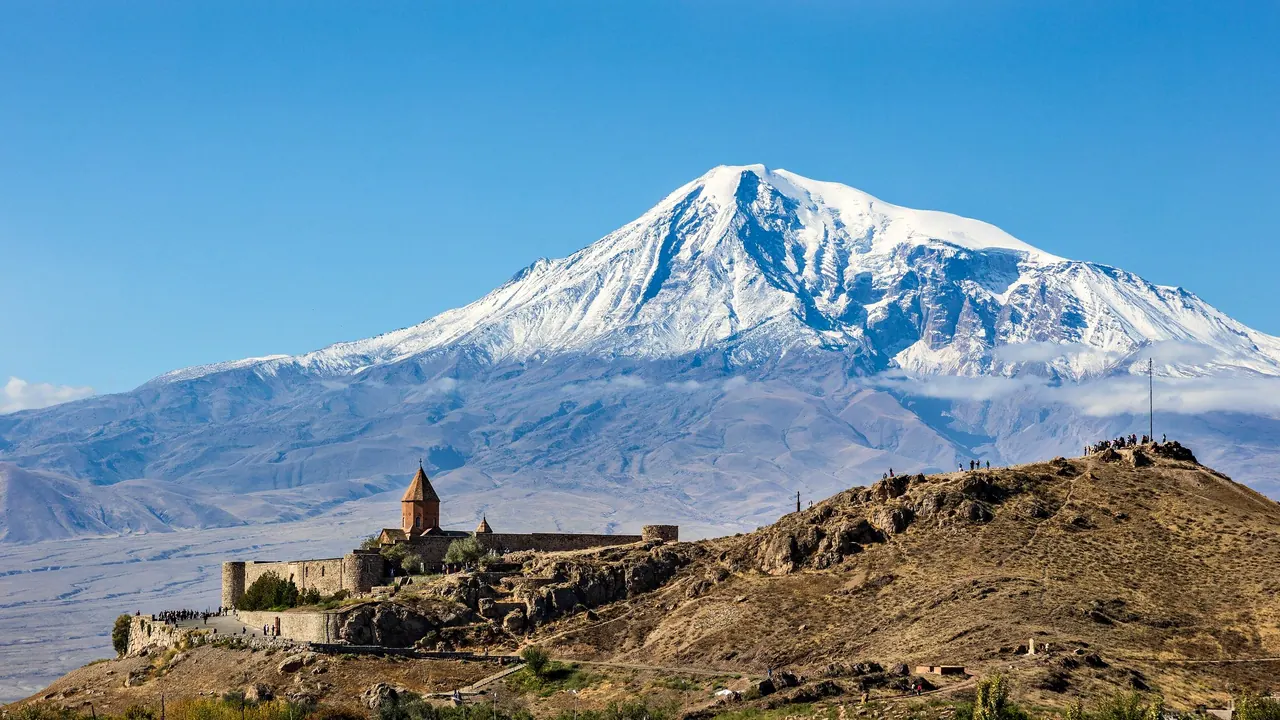
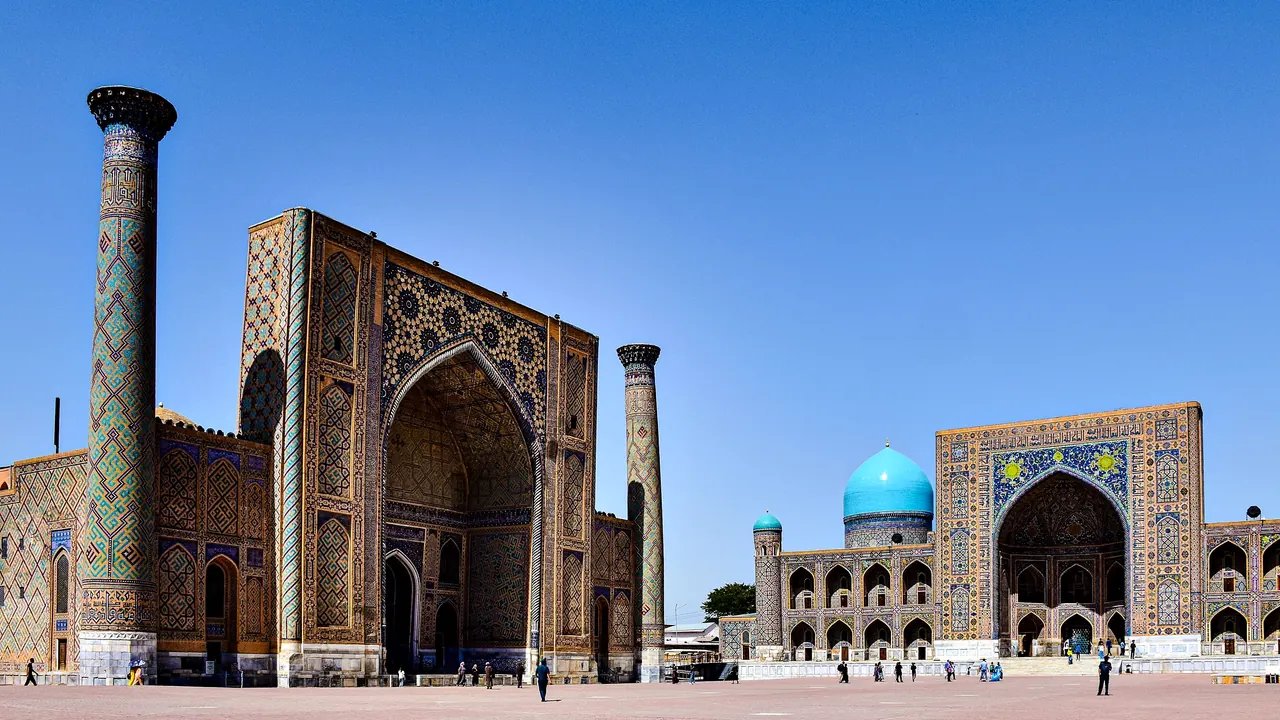
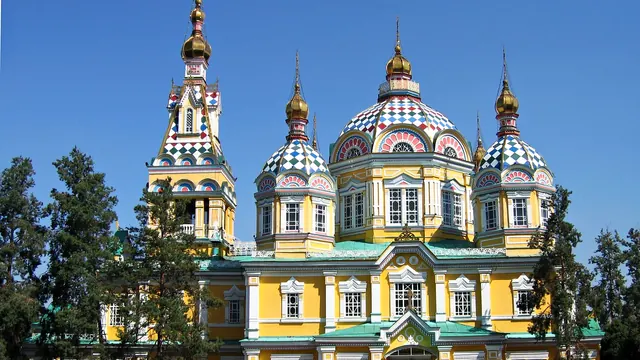
Photos: Armenia by Diego Delso, CC BY-SA 4.0, cropped; Uzbekistan by AXP Photography, Pexels License.
Armenia or Uzbekistan?
Our verdict in twelve categories, each scored against the same fixed benchmark cities, and the climate month by month, so you can choose for your trip.
Choose Armenia for
- nature and the outdoors
- nightlife
- beaches
Armenia suits travellers who want mountains and monasteries on the same trip and like coming back to one base each night. Most outings leave Yerevan and return the same day, so a week can take in the cliff church at Geghard, the forests around Dilijan and the wine cellars of Areni without changing hotels. The capital also gives you more to do after dark, with late terraces, wine bars and a proper opera house.
Choose Uzbekistan for
- getting around
- shopping
- culture and sights
If the architecture itself is the reason for going, Uzbekistan is the better pick. You travel between separate cities: fast trains link Tashkent, Samarkand and Bukhara, while Khiva lies far out in the western desert, a long train ride or a flight further on. The bazaars and craft workshops along the way are worth saving luggage space for. Day-to-day costs are a little lower too. On the other hand, the land between the oasis towns is mostly flat and the evenings are quiet.
Scoreboard
Twelve categories on one fixed scale from 0 to 100. The shaded stretch is the gap between the two.
Your match
Pick a travel style or drag the sliders, and both match scores follow your weighting.
Too close to call, 1 point apart
Wins on nature and the outdoors and nightlife with your weighting.
Wins on getting around and shopping with your weighting.
What matters to you?
Category by category
What the scores mean for a trip.
Beaches & swimming
Neither country is a place to go for the water, but Armenia has a little more to offer. Lake Sevan is a large alpine lake with sandy and pebbly shores, and Armenians spend summer weekends there. It is a cool, clear break of a day or two.
Uzbekistan's equivalent is the Charvak reservoir in the mountains about two hours from Tashkent. Elsewhere you are left with hotel pools in Bukhara and Khiva, and the old Aral Sea shore near Moynaq is now desert.
Where in Armenia: Lake Sevan
Where in Uzbekistan: Charvak Reservoir
Food & drink
The two are about level, and both cuisines are built on bread and meat. Armenia cooks over vine cuttings and in the tonir oven, with khorovats, lavash, dolma and plenty of fresh herbs. Its strongest card is wine: the cellars around Areni in Vayots Dzor pour the local red grape.
In Uzbekistan everything centres on plov, cooked in huge kazans with a different recipe in every region. Alongside it come samsa, lagman noodles and green tea in the chaikhanas. Its great food sights are the bazaars, Chorsu in Tashkent and Siab in Samarkand, but vegetarians will find it harder going than in Armenia.
Where in Armenia: Yerevan, Vayots Dzor
Where in Uzbekistan: Tashkent, Samarkand, Bukhara, Fergana Valley
Culture & sights
Uzbekistan leads here. Samarkand's Registan, Shah-i-Zinda and Gur-e-Amir, the low brick old town of Bukhara and the walled Itchan Kala in Khiva are whole townscapes of tilework and domes, and each fills a day or more.
Armenia's heritage is more spread out and quieter. It consists of stone monasteries in their valleys, from Geghard and Noravank to Tatev and the UNESCO-listed churches of the Debed canyon, plus the Matenadaran manuscripts in Yerevan. Here the setting counts as much as the buildings.
Where in Armenia: Yerevan, Debed Canyon, Syunik (Tatev), Gyumri
Nightlife
Armenia is the livelier of the two, though only in Yerevan. On summer evenings crowds fill Northern Avenue and the Cascade, terraces stay open late, wine bars cluster in the centre and a few clubs run into the early hours at weekends.
Uzbekistan's going-out scene is in Tashkent, with bars, karaoke rooms and a few clubs that mostly draw local crowds. In Samarkand, Bukhara and Khiva the evening means dinner and a walk past the lit monuments.
Where in Armenia: Yerevan
Where in Uzbekistan: Tashkent
Nature & outdoors
Armenia is the clear choice for landscape. The whole country is high ground. You can climb Mount Aragats without technical gear, walk through beech and oak forest in Dilijan National Park, see the red gorges of Syunik around Tatev, or take in the wide alpine views at Lake Sevan. The catch is that trails are poorly marked, so many hikers go with a guide.
In Uzbekistan, much of what you see between cities is cotton fields and desert. The best of the outdoors is the Chimgan and Ugam-Chatkal ranges near Tashkent, homestays in the Nuratau mountains, and the yurt camps by Aydarkul in the Kyzylkum. These are distinctive, but they take some effort to reach.
Where in Armenia: Dilijan National Park, Syunik, Mount Aragats, Lake Sevan
Where in Uzbekistan: Ugam-Chatkal National Park, Chimgan Mountains, Nuratau Mountains, Kyzylkum Desert
Day trips
Armenia works better for day trips, because so much is within reach of Yerevan. Echmiadzin is half an hour away, and Khor Virap, Sevan, Dilijan and the Areni wine villages are all easy outings. Gyumri is a full day out by train.
In Uzbekistan the great cities are separate stops rather than outings from each other, so each base has only one or two trips of its own. From Samarkand you can reach Shakhrisabz, from Bukhara Gijduvan's ceramic workshops, and from Khiva the desert fortresses of Ayaz Kala and Toprak Kala.
Where in Armenia: Yerevan, Echmiadzin, Gyumri, Vayots Dzor (Areni)
Where in Uzbekistan: Shakhrisabz, Ayaz Kala and Toprak Kala, Gijduvan, Margilan
Good for families
For families the two are much alike. Both are warm towards children and safe, and both are really built for adults with an interest in history. In Armenia the highlights for children are Lake Sevan's gently shelving shores, cool walks in Dilijan and the Tatev aerial tramway. Long, winding drives are the drawback.
In Uzbekistan, Tashkent has the amusement parks and a zoo, Khiva's ramparts are good for climbing, and the Konigil paper mill near Samarkand holds children's attention. In both countries the summer heat is the main problem with small children.
Where in Armenia: Yerevan, Lake Sevan, Dilijan
Getting around
Uzbekistan is much easier to travel around. Fast trains link Tashkent, Samarkand and Bukhara, and the old centres can be explored on foot. You only need a car with driver for the mountains, the desert camps and the far west around Khiva.
In Armenia the trouble begins as soon as you leave Yerevan. Rail barely goes beyond the Gyumri line, minibuses rarely reach the monasteries, and mountain roads are slow. That is why most visitors book tours, hire a driver or rent a car, even in such a small country.
Where in Armenia: Yerevan, Gyumri
Shopping & style
Uzbekistan is the place for crafts by a clear margin. Bukhara's trading domes sell suzani, carpets and miniature paintings, Margilan weaves ikat silk and Rishtan fires its blue and green ceramics. Samarkand and Khiva add silk paper and carved wood. If you buy direct from the workshops, quality is better.
Armenia's shopping is concentrated in Yerevan's Vernissage weekend market, with its carpets, obsidian jewellery and Soviet relics. Brandy, wine and dried fruit are the usual things to take home.
Where in Armenia: Yerevan
Where in Uzbekistan: Bukhara, Fergana Valley, Samarkand, Tashkent
Affordability
Both are inexpensive, and Uzbekistan goes a little further. Bazaar food, plov and tea cost little, the fast trains are modest, and family guesthouses in Bukhara and Khiva are good value. Costs climb with boutique hotels in peak season and the separate site tickets, which add up in Samarkand.
In Armenia most monasteries are free to enter, and Gyumri and the guesthouses of Vayots Dzor are cheap. Yerevan is the dearer exception, with central hotels and the better restaurants priced closer to Southern Europe.
Where in Armenia: Gyumri, Vayots Dzor, Dilijan
Live music & performing arts
The two are close, with Armenia slightly ahead. Yerevan has Tamanyan's circular Opera and Ballet Theatre, which leans on Khachaturian, as well as the Philharmonic and small jazz clubs. Duduk and folk ensembles are easy to hear over dinner.
Tashkent has an equally grand stage in the Alisher Navoi Theatre. Elsewhere in Uzbekistan, performance means maqom music and dance in madrasa courtyards in Bukhara and Samarkand, aimed at visitors but often well done.
Where in Armenia: Yerevan
Wellness & relaxation
Armenia has a slight edge for a restful trip, thanks to its Soviet health-resort heritage. Jermuk is a whole town built around hot mineral springs, with drinking galleries and a waterfall, and pine-scented Dilijan and Arzni carry on the same tradition.
Uzbekistan's draw is different: centuries-old domed hammams in Bukhara, still in use for steam and a hard scrub. Beyond that, rest there means afternoons on a tea bed and quiet courtyard guesthouses.
Where in Armenia: Jermuk, Dilijan, Arzni
When should you go?
Pick your month, and for a country the place in it. The climate figures are measured averages, not a forecast.
Where in Uzbekistan
Yerevan (Armenia) in July
Tashkent (Uzbekistan) in July
Daytime high, °C
Rainfall in the month, mm
Temperature and rainfall are climate normals, averaged over the years shown. Yerevan (Armenia): 1991-2020 normals, Yerevan (6.7 km from centre). Tashkent (Uzbekistan): 1991-2020 normals, Tashkent (5.1 km from centre).
Both countries have the same pattern: very hot summers, cold winters, and the best weather in spring and autumn. In Yerevan the Ararat plain reaches about 33°C in July and August, and January days hover just above freezing at 1°C. May, June, September and October are the months for sightseeing. The rain falls mostly in April and May, and late summer is almost completely dry. Lake Sevan sits high up and stays pleasant when the capital is hot, so July and August are the months to swim there.
Uzbekistan gets hotter still. Tashkent and Khiva reach around 36°C in July, which makes walking between monuments in the middle of the day tiring. Winter is milder in Samarkand, with highs near 7°C in January, but the wettest months come in early spring, up to 69mm in March. Khiva, in the western desert, stays dry all year and gets colder in winter. April to May and September to October suit the Silk Road cities best, and that timing is close to Armenia's.
Which traveller are you?
On an outdoors trip, choose Armenia. Most of the country lies above 1,000m, so you can climb Aragats in summer, walk between monasteries in Dilijan's forests or follow the gorges of Syunik. Uzbekistan's mountains are only at its edges.
For a culture and arts trip, Uzbekistan has the stronger case. Armenia has fine stone monasteries such as Geghard and Noravank, but Uzbekistan's Silk Road towns survive as whole townscapes. You can walk Bukhara's domes and Kalyan minaret at dusk, Khiva's walled Itchan Kala or Samarkand's tiled Bibi-Khanym mosque.
More comparisons
Each shares a side with Armenia or Uzbekistan.
Where else could you go?
Set Armenia or Uzbekistan against any other country.