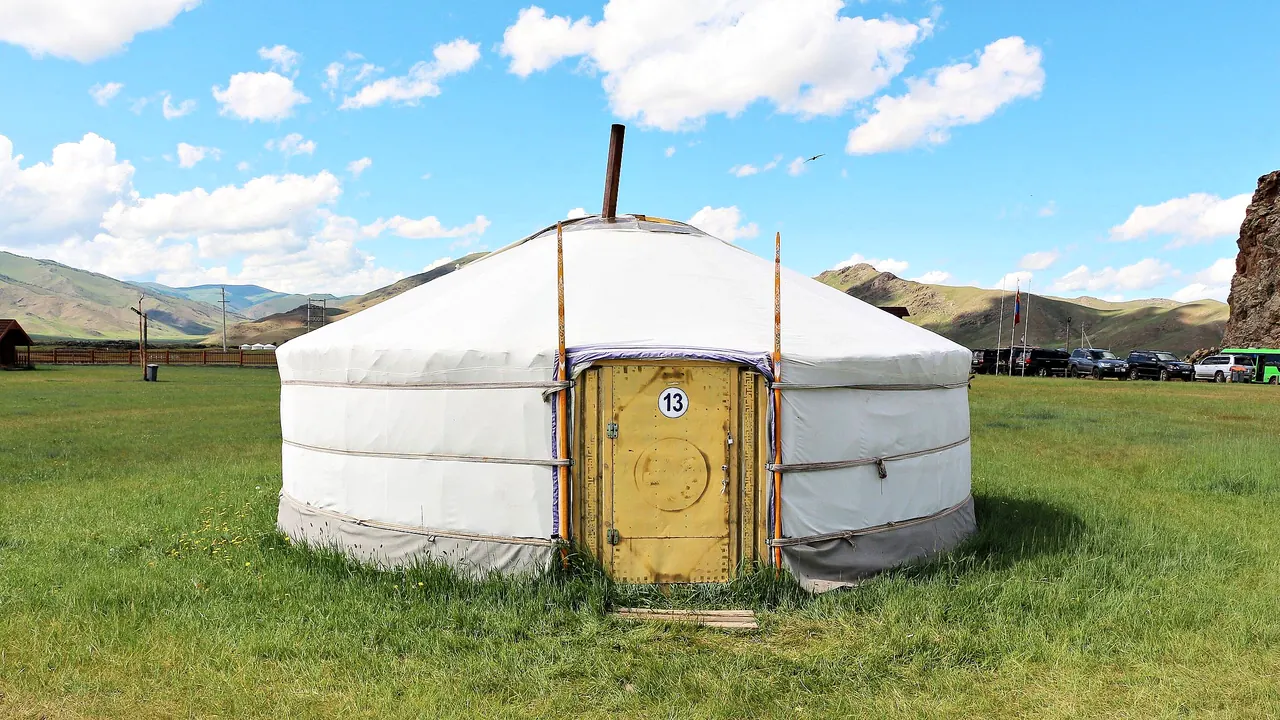
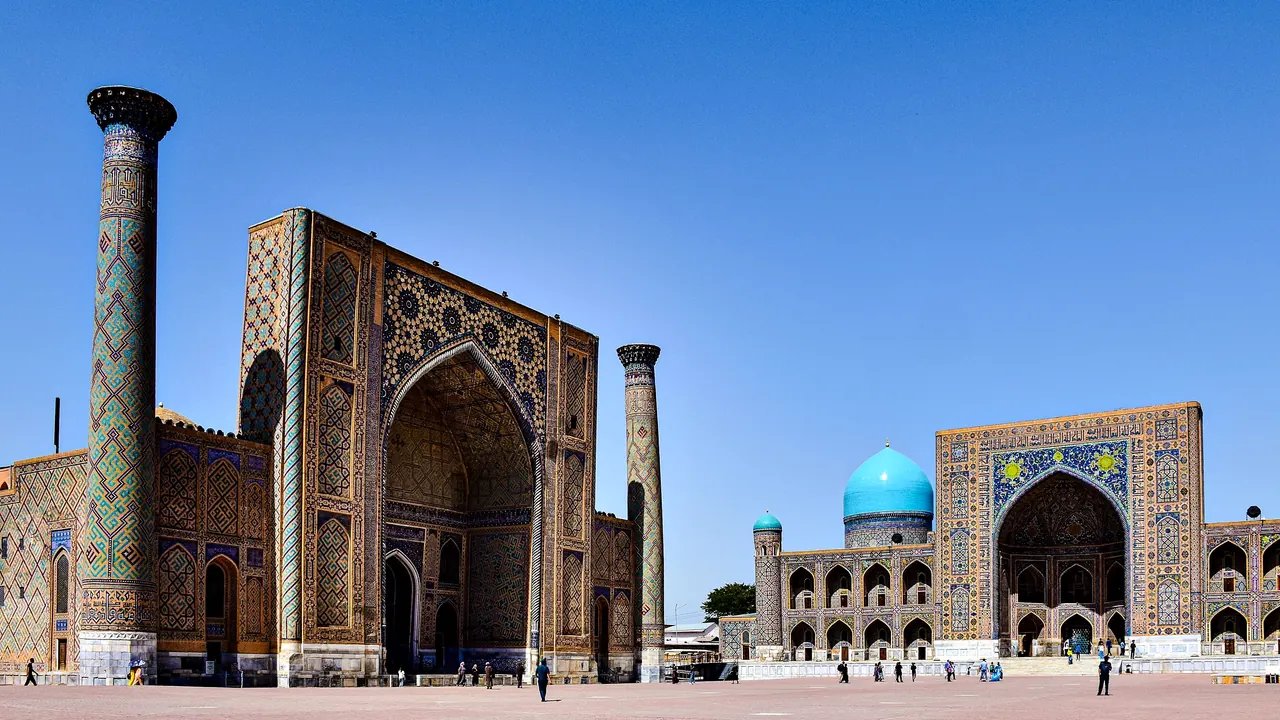
Photos: Mongolia by Bernard Gagnon, CC0; Uzbekistan by AXP Photography, Pexels License.
Mongolia or Uzbekistan?
Our verdict in twelve categories, each scored against the same fixed benchmark cities, and the climate month by month, so you can choose for your trip.
Choose Mongolia for
- nature and the outdoors
- live music and the arts
Mongolia is for travellers who want space more than buildings. Its draw is the land: steppe with herds grazing to the horizon, the dunes and cliffs of the Gobi, larch forest around Lake Khövsgöl and glaciers in the far west, crossed on horseback, by camel or in a four-wheel drive, with nights in ger camps. It suits people who can give it a week or more on rough tracks and who will happily give up variety at the table and easy logistics in return for the open country.
Choose Uzbekistan for
- getting around
- culture and sights
- day trips
Uzbekistan is the better choice for anyone who wants great architecture, good food and a route that is simple to follow. Fast trains link Tashkent, Samarkand and Bukhara, the old towns are compact enough to walk, and the madrasas, bazaars and craft workshops fill every day. It is also cheaper to travel through and easier with children, but it has far less wild landscape than Mongolia.
Scoreboard
Twelve categories on one fixed scale from 0 to 100. The shaded stretch is the gap between the two.
Your match
Pick a travel style or drag the sliders, and both match scores follow your weighting.
Wins on nature and the outdoors and live music and the arts with your weighting.
Wins on getting around and culture and sights with your weighting.
What matters to you?
Category by category
What the scores mean for a trip.
Beaches & swimming
Neither country belongs on a beach list, since both are deep inland. Mongolia's swimming is a cold, quick plunge from the pebbly shores of Khövsgöl or the western lakes, even at the height of summer.
Uzbekistan has warmer water at the Charvak reservoir, about two hours from Tashkent, where locals swim from June to September, and a hotel pool helps a lot in Bukhara's summer heat.
Where in Uzbekistan: Charvak Reservoir
Food & drink
Mongolia feeds you like a herding family would. Mutton, goat and milk are on almost every plate, and on a countryside circuit the same buuz and khuushuur come back at camp after camp. The memorable meals come from the welcome, not the menu: milk tea and dried curds in an Arkhangai ger, airag in late summer, or a khorkhog cooked with hot stones. Ulaanbaatar is your break from the routine, with Korean, Japanese and Russian cooking, so stock up on variety there before heading out.
Uzbekistan is the better trip for anyone who travels to eat, because good food runs along the whole route rather than stopping at the capital. Every city claims its own plov, Samarkand bakes its prized glazed loaves, and a morning among the fruit, nuts and spices of the Chorsu or Siab bazaar is as much a sight as a meal. Vegetarians struggle in both countries, and they will do best in the two capitals, Ulaanbaatar and Tashkent.
Where in Mongolia: Ulaanbaatar, Arkhangai
Where in Uzbekistan: Tashkent, Samarkand, Bukhara, Fergana Valley
Culture & sights
Mongolia lost most of its built heritage in the purges of the 1930s, so what survives is valued but spread thin. Gandan Monastery and the Bogd Khan Winter Palace in Ulaanbaatar, Erdene Zuu in the Orkhon Valley and Amarbayasgalant in the north are each worth seeing. The rural sites take long overland journeys, though, and few trips are built around them.
Uzbekistan is far ahead. Samarkand's Registan and Gur-e-Amir, Bukhara's Kalyan minaret and Ark and the walled town of Khiva are whole Silk Road cities that you explore on foot, one after another, and even Soviet-era Tashkent adds ornate metro stations and history museums.
Where in Mongolia: Ulaanbaatar, Orkhon Valley, Amarbayasgalant, Mongolian Altai
Nightlife
Both are quiet at night, and in both countries the capital is the only place with any real scene. Ulaanbaatar's bars around Sükhbaatar Square and its weekend clubs have a young, sometimes rowdy crowd. Tashkent's bars and karaoke rooms feel similar.
What differs is the rest of the trip. In Mongolia an evening ends with vodka at a ger camp under the stars, and in Uzbekistan it ends with a stroll past the lit monuments of Bukhara or Khiva.
Where in Mongolia: Ulaanbaatar
Where in Uzbekistan: Tashkent
Nature & outdoors
Mongolia is on another level. Within one country it has the Gobi with Yolyn Am and the Flaming Cliffs, the taiga and mountains around Lake Khövsgöl, the volcanic valleys of Arkhangai and the glaciers of Altai Tavan Bogd. Reaching them means long hours on rough tracks, or a domestic flight for the far west. Once you are there, horse and camel treks are the way to take in the country.
Uzbekistan's scenery is mostly cotton fields and desert between the oasis cities. The outdoors is at its edges: walnut forest and hiking in Ugam-Chatkal and Chimgan, homestays in the Nuratau mountains and yurt camps by Aydarkul. These are good additions to a trip, but rarely the reason for it.
Where in Mongolia: Gobi Desert, Lake Khövsgöl, Arkhangai and the Orkhon Valley, Altai Tavan Bogd
Where in Uzbekistan: Ugam-Chatkal National Park, Chimgan Mountains, Nuratau Mountains, Kyzylkum Desert
Day trips
Uzbekistan lends itself far better to outings from a base. Shakhrisabz is a scenic drive from Samarkand, Bukhara has the emirs' summer palace and the potteries of Gijduvan nearby, and from Khiva you can reach the desert fortresses of Ayaz Kala and Toprak Kala.
Mongolia is travelled as one long loop rather than from a fixed point, so day trips barely exist. From Ulaanbaatar you have the steel Chinggis Khaan statue at Tsonjin Boldog and the ruins of Manzushir Monastery, and little else.
Where in Mongolia: Tsonjin Boldog, Manzushir Monastery
Where in Uzbekistan: Shakhrisabz, Ayaz Kala and Toprak Kala, Gijduvan, Margilan
Good for families
Uzbekistan is the easier of the two with children. The old towns are safe and largely free of traffic, Tashkent has amusement parks and a zoo, and in Khiva children can climb the ramparts. The catch is the summer heat and the long run of monuments, which suit older children more than toddlers.
Mongolia gives hardy older children a real adventure, with gers, camels and dunes, best kept short at a camp in Gorkhi-Terelj. Long days on tracks with basic toilets, and limited medical care in the countryside, rule out most trips with small children.
Where in Mongolia: Gorkhi-Terelj, Gobi Desert, Ulaanbaatar
Getting around
Moving around is where the two differ most in practice. In Uzbekistan the fast trains take you from Tashkent to Samarkand in a little over two hours, Tashkent has a metro, and the historic centres are easy to walk. Only Khiva and the desert and mountain trips need extra effort.
In Mongolia almost every route means hiring a driver and a four-wheel drive for a week or more on dirt tracks, with domestic flights to the Gobi or the far west. Ulaanbaatar itself is jammed with traffic and unpleasant to walk once you leave the centre.
Where in Mongolia: Ulaanbaatar
Shopping & style
Uzbekistan has more to bring home. Suzani and carpets in Bukhara's trading domes, ikat silk from Margilan, Rishtan ceramics and carved wood from Khiva make a whole route of craft workshops.
Mongolia's one standout is cashmere. Ulaanbaatar's factory shops and the State Department Store sell sweaters and blankets of very good quality, and Narantuul market has felt and deels. That is worth one focused afternoon rather than a shopping trip.
Where in Mongolia: Ulaanbaatar
Where in Uzbekistan: Bukhara, Fergana Valley, Samarkand, Tashkent
Affordability
Both are inexpensive day to day, but Uzbekistan stays cheap over a whole trip. Guesthouses in Bukhara and Khiva, bazaar meals and even the fast trains are modest, and independent travel works, so the main extras are entry fees at the monuments and boutique hotels in peak season.
Mongolia is cheap in the capital, but the cost comes from moving around: a driver, a vehicle, fuel and often a guide. Sharing a jeep and keeping to Arkhangai and the Orkhon Valley, which you can reach without a flight, is the way to keep the cost down.
Where in Mongolia: Ulaanbaatar, Arkhangai
Live music & performing arts
The two are close, and both keep their best performances in the capital. Ulaanbaatar's draw is its own tradition: throat singing, the horse-head fiddle and tsam dance are easy to catch in summer, and Naadam in July fills every town with wrestling, archery and music.
Tashkent leans more classical, with opera and ballet at the Alisher Navoi Theatre and a philharmonic, while Bukhara and Samarkand stage maqom and dance evenings in madrasa courtyards.
Where in Mongolia: Ulaanbaatar
Wellness & relaxation
Neither country is a place for a wellness trip, and what each offers is quite different. Mongolia has natural hot springs, above all the outdoor pools at Tsenkher in Arkhangai, which are a welcome soak during a tiring circuit.
Uzbekistan has bathing in town, in Bukhara's centuries-old domed hammams with steam and a scrub. Its slower pace also helps you rest: tea beds under mulberry trees and quiet courtyard guesthouses after the day visitors leave.
Where in Mongolia: Tsenkher Hot Springs, Arkhangai, Shargaljuut
When should you go?
Pick your month, and for a country the place in it. The climate figures are measured averages, not a forecast.
Where in Uzbekistan
Ulaanbaatar (Mongolia) in July
Tashkent (Uzbekistan) in July
Daytime high, °C
Rainfall in the month, mm
Temperature and rainfall are climate normals, averaged over the years shown. Ulaanbaatar (Mongolia): 1991-2020 normals, Ulaan-Baator (2.9 km from centre). Tashkent (Uzbekistan): 1991-2020 normals, Tashkent (5.1 km from centre).
Mongolia has a short season. Ulaanbaatar reaches about 26°C in July, and June to September is the window for the steppe, the Gobi and Khövsgöl. Summer is also when most of the year's rain falls, peaking at around 71mm in July, though even then the sun is out for long hours. From November to March the capital is bitterly cold, down to about -16°C in January, and travel in the countryside largely stops.
Uzbekistan works almost the other way round. Spring and autumn are the best seasons. Tashkent and Samarkand are around 22°C in April and October and Khiva is similar, which is ideal for walking the old towns. From June to August all three are fiercely hot at about 36°C, with almost no rain and long days of sun. Winters are mild compared with Mongolia but grey, and Tashkent and Samarkand get most of their rain between November and April. So Mongolia belongs to high summer, and Uzbekistan to the months either side of it.
Which traveller are you?
For an outdoors trip, Mongolia is the clear choice. Riding across the Orkhon Valley, climbing the singing dunes of Khongoryn Els or hiking above Lake Khövsgöl gives a scale of wilderness that Uzbekistan's mountain edges near Tashkent cannot match.
On a trip with a tight budget, Uzbekistan goes further. Guesthouses, bazaar meals and fast trains all cost little, and you can travel independently, while in Mongolia the cheap daily costs are outweighed by the drivers and jeeps needed to reach anything.
More comparisons
Each shares a side with Mongolia or Uzbekistan.
Where else could you go?
Set Mongolia or Uzbekistan against any other country.