Ecuador
Quito
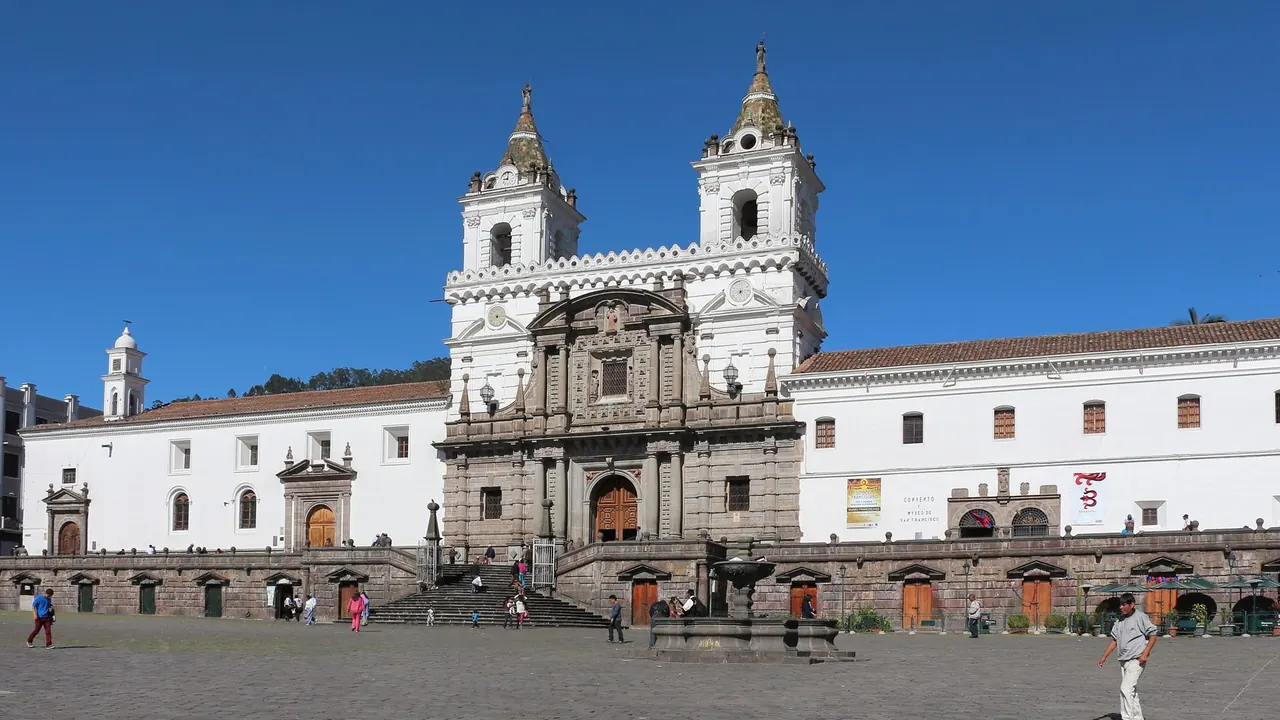
The church of San Francisco under a blue sky
- Nature & outdoors86
- Affordable cities78
- Culture & sights77
Photo: Bernard Gagnon, CC BY-SA 3.0, cropped
Match
50
Every category weighted equally
- Beach & sun46
- Culture & arts53
- Food & nightlife48
- Family trip49
- Outdoors55
- Relax & unwind49
- Shopping & style49
- On a budget53
Quito in twelve categories
Our verdict on each, scored 0 to 100 against the same fixed benchmark cities, so a score means the same thing on every page.
Beaches & swimming. Scores 5 out of 100.
Food & drink. Scores 54 out of 100.
Culture & sights. Scores 77 out of 100.
Nightlife. Scores 40 out of 100.
Nature & outdoors. Scores 86 out of 100.
Day trips. Scores 55 out of 100.
Good for families. Scores 32 out of 100.
Getting around. Scores 45 out of 100.
Shopping & style. Scores 40 out of 100.
Affordability. Scores 78 out of 100.
Live music & performing arts. Scores 38 out of 100.
Wellness & relaxation. Scores 44 out of 100.
Quito category by category
Beaches & swimming
5Quito sits at about 2,850m in an Andean valley, and the Pacific coast is a long day's drive or a domestic flight away. There is no beach life of any kind from the city. Swimming means a hotel pool or the warm municipal pools in the valleys below town, and travellers who want sand usually add the coast or the Galápagos as a separate leg of the trip.
Food & drink
54Highland Ecuadorian cooking is hearty and built on potatoes, corn and pork: locro de papa soup with cheese and avocado, slow-roasted hornado, fritada, llapingachos and puffy empanadas de viento dusted with sugar. The cheapest way in is the set lunch, the almuerzo, and the food courts of the Mercado Central and Mercado Santa Clara, where you can also try juices made from fruits you may never have seen. On cold evenings people drink canelazo, a hot cinnamon and naranjilla punch.
Ecuador grows some of the world's finest cacao and good highland coffee, and both are easy to taste in the old town and La Floresta. A modern restaurant scene built on Andean produce adds some ambition, but beyond that the range is narrow.
Culture & sights
77Quito's historic centre was among the first places ever inscribed as a UNESCO World Heritage site, and it is still one of the largest and least-altered colonial cores in the Americas. The church of La Compañía de Jesús is covered almost entirely in gold leaf. The vast San Francisco monastery faces a broad cobbled plaza, and white churches and convents with carved altarpieces from the Quito school of colonial art fill the grid of streets around the Plaza Grande. The neo-Gothic Basílica del Voto Nacional lets you climb its towers above the rooftops.
Good museums back this up. Casa del Alabado holds pre-Columbian art, the Capilla del Hombre has Guayasamín's paintings, and the Museo Nacional gives the broad history. El Panecillo hill, crowned by its winged Virgin, completes a long list for a city of its size.
Nightlife
40Going out happens mainly in La Mariscal, around Plaza Foch, where bars, salsa clubs and backpacker hangouts are packed on Thursday to Saturday nights. Quieter craft-beer and cocktail bars are spread through La Floresta and the area around González Suárez. In the old town, the restored lane of La Ronda is pleasant for a canelazo and an evening stroll, but it is not a late scene. The night is livelier than its reputation on weekends and fairly quiet midweek. After dark, visitors take taxis between areas rather than walking.
Nature & outdoors
86Quito lies on the flank of the active Pichincha volcano. The TelefériQo cable car lifts you from the edge of the city to about 4,000m, where a trail climbs on through páramo grassland to the rocky summit of Rucu Pichincha. Most visitors begin with that hike to get used to the altitude. Further out along the Avenue of the Volcanoes, Cotopaxi National Park is about two hours south, with its snow cone and glacier hikes, mountain biking and horse riding on the high plains. Antisana, Cayambe and the crater lakes of the north are within reach too.
To the west, the road drops into the cloud forest around Mindo, which has some of the richest birdwatching on earth, hummingbirds by the dozen, and canopy zip-lines, river tubing and waterfall walks.
Day trips
55The classic day out runs north to Otavalo, about two hours by road, whose Saturday market is one of the largest Indigenous markets in South America. It pairs well with the leather town of Cotacachi and the weaving villages around Peguche. Closer in, about forty-five minutes north, the Mitad del Mundo complex marks the equator, next to the small Intiñan museum and the pre-Inca site at Rumicucho. The village of Mindo is a pleasant base for a day in the cloud forest, and the thermal-spring hamlet of Papallacta is east over the Andes. Beyond these, the places worth a day are mostly mountains rather than towns.
Good for families
32Children enjoy straddling the equator line at Mitad del Mundo, the ride up the TelefériQo cable car and the hands-on Yaku water museum above the old town. Parque La Carolina in the north has open lawns, pedal boats, a vivarium and playgrounds. Ecuadorians are warm towards children. The difficulties are physical: the altitude of about 2,850m tires small children and can make them unwell for the first days, the old town is steep, traffic is heavy and pavements are uneven. Families tend to keep days short and treat Quito as a gateway to the coast, the cloud forest or the Galápagos.
Getting around
45Quito stretches for about 40km along a narrow valley, so the city is long and thin. A single metro line runs north to south along its length. It is backed by the Trolebús and Ecovía bus rapid-transit corridors, which are cheap but very crowded at rush hour, where pickpockets work the carriages. The historic centre is compact and best seen on foot, though its streets are steep and the altitude leaves newcomers out of breath. Between neighbourhoods and at night, most visitors use registered taxis or ride-hailing, which are easy and cheap. You don't need a car in the city, but day trips usually mean a tour, a driver or an intercity bus from the terminals at the city's edges.
Shopping & style
40The things worth taking home are distinctively Ecuadorian: toquilla-straw Panama hats, which are made in Ecuador, fine bean-to-bar chocolate, alpaca and wool textiles, tagua-nut carvings and silver. The artisan market in La Mariscal gathers these under one roof, and a few galleries and craft shops in the old town and La Floresta sell better-made pieces. Fashion shopping happens in large malls in the north of the city and holds little interest for visitors. Serious craft buyers save themselves for the market at Otavalo.
Affordability
78Day-to-day costs are low. A filling set lunch in a local restaurant, a city bus or metro ride and a taxi across town all cost very little, and market food and fresh juices are cheaper still. Comfortable guesthouses and boutique hotels in old colonial houses are good value. The costs rise for international-standard hotels in the north of the city, imported wine and spirits, and guided excursions to the volcanoes or the cloud forest. Galápagos trips, often booked from here, are expensive.
Live music & performing arts
38The centrepiece is the Teatro Nacional Sucre, an elegant nineteenth-century theatre on Plaza del Teatro that stages opera, concerts and dance. The national symphony orchestra performs there and at other halls around town. The folk ballet tradition is the most distinctive thing to see, with large companies performing Andean music and dance in colourful costume. Small venues and bars in La Floresta and La Mariscal host live Latin, rock and Andean bands, and churches in the old town hold occasional choral and baroque concerts. It is a modest programme, worth checking for an evening rather than a reason to come.
Wellness & relaxation
44The real draw for relaxation is outside the city. Papallacta, on the eastern side of the Andes about an hour and a half away, has steaming thermal pools set among páramo hills that are often wrapped in mist, and a spa culture that Quiteños use at weekends. Closer in, the warmer valleys below the city have simple public thermal pools such as those at El Tingo. In Quito itself, wellness comes down to hotel spas and massage studios in the north. The city is noisy and congested, and the altitude makes the first days tiring rather than restful.
When should you go?
Pick a month to see what it is like. The climate figures are measured averages, not a forecast.
Quito in July
Daytime high, °C
Rainfall in the month, mm
The whole year
Shaded against this city’s own year: the deepest cell is its best month for that figure and the palest its weakest.
Where the figures come from
Quito's station stands 208 m above the city centre, so the centre is likely a little warmer than the figures say.
Temperature and rainfall are climate normals, averaged over the years shown. Quito: 1961-1990 normals, Izobamba-Santa Catalina (16.8 km from centre).
Before you go
| Measure | Quito |
|---|---|
| Official language | Spanish, Shuar, Northern Quichua |
| Currency | US Dollar (USD) |
| Sockets | AB120 V, 60 Hz |
| Driving side | Right |
| Time zone | UTC-5 |
| Emergency number | 911 |
| Elevation | 2,850 m |
| Main airport | Mariscal Sucre International Airport (UIO)20 km from centre22 non-stop destinations |
| Public holidays this year | 11 days |
By the numbers
| Measure | Quito |
|---|---|
| City population | 1,763,275 |
| People per km² | 4,735 |
| Museums within 10 km | 16 |
| UNESCO World Heritage sites within 50 km | 2 |
Compare Quito with
Every comparison with a written verdict behind it.