Georgia
Tbilisi
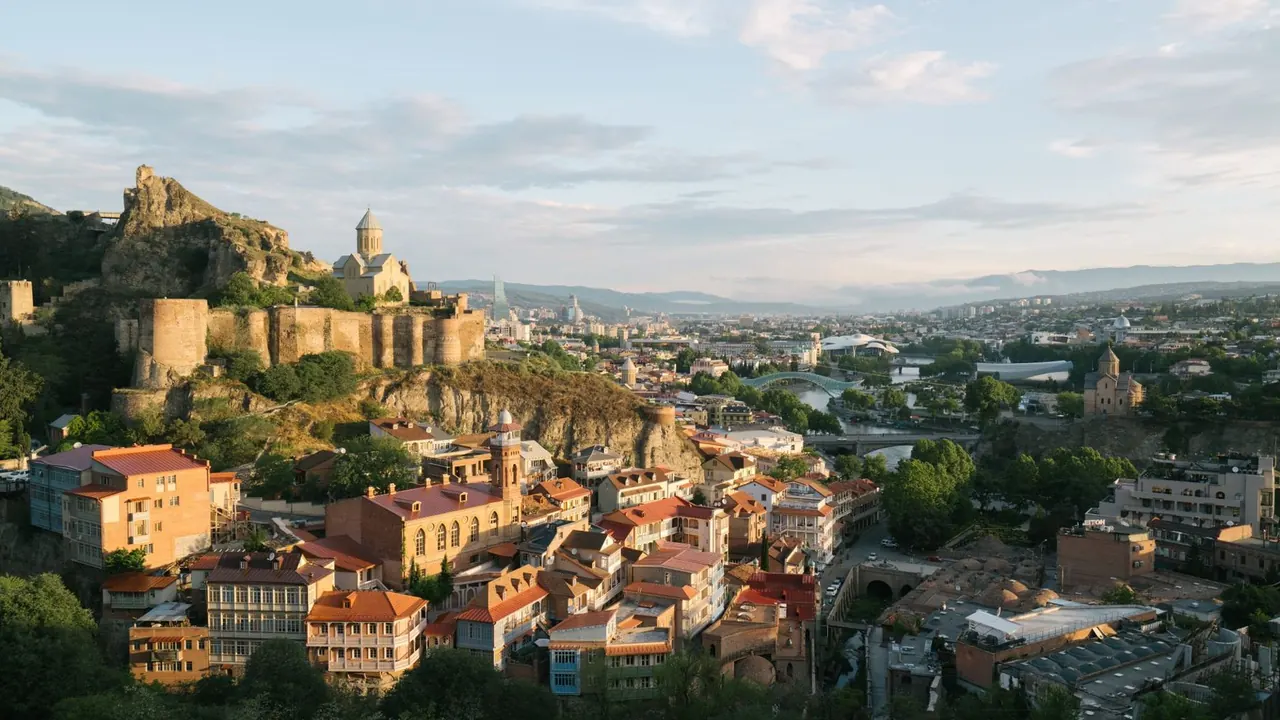
Narikala Fortress above the old town
- Affordable cities80
- Day trips77
- Food & drink72
Photo: ArtHouse Studio, Pexels License
Match
57
Every category weighted equally
- Beach & sun54
- Culture & arts61
- Food & nightlife61
- Family trip54
- Outdoors59
- Relax & unwind56
- Shopping & style58
- On a budget60
Tbilisi in twelve categories
Our verdict on each, scored 0 to 100 against the same fixed benchmark cities, so a score means the same thing on every page.
Beaches & swimming. Scores 7 out of 100.
Food & drink. Scores 72 out of 100.
Culture & sights. Scores 62 out of 100.
Nightlife. Scores 70 out of 100.
Nature & outdoors. Scores 58 out of 100.
Day trips. Scores 77 out of 100.
Good for families. Scores 45 out of 100.
Getting around. Scores 52 out of 100.
Shopping & style. Scores 42 out of 100.
Affordability. Scores 80 out of 100.
Live music & performing arts. Scores 57 out of 100.
Wellness & relaxation. Scores 66 out of 100.
Tbilisi category by category
Beaches & swimming
7Tbilisi is an inland city in a river valley, and the Black Sea coast is about five hours away by road or train, which makes it a separate trip, not a day out. In summer, locals swim at the large reservoir called the Tbilisi Sea, at the small Lisi Lake and Turtle Lake on the hills above town, and in hotel and public pools. These are fine for cooling off in the July heat, but they are not beaches anyone travels for.
Food & drink
72Georgian food is one of the great discoveries of the region, and Tbilisi is the best place to eat it. Soup dumplings called khinkali, cheese breads like the boat-shaped Adjarian khachapuri, walnut sauces, pomegranate, fresh herbs and grilled mtsvadi are the staples. Bakeries sell hot shoti bread from round clay ovens set into the ground. The feast, or supra, run by a toastmaster, is still how Georgians celebrate.
Wine is the other half of it. Georgia has made wine in buried clay qvevri for thousands of years, and amber wines from Kakheti fill the wine bars of Sololaki and the Old Town. The Dezerter Bazaar shows the produce side, from churchkhela to cheeses. Cooking from other parts of the world is limited, and there is not much fine dining.
Culture & sights
62The old city spreads below the Narikala fortress walls. It has crooked lanes, houses with carved wooden balconies, the domed brick sulphur baths and some of the country's oldest churches, including sixth-century Anchiskhati and Sioni Cathedral. Across the Mtkvari river, Metekhi Church stands on its cliff. Holy Trinity Cathedral on Elia Hill shows the scale of the Orthodox revival. Sololaki and Rustaveli Avenue add faded Art Nouveau mansions with painted entrance halls.
The Georgian National Museum is the main collection, and its treasury of ancient Colchian gold is a real highlight. Smaller galleries cover Niko Pirosmani and modern Georgian painting. Soviet-era buildings round out a city that rewards a few days of walking, though it has few sights of international fame.
Nightlife
70Tbilisi is known abroad for techno. A few large clubs in industrial spaces and old Soviet buildings bring in DJs and visitors from across Europe, and at weekends they run until well after dawn. The scene is serious, with strict door policies and a crowd that comes to dance. It is not a resort party scene.
Away from the clubs, evenings are relaxed. Wine bars and cocktail bars fill the old houses of Sololaki. On the left bank near Marjanishvili, courtyard bars gather in converted Soviet-era buildings, and Shardeni Street in the Old Town draws a more touristy crowd. People go out late and stay out late. The city is not large, though, and on nights without a big club event it is much quieter.
Nature & outdoors
58The city sits in a valley with steep green hills on both sides. A funicular climbs to Mtatsminda, a cable car runs up to Narikala and the botanical garden, and trails lead from Turtle Lake into the large forested Tbilisi National Park. Spring and autumn are the best seasons for walking. Summers in the valley are hot.
The real draw is the Greater Caucasus to the north. The Georgian Military Road reaches the Gudauri ski area and the high Jvari Pass in about two hours, with skiing in winter and paragliding and hiking in summer. Kazbegi, Mount Kazbek and the high valleys are further and are better done with a night there than as a rushed day trip.
Day trips
77Mtskheta, the ancient capital and a UNESCO site, is about half an hour away, where Svetitskhoveli Cathedral and the hilltop Jvari Monastery stand above the meeting of two rivers. Westwards, Gori and the rock-cut town of Uplistsikhe make an easy combined outing of about an hour and a half.
East lies Kakheti, Georgia's main wine region. Walled Sighnaghi, Telavi, the Alaverdi and Gremi monasteries and family wineries with qvevri cellars fill a full day about two hours out. In the semi-desert to the south-east, the cave monastery of David Gareja is a memorable trip. North on the Military Road, the Ananuri fortress by its reservoir is often combined with the drive into the mountains.
Good for families
45Georgians make a great fuss of children, and they are welcome in restaurants late into the evening. The funicular up to the Mtatsminda amusement park, with its Ferris wheel above the city, is the obvious treat. The cable car to Narikala, the zoo, Turtle Lake and the Dedaena and Vake parks add easy outings.
Getting around with small children is the hard part. The Old Town is steep and cobbled, pavements are uneven, traffic is aggressive and main roads are often crossed by underpasses with stairs, which are awkward with a pushchair. Summer heat in the valley also limits the day. There are no large aquariums, science centres or theme parks.
Getting around
52The central districts, from the Old Town through Sololaki to Rustaveli Avenue, are close together and can be walked, though often uphill and on broken pavements. The Soviet-built metro has two lines with deep stations and long escalators. It covers the main axis well but not the hillside districts. Buses and minibuses fill the gaps, but they are harder for a visitor to work out.
Most travellers rely on ride-hailing apps, which are cheap and widely used. Traffic is heavy and drivers do not yield readily, so crossing big roads often means an underpass. No car is needed in town, but day trips are easier with a driver or a tour.
Shopping & style
42The best shopping here is for Georgian things. The Dry Bridge market spreads Soviet badges, cameras, old silver, carpets and paintings along the riverside and in the park beside it. Workshops sell cloisonné enamel jewellery, felt and Georgian carpets. Wine shops pack qvevri wines and chacha for the flight home. A small group of local fashion designers has boutiques in Vera and Sololaki.
Beyond that, the range is thin. Rustaveli Avenue and the big malls carry international chains, luxury brands are few, and the Old Town's main streets lean towards souvenirs.
Affordability
80Tbilisi is a cheap city for a European-style break. A generous Georgian meal with wine costs little, bakery bread and khachapuri make cheap snacks, and metro rides and ride-hailing trips across town are inexpensive. Guesthouses and simple apartments are plentiful. Most churches and many sights are free, and museum entry is modest. Boutique hotels in the Old Town and Sololaki, cocktail bars and imported goods sit closer to European prices, but a visitor who eats and drinks Georgian will spend little.
Live music & performing arts
57Georgian folk dance and singing are the highlight. The national ballet ensembles perform athletic, swirling traditional dances on stage, and Georgia's ancient polyphonic singing, which UNESCO recognises, can be heard at concerts and in church services, where it is the most moving of all. The Moorish-style Opera and Ballet Theatre on Rustaveli Avenue runs a full season of opera and classical ballet.
The Gabriadze marionette theatre, beside its leaning clock tower in the Old Town, stages poetic puppet plays that do not need translation. The Rustaveli and Marjanishvili drama theatres have strong reputations, but most plays are in Georgian. A long-running jazz festival adds to the calendar, but most nights the choice is limited.
Wellness & relaxation
66Tbilisi takes its name from its warm springs. Under the brick domes of Abanotubani, at the foot of the Old Town, sulphur water still feeds historic bathhouses, including the one with the ornate blue-tiled Persian façade. Most visitors book a private room with its own hot pool, often with a vigorous scrub called kisi. It is a ritual that has hardly changed in centuries, and the waters smell strongly of sulphur.
Outside the baths, the city is not especially restful. Traffic is loud and the streets are steep. Long, slow meals in shaded courtyards and evenings over wine give it a gentle side, and hotel spas fill in the rest.
When should you go?
Pick a month to see what it is like. The climate figures are measured averages, not a forecast.
Tbilisi in July
Daytime high, °C
Rainfall in the month, mm
The whole year
Shaded against this city’s own year: the deepest cell is its best month for that figure and the palest its weakest.
Temperature and rainfall are climate normals, averaged over the years shown. Tbilisi: 1991-2020 normals, Tbilisi (13.8 km from centre).
Before you go
| Measure | Tbilisi |
|---|---|
| Official language | Georgian |
| Currency | Lari (GEL) |
| Sockets | CF220 V, 50 Hz |
| Driving side | Right |
| Time zone | UTC+4 |
| Emergency number | 112 |
| Elevation | 575 m |
| Main airport | Tbilisi International Airport (TBS)15 km from centre64 non-stop destinations |
| Public holidays this year | 17 days |
By the numbers
| Measure | Tbilisi |
|---|---|
| City population | 1,331,485 |
| People per km² | 1,849 |
| Museums within 10 km | 29 |
| UNESCO World Heritage sites within 50 km | 1 |
Compare Tbilisi with
Every comparison with a written verdict behind it.