Japan
Sapporo
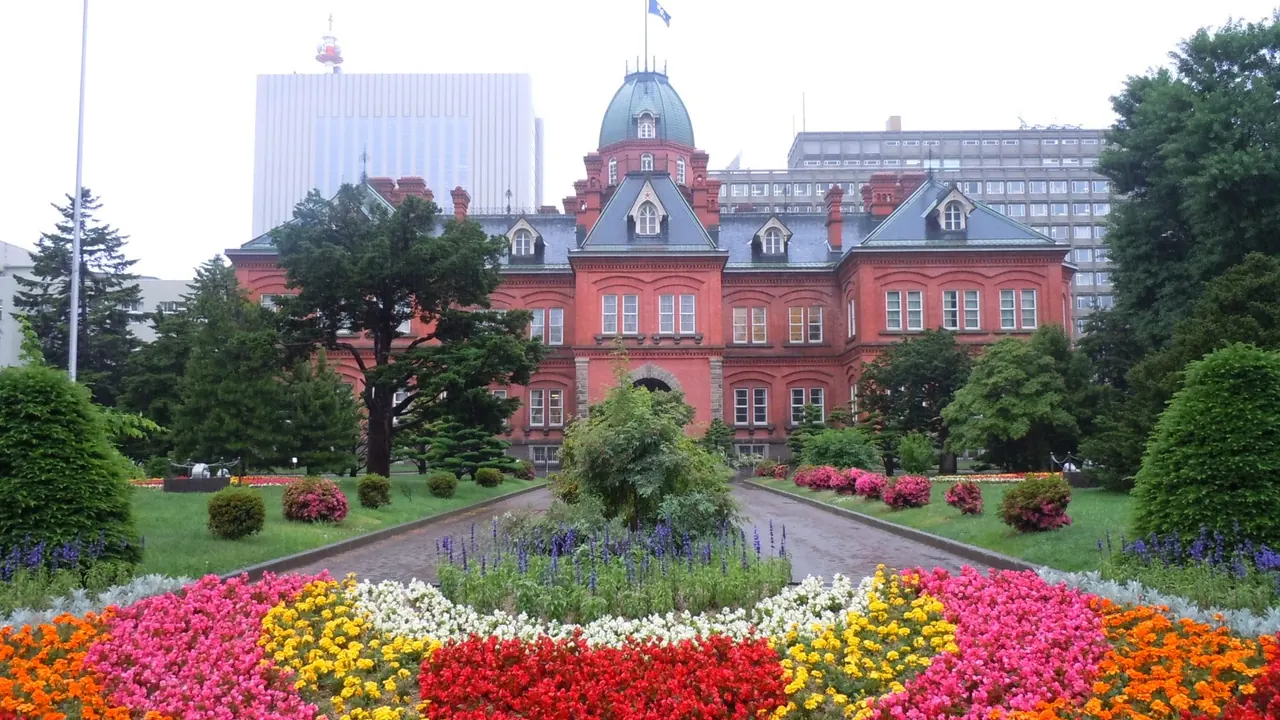
The old Hokkaido Government Office and its flower beds
- Nature & outdoors86
- Food & drink80
- Getting around80
Match
63
Every category weighted equally
- Beach & sun62
- Culture & arts61
- Food & nightlife63
- Family trip64
- Outdoors66
- Relax & unwind65
- Shopping & style64
- On a budget63
Sapporo in twelve categories
Our verdict on each, scored 0 to 100 against the same fixed benchmark cities, so a score means the same thing on every page.
Beaches & swimming. Scores 28 out of 100.
Food & drink. Scores 80 out of 100.
Culture & sights. Scores 40 out of 100.
Nightlife. Scores 62 out of 100.
Nature & outdoors. Scores 86 out of 100.
Day trips. Scores 64 out of 100.
Good for families. Scores 72 out of 100.
Getting around. Scores 80 out of 100.
Shopping & style. Scores 58 out of 100.
Affordability. Scores 60 out of 100.
Live music & performing arts. Scores 44 out of 100.
Wellness & relaxation. Scores 80 out of 100.
Sapporo category by category
Beaches & swimming
28Sapporo is an inland city, and beaches play almost no part in a stay. The nearest swimming is on the Sea of Japan, about half an hour to an hour away at Ishikari or around Otaru, on wide, plain sand backed by low hills. In a short summer window from late July to mid-August the water reaches about 22-24°C and local families come out for barbecues and a swim. Outside those weeks the coast is for looking at, not bathing. Anyone who wants a beach vacation should look elsewhere and think of the sea here as a summer afternoon out.
Food & drink
80Sapporo is one of Japan's great places to eat, built on Hokkaido's seafood, dairy and farm produce. The city has its own dishes: rich miso ramen, spicy soup curry with whole vegetables, and jingisukan, lamb grilled at the table on a domed skillet. In the morning the stalls of Nijo Market and the Central Wholesale Market's outer market serve bowls of rice topped with sea urchin, salmon roe and crab, and in winter whole crabs are the centrepiece of a meal.
Beer is part of the city's identity, and the red-brick brewery buildings in the east of the centre hold a beer museum and huge beer halls. Susukino and the arcades around it pack in ramen counters, izakaya and sushi bars, and the department-store food halls are full of Hokkaido sweets, cheese and melon. The range is mostly Japanese, with less international depth than the largest cities.
Culture & sights
40Sapporo was laid out on a grid in the 1870s, so it has little old heritage. Its landmarks come from the Meiji pioneer period: the small wooden Clock Tower, the red-brick former Hokkaido government building and the Western-style houses at the Historical Village of Hokkaido, an open-air museum on the city's edge. The Hokkaido Museum covers Ainu culture and settlement, and the Hokkaido University campus has avenues of poplars and ginkgo.
The most memorable sight is modern. Moerenuma Park is a whole park designed by the sculptor Isamu Noguchi, with a glass pyramid and a grassy man-made mountain. Odori Park and the TV Tower give the centre a focus. You can see it all in two days, and most visitors come for other things.
Nightlife
62Going out in Sapporo means Susukino, one of the biggest entertainment districts in northern Japan. It is a block of neon-lit towers with thousands of small bars stacked floor above floor, izakaya, karaoke boxes, standing bars and late ramen counters, and it stays busy well past midnight, even in deep winter. Many bars are tiny counters with a handful of seats, and the hard part is choosing which door to try. Some are hostess bars and touts work the main corners, so the side streets and visibly open bars are the easier places to start. There are a few clubs, but this is a city for bar-hopping and late noodles, not for dancing until dawn.
Nature & outdoors
86Sapporo sits between forested hills and the plain, with some of the world's most reliable snow arriving from December to March. Ski slopes are close: Teine, which hosted the 1972 Winter Olympic alpine events, and Kokusai are both inside the city limits, and the deep powder of Niseko is about two hours away. Mount Moiwa and Maruyama offer short climbs and views straight from town, and cross-country trails and snowshoe routes start at the city's edge.
In summer and autumn, Shikotsu-Toya National Park is about an hour south, with a clear caldera lake for canoeing, volcanoes to hike and steaming fumaroles. The flower fields and hills of Furano and Biei are within reach, and the Jozankei valley turns red and gold in October.
Day trips
64The classic day out is Otaru, about forty minutes by train along the coast, a former herring and trading port with a stone-warehouse canal, glassblowing workshops, music-box shops and excellent sushi. On the way, Yoichi has a whisky distillery founded in the 1930s that welcomes visitors. To the south, Shiraoi has Upopoy, the national museum and park of Ainu culture, and Noboribetsu is a hot-spring town about an hour and a quarter away, with a smoking volcanic valley above it.
North-east, Asahikawa is about an hour and a half by express train, known for its zoo and its ramen. Beyond these, most trips from Sapporo lead to lakes, mountains and farmland rather than to towns, and Hakodate is too far for a comfortable day.
Good for families
72Sapporo is an easy city to manage with children. It is safe and clean, the transport is simple, and an underground walkway links the main districts, which helps when the weather turns. Winter is the high point for children: the Snow Festival fills Odori Park with huge snow and ice sculptures and slides, and the ski hills inside the city offer lessons and gentle slopes for beginners. Maruyama Zoo has polar bears and is easy to reach by subway, and the famous Asahiyama Zoo is a day out by train.
In summer, Moerenuma Park, with its fountains, playground hills and a shallow sea-like pool, and the big Takino hill park on the city's southern edge give children room to run. The main drawback is cold: January and February need serious winter clothing.
Getting around
80Central Sapporo is laid out on a numbered grid, so an address tells you roughly where you are, and the flat core around Sapporo Station, Odori Park and Susukino is easy to walk. Three subway lines cross the city and cover most of what a visitor needs, all on one IC card. A single streetcar line runs a loop from the centre through Susukino and the older south-western districts. It is the easy way to reach the ropeway at the foot of Mount Moiwa. In winter, a long underground walkway lined with shops runs from the station to Susukino, so you can cross the centre without stepping onto icy pavements.
Trains run to New Chitose Airport and along the coast to Otaru. Places on the city's edge, such as Moerenuma Park and Jozankei, need a bus. In midwinter, packed snow and ice on the streets slow everyone down, and good footwear matters more than in most cities.
Shopping & style
58Shopping in Sapporo centres on a few clear areas. The station complex has department stores and fashion malls stacked above the trains, and the old department stores around Odori carry the usual Japanese brands and a basement food hall. Tanukikoji, a covered arcade several blocks long, runs from cheap drugstores and second-hand shops to traditional sweet shops, and is good on snowy days.
What visitors take home is mostly edible: Hokkaido chocolate, butter biscuits, dried seafood, cheese and sake, as well as Ainu-patterned woodcarving and textiles. Luxury and independent fashion are thinner than in Japan's largest cities, and there is no great market for crafts.
Affordability
60Sapporo is reasonably priced by the standards of developed countries and cheaper than Japan's largest cities. Business hotels are comfortable and good value, and a bowl of miso ramen, a soup-curry lunch or a department-store bento costs little. Transit fares are modest and many sights, such as the parks, the old government building and the university campus, are free. Costs go up with crab and sea-urchin dinners, ski passes and resort stays in the mountains, and hotel rooms in the centre are scarce and expensive during the February Snow Festival.
Live music & performing arts
44Sapporo's performing arts are anchored by classical music. Sapporo Concert Hall Kitara, in Nakajima Park, is a well-regarded hall with fine acoustics and a large organ, and it is home to the Sapporo Symphony Orchestra. Each July it hosts the Pacific Music Festival, an international training festival for young musicians that Leonard Bernstein founded in 1990. The city also has a large modern theatre for touring opera, ballet and musicals, as well as small live houses and jazz bars around Susukino.
In June, the Yosakoi Soran festival fills the streets with dance teams. Outside these events, the programme is that of a regional city, and most performances are in Japanese.
Wellness & relaxation
80Hot springs are within easy reach of Sapporo, and taking the waters is the best way to unwind here. Jozankei, a hot-spring town in a forested river gorge still inside the city limits, is about an hour by bus from the centre. Its inns and day-use baths have open-air pools where you can soak while the snow falls or the autumn leaves turn. Noboribetsu, one of Japan's best-known onsen towns, with springs of several mineral types, is close enough for a day or a night.
In town there are public bathhouses and hotels with rooftop baths. For a city of its size, Sapporo feels unhurried, with wide streets, large parks and a quiet snowbound hush in winter.
When should you go?
Pick a month to see what it is like. The climate figures are measured averages, not a forecast.
Sapporo in July
Daytime high, °C
Rainfall in the month, mm
The whole year
Shaded against this city’s own year: the deepest cell is its best month for that figure and the palest its weakest.
Temperature and rainfall are climate normals, averaged over the years shown. Sapporo: 1991-2020 normals, Sapporo (2.2 km from centre).
Before you go
| Measure | Sapporo |
|---|---|
| Official language | Japanese |
| Currency | Yen (JPY) |
| Sockets | AB100 V, 50 and 60 Hz depending on the region |
| Driving side | Left |
| Time zone | UTC+9 |
| Emergency number | Police 110, fire 119 |
| Elevation | 5 m |
| Main airport | New Chitose Airport (CTS)42 km from centre42 non-stop destinations |
| Public holidays this year | 16 days |
By the numbers
| Measure | Sapporo |
|---|---|
| City population | 1,959,313 |
| People per km² | 1,747 |
| Museums within 10 km | 33 |
| UNESCO World Heritage sites within 50 km | 1 |
| Swim season, months above 21 °C | 1 month |
Compare Sapporo with
Every comparison with a written verdict behind it.