Morocco
Chefchaouen
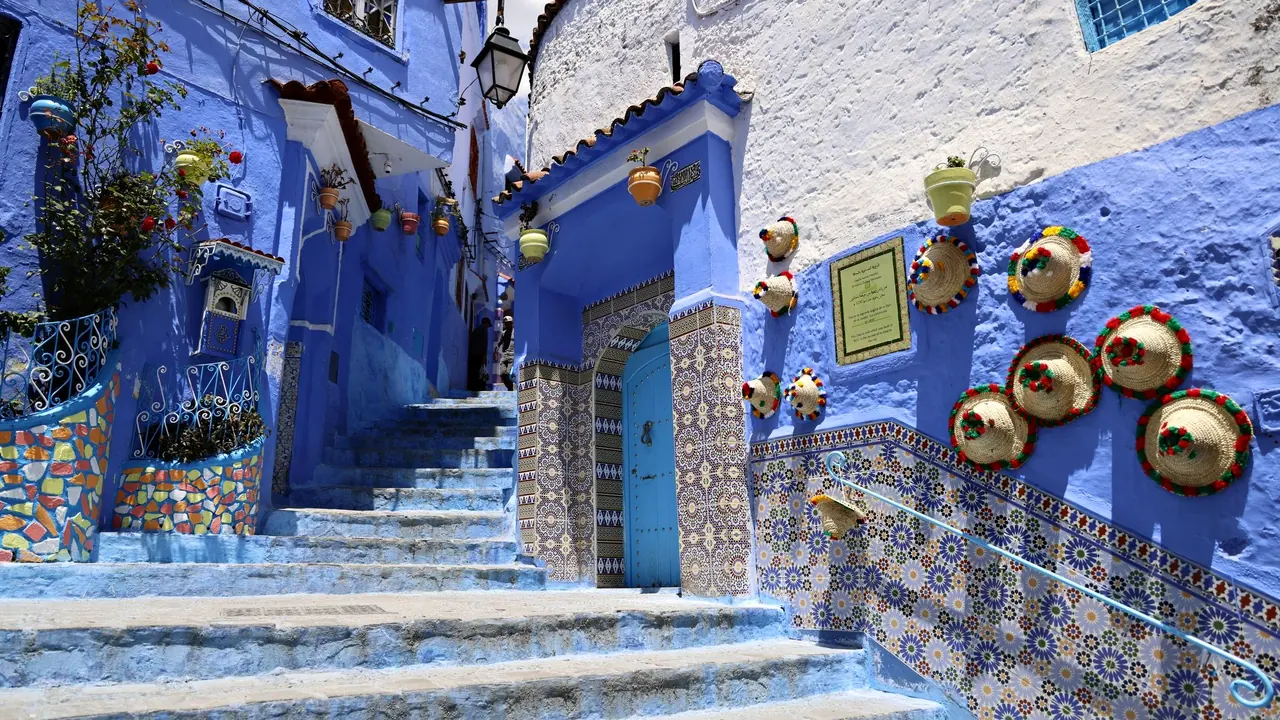
A blue stairway with tiled walls in the medina
- Affordable cities85
- Nature & outdoors68
- Getting around52
Photo: Christophe RASCLE, Pexels License
Match
38
Every category weighted equally
- Beach & sun39
- Culture & arts36
- Food & nightlife32
- Family trip43
- Outdoors44
- Relax & unwind41
- Shopping & style35
- On a budget43
Chefchaouen in twelve categories
Our verdict on each, scored 0 to 100 against the same fixed benchmark cities, so a score means the same thing on every page.
Beaches & swimming. Scores 20 out of 100.
Food & drink. Scores 30 out of 100.
Culture & sights. Scores 40 out of 100.
Nightlife. Scores 4 out of 100.
Nature & outdoors. Scores 68 out of 100.
Day trips. Scores 32 out of 100.
Good for families. Scores 30 out of 100.
Getting around. Scores 52 out of 100.
Shopping & style. Scores 35 out of 100.
Affordability. Scores 85 out of 100.
Live music & performing arts. Scores 7 out of 100.
Wellness & relaxation. Scores 48 out of 100.
Chefchaouen category by category
Beaches & swimming
20Chefchaouen is a mountain town, and swimming is not part of a stay here. The nearest sea is the Mediterranean at Oued Laou, about an hour and a quarter away down a winding road through a gorge, where a long grey-sand beach and a modest village face water that warms to around 23°C in late summer. Getting there means a grand taxi or a hired car, so it works as a day out rather than a reason to come. Closer to town, the river pools at Akchour are where locals cool off in the heat, but they are cold and shallow, more a dip than a swim.
Food & drink
30Eating in Chefchaouen is simple and repetitive. The restaurants around Outa el-Hammam square and up the medina lanes mostly serve the same menu of tagines, couscous, harira and grilled kefta, decent but rarely memorable. The things worth seeking out are local: fresh goat cheese from the Rif farms, wrapped in palm leaf and sold in the market, bowls of bissara bean soup for breakfast, and bread from the communal ovens. The weekly market brings villagers down from the hills with produce and cheese. Alcohol is scarce and fine dining absent, so a few days is enough to work through what the town offers.
Culture & sights
40The town itself is the sight. Founded in 1471 as a fortress against the Portuguese and settled by Muslim and Jewish refugees from Andalusia, the medina is a tangle of steep lanes and stairways washed in shades of blue, with tiled doorways, wooden balconies and small squares that reward slow wandering with a camera. At its heart, Outa el-Hammam square holds the red-walled kasbah, whose garden, tower and small ethnographic museum are the only formal visit, and the octagonal minaret of the Grand Mosque beside it.
Beyond that the list is short: the Ras el-Maa spring where women still wash clothes, the old gates in the walls, and the walk up to the Spanish Mosque for the view over the rooftops at sunset. There are no major museums or monuments, and most visitors have seen it all in a day or two.
Nightlife
4There is essentially no nightlife. Alcohol is hard to find, with only a couple of hotel bars, and evenings consist of dinner, mint tea in the square and a stroll through the lit-up lanes before the medina falls silent. Visitors looking for a night out should look elsewhere; those who stay enjoy the quiet.
Nature & outdoors
68Chefchaouen sits at around 600m on the flank of the Rif mountains, and the hills start where the medina ends. A path from the Ras el-Maa spring climbs past the Spanish Mosque into terraced slopes and up towards the twin peaks that give the town its name, with longer routes onto Jebel el-Kelaa above. About forty minutes away by grand taxi, Akchour is the gateway to Talassemtane National Park, where a river gorge leads to waterfalls and the natural rock arch known as God's Bridge, a popular full-day walk.
The park's cedar and fir forests hold some of the last Barbary macaques, and multi-day treks cross Rif villages towards the coast. Spring brings wildflowers and full rivers, summer is hot in the valleys, and winter is cold and wet with snow on the high ground. Marked trails and maps are limited, so many walkers take a local guide.
Day trips
32Day trips from Chefchaouen are limited to one good outing and a few lesser ones. Tetouan, about an hour and a quarter by bus or taxi, is the clear choice: its UNESCO-listed medina is larger and far less visited than Chefchaouen's, with whitewashed lanes, artisans' quarters and a Spanish colonial new town below. The coastal town of Martil lies just beyond it. Ouezzane, a pilgrimage town to the south, makes a quieter trip. Tangier and Fes are each around three hours away, better as the next stop on a route through northern Morocco than as a return trip in a day.
Good for families
30Chefchaouen is calmer and easier on families than Morocco's big medinas, with little traffic inside the walls and children made welcome by locals. But nothing here is built for children: the attractions are photogenic streets and a small kasbah, the lanes are steep and stepped, which makes pushchairs useless, and older children may enjoy the river pools at Akchour more than anything in town. Persistent offers of hashish to adults in the lanes are an awkward presence. Best for a short stop with older children who can walk.
Getting around
52Within town, everything is on foot and the medina can be crossed in fifteen minutes, but nearly every walk involves steep stairs and slippery polished steps, which makes it tiring with luggage or for anyone unsteady on their feet. There is no public transport to speak of: petit taxis link the bus station and new town to the medina gates, and shared grand taxis or a hired driver handle trips to Akchour and neighbouring towns. There is no railway, so arrival is by long-distance bus or road from Tangier, Tetouan or Fes.
Shopping & style
35Shopping here is a small medina's worth of crafts, many of them actually made in the region. The lanes are lined with stalls selling thick woollen blankets and striped Rif weavings, hooded djellabas, leather slippers and bags, woven baskets and the bottles of blue pigment that colour the walls. Some weavers work on looms in their shopfronts. Bargaining is expected but the pressure is mild compared with the larger souks. Beyond these crafts and the usual souvenirs there is little else, no boutiques or department stores, and the range repeats itself after a few streets.
Affordability
85Chefchaouen is a very cheap place to stay. Simple guesthouses and riads cost a fraction of European prices, a tagine and mint tea in the square is inexpensive, and the main sight, the town itself, is free to walk. Shared grand taxis to nearby valleys and towns are cheap too. Restaurants on the main square and the better-restored riads charge noticeably more than places a few lanes away, but even these remain modest by international standards.
Live music & performing arts
7There is no theatre, concert hall or regular live music. The town's Andalusian heritage surfaces in occasional performances of traditional music, mostly around festivals, and a sufi chant or call to prayer drifting over the rooftops is the most music most visitors hear.
Wellness & relaxation
48Chefchaouen's appeal for rest is its pace. Days slow to mint tea on a roof terrace, the sound of water at the Ras el-Maa spring and cool mountain air after the heat of the lowlands, and many visitors stay longer than planned simply to do very little. The medina has traditional neighbourhood hammams, simple steam rooms with separate hours or sections for men and women, which give an authentic scrub at little cost. Polished spa treatments are another matter: only a handful of riads offer massages or a private hammam, and there are no thermal baths.
When should you go?
Pick a month to see what it is like. The climate figures are measured averages, not a forecast.
Chefchaouen in July
Daytime high, °C
Rainfall in the month, mm
The whole year
Shaded against this city’s own year: the deepest cell is its best month for that figure and the palest its weakest.
Where the figures come from
Chefchaouen has no weather station within reach, so its figures come from a gridded climate model rather than a measured record, and read a broad area rather than the city itself.
Temperature and rainfall are climate normals, averaged over the years shown. Chefchaouen: 2001-2020 normals, NASA POWER reanalysis grid, no weather station within 90 km.
Before you go
| Measure | Chefchaouen |
|---|---|
| Official language | Arabic, Standard Moroccan Tamazight |
| Currency | Moroccan Dirham (MAD) |
| Sockets | CE50 Hz |
| Driving side | Right |
| Time zone | UTC+1 |
| Emergency number | Police 19/112, ambulance 15, fire 15 |
| Elevation | 564 m |
| Main airport | Tangier Ibn Battuta Airport (TNG)86 km from centre50 non-stop destinations |
| Public holidays this year | 11 days |
By the numbers
| Measure | Chefchaouen |
|---|---|
| City population | 46,168 |
| People per km² | 2,998 |
| Museums within 10 km | 1 |
| UNESCO World Heritage sites within 50 km | 1 |
| Swim season, months above 21 °C | 3 months |
Compare Chefchaouen with
Every comparison with a written verdict behind it.