Poland
Krakow
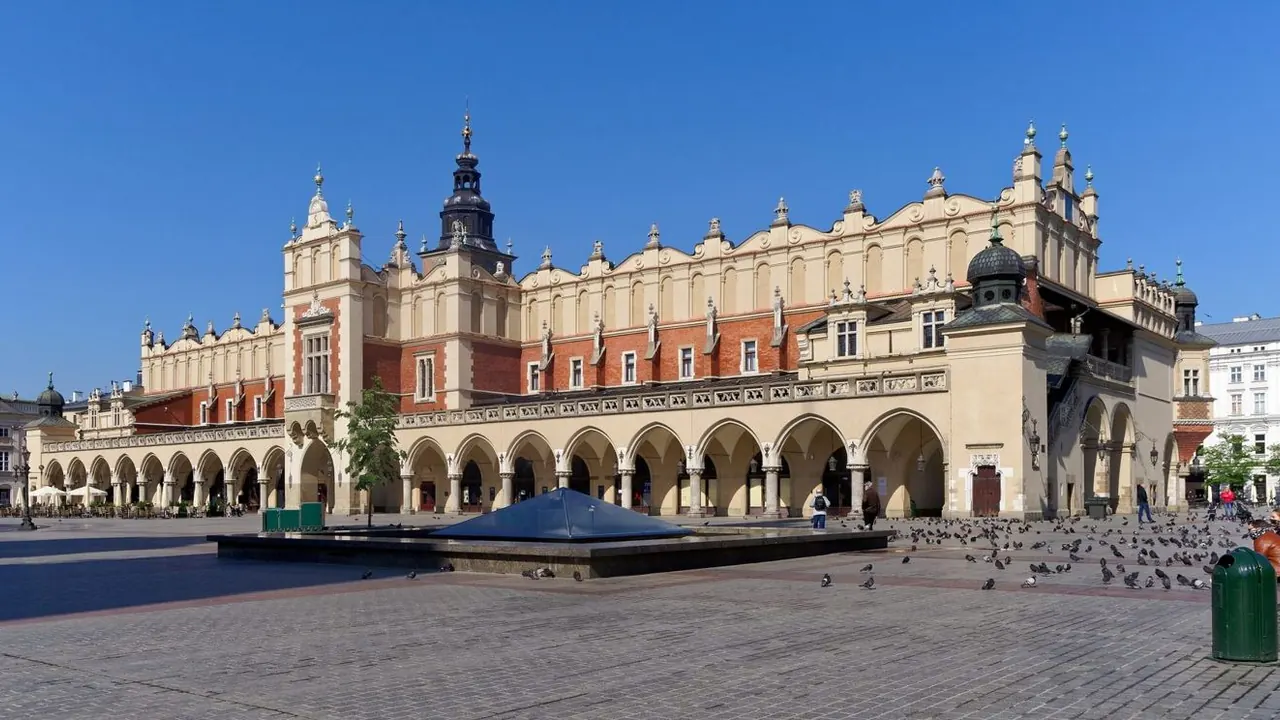
The Cloth Hall on the Main Square
- Culture & sights77
- Day trips76
- Getting around74
Photo: Jakub Hałun, CC BY-SA 4.0, cropped
Match
58
Every category weighted equally
- Beach & sun51
- Culture & arts64
- Food & nightlife59
- Family trip57
- Outdoors58
- Relax & unwind51
- Shopping & style59
- On a budget59
Krakow in twelve categories
Our verdict on each, scored 0 to 100 against the same fixed benchmark cities, so a score means the same thing on every page.
Beaches & swimming. Scores 9 out of 100.
Food & drink. Scores 55 out of 100.
Culture & sights. Scores 77 out of 100.
Nightlife. Scores 68 out of 100.
Nature & outdoors. Scores 62 out of 100.
Day trips. Scores 76 out of 100.
Good for families. Scores 58 out of 100.
Getting around. Scores 74 out of 100.
Shopping & style. Scores 48 out of 100.
Affordability. Scores 72 out of 100.
Live music & performing arts. Scores 55 out of 100.
Wellness & relaxation. Scores 36 out of 100.
Krakow category by category
Beaches & swimming
9Krakow is an inland city, many hours from the Baltic coast, so beach life is not part of a visit here. The nearest thing to it is Zakrzowek, a flooded limestone quarry a short tram ride south-west of the centre. Its clear turquoise water and cliffs make a striking setting, and swimming there is limited to fenced bathing areas in summer. Some locals also cool off along the grassy Vistula banks, but the river is for sitting beside, not swimming in. For real swimming, visitors use pools or the large indoor water park.
Food & drink
55Eating in Krakow centres on generous Polish home cooking: pierogi with every filling, zurek sour rye soup served in bread, roast duck, potato pancakes and cabbage dishes. Old-style milk bars still serve cheap canteen lunches, and the round braided obwarzanek bread sold from street carts is a local signature. In Kazimierz, Plac Nowy's round market hall is the place for zapiekanki, the long open toasted baguettes eaten late at night.
The drinking side is good: flavoured vodkas, a solid craft beer scene and cosy cafés in the cellars and courtyards of the Old Town. Stary Kleparz is the main produce market. The fine-dining tier is small, and the restaurants lining the Main Square trade more on the view than the cooking.
Culture & sights
77Krakow came through the Second World War largely undamaged, and its medieval centre is one of the best preserved in Central Europe. The Main Market Square is among the largest in Europe, with the Renaissance Cloth Hall at its heart and St Mary's Basilica beside it. The basilica holds Veit Stoss's carved wooden altarpiece, and a bugle call sounds from its tower every hour. Wawel Hill, with its royal castle and the cathedral where Polish kings were crowned and buried, rises over the Vistula.
Kazimierz, the historic Jewish quarter, keeps its synagogues and cemeteries. Across the river, the Schindler Factory museum tells the story of the city under occupation. The Czartoryski Museum holds Leonardo's Lady with an Ermine, and the medieval street level is shown beneath the square. Most of it can be covered in two or three days.
Nightlife
68Krakow goes out late and often, helped by a large student population. The Old Town is full of brick-vaulted cellar bars under the burgher houses, and many of them run well past midnight. Kazimierz has the most character: shabby-chic bars with mismatched furniture, vodka bars and crowded courtyards around Plac Nowy, where the night tends to end with a zapiekanka.
There are clubs, mostly mainstream with a smaller electronic scene, and drinks are cheap enough that bar-hopping is the main way to spend an evening. On weekends parts of the Old Town fill with stag and hen groups. Visitors who would rather avoid them usually head to Kazimierz or Podgorze across the river.
Nature & outdoors
62The Old Town is ringed by the Planty, a strip of park laid out where the city walls once stood. To the west, the open meadow of Blonia leads to the Wolski Forest and the Kosciuszko Mound, which gives views towards the mountains on clear days. Cycling paths follow the Vistula in both directions.
Ojcow National Park, a small limestone valley with rock pinnacles, caves and castle ruins, is about half an hour north. The Tatra Mountains, with real alpine hiking, lie about two hours south. The Pieniny gorge, where visitors raft the Dunajec in wooden boats, is a similar distance away. Both are long days rather than easy outings, so the landscape close to the city is gentle.
Day trips
76Two of the most visited sites in Poland are within easy reach. The Wieliczka Salt Mine, about half an hour away, is a maze of chambers and chapels carved entirely from salt, including a vast underground church. The Auschwitz-Birkenau memorial and museum lies about an hour and a half west, a sobering visit that most travellers set aside a full day for.
Beyond these, Zakopane is the wooden-villa mountain town at the foot of the Tatras, about two hours by road. Kalwaria Zebrzydowska is a UNESCO-listed pilgrimage park, and Wadowice is the birthplace of Pope John Paul II. Czestochowa's Jasna Gora monastery and the old salt-mining town of Bochnia add more. Wooden churches dot the surrounding countryside.
Good for families
58Krakow is safe, compact and relaxed, and the car-free Main Square with its horse carriages, pigeons and street performers keeps children busy. The dragon legend at Wawel Hill helps too. A metal dragon by the river breathes fire at intervals, and the Dragon's Den cave can be explored. The zoo sits in the Wolski Forest, and a large indoor water park is open all year.
The Wieliczka salt mine works well for older children. Energylandia, one of the biggest amusement parks in Central Europe, is about an hour away by car. The downsides are cobbles that are hard on pushchairs and heavy subject matter at several major sights, which is not suitable for younger children.
Getting around
74Most of what a visitor wants to see sits within a small area. The Old Town, Wawel, Kazimierz and Podgorze are all comfortably walkable from one another, and much of the centre is closed to traffic. Trams cover the rest, with a dense network around the centre and out to Nowa Huta and the zoo area. A train links the airport with the main station.
There is no metro, and trams can be slowed by roadworks and traffic. Day trips to Wieliczka and Auschwitz are easy by train, bus or minibus without a car. Cobbled streets make for slow going with wheeled luggage.
Shopping & style
48The Cloth Hall in the middle of the Main Square has traded since the Middle Ages, and its stalls still sell amber jewellery, carved wooden boxes, embroidered linen and lace. Boleslawiec stoneware pottery with its blue patterns is the classic Polish item to take home. Florianska and Grodzka streets have mainstream fashion mixed with souvenir shops, and a large shopping mall stands next to the main station.
Kazimierz has a few vintage, design and antique shops, and Plac Nowy has a weekend flea market. Luxury brands and serious fashion shopping are largely missing, and much of what is sold around the square is aimed at tourists.
Affordability
72Krakow is one of the cheaper well-known cities in the European Union for a visitor. Beer and vodka cost little, milk bars and pierogi places keep lunch inexpensive, and trams and city museums are cheap. Mid-range hotels and apartments are reasonably priced for most of the year.
Prices are highest around the Main Square, where restaurants and bars charge for the location, and on summer weekends and around Christmas markets when rooms fill up. Moving a few streets away, or into Kazimierz and Podgorze, brings costs down noticeably. Organised day trips to the salt mine and Auschwitz add up faster than independent travel by train or bus.
Live music & performing arts
55Krakow's theatre tradition is serious, rooted in the Stary Teatr and the experimental legacy of Tadeusz Kantor, but almost all of it is in Polish. For most visitors, music is the way in. The Krakow Philharmonic and the city opera have regular seasons, and chamber recitals of Chopin and other favourites are held in churches and palaces around the Old Town most evenings.
Jazz has a long history here, and several brick cellar clubs host live sets through the week. Klezmer concerts in Kazimierz are common, and the summer Jewish Culture Festival ends in a big open-air concert on Szeroka Street. Large touring productions are less frequent than in bigger capitals.
Wellness & relaxation
36Krakow has no bathing culture of its own. Wellness here means hotel spas, massage studios and the large indoor water park with its saunas. The Wieliczka mine runs underground salt-air therapy sessions, an unusual way to spend a slow few hours. The thermal pools of the Podhale region near Zakopane are about two hours south, and the water is naturally hot.
The city itself is calm to unwind in when you step away from the busiest streets. Visitors can walk the Planty under the trees, sit on the Vistula banks below Wawel, or linger in an Old Town café with cake and coffee. Weekend crowds on the Main Square are the main thing to avoid.
When should you go?
Pick a month to see what it is like. The climate figures are measured averages, not a forecast.
Krakow in July
Daytime high, °C
Rainfall in the month, mm
The whole year
Shaded against this city’s own year: the deepest cell is its best month for that figure and the palest its weakest.
Temperature and rainfall are climate normals, averaged over the years shown. Krakow: 1991-2020 normals, Krakow (10.1 km from centre).
Before you go
| Measure | Krakow |
|---|---|
| Official language | Polish |
| Currency | Zloty (PLN) |
| Sockets | CE50 Hz |
| Driving side | Right |
| Time zone | UTC+1, UTC+2 in summer |
| Emergency number | 112 |
| Elevation | 219 m |
| Main airport | Kraków John Paul II International Airport (KRK)11 km from centre132 non-stop destinations |
| Public holidays this year | 14 days |
By the numbers
| Measure | Krakow |
|---|---|
| City population | 804,237 |
| People per km² | 2,459 |
| Museums within 10 km | 113 |
| UNESCO World Heritage sites within 50 km | 4 |
Compare Krakow with
Every comparison with a written verdict behind it.