United States
Baltimore
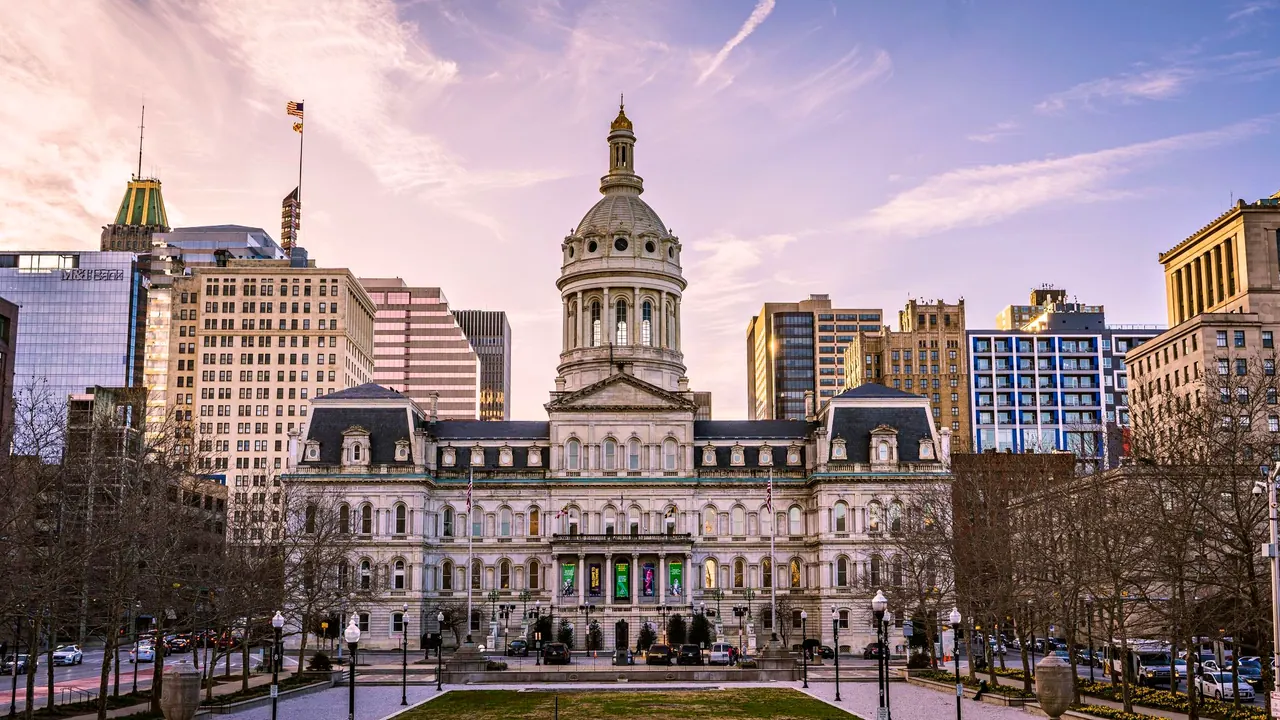
City Hall and the skyline
- Day trips80
- Culture & sights62
- Families62
Photo: Styves Exantus, Pexels License
Match
47
Every category weighted equally
- Beach & sun43
- Culture & arts52
- Food & nightlife47
- Family trip48
- Outdoors51
- Relax & unwind43
- Shopping & style47
- On a budget47
Baltimore in twelve categories
Our verdict on each, scored 0 to 100 against the same fixed benchmark cities, so a score means the same thing on every page.
Beaches & swimming. Scores 22 out of 100.
Food & drink. Scores 58 out of 100.
Culture & sights. Scores 62 out of 100.
Nightlife. Scores 48 out of 100.
Nature & outdoors. Scores 52 out of 100.
Day trips. Scores 80 out of 100.
Good for families. Scores 62 out of 100.
Getting around. Scores 40 out of 100.
Shopping & style. Scores 32 out of 100.
Affordability. Scores 40 out of 100.
Live music & performing arts. Scores 55 out of 100.
Wellness & relaxation. Scores 18 out of 100.
Baltimore category by category
Beaches & swimming
22Baltimore sits on a tidal arm of the Chesapeake Bay, but this is a working harbour, not a place to swim. The nearest proper beach is Sandy Point State Park, about forty minutes' drive towards Annapolis, where a sandy strip faces the Bay Bridge and the water reaches about 27°C in August. It is pleasant for a family afternoon, but the bay is brackish, sea nettles drift in during high summer and swimming is sometimes closed after heavy rain.
The Atlantic surf beaches of the Maryland and Delaware coast are roughly three hours away, which makes them a separate trip rather than part of a city stay. Anyone who wants beach time should plan for a pool or a different base.
Food & drink
58Eating in Baltimore centres on the blue crab. In summer and early autumn, crab houses cover tables in brown paper and pile on steamed crabs dusted with Old Bay seasoning, eaten with mallets and plenty of beer. Crab cakes, mostly lump meat with little filler, are the year-round version. Lexington Market, one of the oldest continuously operating markets in the country, and the Cross Street and Broadway market halls sell oysters, coddies and other local snacks.
The rest of the scene happens neighbourhood by neighbourhood: red-sauce Italian restaurants and pastry shops in Little Italy, pubs serving seafood in Fells Point and Canton, pit beef stands, and a respectable group of chef-led restaurants in Hampden and Harbor East. The city's cooking has character, but it is not deep in range.
Culture & sights
62Baltimore's sights are stronger than many visitors expect. The Baltimore Museum of Art holds the Cone Collection, one of the largest groups of Matisse works anywhere, and admission is free, as it is at the Walters Art Museum, whose holdings run from Egyptian antiquities to Fabergé. Fort McHenry, where the defence against British bombardment in 1814 inspired the national anthem, stands at the tip of the harbour. The B&O Railroad Museum occupies the roundhouse where American railroading began.
The historic fabric is in the streets: the cobbles and brick warehouses of Fells Point, the grand townhouses around the Washington Monument in Mount Vernon, and miles of marble-stooped rowhouses. The Inner Harbor keeps historic ships, including the sloop-of-war USS Constellation, and the American Visionary Art Museum shows self-taught artists. It is a city for two or three good days of sightseeing.
Nightlife
48A night out in Baltimore means bars, not clubs. Fells Point has the oldest and densest cluster, with taverns in centuries-old buildings around the cobbled square by the water, and weekends there fill with students and young locals. Federal Hill, above the harbour, is the sports-bar and rooftop district, at its loudest after Orioles and Ravens games, while Canton's square is a little calmer. Station North and Mount Vernon have dive bars and a more artistic crowd.
The last call is at 2am and the club scene is small. Away from the busy streets, parts of the city are quiet and best crossed by taxi after dark. It is a good bar town for a few evenings, not a reason to come.
Nature & outdoors
52The countryside around Baltimore is gentle and green rather than dramatic. Patapsco Valley State Park begins at the city's south-western edge, with wooded river gorges, mountain-bike trails and a swinging bridge, and the Gunpowder Falls valley to the north has trout streams and quiet hiking along an old rail trail. Inside the city, Gwynns Falls and Leakin Park make up one of the largest urban forests in the country.
The water is the other outlet: kayaks and paddleboards on the harbour, and sailing out of Annapolis on the wide, sheltered Chesapeake, where the creeks and marshes hold herons, ospreys and bald eagles. The Appalachian Trail and the Catoctin and Blue Ridge hills are about an hour and a half to the west. Humid summers make hiking hard work, and spring and autumn are the seasons for it.
Day trips
80Baltimore's location is one of its best assets. Washington DC is about an hour away by commuter or intercity train, close enough for a full day among the Smithsonian museums, the monuments and the Capitol. Philadelphia, with Independence Hall and its old city, is a little over an hour north by train. Annapolis, the Maryland capital, is a well-preserved colonial port and home to the Naval Academy, about forty-five minutes by car.
By car there is more. Gettysburg's battlefield is about an hour and a quarter away, Harpers Ferry sits where two rivers meet, with its historic armoury town, and the small mill town of Ellicott City is twenty minutes out. Across the Bay Bridge, the Eastern Shore has maritime villages such as St Michaels. Most of these are best reached by car.
Good for families
62The Inner Harbor is built for a family day. The National Aquarium is one of the largest in the country, with a tropical rainforest under its glass pyramid, a ring-shaped tank where sharks circle past, and a coral reef exhibit that children can follow down a spiral ramp. The Maryland Science Center and the Port Discovery children's museum are a short walk away, and paddle boats on the harbour and the decks of the historic ships fill the gaps between them.
Further out, the Maryland Zoo sits in the parkland of Druid Hill, and the hall of old locomotives at the B&O Railroad Museum suits younger children who like trains. The ramparts and cannon at Fort McHenry work well for school-age children. The attractions cluster around the water, which makes the first days easy, but the city beyond the harbour is uneven, summers are hot and humid, and most families move between areas by car or taxi.
Getting around
40The core of Baltimore is compact. The Inner Harbor, Fells Point, Federal Hill, Harbor East and Little Italy are within walking distance of each other along a waterfront promenade, and water taxis cross between the piers and Fort McHenry, which is the most pleasant way to get around in fine weather. Mount Vernon's museums are a fifteen-minute walk uphill.
Beyond that, the transit network thins out. There is one metro line and one light rail line, useful mainly for the airport, the stadiums and Penn Station, while Hampden, the art museum and the zoo need a bus, a taxi or a car. Rail links to Washington and Philadelphia are excellent. A car is not essential for a harbour-focused stay, but it helps for most else.
Shopping & style
32Shopping is not a reason to visit Baltimore. The most characterful strip is 36th Street in Hampden, known locally as the Avenue, with vintage clothing, kitsch, local art and small boutiques in a neighbourhood that plays up its working-class Baltimore identity. Fells Point has antique shops, record stores and gift shops on its old streets, and the market halls sell crab mallets, Old Bay souvenirs and local food to take home.
There is no luxury street or major department store in the city, and for chain fashion residents go to the suburban malls in Towson or Columbia. A visitor will find some interesting afternoons of browsing, but not much more.
Affordability
40Baltimore is one of the more affordable cities on the American East Coast, noticeably cheaper for hotels than Washington or New York, and the Baltimore Museum of Art and the Walters charge no admission. Many people stay here when visiting the capital because of this.
It is still an American city in price terms. Restaurant meals with tax and tip add up, a crab feast is a treat rather than a cheap meal, and the waterfront hotels around the harbour charge accordingly. Taxis and ride-hailing, which most visitors use more than they expect, raise the daily cost further.
Live music & performing arts
55Baltimore has a performing arts scene of its own. The Baltimore Symphony Orchestra plays a full season at the Meyerhoff Symphony Hall, and the Peabody Institute, one of the oldest conservatories in the country, holds frequent student and faculty concerts in Mount Vernon, many of them free. Touring Broadway productions come to the restored Hippodrome Theatre, and Center Stage and Everyman Theatre stage professional repertory work.
The live music circuit leans towards indie, punk and experimental music in small clubs around Station North, along with mid-sized rock venues near the harbour and a long jazz history on Pennsylvania Avenue. There is no resident opera of note, and the deepest programming is in autumn through spring.
Wellness & relaxation
18Baltimore has no bathing tradition and little to offer for a restful stay. Wellness means the spas in the larger harbour hotels and a scattering of day spas and yoga studios in neighbourhoods such as Harbor East and Hampden. The city's pace is gritty and urban rather than restorative.
The calmest moments are a morning walk along the harbour promenade, an hour under the trees of Druid Hill Park or a quiet visit to the Walters galleries. Visitors who want to unwind usually head out of town to the Eastern Shore.
When should you go?
Pick a month to see what it is like. The climate figures are measured averages, not a forecast.
Baltimore in July
Daytime high, °C
Rainfall in the month, mm
The whole year
Shaded against this city’s own year: the deepest cell is its best month for that figure and the palest its weakest.
Temperature and rainfall are climate normals, averaged over the years shown. Baltimore: 1991-2020 (sunshine 1971-2000) normals, Baltimore (0.4 km from centre).
Before you go
| Measure | Baltimore |
|---|---|
| Currency | US Dollar (USD) |
| Sockets | AB120 V, 60 Hz |
| Driving side | Right |
| Time zone | UTC-5, UTC-4 in summer |
| Emergency number | 911 |
| Elevation | 10 m |
| Main airport | Baltimore/Washington International Thurgood Marshall Airport (BWI)13 km from centre89 non-stop destinations |
| Public holidays this year | 12 days |
By the numbers
| Measure | Baltimore |
|---|---|
| City population | 585,708 |
| People per km² | 2,457 |
| Museums within 10 km | 27 |
| UNESCO World Heritage sites within 50 km | 0 |
| Swim season, months above 21 °C | 3 months |
Compare Baltimore with
Every comparison with a written verdict behind it.
- Asheville
- Atlanta
- Atlantic City
- Bethany Beach
- Boston
- Charleston
- Chicago
- Daytona Beach
- Gatlinburg
- Myrtle Beach
- Nashville
- New York
- Newport, Rhode Island
- Niagara Falls
- Ocean City, Maryland
- Philadelphia
- Pigeon Forge
- Portland, Maine
- Rehoboth Beach
- Savannah
- St. Augustine
- Virginia Beach
- Washington DC
- Wilmington