India
Varanasi
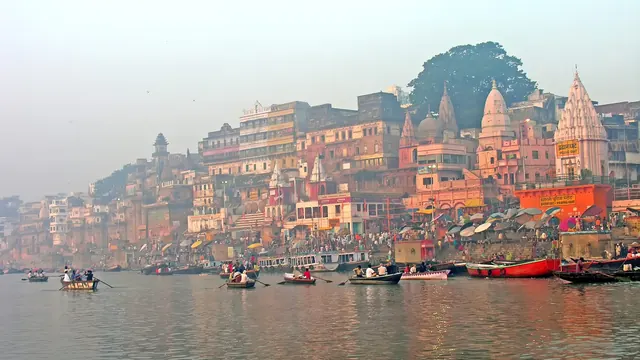
Photo: Dennis G. Jarvis, CC BY-SA 2.0, cropped
Match
40
- Beach & sun35
- Culture & arts49
- Food & nightlife44
- Family trip37
- Outdoors38
- Relax & unwind38
- Shopping & style44
- On a budget46
Varanasi in twelve categories
Our verdict on each, scored 0 to 100 against the same fixed benchmark cities, so a score means the same thing on every page.
Beaches & swimming. Scores 4 out of 100.
4Food & drink. Scores 55 out of 100.
55Culture & sights. Scores 80 out of 100.
80Nightlife. Scores 10 out of 100.
10Nature & outdoors. Scores 18 out of 100.
18Day trips. Scores 42 out of 100.
42Good for families. Scores 5 out of 100.
5Getting around. Scores 28 out of 100.
28Shopping & style. Scores 55 out of 100.
55Affordability. Scores 92 out of 100.
92Live music & performing arts. Scores 58 out of 100.
58Wellness & relaxation. Scores 30 out of 100.
30Varanasi category by category
Beaches & swimming4
Varanasi is a river city hundreds of kilometres from any coast, and there is no swimming here in the vacation sense. Pilgrims take ritual dips in the Ganges from the ghats at dawn, but the water is badly polluted and the current is strong, so it is not water a visitor should swim in. If you want a swim, you will need a hotel pool, and only a few of the larger hotels away from the old city have one.
Food & drink55
Varanasi eats on the street and eats vegetarian. Mornings start with kachori and spiced potato sabzi fried in the lanes of the old city, followed by jalebi. Later come tamatar chaat, thick lassi served in clay cups that are smashed after use, and thandai. In winter there is malaiyo, a saffron milk foam that is whisked overnight and sold only at dawn. Banarasi paan, rolled to order at counters all over Godowlia and the Chowk, is a ritual in itself.
The limits are real, though. Near the ghats and temples food is overwhelmingly vegetarian, alcohol is hard to find, and the cafés along Assi Ghat mostly serve backpacker menus. Fine dining is limited to a few hotel restaurants. Come for a handful of excellent street snacks and sweet shops, not for range.
Culture & sights80
Varanasi is one of the oldest continuously inhabited cities on earth, and its great sight is the riverfront itself. More than eighty ghats run for several kilometres along the curve of the Ganges, each with its own stone steps, palaces and shrines. Pilgrims bathe, priests perform rites, and cremations burn day and night at Manikarnika and Harishchandra. Behind the ghats, the old city is a maze of narrow lanes packed with small shrines. It leads to the gold-spired Kashi Vishwanath temple and its broad corridor down to the river.
Other sights include the Durga and Sankat Mochan temples, the Mughal-era Alamgir mosque above Panchganga Ghat, and Ramnagar Fort across the river. The Banaras Hindu University campus has the Bharat Kala Bhavan museum of miniatures and textiles. Museums are not the city's strength, and some inner sanctums are closed to non-Hindus. What makes the place is watching daily ritual on a scale that is hard to find anywhere else.
Nightlife10
Varanasi has almost no nightlife. It is a holy city, and alcohol is scarce and frowned upon around the ghats and the old city. Evenings revolve around the riverside aarti, a rooftop dinner and an early night, because the city wakes before dawn. Drinking means a licensed shop or a bar in one of the larger hotels in the cantonment area. The Assi Ghat cafés stay sociable into the evening over chai and music, but nothing runs late.
Nature & outdoors18
The landscape here is the river. Rowing boats at sunrise along the crescent of ghats, and walks or camel rides on the wide sandbank opposite the city, are the main ways to be outdoors. Around the city lies the flat, farmed Gangetic plain. The nearest real scenery is the Vindhya hills to the south, with the Chandraprabha wildlife sanctuary and its seasonal waterfalls about two hours by road and at their best after the monsoon. Summers are fiercely hot and the air is often hazy in winter, so outdoor activity mostly fits into early mornings.
Day trips42
The essential outing is Sarnath, about half an hour from the old city. This is where the Buddha gave his first sermon, and it has the great Dhamek Stupa, monastery ruins, temples built by Buddhist nations and a museum holding the Ashokan lion capital. Chunar Fort, on a rock above the Ganges about an hour away, makes a pleasant half day. Jaunpur, around an hour and a half by road, has a remarkable group of fifteenth-century mosques that few foreign visitors see.
After that the list thins out. Prayagraj, where the Ganges and Yamuna meet, is a long day at around two and a half to three hours. Bodh Gaya and Khajuraho are too far for a return trip in a day.
Good for families5
Varanasi is extraordinary for adults and very hard going with children. The old city lanes are narrow and crowded, with cows, motorbikes and open drains. Cremations burn in plain view on the ghats, and traffic in the newer city is chaotic. Hygiene needs constant care, and summer heat is extreme. Nothing here is made for children: no parks worth the trip, no zoos or museums designed for them, and few calm spaces. Families who do come tend to keep it to a short stay, with a boat ride at dawn, a visit to Sarnath and a comfortable hotel away from the ghats.
Getting around28
The best way to see Varanasi is on foot along the ghats, which link up for several kilometres beside the river from Assi in the south to Raj Ghat in the north. Rowing and motor boats run the same stretch from the water. Away from the river things get harder. The old city is a tangle of lanes too narrow for cars, easy to get lost in and shared with cattle and motorbikes. The newer city has no metro and heavy, noisy traffic. Visitors use cycle rickshaws, e-rickshaws and autos for anything further, agreeing the fare or booking through an app, and taxis for Sarnath and the airport.
Shopping & style55
Varanasi has one great reason to shop: Banarasi silk. The city's woven brocade saris and fabrics, worked with gold and silver thread, are among the most prized textiles in India. They can be bought straight from weaving workshops in the Muslim weavers' quarters or from the silk houses around Godowlia and the Chowk. Around it sit other traditional crafts: brass and copper ritual ware, painted wooden toys, glass beads, rudraksha malas and musical instruments.
The Vishwanath Gali and the lanes off Dashashwamedh are packed and lively, but much of their stock is devotional goods and souvenirs. Commission-driven touts often steer visitors to particular silk shops. Beyond the crafts there is little to look for.
Affordability92
Varanasi is one of the cheapest places to travel anywhere. Simple guesthouses on the ghats, street snacks, chai, rickshaw rides and boat trips cost very little, and most of the city's great sights, the ghats and the aarti, are free. Spending goes up only if you choose one of the restored palace hotels on the river or hire private guides and boats. Silk is the main temptation for the wallet, and haggling over it is normal.
Live music & performing arts58
Banaras is one of the great homes of Hindustani classical music. It has its own gharanas of vocal, tabla and dance, and a long line of famous musicians. A visitor finds this tradition in small evening recitals in music schools and guesthouse rooms, and above all at the festivals. The Sankat Mochan Sangeet Samaroh in spring brings top classical performers to play through the night in a temple courtyard. The Dhrupad Mela takes place on Tulsi Ghat, and the Ganga Mahotsav comes in autumn.
Every evening, the Ganga aarti at Dashashwamedh and Assi is a staged ritual of fire, bells and chant that thousands watch from the steps and from boats. The month-long Ramlila at Ramnagar is a remarkable traditional performance. Theatre and Western concerts are almost absent.
Wellness & relaxation30
Varanasi draws seekers more than spa-goers. Yoga classes, meditation teachers and Ayurvedic massage are easy to find around Assi Ghat. Watching dawn from a quiet ghat or a slow boat can be deeply calming. But the river bathing here is religious ritual, not a wellness tradition visitors can share, and the spa offer is limited to a few hotels. The rest of the city is loud, crowded and emotionally intense. Many people find a stay here moving but tiring, so plan rest into the day rather than expecting the place to provide it.
When should you go?
Pick a month to see what it is like. The climate figures are measured averages, not a forecast.
| July | Varanasi |
|---|---|
| Daytime high | 35 °C |
| Night-time low | 27 °C |
| Rainfall in the month | 249 mm |
| Daylight | 14 hours a day |
The whole year
Shaded against this city’s own year: the deepest cell is its best month for that figure and the palest its weakest.
Where the figures come from
Varanasi has no weather station within reach, so its figures come from a gridded climate model rather than a measured record, and read a broad area rather than the city itself.
Temperature and rainfall are climate normals, averaged over the years shown. Varanasi: 2001-2020 normals, NASA POWER reanalysis grid, no weather station within 90 km.
Getting there
| Flying from | Varanasi |
|---|---|
| MumbaiBOM, NMI | 2 h 10 m €147-164 VNS · 21 km |
| New DelhiDEL | 1 h 25 m €121-127 VNS · 21 km |
| BengaluruBLR | 2 h 25 m no fares VNS · 21 km |
| HyderabadHYD | 1 h 50 m no fares VNS · 21 km |
| BangkokBKK, DMK | 3 h 20 m €433-468 1 stop VNS · 21 km |
| SharjahSHJ | 3 h 55 m €368-384 VNS · 21 km |
| ChennaiMAA | 2 h 20 m no fares VNS · 21 km |
| KathmanduKTM | 1 h 5 m no fares VNS · 21 km |
| AhmedabadAMD | 1 h 55 m no fares VNS · 21 km |
| KolkataCCU | 1 h 25 m no fares VNS · 21 km |
The busiest departure cities for Varanasi, with a place kept for each other part of the world. Busiest means arriving passengers where an official count exists, and where none does, the number of non-stop services flown: official route statistics are published by the European reporting countries and by nobody else, so a table ranked on them alone would offer a reader in New York or Tokyo ten European cities. Flying times are estimated from the distance between airports, and every row is a city flown non-stop. Where the typical offer connects anyway, the stops are shown. Under each figure is the airport the flight lands at and how far that is from the centre, because the nearest airport is not always the one a route is flown to. Typical return fares for 2026-10 to 2026-12, cached market data up to 7 days old. The figure is the middle half of the offers found, so a single price means they agreed and a range means they did not; for a typical route that middle half spans about a quarter of the median, and for the least settled routes rather more than the median itself.
Before you go
| Measure | Varanasi |
|---|---|
| Official language | Hindi, English |
| Currency | Indian Rupee (INR) |
| Sockets | CM230 V, 50 Hz |
| Driving side | Left |
| Time zone | UTC+5:30 |
| Emergency number | 108 or 112 |
| Elevation | 76 m |
| Main airport | Lal Bahadur Shastri International Airport (VNS)21 km from centre16 non-stop destinations |
By the numbers
| Measure | Varanasi |
|---|---|
| City population | 1,198,491 |
| People per km² | 14,598 |
| Museums within 10 km | 2 |
| UNESCO World Heritage sites within 50 km | 1 |
Compare Varanasi with
Every comparison with a written verdict behind it.