Japan
Takayama
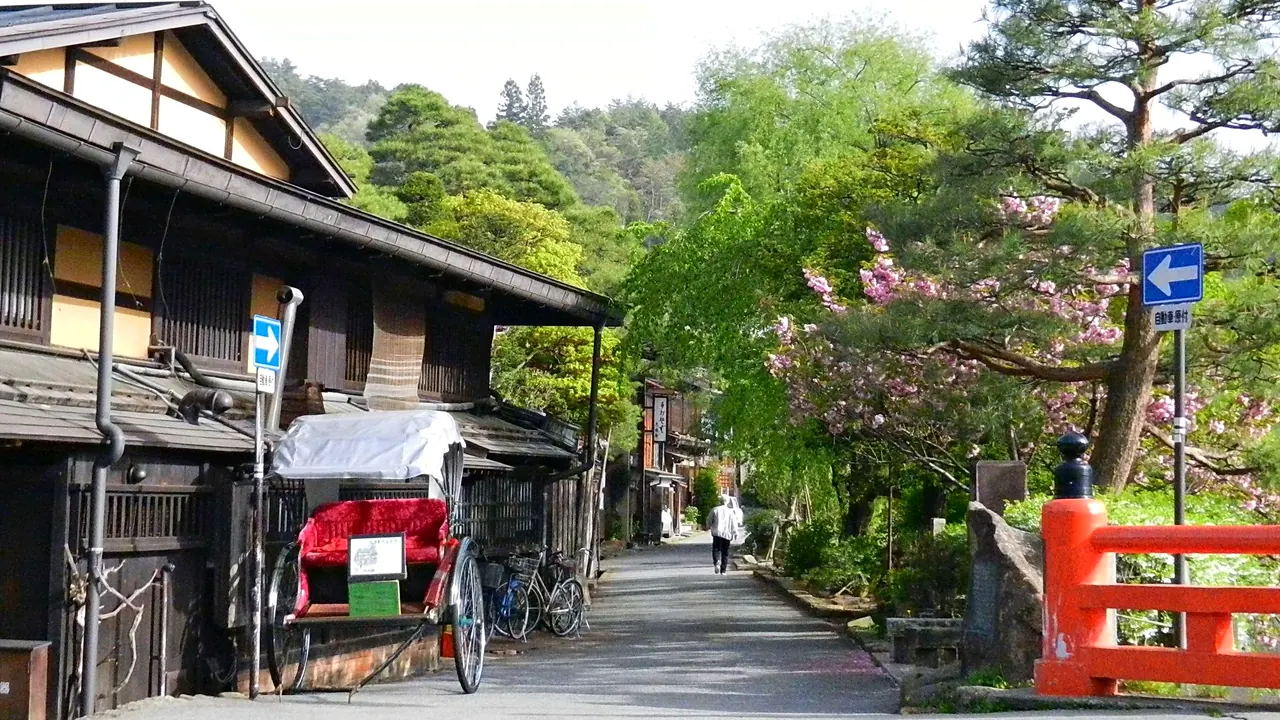
The Nakabashi bridge with old wooden houses and blossom
- Wellness & relaxation76
- Nature & outdoors74
- Day trips70
Photo: lienyuan lee, CC BY 3.0, cropped
Match
47
Every category weighted equally
- Beach & sun45
- Culture & arts49
- Food & nightlife41
- Family trip50
- Outdoors54
- Relax & unwind51
- Shopping & style46
- On a budget47
Takayama in twelve categories
Our verdict on each, scored 0 to 100 against the same fixed benchmark cities, so a score means the same thing on every page.
Beaches & swimming. Scores 5 out of 100.
Food & drink. Scores 45 out of 100.
Culture & sights. Scores 58 out of 100.
Nightlife. Scores 12 out of 100.
Nature & outdoors. Scores 74 out of 100.
Day trips. Scores 70 out of 100.
Good for families. Scores 45 out of 100.
Getting around. Scores 70 out of 100.
Shopping & style. Scores 40 out of 100.
Affordability. Scores 52 out of 100.
Live music & performing arts. Scores 15 out of 100.
Wellness & relaxation. Scores 76 out of 100.
Takayama category by category
Beaches & swimming
5Takayama sits in a basin in the Hida mountains, well inland, and the nearest coast at Toyama Bay is roughly two hours away. Nobody comes here to swim. In summer the closest thing to bathing is a soak in a hot spring, and a visitor who wants the sea should plan a separate stop elsewhere.
Food & drink
45Takayama eats like a mountain town that knows what it is good at. Hida beef turns up everywhere, grilled on a magnolia leaf with hoba miso, seared on skewers from street stalls in the old town, or served as sushi on rice crackers. The local soy-based ramen, mitarashi dango glazed with soy rather than sweet sauce, and pickles from the morning markets by the Miyagawa river fill out the everyday side.
Sake is the other draw: several old breweries in the merchant quarter, marked by cedar balls over the door, offer tastings. Beyond these specialities the range is narrow, with few international options and a dining scene that winds down early. Two or three days of eating well is easy; a week starts to repeat.
Culture & sights
58The heart of Takayama is Sanmachi Suji, a few parallel lanes of dark-timbered Edo-period merchant houses, sake breweries and lattice fronts that have survived largely intact. Nearby, Takayama Jinya is the rare surviving example of a feudal government office, with its rice storehouses and interrogation room. The Kusakabe and Yoshijima houses show the craftsmanship of wealthy merchant families in their beams and light.
On the edge of town, Hida Folk Village gathers thatched gassho farmhouses on a hillside, and a hall by Sakurayama Hachimangu shrine displays the elaborate festival floats. The Higashiyama walking course links a string of quiet temples, and Hida Kokubunji has a three-storey pagoda in the centre. It is a coherent, atmospheric town best seen in a day or two, not a city of major museums.
Nightlife
12Evenings in Takayama are short and quiet. Most visitors eat at their ryokan, and the old town shuts down once the shops close. A handful of izakaya and small bars around the station and the streets east of the river keep going for a while, good for a beer or a sake after dinner, but there are no clubs and little after eleven. Treat it as a place to rest between busier stops.
Nature & outdoors
74Takayama is a gateway to the Northern Japan Alps. Within about an hour and a half by bus are the Okuhida valleys, where the Shin-Hotaka ropeway lifts visitors to views of peaks near 3,000m, and Kamikochi, a high river valley with flat trails along clear water beneath the Hotaka range. Norikura offers high-altitude walking in summer. In winter, snow covers the region and there is skiing within reach.
The town itself is gentler: the river through the centre, the temple-lined Higashiyama walking course and the wooded hill of Shiroyama park. Autumn colour in the mountains is a highlight. Kamikochi closes for the cold months, and serious hiking needs planning around bus connections rather than a walk out of the door.
Day trips
70The headline trip is Shirakawa-go, about fifty minutes by bus, a village of steep thatched gassho farmhouses listed by UNESCO, especially striking under winter snow. The quieter Gokayama villages share that listing a little further on. Hida-Furukawa, a quarter of an hour by train, is a smaller sister town of white-walled storehouses and canals full of carp.
Gero Onsen, one of Japan's best-known spa towns, is less than an hour south by limited express, and the castle town of Kanazawa, with its garden and samurai and geisha districts, is a little over two hours by bus, best combined as an onward stop. Beyond these, much of what lies around Takayama is mountain country rather than towns.
Good for families
45Takayama is safe, clean and easy to manage, and the flat old town is short walks from the station. Children tend to enjoy the morning markets, the street snacks, the thatched houses of the folk village and the giant festival floats, and in winter there is snow to play in. What it lacks is anything made for them: no zoo, aquarium or theme park, and much of the town is craft shops and old houses that hold young attention only briefly. It suits a day or two within a wider Japan trip with children.
Getting around
70The centre is small and flat: the old town, the Jinya and the markets are all within a fifteen-minute walk of the station, and a circular bus reaches the folk village on the hill. Trains on the JR Takayama line link the town with Gero and Hida-Furukawa, while the bus centre beside the station handles Shirakawa-go, the Okuhida valleys and Kanazawa. Regional buses need some planning around connections and can fill in busy seasons, but a car is never necessary.
Shopping & style
40Shopping in Takayama means local craft. The old merchant lanes sell Shunkei lacquerware with its translucent amber finish, ichii itto-bori carvings cut from a single block of yew, Hida bentwood furniture and sake from the breweries. The red, faceless sarubobo charms are everywhere. The morning markets add pickles, miso and handmade goods. There is little fashion or department-store shopping, and plenty of the old town leans towards souvenirs, but for well-made traditional objects it is rewarding.
Affordability
52Takayama is moderately priced. Simple guesthouses and business hotels near the station are fair value, and ramen, street snacks and market food keep everyday eating cheap. The costs gather around the things many visitors come for: a night in a ryokan with a full multi-course dinner, a proper Hida beef meal, and rooms in the spring and autumn festival weeks, which book out and cost more. Sights are inexpensive, and the town is small enough that transport costs little beyond regional buses.
Live music & performing arts
15Performance in Takayama comes almost entirely from the Takayama Festival, held each spring and autumn, when ornate floats are paraded through town and some stage karakuri, mechanical puppets worked by strings, along with lantern-lit evening processions. It is a remarkable tradition, but outside those days there is no theatre, concert or live-music life to speak of.
Wellness & relaxation
76Takayama sits in Japan's hot-spring heartland, and much of a stay here is about slowing down. Many of the town's ryokan pipe in spring water for their indoor and open-air baths, so a soak before dinner and a yukata evening come with the room. The town itself is quiet, with early nights and morning walks along the river.
The great baths lie just beyond. The Okuhida villages, about an hour away, are known for open-air pools beside mountain rivers, and Gero Onsen, one of the country's most celebrated spa towns, is under an hour by train. There is little in the way of Western-style day spas, but the bathing culture more than makes up for it.
When should you go?
Pick a month to see what it is like. The climate figures are measured averages, not a forecast.
Takayama in July
Daytime high, °C
Rainfall in the month, mm
The whole year
Shaded against this city’s own year: the deepest cell is its best month for that figure and the palest its weakest.
Where the figures come from
Takayama's sunshine is measured 65 km from the centre, at Matsumoto.
Temperature and rainfall are climate normals, averaged over the years shown. Takayama: 1971-2000 (sunshine 1991-2020, rainfall 1981-2010) normals, Takayama (0.5 km from centre).
Before you go
| Measure | Takayama |
|---|---|
| Official language | Japanese |
| Currency | Yen (JPY) |
| Sockets | AB100 V, 50 and 60 Hz depending on the region |
| Driving side | Left |
| Time zone | UTC+9 |
| Emergency number | Police 110, fire 119 |
| Elevation | 573 m |
| Main airport | Chubu Centrair International Airport (NGO)149 km from centre43 non-stop destinations |
| Public holidays this year | 16 days |
By the numbers
| Measure | Takayama |
|---|---|
| City population | 85,199 |
| People per km² | 39 |
| Museums within 10 km | 14 |
| UNESCO World Heritage sites within 50 km | 1 |
Compare Takayama with
Every comparison with a written verdict behind it.