Spain
Valencia
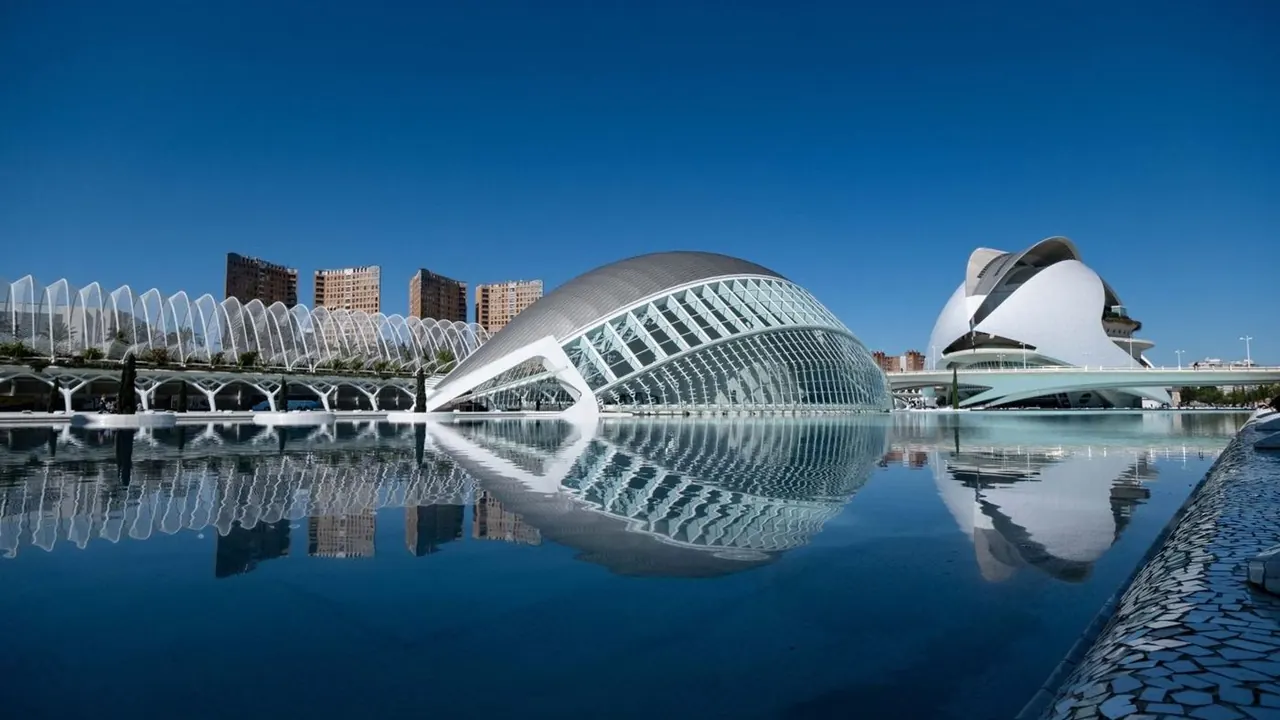
The City of Arts and Sciences
- Beaches78
- Getting around76
- Families75
Photo: Francesco Ungaro, Pexels License
Match
65
Every category weighted equally
- Beach & sun65
- Culture & arts65
- Food & nightlife65
- Family trip67
- Outdoors65
- Relax & unwind63
- Shopping & style65
- On a budget64
Valencia in twelve categories
Our verdict on each, scored 0 to 100 against the same fixed benchmark cities, so a score means the same thing on every page.
Beaches & swimming. Scores 78 out of 100.
Food & drink. Scores 74 out of 100.
Culture & sights. Scores 68 out of 100.
Nightlife. Scores 66 out of 100.
Nature & outdoors. Scores 60 out of 100.
Day trips. Scores 70 out of 100.
Good for families. Scores 75 out of 100.
Getting around. Scores 76 out of 100.
Shopping & style. Scores 57 out of 100.
Affordability. Scores 57 out of 100.
Live music & performing arts. Scores 55 out of 100.
Wellness & relaxation. Scores 42 out of 100.
Valencia category by category
Beaches & swimming
78Valencia has a long, wide band of fine golden sand along its eastern edge. Las Arenas and Malvarrosa are the city beaches, with a promenade and rows of rice restaurants, and Patacona runs on to the north. Tram and bus lines reach them from the centre in about twenty minutes, and there is room to spread out even in high summer. The water is shallow and calm and reaches about 26°C in August, and swimming is comfortable from June into October.
South of the port the shore turns wilder. El Saler and La Devesa lie behind pine woods and dunes inside the Albufera park, quieter and less built up, and easiest to reach by bike or bus. The beach is part of everyday life here, but in a city that also gives you plenty to do away from it.
Food & drink
74This is the home of paella, and rice is the backbone of the local table: paella valenciana with rabbit and chicken, arroz negro, arroz a banda, and fideuà made with noodles. Valencians eat it at lunch, and the best of it comes from the beachfront restaurants at Las Arenas and the villages of the Albufera, where all i pebre, an eel stew, is the other speciality. The Mercado Central, a great modernista hall, is one of the finest food markets in Europe, packed with huerta vegetables, seafood and cured meats.
Horchata, a cold tigernut drink taken with fartons for dipping, is a summer ritual, and the old horchaterías of Alboraya are where people go for it. Ruzafa and the centre have tapas bars, vermouth spots and a serious creative restaurant scene, and the local Valencia and Utiel-Requena wines go with all of it. The range is narrower than in the very largest food capitals.
Culture & sights
68The old town, Ciutat Vella, holds the essentials within a short walk of each other. The Lonja de la Seda is a late Gothic silk exchange with a forest of twisted columns and is on the UNESCO list. The cathedral mixes Romanesque, Gothic and Baroque, keeps a chalice venerated as the Holy Grail, and has the Miguelete bell tower to climb. The Torres de Serranos and Torres de Quart are two massive gates left from the medieval walls, and the Palacio del Marqués de Dos Aguas, with its extravagant alabaster doorway, houses the national ceramics museum.
At the other end of the old riverbed stands the City of Arts and Sciences, a run of white futuristic buildings that is the modern city's emblem. The Museo de Bellas Artes has a strong collection of Spanish painting, and IVAM covers modern art. It is a rewarding city to see over two or three days rather than a week.
Nightlife
66Nights start late and run late, in the Spanish way. Ruzafa is the centre of going out, a grid of streets full of cocktail bars, wine bars and terraces that stay busy well past midnight. El Carmen, in the old town, has rougher, older bars and a student crowd, and the university areas around Benimaclet and Avenida Blasco Ibáñez are cheaper and younger. In summer the action moves towards the sea, to open-air clubs and bars near the port and Malvarrosa that go on until dawn.
The city goes out for Fallas in March, when whole neighbourhoods party in the street for days. For the rest of the year it is a lively, local-feeling scene rather than a famous clubbing destination.
Nature & outdoors
60The Albufera natural park starts about 10km south of the centre: a large freshwater lagoon ringed by rice fields, reed beds and fishing villages, with a big population of herons and other wetland birds. Boat trips at sunset are the classic way to see it. Between the lagoon and the sea the Devesa del Saler is a strip of pine forest and dunes with walking trails. In the city itself, the Turia gardens follow the old riverbed for about 9km, a green corridor for running and cycling, and the flat land and coast make the whole area easy to ride.
For hills you need to drive. The Sierra Calderona is under an hour away, and the limestone gorge at Chulilla, with its hanging bridges and rock climbing, is about an hour inland. Sailing and kitesurfing are possible along the coast.
Day trips
70Sagunto is the easiest outing, about half an hour by train, with a Roman theatre and a long hilltop castle that has layers from the Iberians to the Moors. Xàtiva, a similar distance south, has a twin castle along a ridge above a handsome old town. High-speed trains reach Cuenca in about an hour, with its hanging houses built over a gorge and its UNESCO-listed old town, and Requena and the Utiel-Requena wine country, with cellars dug under the medieval quarter, are about an hour inland.
Up the coast, Peñíscola is a walled castle town on a rock in the sea, about an hour and a half away. To the south, Alicante and the UNESCO palm grove of Elche take nearer two hours, as do the white towns of the Costa Blanca such as Altea.
Good for families
75Valencia is easy with children. The City of Arts and Sciences is the main draw: the Oceanogràfic is a very large aquarium with sharks, belugas and a dolphin show, the Príncipe Felipe science museum is built for hands-on exploring, and the Hemisfèric shows films on a huge domed screen. Bioparc sets African animals in open habitats without visible bars. Running through the middle of the city, the Turia gardens have flat paths for scooters and bikes, sports fields, and Gulliver, a giant playground figure that children clamber all over.
The city beaches are wide, sandy and shallow, which suits small children, and Spanish life is relaxed about children out late at dinner. The centre is flat and compact, though summer afternoons are hot, and there is no big theme park in the city itself.
Getting around
76The old town and the neighbouring districts of Ruzafa and the Ensanche are flat and compact, and you can see most of the historic sights on foot. Valencia is one of the best cycling cities in Spain: the Turia gardens make a car-free route from the centre to the City of Arts and Sciences, bike lanes run across the city, and there is a public bike-share scheme as well as plenty of rental shops.
Metro and tram lines link the centre with the airport, the port and the beaches, and buses fill in the gaps. The network is smaller than in Spain's two biggest cities, and the beaches and the City of Arts and Sciences are a ride or a long walk from the old town. You do not need a car unless you are heading into the hills.
Shopping & style
57The main shopping is in the Ensanche around Calle Colón and Calle Poeta Querol, where the big Spanish chains and international labels sit alongside a run of luxury boutiques and the department store. El Carmen and Ruzafa have independent fashion, vintage and design shops, and the Mercado Central is good for saffron, rice, turrón and cured ham to take home. The Mercado de Colón is an elegant modernista hall that is more a place to eat than to shop.
The local craft to look for is ceramics, from the traditional workshops of Manises near the airport to fine porcelain figurines, along with hand-painted fans and silk. It is pleasant, varied shopping, but rarely the reason for a trip.
Affordability
57Valencia is easy on the budget for a large Western European city. The set lunch menu, with several courses and wine, is a fixture of local life, tapas and beer cost little outside the most touristy squares, and public transport and bike hire are cheap. Hotels in the centre and Ruzafa are reasonably priced for most of the year.
Costs rise in high summer near the beach and sharply during Fallas in March, when rooms fill up months ahead. A proper rice lunch at a beach restaurant and the City of Arts and Sciences attractions are the bigger expenses, though the museums of the old town are cheap or free.
Live music & performing arts
55The Palau de les Arts Reina Sofía, the opera house in the City of Arts and Sciences, gives Valencia a serious opera and ballet season with its own highly regarded orchestra, in a striking building beside the old riverbed. The Palau de la Música, at the edge of the Turia gardens, is the main concert hall and home to the city orchestra, and the historic Teatro Principal and other stages put on Spanish-language theatre and touring shows.
There is a small but steady jazz and live music circuit in the centre and Ruzafa, and every village in the region has its own wind band, a tradition you hear all through Fallas. A visitor can always find something good to attend, but the scene is modest in size.
Wellness & relaxation
42Valencia has no thermal springs or living bathing tradition. The medieval Baños del Almirante survive as a monument to the city's Moorish past, and modern Arab-style bath houses and hotel spas cover the rest. What the city does offer is an easy Mediterranean pace: long lunches, slow evening walks along the seafront promenade, shady paths through the Turia gardens, and a mild climate for most of the year.
It is a calm city to spend time in, without being a destination for spa or retreat travel. Visitors after real pampering will mostly find it in the resort hotels of the coast.
When should you go?
Pick a month to see what it is like. The climate figures are measured averages, not a forecast.
Valencia in July
Daytime high, °C
Rainfall in the month, mm
The whole year
Shaded against this city’s own year: the deepest cell is its best month for that figure and the palest its weakest.
Temperature and rainfall are climate normals, averaged over the years shown. Valencia: 1991-2020 normals, Valencia (1.6 km from centre).
Before you go
| Measure | Valencia |
|---|---|
| Official language | Spanish |
| Currency | Euro (EUR) |
| Sockets | CF230 V, 50 Hz |
| Driving side | Right |
| Time zone | UTC+1, UTC+2 in summer |
| Emergency number | 112 |
| Elevation | 15 m |
| Main airport | Valencia Airport (VLC)9 km from centre109 non-stop destinations |
| Public holidays this year | 13 days |
By the numbers
| Measure | Valencia |
|---|---|
| City population | 840,792 |
| People per km² | 6,242 |
| Museums within 10 km | 45 |
| UNESCO World Heritage sites within 50 km | 2 |
| Swim season, months above 21 °C | 5 months |
Compare Valencia with
Every comparison with a written verdict behind it.