Switzerland
Engelberg
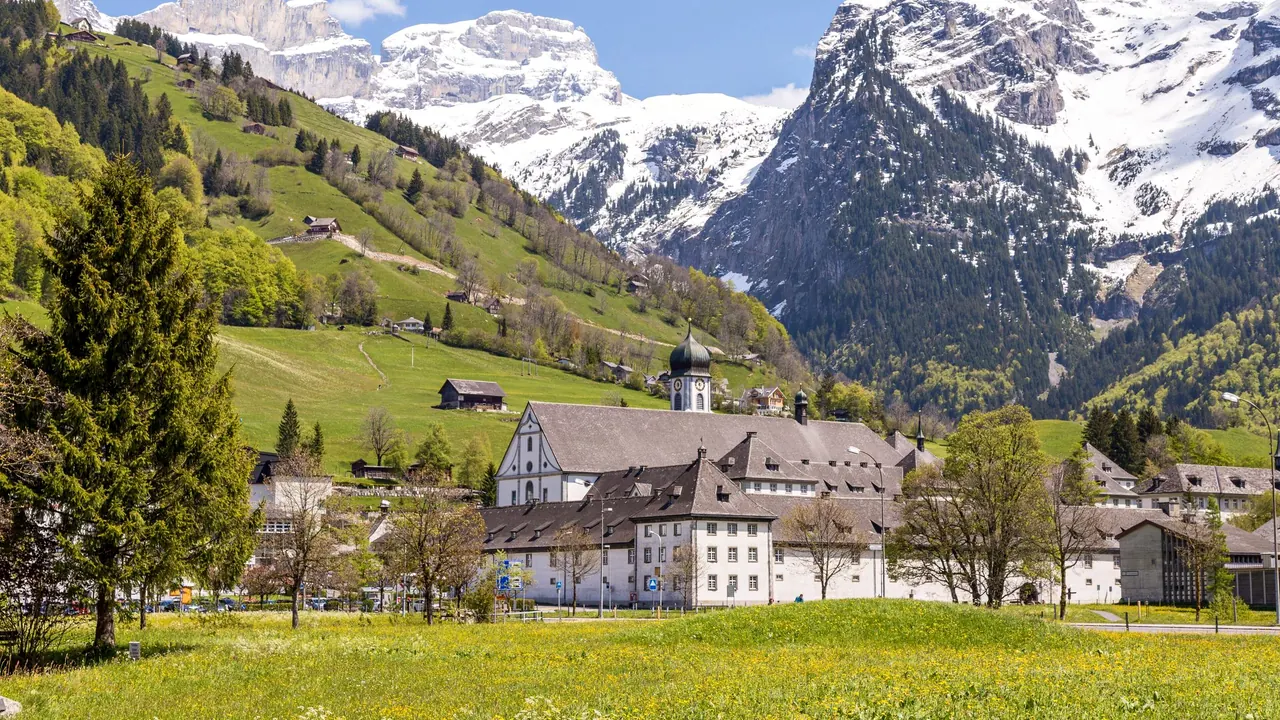
Engelberg Abbey before the mountains
- Nature & outdoors90
- Getting around75
- Day trips66
Photo: JoachimKohler-HB, CC BY-SA 4.0, cropped
Engelberg lies in Swiss Alps, which has its own page.
Match
37
Every category weighted equally
- Beach & sun36
- Culture & arts34
- Food & nightlife29
- Family trip44
- Outdoors48
- Relax & unwind39
- Shopping & style33
- On a budget34
Engelberg in twelve categories
Our verdict on each, scored 0 to 100 against the same fixed benchmark cities, so a score means the same thing on every page.
Beaches & swimming. Scores 17 out of 100.
Food & drink. Scores 22 out of 100.
Culture & sights. Scores 15 out of 100.
Nightlife. Scores 18 out of 100.
Nature & outdoors. Scores 90 out of 100.
Day trips. Scores 66 out of 100.
Good for families. Scores 65 out of 100.
Getting around. Scores 75 out of 100.
Shopping & style. Scores 15 out of 100.
Affordability. Scores 8 out of 100.
Live music & performing arts. Scores 10 out of 100.
Wellness & relaxation. Scores 42 out of 100.
Engelberg category by category
Beaches & swimming
17Engelberg is a high mountain village at the end of a valley, with no beach and no lake that is warm enough for a proper swim. The small mountain lakes above the village, such as the Trübsee, are for looking at and walking round, not for bathing. In midsummer, visitors who want to swim take the train down to Lake Lucerne, about an hour away, where lidos and lakeside meadows offer clear water at around 20°C to 22°C. Otherwise, swimming means the village's indoor sports-centre pool or a hotel pool.
Food & drink
22Eating in Engelberg means hotel dining rooms, wood-panelled village restaurants and mountain huts serving fondue, raclette, rösti and Älplermagronen, the Alpine macaroni with potato, cream and apple sauce. The most distinctive stop is the show cheese dairy inside the monastery, where cheese is made in front of visitors and sold over the counter. Up on the slopes, a terrace lunch with a glacier view is a large part of the appeal. Beyond that the choice is narrow. Prices are high, there is almost no street food or international cooking, and the same few Alpine dishes appear on most menus, so a week here is better suited to hearty mountain meals than to exploring a food scene.
Culture & sights
15The village grew up around its Benedictine monastery, founded in 1120, and the abbey is still the one real sight. Its bright late-baroque church holds one of the largest organs in Switzerland, and the white monastery buildings fill the valley floor. A small valley museum covers local history and the early days of tourism, and the village keeps a few Belle Époque hotel buildings from the age of the grand Alpine resorts. An hour is enough for the church and a walk past the old hotels. The monastery, with its long history and its place at the heart of the valley, remains the cultural centre of Engelberg.
Nightlife
18In winter Engelberg has a lively après-ski scene. Bars at the foot of the slopes and in the village fill up in the late afternoon, and a young crowd of freeriders and seasonal workers, many of them Scandinavian, keeps a couple of late bars and a small club going at weekends in high season. Outside the ski months the village is quiet, and summer evenings usually end after dinner and a drink on a hotel terrace. Spring and late autumn, between the seasons, are quieter still, with many places closed. Going out here is a winter pleasure and a short one.
Nature & outdoors
90Engelberg sits in a deep green valley under Titlis, a glaciated peak of 3,238m. Cable cars run from the edge of the village up past the Trübsee to the glacier, where the rotating gondola, the suspension bridge over the drop and the ice cave bring permanent snow within reach of anyone. On the opposite side of the valley, the Brunni area is gentler, with meadows, a via ferrata and wide views. In summer the classic walk is the Four Lakes route over the Jochpass, and there are mountain-bike trails, paragliding and climbing.
In winter the steep north faces of Titlis make Engelberg one of the best-known freeride areas in the Alps. There are also long pistes, cross-country loops on the valley floor and sledging. Lake Lucerne, Pilatus and Rigi are all an easy day away. The weather in the valley can turn quickly, and late autumn is grey between seasons.
Day trips
66The valley railway runs down to Lucerne in under an hour, and that is the obvious day out: the covered wooden bridges, the old town and the lakefront, with paddle steamers to the lake villages of Weggis and Vitznau. Stans, with its painted old houses, is on the way. Further round the lake, Schwyz keeps the charters of the Swiss Confederation and Einsiedeln has its great baroque abbey. Zug and Zurich are both reachable in a little under two hours. All of these trips start by going back down the same valley, so the list is good but not long.
Good for families
65Engelberg is an easy, safe village for children, with short walks between the station, the hotels and the lifts. The mountains are set up for families. Brunni has a play area by the Härzlisee, a small lake with stepping stones and rafts, and adventure trails. The Trübsee has a playground and small boats, and the snow on Titlis delights children even in summer. In winter there are ski schools, gentle beginner slopes and sledging runs. Lucerne's large transport museum is an easy rainy-day trip. Parents should take care with very young children at the glacier station, where the altitude of 3,000m and the cold can be hard going.
Getting around
75The village is small and flat enough to walk everywhere, and a free shuttle bus links the station, hotels and the cable-car stations in the ski season. The valley railway climbs from Lucerne in under an hour, partly up a steep cog section, so a car is unnecessary. Cable cars and gondolas from the village reach both mountain areas. Because Engelberg sits at the head of a valley with no road through, every trip elsewhere starts with the same train back to Lucerne.
Shopping & style
15Shopping is mostly ski and outdoor gear, along with rental shops, souvenirs and a few watch and jewellery shops on the main street that cater to tour groups. Nobody comes to Engelberg to shop. The things worth taking home are edible: cheese made at the monastery dairy, local butter and dried meats, and Swiss chocolate. Those who arrive under-equipped will find the mountain-sports shops well stocked for skiing, hiking and the cold of the glacier.
Affordability
8Engelberg is expensive in the way Swiss mountain resorts are. Hotels, restaurant meals and drinks are all priced far above European norms. The cable car to the Titlis glacier is a large expense on its own, and ski passes and equipment hire add up quickly. Self-catering apartments, supermarket picnics and a Swiss travel pass, which covers the train and gives a discount on some lifts, help. Even so, few visitors leave feeling they did it cheaply.
Live music & performing arts
10Performance here mostly means music in the abbey church, where organ recitals and concerts in a fine baroque interior are the highlight. A small summer festival brings classical concerts to the village. There is no theatre and no regular live-music venue, beyond a band in an après-ski bar in winter. The concert halls of Lucerne are less than an hour away.
Wellness & relaxation
42Engelberg first became known as a health resort, and its quiet valley, clean air and mountain silence still make it a good place to slow down, especially in early summer or on a midweek winter day. Wellness itself comes from hotel spas with saunas, steam rooms and pools, plus the indoor pool at the village sports centre. There are no thermal springs and no public bathing tradition. In peak ski weeks and at the busiest times on the Titlis cable car, the village feels more like a resort than a retreat.
When should you go?
Pick a month to see what it is like. The climate figures are measured averages, not a forecast.
Engelberg in July
Daytime high, °C
Rainfall in the month, mm
The whole year
Shaded against this destination’s own year: the deepest cell is its best month for that figure and the palest its weakest.
Where the figures come from
Engelberg has no weather station within reach, so its figures come from a gridded climate model rather than a measured record, and read a broad area rather than one spot.
Temperature and rainfall are climate normals, averaged over the years shown. Engelberg: 2001-2020 normals, NASA POWER reanalysis grid, no weather station within 90 km.
Before you go
| Measure | Engelberg |
|---|---|
| Official language | French, German, Italian, Romansh |
| Currency | Swiss Franc (CHF) |
| Sockets | CJ230 V, 50 Hz |
| Driving side | Right |
| Time zone | UTC+1, UTC+2 in summer |
| Emergency number | 112 |
| Elevation | 1,015 m |
| Main airport | Zürich Airport (ZRH)72 km from centre226 non-stop destinations |
| Public holidays this year | 13 days |
By the numbers
| Measure | Engelberg |
|---|---|
| Population | 4,181 |
| People per km² | 56 |
| Museums within 10 km | 0 |
| UNESCO World Heritage sites within 50 km | 2 |
Compare Engelberg with
Every comparison with a written verdict behind it.
- Adelboden
- Alpe d'Huez
- Andermatt
- Arosa
- Avoriaz
- Chamonix
- Châtel
- Courchevel
- Crans-Montana
- Davos
- Flaine
- Grindelwald
- Gstaad
- Klosters
- La Clusaz
- La Plagne
- La Rosière
- Laax
- Le Grand-Bornand
- Lenzerheide
- Les Arcs
- Les Deux Alpes
- Les Gets
- Les Menuires
- Leukerbad
- Megève
- Méribel
- Montgenèvre
- Morzine
- Mürren
- Saas-Fee
- Saint-Gervais-les-Bains
- Samnaun
- Samoëns
- Serre Chevalier
- St. Moritz
- Tignes
- Val Cenis
- Val d'Isère
- Val Thorens
- Verbier
- Wengen
- Zermatt