Mexico
Oaxaca
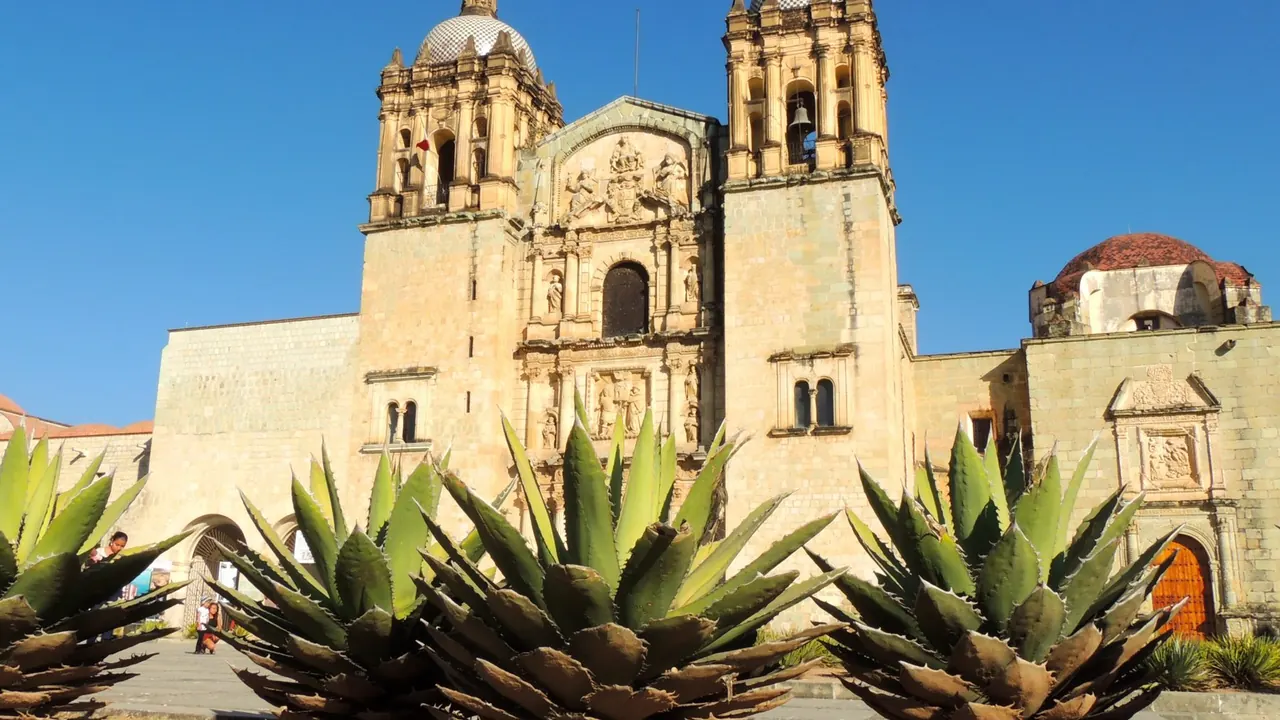
Santo Domingo church behind agaves
- Food & drink84
- Affordable cities77
- Culture & sights74
Photo: Öskr Rck, CC BY-SA 3.0, cropped
Match
54
Every category weighted equally
- Beach & sun51
- Culture & arts60
- Food & nightlife57
- Family trip53
- Outdoors57
- Relax & unwind53
- Shopping & style58
- On a budget57
Oaxaca in twelve categories
Our verdict on each, scored 0 to 100 against the same fixed benchmark cities, so a score means the same thing on every page.
Beaches & swimming. Scores 5 out of 100.
Food & drink. Scores 84 out of 100.
Culture & sights. Scores 74 out of 100.
Nightlife. Scores 40 out of 100.
Nature & outdoors. Scores 62 out of 100.
Day trips. Scores 65 out of 100.
Good for families. Scores 40 out of 100.
Getting around. Scores 55 out of 100.
Shopping & style. Scores 62 out of 100.
Affordability. Scores 77 out of 100.
Live music & performing arts. Scores 38 out of 100.
Wellness & relaxation. Scores 50 out of 100.
Oaxaca category by category
Beaches & swimming
5Oaxaca is a highland city in a valley at about 1,550m, with mountain ranges between it and the sea. The Pacific coast at Puerto Escondido, Mazunte and Huatulco is a separate trip of several hours by road or a short flight, so it is not a day at the beach. In the city, swimming means a hotel pool. Travellers who want sand usually split their stay and finish with a few days on the coast.
Food & drink
84Oaxaca is often called the heart of Mexican cooking, and for good reason. The region is known for its many moles, from the dark, chocolate-rich negro to the yellow amarillo, and for tlayudas crisped over charcoal, stringy quesillo, tamales in banana leaf and toasted chapulines (grasshoppers). The Mercado 20 de Noviembre has a smoke-filled aisle where you choose raw meat and have it grilled in front of you, and the Benito Juárez and Abastos markets go on for blocks.
Drinking is just as rooted in the place. Mezcal comes from small village distilleries in the surrounding valleys, and tasting rooms in the centre pour dozens of agave varieties. Thick hot chocolate ground with cinnamon and almonds is a morning habit, served alongside egg bread. On top of all this, a group of serious chefs runs tasting menus built on local maize and heirloom ingredients. What the city lacks is range beyond Mexican food, but few visitors come looking for that.
Culture & sights
74The historic centre is a grid of low colonial buildings in pale green volcanic stone, listed by UNESCO together with Monte Albán. Its centrepiece is the church of Santo Domingo de Guzmán, with a gilded Baroque interior, and the former monastery beside it. That monastery holds the Museo de las Culturas de Oaxaca, home to the gold treasure from Monte Albán's Tomb 7, and an ethnobotanical garden of cacti and agaves. The cathedral, the Basilica de la Soledad and the arcaded zócalo complete the colonial core.
Oaxaca also has a strong art scene. The Rufino Tamayo museum shows pre-Hispanic pieces, the Textile Museum covers regional weaving, and a graphic arts institute and printmaking workshops reflect the city's long line of painters. Monte Albán, the Zapotec capital laid out on a flattened mountaintop, is twenty minutes away and makes an easy half-day. Everything in the centre can be seen in two or three unhurried days.
Nightlife
40Evenings in Oaxaca revolve around mezcal. Small tasting bars in the centre and in the Jalatlaco neighbourhood pour village spirits by the glass, and rooftop terraces look over the domes of Santo Domingo at dusk. The pedestrian Macedonio Alcalá and the streets around it stay lively into the evening, and a few bars have DJs or salsa nights that run past midnight at weekends.
It is a relaxed, sociable scene rather than a big one. There are only a handful of clubs, and most nights wind down well before dawn. Travellers who like a long dinner followed by good drinks will enjoy it. Anyone looking for serious clubbing will find little.
Nature & outdoors
62The city sits where three dry valleys meet, ringed by mountains. The richest outdoor country is the Sierra Norte, about an hour and a half away, where Zapotec villages known as the Pueblos Mancomunados jointly run trails, cabins and local guides through pine-oak and cloud forest at up to about 3,000m. You can walk village to village over several days or do a single long hike. Hierve el Agua, where mineral springs have built cliffs that look like frozen waterfalls, is a popular half-day out.
Closer to town, the valley floor suits guided mountain biking among agave fields, and the Cerro del Fortín offers a short climb with views over the city. The dry season from November to May gives clear skies and dusty hillsides. The summer rains turn everything green but can wash out trails.
Day trips
65Most of Oaxaca's day trips are in the Central Valleys, within an hour of the city. They are small places rather than big destinations. The road east passes the vast cypress at Santa María del Tule, then the weaving village of Teotitlán del Valle, and ends at Mitla. Its palace walls are covered in geometric stone fretwork unlike anything else in Mesoamerica. On the way are Yagul, a hilltop ruin above a valley of prehistoric caves listed by UNESCO, and the mezcal country around Santiago Matatlán, where small distilleries roast agave in earth pits.
To the south, the roofless Dominican basilica at Cuilapan and the Zapotec tombs at Zaachila make a good half-day, which can be joined to the pottery and alebrije-carving villages nearby. For a longer day, the Mixteca Alta is about two hours north-west. There, the great sixteenth-century monasteries of Yanhuitlán, Teposcolula and Coixtlahuaca stand almost alone in quiet farming valleys. Colectivos, taxis and tours make it easy to see two or three places in a day. What the region lacks is a second historic city to compare with Oaxaca itself.
Good for families
40Mexican family culture makes children welcome everywhere, and the pedestrian streets and zócalo, with balloon sellers and evening music, are pleasant places to be with them. Older children often enjoy painting alebrijes in the craft villages, joining a chocolate or tortilla-making session or watching festival parades. Oaxaca has no zoo, aquarium or theme park, though, and the main outings are archaeological sites with little shade. Cobbled streets and narrow pavements make pushchairs hard going, and younger children may find the long days dull.
Getting around
55Almost everything a visitor wants in the city lies within a twenty-minute walk of the zócalo. The pedestrian Macedonio Alcalá links the main square to Santo Domingo, and Jalatlaco and Xochimilco are a short stroll away. Pavements are narrow and uneven in places, but the grid is easy to follow.
Beyond the centre, things get more complicated. There is no rail or metro. City buses are confusing for visitors, so most people use cheap taxis. For the valley villages and ruins, shared colectivo taxis and second-class buses leave from the edge of the centre, and many visitors simply book a driver or a tour for the day. A hire car is useful only if you want to explore far into the mountains.
Shopping & style
62Oaxaca is one of Mexico's great places to buy crafts, and many visitors leave with a heavier bag than planned. In the centre, boutiques and cooperative galleries along and around the Macedonio Alcalá sell handwoven textiles, embroidered huipiles, black barro negro pottery, carved alebrijes, tin work and contemporary Oaxacan design. The Benito Juárez and 20 de Noviembre markets add chocolate, mole paste and mezcal to take home.
The best buying is in the villages where things are made: rugs in Teotitlán del Valle, pottery in San Bartolo Coyotepec and Atzompa, wood carving in Arrazola and San Martín Tilcajete. The weekly markets at Tlacolula and Ocotlán are wonderful to wander. What you will not find is fashion brands, luxury streets or large department stores.
Affordability
77Oaxaca is easy on the budget for most of what a visitor does. Market food, street tlayudas and set lunches at family-run fondas cost very little, taxis and colectivos to the valley villages are cheap, and archaeological sites charge modest entry. Simple guesthouses are inexpensive and comfortable.
The gap appears at the top end. Restored colonial boutique hotels in the centre and chef-led tasting menus are priced with foreign visitors in mind, and rooms book up and cost much more during Guelaguetza and the Day of the Dead. Travellers who eat in the markets and stay just outside the main tourist streets will find it very good value.
Live music & performing arts
38Oaxaca's great performance is the Guelaguetza, held each July. Delegations from the state's regions perform their traditional dances and music in a hillside auditorium above the city, and parades fill the streets for weeks. The Day of the Dead brings comparsas, processions and music to the streets and cemeteries.
The rest of the year is quieter. The state band and marimba players perform in the zócalo on many evenings, and the ornate Teatro Macedonio Alcalá hosts concerts, dance and the occasional opera. A few bars have live son, jazz or local bands. It is a pleasant backdrop to a stay, but outside the festivals it is not enough on its own to plan a trip around.
Wellness & relaxation
50Oaxaca's bathing tradition is the temazcal, a domed sweat lodge heated with volcanic stones and herbs. It is still used in Zapotec and Mixtec communities, and in the city and the valley villages you can join a ceremony led by a traditional healer, often followed by herbal rubs or massage. Small spas and yoga studios in the centre add massage and other treatments.
The city itself moves at an easy pace. Shaded courtyards, slow mornings over hot chocolate and quiet evenings in the gardens of Jalatlaco make it a good place to unwind. There are no large thermal baths, though, and festival weeks bring fireworks and crowds.
When should you go?
Pick a month to see what it is like. The climate figures are measured averages, not a forecast.
Oaxaca in July
Daytime high, °C
Rainfall in the month, mm
The whole year
Shaded against this city’s own year: the deepest cell is its best month for that figure and the palest its weakest.
Temperature and rainfall are climate normals, averaged over the years shown. Oaxaca: 1961-1990 normals, Oaxaca, Oax. (1.1 km from centre).
Before you go
| Measure | Oaxaca |
|---|---|
| Official language | Spanish, Nahuatl, Yucatec Maya |
| Currency | Mexican Peso (MXN) |
| Sockets | AB127 V, 60 Hz |
| Driving side | Right |
| Time zone | UTC-6 |
| Emergency number | 911 |
| Elevation | 1,555 m |
| Main airport | Xoxocotlán International Airport (OAX)7 km from centre14 non-stop destinations |
| Public holidays this year | 9 days |
By the numbers
| Measure | Oaxaca |
|---|---|
| City population | 258,913 |
| People per km² | 3,028 |
| Museums within 10 km | 10 |
| UNESCO World Heritage sites within 50 km | 2 |
Compare Oaxaca with
Every comparison with a written verdict behind it.