North Macedonia
Skopje
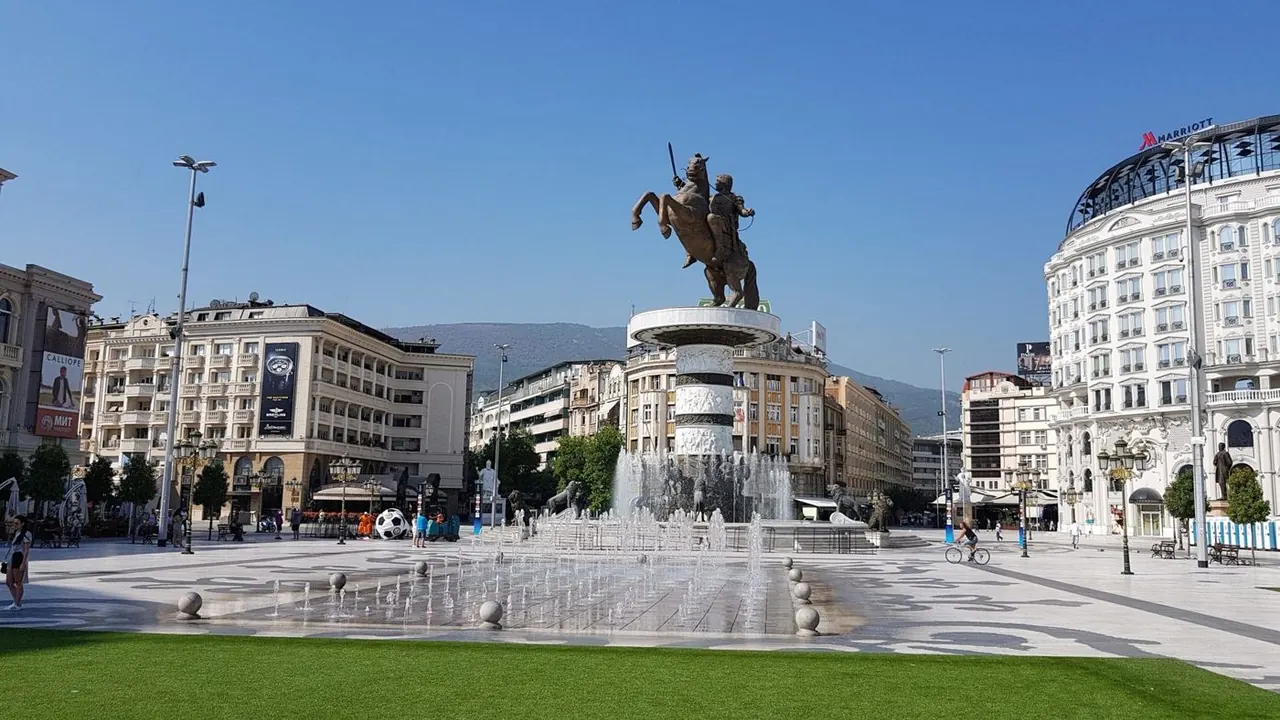
The Warrior on a Horse, Macedonia Square
- Affordable cities80
- Nature & outdoors70
- Culture & sights56
Photo: George M. Groutas, CC BY 2.0, cropped
Match
46
Every category weighted equally
- Beach & sun42
- Culture & arts49
- Food & nightlife46
- Family trip46
- Outdoors50
- Relax & unwind43
- Shopping & style45
- On a budget49
Skopje in twelve categories
Our verdict on each, scored 0 to 100 against the same fixed benchmark cities, so a score means the same thing on every page.
Beaches & swimming. Scores 6 out of 100.
Food & drink. Scores 52 out of 100.
Culture & sights. Scores 56 out of 100.
Nightlife. Scores 42 out of 100.
Nature & outdoors. Scores 70 out of 100.
Day trips. Scores 56 out of 100.
Good for families. Scores 35 out of 100.
Getting around. Scores 45 out of 100.
Shopping & style. Scores 40 out of 100.
Affordability. Scores 80 out of 100.
Live music & performing arts. Scores 38 out of 100.
Wellness & relaxation. Scores 27 out of 100.
Skopje category by category
Beaches & swimming
6Skopje is landlocked, and its nearest real swimming is at Lake Ohrid, about three hours away by road. In the city, summer swimming means hotel pools and public outdoor pools. The reservoir in Matka Canyon is for kayaking more than bathing, and its water stays cold. Anyone who wants a beach on this trip should add a few days at Ohrid, not plan on day trips from Skopje.
Food & drink
52Eating in Skopje means hearty Balkan home cooking. The local favourites are tavche gravche, baked beans served in a clay dish, stuffed peppers, sarma, and grilled meat with sharp sheep's cheese and ajvar made from roasted peppers. In the Old Bazaar, grill houses serve kebapi and pastrmajlija, a meat-topped flatbread, and burek bakeries open early for breakfast with drinking yoghurt. Debar Maalo, the old residential quarter, is full of taverns with long tables, and live starogradska music plays late.
The wine is the real surprise. Vranec reds and Temjanika whites from the Tikves region fill every list, and rakija comes before almost every meal. What Skopje lacks is range. There is little fine dining, the international choice is thin, and you can try the full local repertoire within a few days.
Culture & sights
56Skopje has two faces. North of the Stone Bridge, the Old Bazaar is one of the largest surviving Ottoman market quarters in the Balkans. It has cobbled lanes, caravanserais such as Kursumli An and Suli An, the Mustafa Pasha Mosque and the Daut Pasha Hamam, which houses an art gallery. Kale Fortress stands above it. Nearby, the small Church of the Holy Saviour hides a remarkable carved walnut iconostasis.
South of the river, Macedonia Square and the embankments are crowded with bronze statues, neoclassical facades and replica galleons, all built under the Skopje 2014 programme. Some visitors find it fascinating and others find it kitsch. The 1963 earthquake explains a lot about the city. The ruined old railway station, its clock stopped at 5:17 when the quake struck, houses the City Museum. Other highlights are the Mother Teresa Memorial House and the Museum of Contemporary Art, built with donations sent after the disaster. Two or three days covers it all.
Nightlife
42Going out in Skopje is built around cafe-bars, and they fill up properly on weekend nights. Debar Maalo and the streets around it are the centre of it, with terraces that turn from coffee to rakija and cocktails as the evening goes on. In summer, Old Bazaar courtyards and riverside spots stay busy well past midnight. There are a few clubs, and summer open-air parties near the city park, but the scene is local and sociable rather than a reason to travel. Weeknights are quiet.
Nature & outdoors
70Skopje has mountains right on its doorstep. Mount Vodno rises straight from the southern suburbs, and you can walk up through pine woods or take the cable car to the giant Millennium Cross at the top, with views over the whole valley. About half an hour away, Matka Canyon has steep limestone walls above a dammed river. You can kayak or take a boat to Vrelo Cave, and trails lead to old monasteries on the cliffs.
Further out, the Sar mountains above Tetovo give high-ridge hiking in summer and skiing at Popova Sapka in winter. Mavrovo National Park, with its lake, beech forest and ski slopes, is about an hour and a half west. Summers in the valley are very hot, so spring and autumn are the best seasons for walking, and most places beyond Vodno are much easier to reach with a car.
Day trips
56The country's most famous town, Ohrid, is too far for a comfortable day out. It deserves a stay of its own. Within about two hours there is still a good spread of places. Tetovo, less than an hour away, has the richly painted Sarena Mosque. Stobi is the ruin of a Roman and early Christian town with fine floor mosaics, and it sits on the way to the Tikves wine region around Kavadarci and Negotino, where wineries welcome visitors.
To the north-east, Kratovo is a small stone town built inside an old volcanic crater, crossed by medieval bridges. The Kokino megalithic observatory is in the same direction. Across the border in Kosovo, Pristina is about an hour and a half away, and Prizren, with its Ottoman old town and fortress, is roughly two hours away. Buses run to most of these places, but a car makes combining them easier.
Good for families
35Children are warmly welcomed in Skopje's cafes and restaurants, and families stroll the riverside promenade and the large City Park on summer evenings. There is little made specifically for children, though. The zoo is small, there is a modest funfair by the park, and the best outings are the cable car up Vodno and a boat ride in Matka Canyon. Hot summers, busy roads and uneven pavements make long days tiring with young children, so most families combine a short stay here with time at a lake.
Getting around
45The parts of Skopje a visitor wants are close together. The Old Bazaar, the Stone Bridge, Macedonia Square and Debar Maalo are all within a flat, pleasant walk along the Vardar. Beyond that, things get harder. There is no metro or tram, the city's red double-decker buses are cheap but hard to work out for a newcomer, and traffic builds at rush hour. Most visitors use taxis, which are plentiful and inexpensive, for Vodno, Matka or the bus station. A car only becomes useful for trips out into the mountains and the wine country.
Shopping & style
40Skopje's most interesting shopping is old-fashioned. In the Old Bazaar, small workshops sell silver filigree jewellery, copperware and embroidered textiles. Next door, Bit Pazar is a busy everyday market with produce, spices, cheese, peppers for ajvar and piles of household goods. Ohrid pearls and local wine are the usual things to take home. Beyond the bazaar, fashion shopping means a few modern malls with international chains. There is no luxury street and little in the way of independent design.
Affordability
80Skopje is one of the cheapest capitals in Europe to visit. A full meal with wine at a traditional tavern costs very little, coffee and burek cost almost nothing, and both buses and taxis are inexpensive. Central hotels and apartments are reasonably priced even in summer, and the main sights are free or have small entry fees. The few upmarket hotels and restaurants along the river charge more, but even they are modest by Western standards.
Live music & performing arts
38Skopje has the performing arts you expect of a small national capital. The Macedonian Opera and Ballet, the Philharmonic and the National Theatre all run seasons with affordable tickets, though plays are mostly performed in Macedonian. The calendar matters more than the venues. The Skopje Jazz Festival, held every autumn since the early 1980s, has a strong reputation in the region. The summer festival puts on concerts and theatre in the Old Bazaar and at the fortress. Live starogradska and folk music is common in the taverns of Debar Maalo.
Wellness & relaxation
27Skopje has Ottoman bathhouses but no bathing culture. The Daut Pasha and Cifte hamams in the Old Bazaar are now art galleries, not places to bathe. Spa options are mostly in the larger hotels. Katlanovska Banja, an old-style thermal spa about half an hour from the centre, offers mineral pools in a sanatorium setting rather than a polished day spa. The city's calmest pleasure is its slow cafe life: long hours over coffee on shaded terraces in Debar Maalo or by the river.
When should you go?
Pick a month to see what it is like. The climate figures are measured averages, not a forecast.
Skopje in July
Daytime high, °C
Rainfall in the month, mm
The whole year
Shaded against this city’s own year: the deepest cell is its best month for that figure and the palest its weakest.
Where the figures come from
Skopje has no rain gauge within 25 km of the centre, so its rainfall comes from a gridded climate dataset read at the city rather than from a gauge further away.
Skopje's sunshine is measured 68 km from the centre, at Stip.
Temperature and rainfall are climate normals, averaged over the years shown. Skopje: 1991-2020 (sunshine 1961-1990) normals, Skopje-Petrovec (18.3 km from centre).
Before you go
| Measure | Skopje |
|---|---|
| Official language | Albanian, Macedonian |
| Currency | Denar (MKD) |
| Sockets | CF230 V, 50 Hz |
| Driving side | Right |
| Time zone | UTC+1, UTC+2 in summer |
| Emergency number | 112 |
| Elevation | 251 m |
| Main airport | Skopje International Airport (SKP)16 km from centre52 non-stop destinations |
| Public holidays this year | 12 days |
By the numbers
| Measure | Skopje |
|---|---|
| City population | 422,540 |
| People per km² | 739 |
| Museums within 10 km | 17 |
| UNESCO World Heritage sites within 50 km | 0 |
Compare Skopje with
Every comparison with a written verdict behind it.