Spain
Toledo
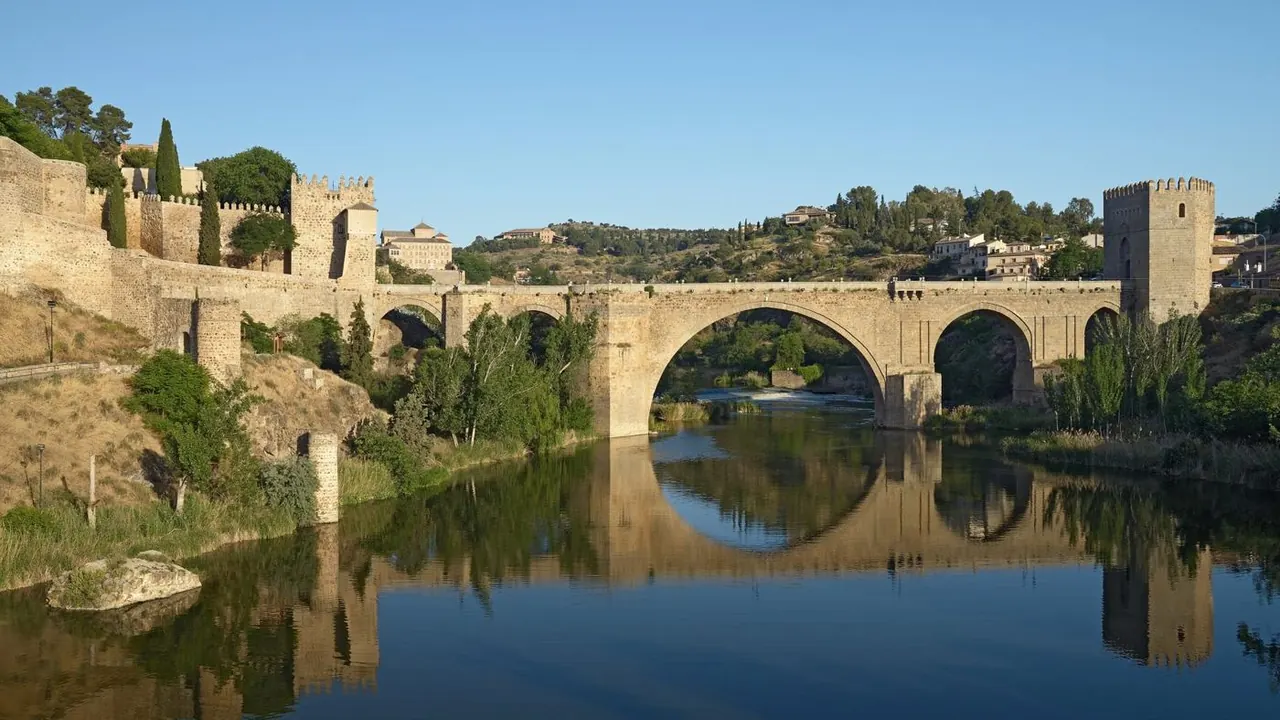
Puente de San Martín over the Tagus
- Culture & sights79
- Day trips78
- Getting around64
Photo: Ввласенко, CC BY-SA 3.0, cropped
Match
43
Every category weighted equally
- Beach & sun38
- Culture & arts50
- Food & nightlife41
- Family trip46
- Outdoors47
- Relax & unwind40
- Shopping & style43
- On a budget45
Toledo in twelve categories
Our verdict on each, scored 0 to 100 against the same fixed benchmark cities, so a score means the same thing on every page.
Beaches & swimming. Scores 5 out of 100.
Food & drink. Scores 40 out of 100.
Culture & sights. Scores 79 out of 100.
Nightlife. Scores 22 out of 100.
Nature & outdoors. Scores 40 out of 100.
Day trips. Scores 78 out of 100.
Good for families. Scores 45 out of 100.
Getting around. Scores 64 out of 100.
Shopping & style. Scores 32 out of 100.
Affordability. Scores 58 out of 100.
Live music & performing arts. Scores 22 out of 100.
Wellness & relaxation. Scores 30 out of 100.
Toledo category by category
Beaches & swimming
5Toledo is a long way inland, on the dry plateau of Castilla-La Mancha, and the nearest sea is several hours' drive away. The Tagus loops around the old town through a rocky gorge, but it is not a river people swim in. In the hot months, cooling off means a hotel pool or one of the municipal outdoor pools.
Food & drink
40Toledo cooks in the hearty style of La Mancha. Partridge stewed in wine and vinegar, venison and wild boar from the Montes de Toledo, carcamusas (a pork and tomato stew served as a tapa), migas and thick Manchego cheese are the dishes to look for, and La Mancha wine is poured everywhere. The city's sweet is marzipan, made by convent nuns for centuries and sold in shops all over the old town.
The range is narrow and the lanes around the cathedral are thick with set menus aimed at day-trippers. Better eating is found in the small taverns a few streets away and in the bars near Zocodover, where a drink still brings a small tapa. There is a modest tier of more ambitious restaurants, but this is a place for a few good regional meals rather than a food destination.
Culture & sights
79The whole old town is a monument, a tight knot of lanes on a granite hill wrapped by the Tagus, where Roman, Visigothic, Islamic, Jewish and Christian Spain sit in layers. The Gothic cathedral is one of the great churches of Spain, with a sacristy hung with El Greco and Goya. Near it stand the small mosque of Cristo de la Luz, the synagogues of Santa María la Blanca and El Tránsito, now housing the Sephardic Museum, and the soaring cloister of San Juan de los Reyes.
El Greco lived and painted here, and his work fills the church of Santo Tomé, his museum and the Hospital de Tavera. The Alcázar crowns the hill and holds the Army Museum, and the Puerta de Bisagra and the Alcántara and San Martín bridges guard the approaches. The view of the city from the road across the river is worth the walk. Everything is close, so the main sights fit into two full days.
Nightlife
22Evenings in Toledo are about a late dinner and a round of tapas bars around Zocodover and the streets behind it. Once the day-trippers have gone back to Madrid the old town grows quiet, which many visitors enjoy. A handful of bars stay open later at weekends, some of them busy with university students, but there is no club scene to speak of, and anyone wanting a real night out takes the short train to Madrid.
Nature & outdoors
40The best outdoor experience is right at the city's edge. A footpath follows the Tagus around the base of the old town, through the rocky gorge below the walls, and the hillside of country estates called cigarrales on the far bank gives the classic views back over the city. Around this, the land is the dry, open plain of La Mancha, with olive groves and wheat fields.
To the south-west the Montes de Toledo rise as low wooded hills with walking and birdwatching, and the Cabañeros national park, with its red deer and raptors, is about two hours away. Summer heat is fierce, so walking is best in spring and autumn. There are no real mountains, and for big landscapes this is not the base to choose.
Day trips
78Toledo's biggest asset as a base is Madrid, about half an hour away by high-speed train, which puts the Prado, the Reina Sofía and the royal palace within easy reach. The royal palace and gardens of Aranjuez are under an hour by road, and the monastery of El Escorial a little over an hour.
Heading south into La Mancha, the white windmills and castle of Consuegra are about an hour's drive, and the arcaded plaza and Golden Age theatre of Almagro about an hour and a half. Talavera de la Reina, known for its painted ceramics, is under an hour west. Segovia, Ávila and the hanging houses of Cuenca are all around two hours, which makes for long but rewarding days. A car opens up most of this list.
Good for families
45Spanish culture welcomes children everywhere, and the old town's walls, swords, armour shops and castle-like Alcázar catch young imaginations. A large theme park built around spectacular shows on Spanish history sits on the city's outskirts and is the main attraction made for children.
The centre itself is harder going: the lanes are steep, narrow and cobbled, pushchairs struggle, and summer afternoons are very hot. Most of the sights are churches, synagogues and paintings that hold children's attention briefly. Families do best with a short stay, early starts and long breaks in the middle of the day.
Getting around
64The old town is small enough to cross on foot in twenty minutes, and nearly every sight is inside it. The catch is the terrain: Toledo sits on a steep hill, and its lanes are narrow, twisting and cobbled, so walking is tiring and getting lost is part of the experience. A series of public escalators climbs from the car parks below the walls up into the centre, which takes the worst out of the arrival.
The railway station, a fine neo-Mudéjar building, lies across the river at the foot of the hill, a bus ride or a steep walk from the centre. Local buses link the old town with the newer districts. Driving inside the walls is best avoided, but a car is useful for trips into the countryside.
Shopping & style
32Shopping in Toledo is about crafts with long roots in the city. Damascene work, black steel inlaid with gold thread, is made here and sold as jewellery and plates, and Toledo blades have a centuries-old name, so swords and armour fill many windows. Convent-made marzipan, painted ceramics from nearby Talavera and Manchego cheese make good things to carry home.
Much of what lines the streets around the cathedral is souvenir stock, and quality varies, so it pays to look for workshops that make their own. For fashion or department stores, visitors head to Madrid.
Affordability
58Toledo is moderately priced by Western European standards, and everyday eating is where it feels easiest on the pocket. Many bars serve a small tapa with each drink, and the set lunch menus in the taverns away from the cathedral are good value. Rooms just outside the walls or in the newer town below the hill are moderate.
Costs go up inside the old town, where hotels with views over the Tagus charge more, especially at weekends. Most monuments, including the cathedral, the synagogues and the El Greco sites, charge separate entry, so a full day of sightseeing adds up. Staying a night rather than visiting for the day spreads those costs out.
Live music & performing arts
22The handsome nineteenth-century Teatro de Rojas, just off Zocodover, holds a regional programme of plays, concerts and dance, and organ and choral music sometimes fills the churches. The great event of the calendar is Corpus Christi, when the cathedral's monstrance is carried through streets hung with awnings and tapestries, with music and processions around it. Beyond that, there is little to see on an ordinary evening, and serious opera, theatre or concerts mean the train to Madrid.
Wellness & relaxation
30Toledo has no bathing culture of its own. The remains of medieval baths survive as ruins, and a few Arab-style bath houses and hotel spas offer warm pools and massage in vaulted rooms, but that is the extent of it. What the city does offer is calm in the evenings and early mornings, when the tour groups are gone and the lanes, terraces and views over the Tagus are quiet. It suits a slow night or two, not a restorative stay.
When should you go?
Pick a month to see what it is like. The climate figures are measured averages, not a forecast.
Toledo in July
Daytime high, °C
Rainfall in the month, mm
The whole year
Shaded against this city’s own year: the deepest cell is its best month for that figure and the palest its weakest.
Temperature and rainfall are climate normals, averaged over the years shown. Toledo: 1991-2020 normals, Toledo (2.3 km from centre).
Before you go
| Measure | Toledo |
|---|---|
| Official language | Spanish |
| Currency | Euro (EUR) |
| Sockets | CF230 V, 50 Hz |
| Driving side | Right |
| Time zone | UTC+1, UTC+2 in summer |
| Emergency number | 112 |
| Elevation | 523 m |
| Main airport | Adolfo Suárez Madrid–Barajas Airport (MAD)80 km from centre239 non-stop destinations |
| Public holidays this year | 13 days |
By the numbers
| Measure | Toledo |
|---|---|
| City population | 87,216 |
| People per km² | 376 |
| Museums within 10 km | 13 |
| UNESCO World Heritage sites within 50 km | 2 |
Compare Toledo with
Every comparison with a written verdict behind it.